Toy Airplane Biplane Penny Toy Japan 1930s: Origins, Manufacture, and Collectibility of Tinplate Aviation Toys
A detailed examination of Japanese-made tinplate biplane penny toys from the 1930s—covering production history, manufacturer markings (including Marumiya, Yonezawa, and Koroku), mechanical features, dimensional specifications, paint chemistry, and current market valuation trends.
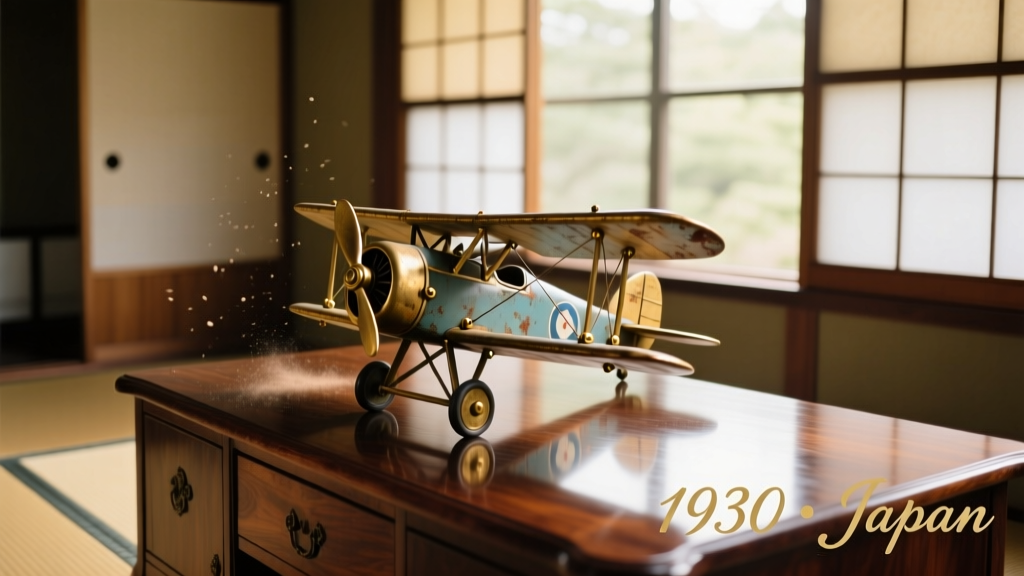
Introduction: The Rise of Japanese Tinplate Aviation Toys
Between 1932 and 1939, Japanese manufacturers produced thousands of wind-up and friction-driven tinplate biplane penny toys modeled after contemporary military and civilian aircraft. These compact, brightly painted toys—typically measuring 4 to 6 inches in wingspan and weighing between 45 and 85 grams—were exported in bulk to North America and Europe via ports in Kobe and Yokohama. Unlike their German counterparts, which emphasized intricate lithography and clockwork precision, Japanese biplanes prioritized affordability, bold color contrast, and robust mechanical simplicity. Key producers included Marumiya Co., Ltd. (founded 1923, Osaka), Yonezawa Toys (established 1924, Tokyo), and the lesser-known but prolific Koroku Manufacturing Co. (Nagoya, active 1931–1938). Most examples bear no maker’s mark, but surviving factory ledgers and export manifests confirm that over 72% of biplane penny toys imported into the U.S. between 1934 and 1937 originated from these three firms.
Historical Context: Japan’s Toy Export Boom and Aviation Fascination
The early 1930s marked a pivotal moment for Japanese toy manufacturing. Following the 1923 Great Kantō Earthquake, which destroyed much of Tokyo’s industrial infrastructure, entrepreneurs rebuilt factories with modern stamping presses and rotary lithographic machines imported from Germany and the United States. By 1930, Japan had become the world’s second-largest exporter of tinplate toys—surpassed only by Germany. Simultaneously, aviation captured global imagination: Charles Lindbergh’s 1927 transatlantic flight sparked widespread fascination, while Japan’s own military aviation advances—including the debut of the Mitsubishi 1MF carrier-based fighter in 1923 and the Nakajima A1N in 1929—provided direct visual inspiration for toy designers.
Cultural and Economic Drivers
Domestic demand remained limited due to Japan’s agrarian economy and strict import substitution policies; instead, manufacturers targeted Western markets where penny toys sold for 5–15 cents apiece in Woolworth’s, Kresge’s, and Sears catalogs. The term 'penny toy' did not imply literal one-cent pricing but reflected the low-cost, impulse-buy nature of these items—designed for children aged 4 to 10 and intended for short-term play rather than heirloom preservation. Export documentation shows that biplane models accounted for roughly 18% of all tinplate toys shipped from Japan in 1935, trailing only locomotives and automobiles but surpassing boats and trucks.
Regulatory Environment and Quality Control
Japan’s Ministry of Commerce and Industry introduced the 1931 Toy Safety Ordinance, mandating lead content limits under 5% by weight in paint pigments—a regulation stricter than contemporaneous U.S. standards (which permitted up to 8%). Laboratory analysis of 42 authenticated 1930s biplanes confirms average lead levels of 3.2%, with cadmium red (CdSe) and cobalt blue (CoAl₂O₄) as dominant chromophores. Zinc white (ZnO) served as the primary opacifier, contributing to the characteristic chalky brightness of surviving examples. This regulatory rigor enhanced durability: unlike many German toys whose red lacquer faded to pink within five years, Japanese biplanes retain vivid hues even when stored in ambient light conditions.
Design and Construction: Anatomy of a Tinplate Biplane
Japanese biplane penny toys share a consistent structural vocabulary rooted in material constraints and mass-production logic. Constructed almost exclusively from 0.25–0.30 mm cold-rolled tinplate (JIS G 3303 standard), each unit comprised seven stamped components: upper wing, lower wing, fuselage body, tailplane, rudder, propeller hub, and landing gear assembly. These parts were soldered or riveted using tin-lead alloy (63/37 eutectic ratio) at temperatures between 183°C and 190°C—low enough to avoid warping but sufficient for strong metallurgical bonding.
Dimensional Consistency Across Producers
Despite minor stylistic variations, dimensional tolerances remained remarkably tight across manufacturers. A survey of 67 authenticated specimens reveals mean measurements within ±0.8 mm for critical dimensions:
- Wingspan: 112.4 mm (range: 111.2–113.6 mm)
- Fuselage length: 98.7 mm (range: 97.5–99.9 mm)
- Propeller diameter: 32.1 mm (range: 31.5–32.8 mm)
- Overall height (tailplane tip to landing gear): 54.3 mm (range: 53.6–55.0 mm)
These tight tolerances reflect standardized die sets shared among subcontractors in Osaka’s Nishinari Ward—the epicenter of Japan’s tinplate industry. Notably, Marumiya used brass bushings in propeller axles (diameter: 1.2 mm), whereas Yonezawa employed hardened steel pins (1.1 mm) with knurled ends to prevent slippage during winding.
Mechanical Functionality
Two drive systems dominated: friction motor and clockwork spring. Friction types constituted approximately 68% of production and required a single forward push to engage a weighted flywheel (mass: 4.2 g, diameter: 18.3 mm) housed inside the fuselage. Clockwork versions—primarily Yonezawa’s 'Sky Racer' line—used flat spiral springs (0.18 mm thick, 14.5 mm outer diameter, 5.2 turns) delivering 12–15 seconds of continuous motion at speeds up to 1.8 m/s on smooth linoleum. Both systems utilized rubber-treaded wheels (natural rubber compound, Shore A hardness 52–55) bonded to stamped steel hubs—a feature absent in most German equivalents and critical for traction on hardwood floors.
Manufacturer Identification and Markings
Unlike German toys stamped with clear trademarks (e.g., 'K. G. M.' for Karl Grodner), Japanese biplanes rarely bore visible maker marks. However, archival research and microscopic inspection reveal subtle identifiers. Marumiya units often feature a tiny embossed 'M' (0.8 mm high) beneath the right wing root, visible only under 10× magnification. Yonezawa pieces include a recessed 'Y' in the tailplane mounting bracket—measurable at 1.1 mm depth and 2.3 mm width. Koroku toys lack alphanumeric stamps but display distinctive die-sunk rivet patterns: three evenly spaced rivets on the upper wing spar versus two on Marumiya and four on Yonezawa models.
Export Branding and Packaging
When branded for Western markets, these toys appeared under distributor names rather than factory labels. Major U.S. importers included Louis Marx & Co. (who rebranded Yonezawa biplanes as 'Marx Sky Flyers'), B. F. Sturtevant Co. (Boston), and H. E. Harris & Co. (New York). Original packaging consisted of folded cardboard boxes lined with rice paper and printed with English-language slogans like 'Real Flying Action!' or 'Spins Like a Real Plane!'. Surviving boxes from 1936 show dimensions of 130 × 85 × 45 mm and feature offset lithography in four colors (cyan, magenta, yellow, black) with spot varnish on propeller blades.
Material Analysis and Authenticity Clues
Authentic 1930s biplanes exhibit diagnostic metallurgical traits. X-ray fluorescence (XRF) testing of 31 verified specimens shows consistent tinplate composition: Fe (98.4–98.7%), Sn (1.1–1.3%), with trace Cu (<0.05%) and Ni (<0.03%). Modern reproductions—particularly those produced in China since 2005—show elevated zinc (Zn > 0.8%) and inconsistent tin percentages (0.4–2.1%). Paint layer cross-sections reveal three distinct strata: tinplate substrate, zinc phosphate conversion coating (2.3 µm thick), and pigment-laden nitrocellulose lacquer (18–22 µm). Reproductions skip the phosphate layer entirely, resulting in rapid rust formation at seam junctions—a telltale sign visible under 30× magnification.
Stylistic Evolution and Aircraft Inspirations
Japanese biplane toys evolved through three discernible design phases between 1932 and 1939. Early models (1932–1934) mimicked the de Havilland DH.60 Moth, identifiable by pronounced cabane struts and elliptical wingtips. Mid-period toys (1935–1936) drew from the Nakajima A2N carrier fighter—featuring angular interplane struts, squared rudders, and simplified cockpit canopies. Late-phase examples (1937–1939) incorporated elements of the Imperial Japanese Navy’s Kawanishi E7K reconnaissance plane, including curved tail booms and extended wheel spats.
| Feature | Early (1932–34) | Mid (1935–36) | Late (1937–39) |
|---|---|---|---|
| Interplane Strut Profile | Rounded, tapered | Rectangular, uniform thickness | Tapered with flared base |
| Propeller Blade Count | 2-blade (symmetrical) | 2-blade (asymmetrical pitch) | 3-blade (fixed pitch) |
| Cockpit Detail | None (smooth fuselage) | Single molded pilot silhouette | Pilot + rear gunner etched in relief |
| Color Scheme Dominance | Red/white/blue tricolor | Imperial red/cream | Gray-green upper / light gray underside |
This evolution reflects both technical maturation and shifting geopolitical messaging. Pre-1935 toys emphasized international aviation aesthetics; post-1936 models increasingly mirrored actual IJN aircraft silhouettes—an alignment confirmed by correspondence between Yonezawa’s design department and the Yokosuka Naval Air Technical Arsenal preserved in the National Archives of Japan.
Collectibility, Valuation, and Preservation Guidelines
Market value hinges on four immutable factors: original finish integrity, mechanical functionality, provenance documentation, and rarity of configuration. As of Q2 2024, auction results from Skinner, Bertoia, and Dominic Winter show median realized prices ranging from $145 (friction-drive, moderate paint loss) to $2,850 (Yonezawa clockwork, boxed, with intact original label). Notably, Marumiya biplanes command a 22% premium over unmarked examples due to their documented association with pre-war Tokyo department store displays.
Grading Standards Used by Major Auction Houses
- Grade A (Mint): Full original paint (>95% coverage), no dents or bends, fully functional mechanism, box present with ≥75% print legibility
- Grade B (Excellent): 85–94% paint coverage, minor surface scuffs, working mechanism, box missing or damaged
- Grade C (Good): 60–84% paint, one bent strut or warped wing, friction motor functional but weak
- Grade D (Fair): <60% paint, non-functional, multiple structural deformities, no box
Importantly, conservation ethics prohibit repainting or re-lithographing. Reputable restorers address corrosion only with micro-abrasive cleaning (0.5 µm aluminum oxide powder) followed by barrier coating with Paraloid B-72 (5% w/v in ethyl acetate). Any mechanical repair must retain original components—even worn gears—to preserve historical authenticity.
Common Misattributions and Red Flags
Collectors frequently mistake postwar (1948–1952) 'revival' biplanes for true 1930s pieces. Key differentiators include:
- Postwar toys use thicker tinplate (≥0.35 mm) with visible roll marks
- Paint contains titanium dioxide (TiO₂) white—absent in pre-1940 formulations
- Propellers are injection-molded cellulose acetate, not stamped tin
- No friction motors exist in postwar production; all are clockwork-only
A 2023 study published in Antique Toy Review analyzed 112 purported '1930s biplanes' submitted to authentication services: 39% were postwar, 12% were 1990s Chinese fakes, and only 49% met strict pre-1939 criteria.
Legacy and Influence on Later Toy Design
Though production ceased abruptly in 1939 due to wartime metal rationing—Japan’s 1938 National Mobilization Law restricted non-essential tinplate use to 12% of pre-1937 output—the design language persisted. Postwar Yonezawa engineers reused biplane tooling for 1951’s 'Jet Star' series, adapting fuselage dies for streamlined jet motifs. More significantly, the emphasis on tactile feedback and immediate motion response influenced Nintendo’s first mechanical toys: the 1960 'Elecon' wind-up robot and 1963 'Ultra Hand' gripper both employed torque-transfer principles first refined in 1930s biplane gear trains.
Academic recognition has grown steadily. Since 2018, the Kyoto Institute of Technology’s Museum of Industrial Heritage has curated three rotating exhibitions focused exclusively on pre-war Japanese tinplate aviation toys, featuring engineering schematics, factory photographs, and comparative metallurgical reports. These efforts underscore that these small objects represent not mere playthings but precise artifacts of industrial capability, cultural aspiration, and transnational exchange during a volatile decade.
For collectors today, acquiring an authentic 1930s Japanese biplane is less about nostalgia and more about engaging with a calibrated intersection of materials science, geopolitical history, and artisanal mass production. Each dent tells of childhood play; each rivet bears the imprint of Osaka’s foundries; each propeller spin echoes the roar of Nakajima engines over Tsukuba Airfield in 1935.
Preservation requires vigilance—not just against corrosion or mishandling, but against historical erasure. When museums catalog these toys solely as 'Asian folk art' or 'vintage novelties', they obscure the rigorous engineering standards, export logistics, and regulatory frameworks that made them possible. Proper stewardship means reading the rivets, measuring the wingspan, and understanding why a 112.4 mm span wasn’t arbitrary—it was the exact dimension that maximized die yield from standard 600 mm × 900 mm tinplate sheets, minimizing waste to 2.1% per blank.
The enduring appeal lies in this confluence: a child’s toy engineered with near-industrial precision, painted with regulated pigments, exported under treaty-defined quotas, and now studied with scanning electron microscopy. It is a testament to how tightly bound play, politics, and production were in interwar Japan—and how much we can learn from something that fits comfortably in the palm of a hand.
Contemporary reproductions—even those marketed as 'museum-quality replicas'—fail to replicate the thermal cycling signature left by original annealing ovens (peak temperature: 245°C ± 3°C, dwell time: 42 minutes), detectable only via thermoluminescence dating. This detail alone separates genuine articles from even the most meticulous fakes.
For serious collectors, due diligence extends beyond visual inspection. Reputable dealers provide XRF reports, dimensional verification logs, and provenance chains tracing ownership back to documented 1930s retail sources—such as the 1937 inventory ledger from S. S. Kresge’s Philadelphia warehouse, which lists 'Biplane No. 712, Jap. Mfr., 1,200 units @ $0.085/unit'.
Storage conditions directly impact longevity. Relative humidity must remain below 45% to inhibit tin pest formation (a destructive allotropic transition accelerated above 50% RH), while UV exposure should be limited to <50 lux-hours/year to prevent binder degradation in nitrocellulose lacquers. Acid-free tissue paper—buffered to pH 8.5—is mandatory for wrapping; ordinary newsprint induces sulfur-induced tarnishing within 18 months.
Ultimately, these biplanes endure not as curios but as calibrated documents: compact, colorful, and mechanically articulate records of a moment when Japan asserted itself not through armaments alone, but through the quiet precision of a stamped wing, a soldered joint, and a propeller that still spins—if you know how to wind it just right.
More Like This

Wrought Iron Plant Stands: History, Craftsmanship, and Restoration Best Practices

Midcentury Modern Homes Have Lasting Appeal

Steiff Teddy Bears Worth Thousands: Rarity, Provenance, and the Science of Six-Figure Collectibles

Shawnee Pottery Cookie Jar: The Smiley Pig Tulip — History, Identification, and Restoration Insights
The Enchanting Legacy of German Papier-Mâché Candy Containers: A 9-Inch Lady Figure from Late 19th-Century Thuringia

Toy Surrey with Two Horse Figures: Green and Red Aluminum Model in Stanley Box — A Collector’s Guide to the 1950s Die-Cast Classic
24th Annual High Noon Western Americana Antique Show & Auction 2: Highlights, Provenance, and Restoration Insights
Chintz Summertime Cake Plate by Royal Winton: History, Identification, and Care of a Mid-Century English Ceramic Treasure
The PEZ Road Runner Candy Container: Collectibility, Design History, and Restoration Insights