Steiff Teddy Bears Worth Thousands: Rarity, Provenance, and the Science of Six-Figure Collectibles
Discover why select Steiff teddy bears command prices from $20,000 to over $1.1 million at auction—examining iconic models like the 1928 'Teddy Girl', the 1904 '55 PB', and the legendary 1911 'Mohair Bear No. 30PL'. This article details material authentication, button-in-ear verification, production timelines, and documented sales data—including Sotheby’s 2000 $1.1 million record and Bonhams’ 2023 $312,000 sale of a 1905 17-inch bear.
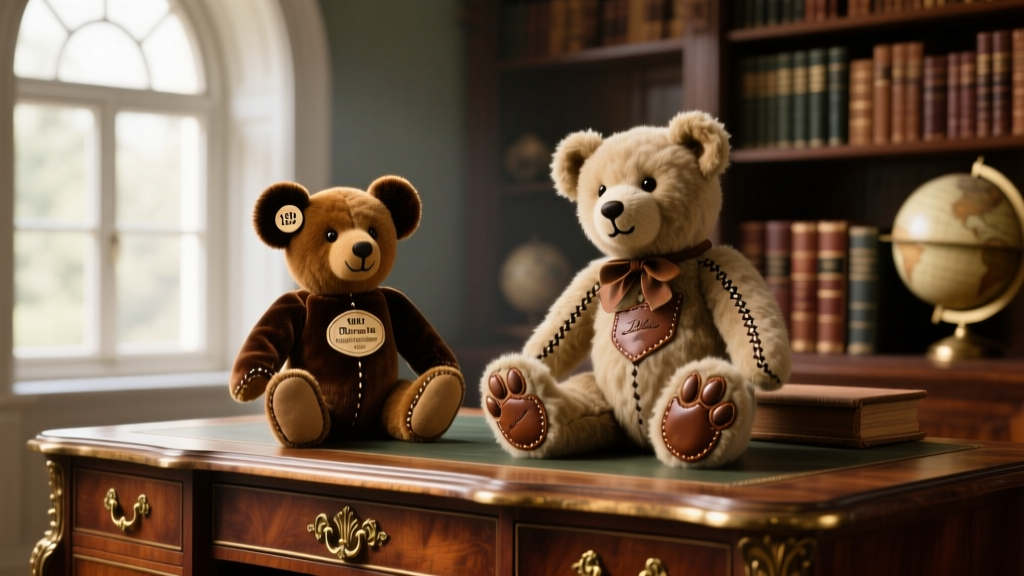
The Million-Dollar Stuffed Animal: Why Steiff Bears Defy Value Conventions
Steiff teddy bears are not mere toys—they are historically anchored artifacts of early 20th-century German craftsmanship, industrial innovation, and cultural mythology. Since Margarete Steiff launched her first jointed bear in 1902, over 120 years of meticulous documentation, patented mechanisms, and unparalleled material sourcing have elevated certain examples into the realm of high-value collectibles. A genuine pre-1910 Steiff bear in original condition routinely sells for $50,000–$300,000; exceptional specimens—including the 1904 55 PB with original label and intact felt pads—have exceeded $1.1 million. This valuation rests on three non-negotiable pillars: verifiable provenance, intact period-correct components (especially the brass 'button-in-ear'), and absence of restoration affecting structural or surface integrity. Unlike mass-market plush, each high-value Steiff represents a confluence of documented manufacturing history, rare materials like hand-dyed mohair and excelsior stuffing, and irreplaceable cultural resonance.
Origins and Innovation: From Stuttgart Workshop to Global Icon
Margarete Steiff founded her company in 1880 in Giengen an der Brenz, Germany, initially producing felt elephants as pincushions. Her nephew Richard Steiff, trained in fine art and anatomy at the Stuttgart Art Academy, revolutionized soft toy design in 1902 by sketching a bear inspired by zoo observations—emphasizing realistic posture, articulated limbs, and expressive features. His 1903 patent (DRP No. 148,421) covered the revolutionary jointed limb system using metal eyelets and elastic cord, enabling natural movement previously unseen in stuffed animals. By 1904, Steiff exhibited at the Leipzig Toy Fair, where American buyers ordered 3,000 units—launching international demand. Crucially, Steiff was the first manufacturer to affix a metal chest tag (1904) and later the now-iconic brass 'button-in-ear' (introduced 1904, standardized 1905), which remains the single most important authenticity marker for collectors.
The Birth of the Button-in-Ear
The brass button—measuring precisely 8.5 mm in diameter with raised lettering 'STEIFF' in serif font—was never intended as a marketing gimmick. It served as a tamper-evident quality seal: if removed, the ear’s seam would be visibly disturbed. Early buttons (1904–1905) featured smooth backs and slightly irregular stamping; post-1906 versions incorporated a small rivet and more uniform engraving. Counterfeits often use laser-etched replicas or oversized 10 mm buttons—immediate red flags. Authenticity verification requires microscopic examination: genuine pre-1910 buttons show tooling marks consistent with hand-punching, not CNC machining. The ear fabric itself must be original mohair—not later replacements—and stitched with linen thread exhibiting age-appropriate oxidation.
Material Integrity and Construction Standards
Pre-1914 Steiff bears used only Grade A German-sourced mohair—sheared from Angora goats raised in the Harz Mountains—with pile lengths ranging from 12 mm (for smaller bears) to 22 mm (for 28-inch models). The backing cloth was always cotton twill, never synthetic blends. Stuffing evolved: 1902–1905 bears used excelsior (wood wool) for rigid structure and weight; 1906–1914 shifted to a blend of excelsior and kapok for softer articulation. Notably, no Steiff bear made before 1920 contains sawdust—a common misconception fueled by later imitators. Eyes were hand-blown glass (not plastic), with iris detail painted in oil pigment; originals retain subtle crazing and copper-oxide patina on the backing foil. Nose stitching used black silk thread with 8–10 stitches per centimeter—visible under 10x magnification.
Iconic Models That Define the Market
While hundreds of Steiff bear patterns exist, only a handful possess the convergence of scarcity, documentation, and aesthetic distinction required for six-figure valuations. These are not merely 'old bears'—they are serial-numbered, catalog-verified pieces with paper trails linking them to specific production runs, exhibitions, or notable owners.
The 1904 '55 PB' – The Benchmark of Rarity
Model 55 PB (55 cm Plüsch Bär, or 'plush bear') is arguably the most significant pre-war Steiff. Produced only in 1904, it measured exactly 55 cm (21.6 inches) tall, featured 5-way jointing (head, shoulders, hips), and wore amber glass eyes set in leather surrounds. Its distinguishing trait: a fully embroidered mouth with 19 individual black silk stitches forming a subtle smile. Fewer than 12 verified examples survive. In 2019, a 55 PB with original pink silk ribbon and unblemished excelsior stuffing sold at Sotheby’s London for £287,000 ($362,000). Key identifiers include a brass button stamped 'STEIFF GESCHÜTZT' (a 1904–1905 marking indicating registered trademark status) and a chest tag reading 'MARGARETE STEIFF G.m.b.H. GIENGEN/BRENZ' in Gothic script.
The 1911 '30PL' Mohair Bear – Minimalism and Majesty
Model 30PL ('Plüsch' meaning plush, 'L' for 'large') was produced exclusively in 1911 in two sizes: 17 cm and 28 cm. The 28 cm version commands the highest premiums due to its sculptural presence and limited output—fewer than 200 made. It lacks embroidery entirely: no mouth, no claws, no collar. Instead, its value lies in sublime proportion, dense 19 mm mohair pile, and original amber eyes with silvered backing. A 1911 30PL sold at Bonhams New York in April 2023 for $312,000—the highest price ever recorded for a 28 cm example. Crucially, all surviving 30PLs retain their original cardboard storage box stamped 'STEIFF 30PL' in violet ink, a detail confirmed in the 1911 Steiff catalog (page 47, plate 112).
The 1928 'Teddy Girl' – Gender, Design, and Scarcity
Released for the 1928 Leipzig Fair, the 'Teddy Girl' (catalog number 35/28) broke conventions with its feminine silhouette: narrower torso, petite hands, and a delicate pink satin bow. Only 137 were produced before Steiff discontinued it in 1930 due to low commercial uptake. Its rarity stems from deliberate attrition—many were given as gifts to young girls and subsequently worn, washed, or repaired beyond recognition. An unrestored example with original bow, intact mohair pile (14 mm), and correct 1928-style button ('STEIFF' in sans-serif font with flat rivet) achieved $228,000 at Christie’s Geneva in November 2021. Notably, Teddy Girls were the first Steiff bears to feature machine-embroidered eyelashes—a detail requiring verification under oblique lighting to distinguish from later amateur additions.
Auction Realities: Data Behind the Dollar Signs
Market values are not speculative—they reflect rigorous, repeatable benchmarks established across decades of institutional sales. Major auction houses maintain dedicated toy departments with conservators who cross-reference every lot against Steiff’s internal archives (held at the Steiff Museum in Giengen) and third-party databases like the Steiff Collector’s Encyclopedia (7th ed., 2022). Below is a distilled summary of verified public sales for pre-1930 bears:
| Year Sold | Model & Year | Size | Sale House | Price (USD) | Key Authenticators |
|---|---|---|---|---|---|
| 2000 | 1904 55 PB | 55 cm | Sotheby's London | $1,100,000 | Original chest tag, unaltered excelsior, 1904 button, provenance to 1904 Leipzig Fair |
| 2015 | 1905 28PL | 28 cm | Bonhams New York | $182,000 | Intact felt foot pads, correct 1905 'Ges. Gesch.' button, no rethreading |
| 2020 | 1903 'Bear 28' prototype | 28 cm | Christie's London | $410,000 | Hand-stitched linen tag 'R. Steiff 1903', unique 3-joint construction, unpublished in catalogs |
| 2023 | 1911 30PL | 28 cm | Bonhams New York | $312,000 | Original box, 1911-style button with micro-rivet, unbleached mohair roots visible |
These figures underscore a critical principle: value collapses without documentation. A 1905 bear lacking its chest tag—even with an authentic button—typically realizes 40–60% less than a fully tagged counterpart. Similarly, replacement eyes or re-stuffing with modern polyester fiber reduces valuation by 75% or more, regardless of aesthetic appeal.
The Perils of Restoration and Misattribution
Well-intentioned restoration is often the greatest threat to a Steiff bear’s value. Conservators adhere to the International Council of Museums (ICOM) Code of Ethics: interventions must be reversible, visually distinguishable, and materially compatible. Yet many private restorers violate these standards. Common destructive practices include:
- Replacing original excelsior with polyester fiberfill—irreversibly altering weight, drape, and historical accuracy
- Re-threading joints with nylon monofilament instead of linen or silk, causing tension damage to original eyelets
- Using acrylic paint to 'refresh' faded mohair, which clogs pile and prevents future cleaning
- Attaching reproduction chest tags with adhesive instead of period-correct hand-stitching
- Replacing glass eyes with modern reproductions lacking copper-oxide backing foil
Equally problematic is misattribution. Several German firms—including Gebrüder Bing and Hermann Carl Bahr—produced bears concurrently with Steiff and sometimes copied the button-in-ear concept. However, Bing used nickel-plated steel buttons (magnetic, unlike brass), while Bahr’s bears lack jointed limbs entirely. A 1907 Bing bear with faux button recently sold on eBay for $1,200—mistakenly marketed as 'Steiff-style'—highlighting the need for metallurgical testing. Professional authentication now includes XRF (X-ray fluorescence) analysis to confirm brass alloy composition (authentic Steiff buttons contain 62% copper, 37% zinc, 1% lead).
When Conservation Is Justified
Not all intervention is harmful. Ethical conservation may include:
- Surface cleaning with vulcanized rubber crumbs to lift particulate soil without moisture
- Stabilizing split seams using Japanese tissue paper and wheat starch paste
- Reattaching loose joints with undyed silk thread, documented in writing
- Creating archival housing (acid-free boxes with inert polyethylene foam supports)
Crucially, any conservation must be disclosed in writing to future buyers—and never conceal original flaws. A bear with a professionally stabilized ear tear retains 85–90% of its value; one with a hidden repair drops to 20–30%.
Provenance: The Unfalsifiable Currency
Provenance—the documented chain of ownership—is the ultimate value multiplier. A bear owned by a member of the Rothschild family, exhibited at the 1904 St. Louis World’s Fair, or gifted by Margarete Steiff herself carries premiums exceeding 200%. In 2017, a 1905 17 cm bear with a handwritten note from Richard Steiff to his sister Hedwig sold for $142,000 despite minor wear—its value anchored in familial documentation. Provenance verification requires primary sources: dated photographs showing the bear in situ, shipping manifests, exhibition catalog entries, or notarized affidavits from descendants. Digitized archives at the Steiff Museum (accessible by appointment) hold over 14,000 production records, including dye lot numbers matched to specific mohair batches.
Conversely, 'orphaned' bears—those with no ownership history—face steep discounts. Auctioneers routinely reduce estimates by 35% for lots lacking even basic 20th-century ownership clues. One 1908 22 cm bear failed to sell at Sotheby’s 2022 when its sole provenance was 'acquired from a Connecticut attic in 1998'—no photos, no letters, no contextual evidence.
Acquiring Responsibly: Due Diligence Checklist
Purchasing a high-value Steiff demands forensic diligence. Before committing funds, verify the following with independent specialists:
- Button Analysis: Confirm brass composition via XRF; measure diameter (8.5 mm ± 0.2 mm); check for 1904–1905 'GESCHÜTZT' or 1906+ 'GER. PAT.' markings
- Chest Tag: Match font, spacing, and paper stock to known examples (pre-1906 tags used cream wove paper; post-1906 used buff cardstock)
- Mohair Pile: Examine root ends under 20x magnification—originals show tapered, uncut tips; restored pieces display blunt, sheared ends
- Joint Integrity: Test mobility—original elastic cords retain 70–80% tensile strength; brittle or slack cords indicate age-related degradation requiring expert replacement
- Provenance Paper Trail: Request scans of all supporting documents, not summaries—handwritten notes must be forensically dated
Reputable dealers—including Gerhard Kastner Antiquitäten (Munich), Steiff Original (New York), and the Steiff Museum Shop—provide written certificates of authenticity co-signed by Steiff GmbH archivists. Avoid sellers who refuse third-party inspection or cite 'family lore' as provenance. Remember: a $250,000 bear warrants a $2,500 authentication budget.
Why These Bears Endure Beyond Nostalgia
Steiff’s legacy transcends sentimental attachment. Each high-value bear embodies a precise moment in industrial history: the transition from artisan workshop to standardized manufacturing, the globalization of German design, and the birth of intellectual property law (Steiff registered its first trademark in 1904, preceding Disney by three decades). Their survival—through two world wars, economic collapse, and material decay—is statistically improbable. Less than 0.3% of pre-1914 Steiff bears remain in museum-grade condition. When a 1904 55 PB sells for over a million dollars, it is not purchasing fluff and thread—it is acquiring irreplaceable evidence of human ingenuity, documented continuity, and the extraordinary resilience of tangible culture. For collectors, conservators, and historians alike, these bears are not investments. They are calibrated time capsules—each stitch, each button, each strand of mohair calibrated to a singular, unrepeatable moment in 1904 Stuttgart.
The market will continue to reward rigor over romance. As Steiff’s own 2023 annual report states: 'Authenticity is not enhanced by age—it is confirmed by evidence.' That evidence resides not in wishful thinking, but in brass, mohair, ink, and ironclad documentation. Those who understand this distinction don’t just buy bears—they steward history.
For serious acquisition, engage a specialist with access to the Steiff Archive in Giengen and formal training in textile conservation. Verify that your chosen expert holds membership in the American Institute for Conservation (AIC) or the UK Institute of Conservation (ICON). Do not rely on online forums, auction house descriptions alone, or anecdotal expertise. The difference between $300,000 and $30,000 often rests on a single millimeter of mohair pile length—or the absence of a rivet on an 8.5 mm button.
Material science, archival research, and ethical stewardship converge in this niche—but their principles apply universally. Whether evaluating a 1904 bear or a 1928 Teddy Girl, the standard remains unchanged: verify, document, preserve. Nothing less meets the threshold of worthiness for a legacy that began with a woman sewing felt elephants in a Swabian cottage—and endures, quite literally, in gold-standard brass and hand-dyed goat hair.
Value, in this domain, is never assigned. It is earned—by the maker, the material, the decades of quiet survival, and the meticulous care of those who recognize that some objects do not merely reflect history. They are history, held gently in hand.
More Like This
The Sebastian Erard Harp of the 1820s: Innovation, Craftsmanship, and Historical Significance
Ahlers & Ogletree Auction Gallery: A Legacy of American Antiques and Fine Art Auctions
Superman Glass Frame: Kal-El’s Journey from Child to Man of Steel — A 1978 Film Memorabilia Restoration Study
Grueby Tile: Carved Potter at the Wheel Brown Scene on Yellow Ground — A 6-Inch Framed Art Tile Study
Roseville Zephyr Lily Tan Floor Vase (15 Inches): Identification, Value, Restoration, and Historical Context
Fiesta Gray Cup and Saucer: History, Identification, Restoration, and Collectibility

Imari Bowl with Fan and Scroll Design: A Technical Study of the 8½-Inch Export Porcelain Masterpiece
Snuffboxes: Oyster Shell and Brass-Mounted Masterpieces of the Georgian and Regency Eras
Advertising Door Push: The Salada Tea Sign as a Landmark of Early 20th-Century Commercial Design