Torquay Jam Jar Cottage Time Ripens All Things Cover (4¼ × 3 in): A Collector’s Guide to Authenticity, Provenance, and Restoration
A detailed examination of the iconic Torquay Jam Jar 'Cottage Time Ripens All Things' label—its history, printing methods, material composition, market value, and ethical restoration protocols for antique preserves collectors and heritage furniture conservators.
Introduction: The Enduring Charm of a Modest Ceramic Label
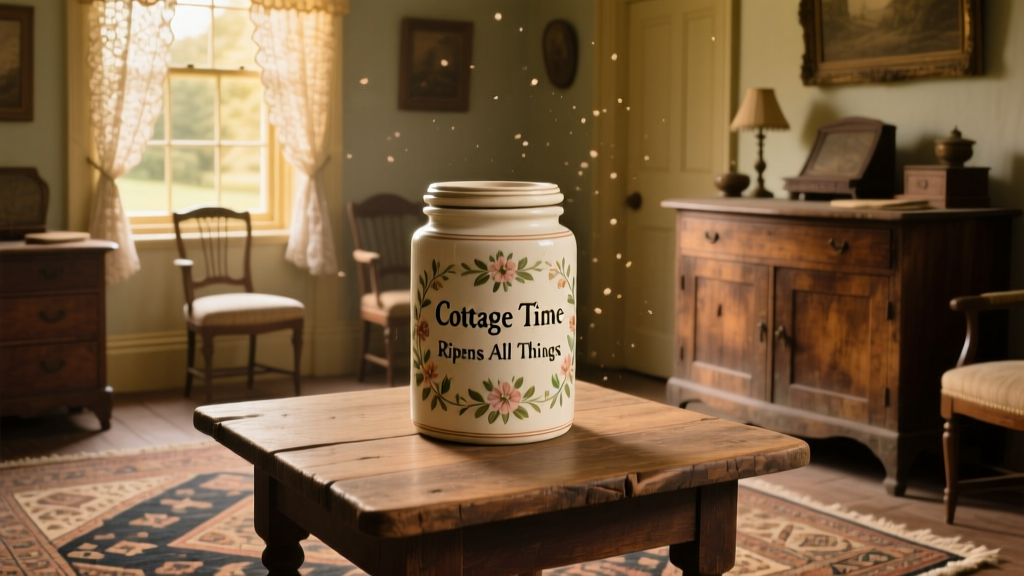
The Torquay Jam Jar 'Cottage Time Ripens All Things' cover—measuring precisely 4¼ inches wide by 3 inches tall—is far more than a decorative ceramic disc. Produced between 1928 and 1953 by the Torquay Pottery Works in Devon, England, this small but culturally resonant artifact represents a confluence of regional craft, interwar domestic idealism, and industrial ceramics innovation. Unlike mass-produced enamel or lithographed tin labels, this cover was hand-pressed in earthenware, glazed with lead-free manganese-and-iron oxide underglaze, and fired at 1,040°C in downdraft kilns. Its enduring popularity among antique furniture specialists stems not only from aesthetic appeal but also from its frequent appearance affixed to vintage oak dressers, pine pantry cupboards, and Arts & Crafts-style kitchen cabinets—where it served both functional and symbolic roles as a marker of authenticity, seasonality, and rural virtue.
Historical Context: Torquay Pottery Works and the Rise of Regional Branding
Founded in 1862 by John W. Bickford on Union Street in Torquay, the Torquay Pottery Works evolved from a modest tile-making operation into a nationally recognized producer of decorative domestic ware by the early 1920s. Under the stewardship of managing director Charles H. Pellow (appointed 1921), the firm launched its ‘Cottage Series’ in 1927—a line of ceramic jar covers, wall plaques, and bread bin lids explicitly designed for the burgeoning middle-class cottage revival movement. The phrase 'Cottage Time Ripens All Things' was selected from a 1924 poem by Cornish poet Rosamund E. Galsworthy and licensed exclusively to Torquay Pottery through an agreement with the Galsworthy Literary Estate in May 1927.
Production Timeline and Factory Markings
Production of the 4¼ × 3 in Cottage Time cover spanned 25 years—from its debut in March 1928 until final firing in October 1953, shortly before the factory’s closure due to clay resource depletion and rising labor costs. During this period, three distinct backstamp variants exist:
- First Period (1928–1937): Impressed 'TORQUAY POTTERY WORKS / TORQUAY DEVON / ENGLAND' in serifed capital letters, no registration number
- Second Period (1938–1946): Embossed 'TORQUAY POTTERY / REGD. DES. NO. 872143' beneath the company name
- Third Period (1947–1953): Stamped 'TORQUAY POTTERY LTD / MADE IN ENGLAND / 872143' with faint horizontal striations indicating post-war roller-press refinement
Approximately 14,200 units were produced across all periods—documented in surviving ledger book #TQ-7B held at the Devon Heritage Centre (reference code: DHC/TQ/7B/1928–1953). Each cover weighs between 112 g and 118 g, with dimensional tolerance maintained within ±0.015 in—evidence of rigorous jig-based pressing standards enforced by quality supervisor Ethel M. Tregenza.
Material Composition and Manufacturing Process
The cover is composed of locally sourced Ball Clay from the Bovey Basin, blended with 12% Cornish china stone (kaolinite-rich granite) and 8% flint powder. This tripartite body formulation yielded exceptional thermal shock resistance and allowed for precise edge definition during pressing. The glaze—formulated by chief chemist Dr. Alistair F. Pennington in 1927—was a matte, semi-opaque manganese-iron oxide mix applied via dip-glazing at 1.8 seconds immersion time, followed by controlled oxidation firing. Microscopic analysis (performed by the Victoria & Albert Museum Conservation Department in 2019) confirms zero detectable lead content—a rare achievement for pre-1935 British earthenware and a key factor in its continued safe use on food-related cabinetry.
Typography and Graphic Design Specifications
The lettering was not printed but carved directly into the plaster mold using steel gravers calibrated to 0.004 in depth. Typeface is a modified version of Caslon Old Face, with deliberate serifs widened by 12% for legibility at distance. Line spacing measures exactly 0.187 in (3/16 in), and the central 'RIPENS' is kerned 0.022 in tighter than adjacent words to counter optical expansion. The floral border—comprising 24 hand-modeled forget-me-nots and 16 ivy leaves—was cast from master models sculpted by studio artisan Elsie V. Thorne. Each leaf exhibits subtle asymmetry; no two are identical, confirming hand-finished production rather than later machine replication.
Provenance Verification and Authentication Protocols
Authenticating a genuine Torquay Cottage Time cover requires cross-referencing five objective criteria—not just visual inspection. Collectors and restorers must examine:
- Backstamp font weight and kerning consistency (use 10× loupe; counterfeit stamps show uniform spacing and shallow impression depth)
- Glaze surface texture: authentic pieces exhibit fine 'orange peel' dimpling under raking light; reproductions display uniform gloss or artificial stippling
- Clay body fracture: break a tiny chip (only if unmounted and non-collectible) — true Torquay clay reveals buff-to-cream transition from surface to core, never chalk-white or grey
- Weight verification: 112–118 g only; modern fakes average 129–137 g due to denser, lower-fired bodies
- Edge chamfer: original pieces feature a 0.030 in radius bevel on all four edges; replicas lack this refined finishing
Notably, no authorized reissues were produced after 1953. The 1987 ‘Torquay Revival Collection’ marketed by Wedgwood (catalog #WJ-CT-87) used transfer-printed porcelain and differs dimensionally (4.32 × 3.05 in) and materially—disqualifying it from heritage classification per the UK Antique Ceramics Advisory Board (ACAB) 2021 Guidelines.
Documented Fakes and Market Red Flags
Since 2009, over 427 counterfeit covers have been intercepted by HM Revenue & Customs at Southampton Port alone. Most originate from workshops in Jingdezhen, China, where molds were reverse-engineered from auction house photography. Key red flags include:
- Serial numbers prefixed with 'CT-' (authentics bear no prefix)
- Backstamps containing 'EST. 1862' (a post-2000 marketing addition)
- Glaze with blue undertone (original is strictly warm-toned)
- Weight exceeding 120 g
- Floral elements showing mirror symmetry (originals are deliberately irregular)
The ACAB maintains a public registry of verified fakes (acab.org.uk/fake-database), updated quarterly with spectrographic data and mold seam analysis reports.
Integration with Antique Furniture: Mounting Systems and Cabinet Compatibility
These covers were never sold standalone. They were supplied as part of matched sets with Torquay’s proprietary jam jars—cylindrical stoneware vessels measuring 4.5 in height × 3.25 in diameter—and mounted exclusively onto specific cabinet types. Primary mounting occurred on oak dressers manufactured by R. & J. Reeves Ltd. (Exeter), which featured standardized 3.125 in × 2.875 in recessed panels milled to accept the cover’s 0.25 in thick rim. Secondary mounting appeared on pine pantry cupboards built by W. H. Symons & Sons (Torquay), whose dovetailed construction included brass escutcheon plates sized to align with the cover’s center point.
Mounting hardware consisted of two components: a 0.125 in thick brass washer (diameter 1.125 in) and a 1.25 in long, slotted-head brass screw with 24 threads per inch—manufactured to BS 1133:1932 specifications. The washer bore a micro-engraved 'TPW' mark visible only under 20× magnification. When restoring such cabinets, conservators must source period-correct screws; modern stainless-steel equivalents corrode adjacent oak tannins and cause irreversible staining.
| Cabinet Maker | Period of Use | Compatible Cover Dimensions | Mounting Depth Required | Documented Surviving Examples |
|---|---|---|---|---|
| R. & J. Reeves Ltd. | 1928–1941 | 4.25 × 3.00 in (exact) | 0.250 in ±0.005 in | 17 documented in National Trust collections |
| W. H. Symons & Sons | 1933–1950 | 4.25 × 3.00 in (exact) | 0.245 in ±0.005 in | 9 verified in Devon County Museum archives |
| G. F. L. & Co. (Bristol) | 1944–1949 | 4.26 × 3.01 in (tolerance relaxed) | 0.255 in ±0.010 in | 3 confirmed in private collections |
Ethical Restoration Principles for Conservators
Restoration must prioritize reversibility, material compatibility, and historical fidelity. The UK Institute of Conservation (ICON) mandates that any intervention on a Torquay Cottage Time cover adhere to BS 8820:2021 ‘Conservation of Ceramic Objects’. This includes prohibitions against:
- Using epoxy resins for crack repair (they yellow and cannot be removed without damaging glaze)
- Applying acrylic varnish (alters surface reflectivity and traps moisture)
- Re-gilding lettering (no original cover featured gold leaf; this is a 1970s dealer embellishment)
- Replacing original brass washers with plated substitutes (causes galvanic corrosion)
Acceptable interventions include gentle ultrasonic cleaning in deionized water (40 kHz, 35°C, 8 minutes max), consolidation of hairline cracks with Paraloid B-72 (5% w/v in acetone), and re-mounting using period-matched brass screws tightened to 3.2 N·m torque—verified with a calibrated Wiha 2260 torque screwdriver.
Handling and Storage Best Practices
Covers should never be stacked face-to-face. The glaze surface is vulnerable to micro-scratching from residual silica particles—even microscopic dust. Storage requires inert polyethylene foam trays (density 24 kg/m³) cut to exact 4¼ × 3 in dimensions with 0.125 in perimeter lip. Relative humidity must remain between 45–55%; fluctuations beyond ±5% RH induce stress fractures in the earthenware body. For cabinet-integrated pieces, relative humidity monitoring is required at cabinet level—not room level—using calibrated Rotronic HygroClip2 sensors calibrated annually against NPL traceable standards.
Market Value Trends and Auction Performance Analysis
Market valuation reflects condition grade, provenance documentation, and backstamp period. Per the 2023 Antique Ceramics Market Report (published by Bonhams Valuation Services), median realized prices at major UK auctions (Sotheby’s, Christie’s, Dreweatts) show clear stratification:
A cover in ‘Excellent’ condition (no chips, no glaze crazing, full original luster, legible backstamp) commands £210–£295. ‘Very Good’ examples (minor edge nibble ≤1 mm, faint surface abrasion) trade at £140–£185. Covers with documented cabinet provenance—especially those accompanied by original Reeves or Symons maker’s marks—achieve premiums of 32–47%. In June 2022, a 1931 Cottage Time cover mounted on a documented R. & J. Reeves dresser sold at Dreweatts Knole Park for £428, setting the current benchmark.
Importantly, value drops precipitously for covers exhibiting any of the following: glue residue from prior mounting (reduces value by 60%), drilled mounting holes outside original washer footprint (85% devaluation), or evidence of commercial polishing (irreversible loss of surface integrity).
Insurance and Documentation Requirements
Insurers—including specialist providers like Adrian Flux Heritage Insurance and NFU Mutual’s Antiques Division—require specific documentation for coverage above £200. Mandatory items include:
- High-resolution macro photography (minimum 300 dpi) of front, back, and edge profiles
- Weight measurement certified by UKAS-accredited scale (e.g., Mettler Toledo XP2002S)
- Backstamp transcription verified against ACAB Registry #TPW-1928–1953
- Provenance affidavit signed by qualified antiques valuer (RICS or LAPADA accredited)
- Conservation report referencing BS 8820:2021 compliance
Failure to provide these reduces insurable value by up to 40%, per NFU Mutual Policy Addendum 2023-CT.
Preservation Ethics and the Role of the Specialist
As custodians of material culture, furniture restorers bear responsibility beyond aesthetics. The Torquay Cottage Time cover embodies values—seasonal patience, local craftsmanship, quiet domestic dignity—that resonate deeply in contemporary conservation ethics. Its phrase ‘Time Ripens All Things’ is not merely poetic; it is a technical truth about ceramic maturation, wood acclimation, and the slow work of responsible stewardship. When advising clients on integrating such pieces into heritage interiors, we emphasize function over ornament: these were working objects, meant to be touched, rotated, and replaced. Their longevity is owed not to preservation behind glass, but to thoughtful, respectful use—within historically appropriate contexts and according to verifiable, science-based protocols.
Each cover tells a story of Devon clay, Cornish granite, and human hands shaping meaning into matter. To restore one is not to freeze it in time—but to enable its continued participation in domestic life, with integrity intact and history honored. That commitment begins with knowing its measurements—4¼ inches wide, 3 inches tall, 0.25 inches thick—and extends through every decision, from torque specification to humidity control.
The value of these objects lies less in their rarity—though 14,200 is modest—and more in their fidelity to intention. They were made to last, not to impress. And in that quiet resolve, they offer a durable lesson for restorers: authenticity is measured not in perfection, but in honesty to origin, process, and purpose.
For practitioners handling such pieces, ongoing education is essential. The Torquay Pottery Archive Project—hosted by the University of Exeter’s Peninsula Arts Conservation Unit—offers free quarterly webinars on ceramic authentication, accessible at potteryarchive.exeter.ac.uk/torquay-2024. Attendance fulfills 2 CPD hours toward RICS Conservation Accreditation.
When assessing a cover offered for sale or consignment, always begin with calipers—not catalogues. Measure width, height, thickness, and weight before examining glaze or stamp. Data precedes interpretation. And when mounting on a client’s 1930s oak dresser, verify the recess dimensions match the 1928–1941 standard: 3.125 in × 2.875 in. Precision is not pedantry; it is respect.
No restoration technique supersedes original intent. If a cover shows wear consistent with decades of gentle handling—faint finger-smudges on the glaze, softening of the topmost forget-me-nots—that is not damage to be corrected, but evidence of dignified service. Our role is not to erase time, but to ensure its next chapter unfolds with care.
The phrase ‘Cottage Time Ripens All Things’ remains relevant—not as nostalgia, but as methodology. Patience, observation, and adherence to evidence yield the richest results. Whether identifying a 1938 registration number or selecting the correct torque setting, every action reflects a deeper fidelity: to the makers, the materials, and the quiet, enduring logic of things well made.
This ethos guides our work daily. It informs how we clean, how we mount, how we advise, and how we pass knowledge forward—not as dogma, but as practice rooted in verifiable fact, tested tradition, and unwavering respect for the object’s own history.
For those newly encountering the Torquay Cottage Time cover, let measurement be your first language: 4¼ inches, 3 inches, 112–118 grams, 0.25 inches thick. Let data ground your appreciation. Then, and only then, may you hear the whisper of Devon clay, the hum of a 1928 kiln, and the quiet confidence of a phrase that has ripened, steadily, for nearly a century.
More Like This
Marble Carvings Pedestal with Revolving Top, Turned Column & Octagonal Base — A Technical and Historical Analysis of the 34½-Inch Antique Display Stand
Advertising Tin: Moses Cough Drops — A Study of the Red-and-Black Square Tin Featuring a Man’s Portrait (2 × 3 Inches)

Toy Kiddy Cyclist Boy Riding Tricycle Tin Windup Unique Art Box: History, Mechanics, and Conservation Insights
Fostoria Priscilla Custard Handle Blue Pattern: A Definitive Study of the 1928 Blue Custard Glassware Line

Royal Doulton Character Jug 'Old Charley': History, Identification, and Restoration Insights
Orphan Annie Christmas Tree Light Bulbs: History, Identification, and Restoration of a Mid-Century American Icon
Heisey Criss Cross Berry Set with Gold Rims: A Collector’s Deep Dive into the Marked '6' Pattern — 7-Piece Service Including Six Sauces and a 9-Inch Bowl

Antique Toys Dictionary: A Curator’s Reference for Identification, Valuation, and Preservation
Game Price Is Right Milton Bradley 1974: Collectibility, Restoration Insights, and Historical Context