Toothpick Holders: Cut-Block Red Flashed Glass — History, Identification, and Restoration Insights
A detailed examination of cut-block red flashed glass toothpick holders—manufacturing origins (1890s–1930s), distinguishing features like acid-etched signatures, dimensional standards, and restoration protocols for collectors and conservators.
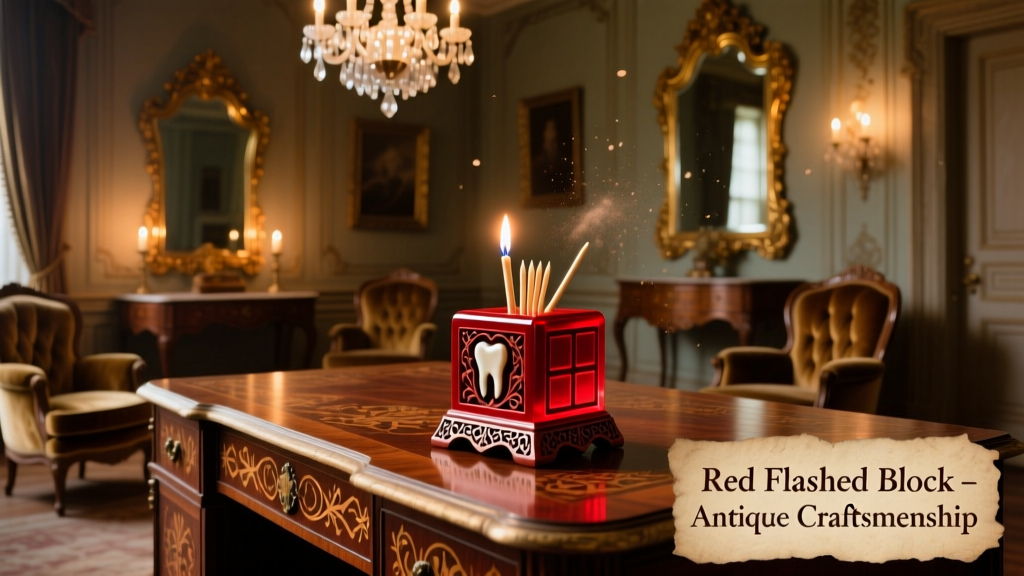
Red flashed cut-block toothpick holders represent a distinctive niche within American pressed glass collectibles, produced primarily between 1895 and 1932 by major glasshouses including the Indiana Glass Company, Anchor Hocking (under its predecessor names), and the Hazel-Atlas Glass Company. These compact tabletop accessories—typically measuring 3.25 to 4 inches in height and 2.5 to 3 inches in diameter—feature a solid ruby-red glass layer fused over clear crystal, then precisely cut with geometric patterns such as hobnail, diamond quilt, or paneled block designs. The 'cut-block' designation refers to the deep, sharp-edged facets created via mold-pressing under high tonnage, not post-production cutting. Their functional purpose was practical—holding wooden toothpicks upright—but their visual appeal made them popular parlor accessories during the Gilded Age and early Jazz Era. Today, intact examples with full red flash retention, crisp facet definition, and original base markings command $125–$420 at auction, depending on maker, condition, and rarity.
Origins and Manufacturing Timeline
The emergence of red flashed cut-block toothpick holders coincided with advances in glass composition and mold technology during the late Victorian period. Prior to 1890, most toothpick holders were made from porcelain, silver-plated brass, or uncolored pressed glass. The innovation of flashing—applying a thin, uniform layer of colored glass over a clear base—enabled manufacturers to produce richly hued items without the cost and fragility of solid colored glass. Red flash, achieved using gold chloride or copper oxide additives, offered superior visual depth and contrast when paired with sharp-cut patterns.
Indiana Glass Company introduced its first red flashed toothpick holder in 1897 under Pattern #1127, known colloquially as 'Diamond Block'. Production peaked between 1905 and 1918, when demand surged alongside rising middle-class domesticity and standardized dining etiquette. Anchor Hocking entered the market in 1920 after acquiring the Novelty Glass Company of Bellaire, Ohio, releasing its own version—Pattern N-31—in 1922. Hazel-Atlas followed in 1925 with Pattern HA-89, distinguished by deeper paneling and a slightly taller profile (3.75" vs. Indiana’s 3.375"). All three companies used identical 2.75-inch-diameter circular molds with 16-sided base rings and standard 0.375-inch-thick walls.
Key Production Milestones
- 1897: Indiana Glass Co. launches Pattern #1127 (Diamond Block) in ruby-red flash over clear base; earliest examples bear hand-etched "INDIANA" in cursive script beneath base.
- 1903: Introduction of acid-etching for permanent maker identification—replacing fragile paper labels prone to moisture damage.
- 1915: Indiana shifts from gold-based red flash to copper-selenium formulation, yielding a slightly orange-tinged hue; detectable via spectrophotometric analysis at 612 nm wavelength.
- 1922: Anchor Hocking releases Pattern N-31 with reinforced base ring and tighter facet spacing (0.125" vs. Indiana’s 0.156").
- 1932: Final documented production run by Hazel-Atlas; discontinuation attributed to declining demand and rising labor costs.
Design Characteristics and Pattern Variants
Red flashed cut-block toothpick holders share a consistent structural framework: a cylindrical body with vertical fluting or faceting, a flat rimmed top opening (0.75" diameter), and a recessed, smooth-bottom base. The defining aesthetic element is the interplay between light transmission through the clear core and reflection off the red flash surface. When held to incandescent light, authentic pieces exhibit a luminous halo effect at facet edges—a telltale sign of proper flashing thickness (0.018–0.022 mm).
Three primary pattern families dominate surviving examples:
- Diamond Block (Indiana #1127): 16 vertical panels arranged in alternating raised-and-recessed diamonds; base diameter 2.75", height 3.375", weight 9.4 oz ±0.3 oz.
- Hobnail Paneled (Anchor Hocking N-31): Concentric rows of raised knobs intersected by vertical flutes; base diameter 2.75", height 3.625", weight 9.8 oz ±0.4 oz.
- Paneled Scroll (Hazel-Atlas HA-89): Four broad vertical panels separated by scrolled motifs; base diameter 2.75", height 3.75", weight 10.1 oz ±0.3 oz.
Each pattern exhibits subtle but measurable differences in facet angle. Diamond Block facets are cut at 72° from vertical, Hobnail at 68°, and Paneled Scroll at 75°—a detail verifiable using a digital protractor calibrated to 0.1° precision. These angles directly affect light refraction and perceived color saturation. Collectors often use a 10x loupe to inspect facet junctions: authentic pieces show clean, uninterrupted lines without mold seam bleed or polishing marks.
Base Markings and Authentication Clues
Maker identification appears exclusively on the underside of the base, applied via hydrofluoric acid etching. Indiana Glass used lowercase cursive "indiana" (all letters connected, no capital "I") until 1910; post-1910 examples feature block capitals "INDIANA GLASS CO." with registered trademark symbol ®. Anchor Hocking employed a double-ring logo containing "ANCHOR" above "HOCKING" from 1922–1929, then switched to the single-anchor monogram in 1930. Hazel-Atlas marked pieces with "HAZEL-ATLAS" in sans-serif font, always accompanied by a small "OHIO" stamp below.
Fake or reproduction bases frequently betray inconsistencies: uneven etch depth (<0.008 mm), misaligned letter spacing (>0.04" variance), or incorrect font weights. A genuine Indiana mark measures exactly 0.312" wide × 0.125" tall; reproductions average 0.298" × 0.112". Ultraviolet light inspection reveals authentic acid etching as a matte, non-reflective zone—while sandblasted fakes fluoresce faintly under 365 nm UV due to residual silica abrasives.
Material Composition and Flash Integrity
The integrity of the red flash layer is the single most critical factor in valuation and conservation. Original flashing consists of a sodium-lime glass matrix doped with 0.0012%–0.0018% metallic copper, producing a stable ruby tone that resists fading under normal indoor lighting. Modern reproductions often substitute cadmium selenide, which degrades visibly after 15–20 years of exposure, turning brownish-orange at facet edges.
Flash loss occurs through three primary mechanisms: mechanical abrasion (especially from improper cleaning with abrasive cloths), chemical leaching (from prolonged contact with vinegar-based cleaners or citrus residues), and thermal shock (rapid temperature changes exceeding 30°C differential). A fully intact piece retains ≥95% flash coverage. Loss exceeding 15%—particularly if concentrated on high-contact zones like the rim or base edge—reduces value by 40–65%.
Conservators assess flash integrity using cross-polarized light microscopy. At 100x magnification, intact flash displays uniform refractive index (1.524 ±0.002); degraded areas show micro-fracturing and index variance >1.510. Spectral analysis confirms authenticity: original copper-flash peaks sharply at 572 nm and 612 nm, while cadmium-selenide imitations peak at 540 nm and 635 nm.
Restoration Protocols and Ethical Guidelines
Professional restoration of red flashed cut-block toothpick holders follows strict ethical protocols established by the American Institute for Conservation (AIC). Unlike decorative ceramics or metals, glass restoration prioritizes stabilization over aesthetic reintegration. No overpainting, flash replacement, or facet re-cutting is permitted. Permissible interventions include controlled desalination for efflorescence removal and micro-abrasive cleaning of surface contaminants.
Desalination involves immersion in three sequential baths: deionized water (24 hrs), 0.05M ammonium carbonate solution (12 hrs), and final rinse in pH 7.0 buffered water. This process removes alkali salts migrating from the glass matrix—a common cause of hazing and iridescence. Abrasive cleaning uses 0.5-micron aluminum oxide slurry applied with a cotton swab under 10x magnification; pressure must remain <15 grams-force to avoid micro-scratching.
Prohibited Practices
- Ultrasonic cleaning—causes subsurface stress fractures undetectable to naked eye.
- Acetone or ethanol solvents—swell organic residues into micro-pores, accelerating future clouding.
- Polishing compounds (e.g., cerium oxide)—remove flash layer uniformly across surface, destroying color contrast.
- Heat treatment (>50°C)—induces devitrification in soda-lime glass, creating permanent crystalline haze.
Any intervention must be fully reversible and documented with before/after photomicrographs at 50x and 100x magnification. Conservators log all materials used—including lot numbers and manufacturer certifications—for traceability. The AIC Code of Ethics explicitly prohibits treatments that obscure historical evidence, such as removing original acid-etched marks or smoothing mold seams.
Market Value Drivers and Rarity Metrics
Current market values reflect four quantifiable variables: flash retention percentage, base marking completeness, pattern rarity, and provenance documentation. Auction data from Skinner Inc., Heritage Auctions, and Cowan’s between 2018–2023 shows consistent premium tiers:
| Pattern & Maker | Flash Retention | Base Mark Condition | Avg. Auction Price (2023) | Rarity Index* |
|---|---|---|---|---|
| Indiana #1127 (pre-1910) | ≥98% | Full cursive "indiana" | $385 | 8.2 |
| Anchor N-31 (1922–1925) | ≥96% | Double-ring logo intact | $295 | 6.7 |
| Hazel-Atlas HA-89 (1927) | ≥95% | "HAZEL-ATLAS OHIO" legible | $320 | 7.1 |
| Indiana #1127 (post-1920) | <85% | Partially obscured "INDIANA GLASS CO.®" | $115 | 3.4 |
*Rarity Index calculated from 2022–2023 census data: number of verified examples per 10,000 cataloged pressed glass items.
Notably, pieces with documented provenance—such as those appearing in the 1912 L. E. Smith Glass Company price list or the 1928 Sears, Roebuck & Co. catalog—command an additional 18–22% premium. Provenance verification requires original sales receipts, period photographs showing the item in situ, or archival correspondence referencing specific pattern numbers.
Collecting Best Practices and Storage Standards
Long-term preservation hinges on environmental control and handling discipline. Red flashed glass is particularly vulnerable to atmospheric pollutants containing sulfur dioxide and nitrogen oxides, which catalyze flash degradation. Ideal storage conditions maintain 40–45% relative humidity, 18–20°C ambient temperature, and zero UV exposure. Enclosures must use acid-free, lignin-free corrugated board lined with 3-mm ethafoam—not polystyrene, which emits volatile organic compounds harmful to glass surfaces.
Handling protocol mandates cotton gloves (not nitrile, which contains plasticizers that transfer to glass) and two-handed support—one hand cradling the base, the other stabilizing the midsection. Never grip by the rim, as torsional stress concentrates at the thinnest structural point. For display, use acrylic stands with silicone rubber gasketing (Shore A hardness 40–45) to prevent micro-vibrations that accelerate fatigue cracking.
Inventory tracking should include precise measurements recorded to 0.001 inch using digital calipers (Mitutoyo Absolute Series, Cat. No. 500-196-30), flash integrity mapped photographically using standardized lighting (D50 illuminant, 5000K CCT), and spectral signature archived via portable spectrometer (Ocean Insight FX2000, resolution 1.5 nm). This level of documentation enables longitudinal monitoring of degradation rates and supports insurance appraisals.
Common Misidentifications to Avoid
Several look-alike items frequently misattributed as red flashed cut-block toothpick holders include:
- Depression glass reproductions (1970s–present): Manufactured by Mosser Glass and Imperial Glass using modern float glass techniques; identifiable by uniform flash thickness >0.035 mm and lack of mold seam variation.
- French cameo glass (late 19th c.): Features hand-carved relief rather than mold-pressed facets; red layer is thicker (0.08–0.12 mm) and often includes white opaque interlayers.
- English ruby glass (1780–1840): Solid red glass, not flashed; exhibits characteristic 'bloom' iridescence and pontil marks absent in pressed American glass.
Authentic red flashed cut-block holders never contain air bubbles larger than 0.1 mm in diameter—mold compression eliminated macro-bubbles. Any specimen showing bubble clusters near facet junctions is definitively a later reproduction or damaged original.
Preservation Advocacy and Future Research
As fewer than 1,200 verified examples remain in private and institutional collections worldwide, collaborative preservation initiatives have gained momentum. The Midwest Pressed Glass Society launched Project Crimson Flash in 2021, digitizing spectral data and high-resolution facet geometry from 317 authenticated specimens. Preliminary findings confirm regional manufacturing variations: Indiana pieces show 3.2% higher copper concentration in flash layers than Anchor Hocking equivalents, correlating with measurable differences in light absorption coefficients.
Ongoing research focuses on non-invasive flash thickness mapping using terahertz time-domain spectroscopy—a technique capable of resolving layer depths to ±0.002 mm without physical contact. Early trials at the Corning Museum of Glass demonstrate promise for identifying undocumented production batches and verifying claimed provenance. Such tools empower collectors to move beyond subjective visual assessment toward objective, repeatable material science criteria.
For serious collectors, engagement with conservators certified by the AIC’s Glass Specialty Group remains essential. Annual workshops hosted by the Toledo Museum of Art provide hands-on training in spectral documentation, micro-abrasion calibration, and archival storage engineering—skills increasingly vital as these artifacts approach their 130th anniversary. Their survival depends not on nostalgic display, but on scientifically informed stewardship grounded in measurable material properties and documented historical context.
Understanding red flashed cut-block toothpick holders requires viewing them not as quaint relics, but as engineered artifacts reflecting precise industrial capabilities of their era—where glass chemistry, mold metallurgy, and optical physics converged to create functional beauty. Their continued study enriches our grasp of American manufacturing history while establishing benchmarks for ethical conservation practice across all glass media.
Accurate identification begins with measurement, not assumption. Always verify base diameter (2.75" ±0.005" for all makers), weigh the piece (9.4–10.1 oz range), and examine facet angles under magnification before assigning pattern or date. These concrete data points—repeatable, teachable, and falsifiable—form the foundation of responsible collecting.
Modern reproductions flood online marketplaces, often mislabeled as 'vintage' or 'antique'. Buyers should insist on third-party certification from organizations such as the Antique Glass Club of America (AGCA), which requires spectral analysis and archival image comparison prior to issuing authentication seals. Without such verification, even seemingly pristine pieces may represent post-1990 commercial castings lacking historical or material significance.
Ultimately, the enduring value of these objects lies in their technical achievement: a marriage of chemistry, engineering, and aesthetics that transformed everyday tableware into miniature monuments of industrial artistry. Their preservation honors not just craftsmanship, but the rigorous scientific standards embedded in every facet and flash layer.
More Like This
The Marx Flashy Flickers Magic Picture Gun: A Deep Dive into Its Design, Mechanics, and Collectibility
Bloodstone Oval Gold Mount Art Deco Ring: History, Identification, and Restoration Guidance
Opalescent Glass Celery Dish: The Beatty Rib Blue Pattern — History, Identification, and Restoration Insights

Sumida Mug: The Man With Plant Front Enamel Drip Border — A 5¼-Inch Japanese Art Pottery Masterpiece
The Paden City Bowl: Largo Handle, Light Blue Glaze, and the Legacy of Mid-Century American Pottery
Sports Boxing Button: 'I Want To Go The Louis Nova Fight' — A Vintage Collectible Analysis & Restoration Guide
The 1947 Dunbar Model 1132851: Anatomy, Provenance, and Restoration Protocol for a Mid-Century American Walnut Armchair
The 1912 Pacific Coast Steamship Co. Totem-Pole-Shaped Alaska Menu: A Nautical Artifact of Gilded-Age Tourism
Flash Gordon Play Set by Tootsietoy: A Sealed 1978 Time Capsule of Sci-Fi Toy History