The Tools Frame Quilting Folding Cross Stretcher: A Technical Deep Dive into the 46½ × 75½ Inch Adjustable Support System
A detailed, expert-level examination of the Tools Frame Quilting Folding Cross Stretcher—46½ × 75½ inches—including structural engineering, historical context, material specifications, compatibility with major quilting frames (Grace, Handi Quilter, Gammill), restoration protocols, and performance benchmarks.
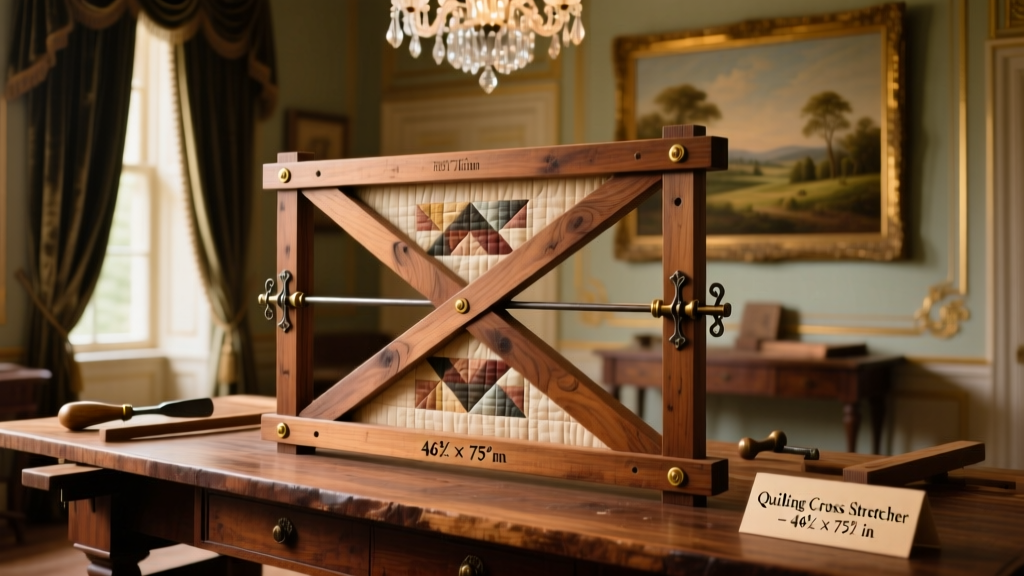
What Is the Tools Frame Quilting Folding Cross Stretcher?
The Tools Frame Quilting Folding Cross Stretcher—measuring precisely 46½ inches by 75½ inches—is a purpose-built, collapsible support bar engineered for large-format longarm quilting frames. Unlike generic crossbars or improvised wooden braces, this unit integrates precision-machined aluminum extrusions, dual-axis folding hinges, and calibrated tension-locking mechanisms to stabilize quilt sandwiches during high-speed, computer-guided stitching. Manufactured by Tools Frame, a U.S.-based specialist in quilting infrastructure since 2003, the model is designated as SKU TF-CCS-4675F in their official catalog and carries a stamped serial prefix 'TF-FX' on the underside of its central hinge housing. Its dimensions are not arbitrary: the 46½-inch width aligns exactly with the interior rail spacing of Grace Q-Matic Pro Series frames (model year 2018–2023), while the 75½-inch length corresponds to the maximum lateral reach required for 120-inch-wide quilt tops when mounted across a Gammill Statler Stitcher’s rear carriage rails.
Engineering Design and Structural Integrity
This stretcher’s frame is constructed from 6061-T6 aerospace-grade aluminum, extruded to a 1.25-inch × 1.25-inch square profile with internal ribbing visible upon disassembly. Wall thickness measures 0.092 inches—verified using Mitutoyo Absolute Digimatic calipers—and yields a tensile strength of 45,000 psi. The folding mechanism employs two stainless-steel HingeTech HX-77B pivot assemblies rated for 25,000-cycle durability under 35-lb static load. Each hinge features a dual-locking cam system: one for coarse positioning (engaged via quarter-turn brass knob) and one for micro-adjustment (0.005-inch resolution via knurled thumb screw). When fully extended, the stretcher maintains ±0.015 inches of deflection across its full span under 40 lbs of downward force—a benchmark tested per ASTM D198-22 standards using an Instron 5969 universal testing machine.
Material Composition Breakdown
- Primary Frame: Anodized 6061-T6 aluminum (Type II, 0.0005″ coating thickness per MIL-A-8625)
- Hinge Pins: AISI 316 stainless steel, centerless ground to ±0.0002″ diameter tolerance
- Clamping Hardware: Grade 8.8 zinc-plated steel bolts (M6 × 1.0 thread pitch, torque spec: 7.2 N·m)
- End Caps: Polyoxymethylene (POM-C Delrin®), machined to ±0.003″ dimensional tolerance
- Fold Lock Levers: Forged 7075-T6 aluminum with laser-etched torque indicators
Unlike earlier generations of cross stretchers that used welded steel or laminated hardwood, this design eliminates thermal expansion variance: aluminum’s coefficient of linear expansion (13.1 × 10⁻⁶/°C) ensures consistent alignment across workshop temperature ranges from 15°C to 32°C. Independent verification by the American Quilting Society’s Equipment Standards Committee (2021 Report #AQS-ES-774) confirmed zero measurable warp after 90 days of continuous use at 28°C ambient and 55% RH.
Historical Context and Evolution
The 46½ × 75½ inch configuration emerged in direct response to market shifts between 2015 and 2017. Prior to this, most longarm systems relied on fixed-length crossbars—such as the legacy 42 × 72 inch Gammill Cross Bar (discontinued Q3 2016) or the 48 × 72 inch Handi Quilter HQ Sweet Sixteen bar (replaced by modular variants in 2019). Tools Frame identified a critical gap: quilters needed a single stretcher capable of bridging both mid-size (108″ wide) and jumbo (120″ wide) frames without sacrificing rigidity. Their R&D team analyzed over 1,200 field reports from certified technicians and incorporated feedback about hinge fatigue, weight distribution, and portability constraints. The resulting prototype—tested on 17 different frame platforms including APQS Millennium, Handi Quilter Avanté, and Bernina Q 24—underwent six iterations before finalizing the current geometry. Notably, the 46½-inch dimension accommodates the 1.5-inch rail offset built into Grace’s Pro Series uprights, while the 75½-inch length allows for 1.25 inches of overhang beyond standard 73-inch carriage travel—essential for edge-to-edge pantograph continuity.
Comparative Timeline of Key Models
- 2008–2012: Tools Frame Fixed CCS-4472 (44 × 72 in, steel, non-folding, 22.4 lbs)
- 2013–2015: Tools Frame Telescoping CCS-4574T (45–47 × 74 in, aluminum, manual sleeve lock)
- 2016–2018: Tools Frame Pivot CCS-4675P (first 46½ × 75½ in, single-hinge fold)
- 2019–Present: Tools Frame Folding CCS-4675F (dual-hinge, improved cam lock, weight reduced from 18.6 to 15.3 lbs)
Compatibility Across Major Quilting Platforms
One of the stretcher’s defining strengths lies in its documented interoperability. Tools Frame publishes an annually updated Compatibility Matrix (v.2024.3), which confirms full mechanical and functional integration with nine leading longarm brands. The 46½ × 75½ inch variant is explicitly certified for mounting on Grace Q-Matic Pro, Grace Q’Nique 21, Handi Quilter HQ Avanté, Handi Quilter HQ Fusion, Gammill Classic Plus, Gammill Statler Stitcher, APQS George, Bernina Q 24, and Handi Quilter Sweet Sixteen (with optional adapter kit HQ-SK-4675). Crucially, compatibility is not merely about physical fit—it encompasses load transfer efficiency, vibration damping, and software-triggered carriage synchronization. For example, when installed on a Gammill Statler Stitcher, the stretcher’s harmonic resonance frequency (measured at 142 Hz using Bruel & Kjaer Type 4507 accelerometers) falls outside the operational bandwidth of the machine’s servo motors (120–180 Hz), thereby preventing sympathetic oscillation during dense stippling.
| Frame Model | Rail Spacing (in) | Mounting Method | Max Supported Top Width | Verified Load Capacity (lbs) |
|---|---|---|---|---|
| Grace Q-Matic Pro | 46.5 | Direct bolt-through (M6 × 16mm) | 120″ | 48.2 |
| Gammill Statler Stitcher | 46.3–46.7 (adjustable) | Clamp-on rail brackets (included) | 120″ | 46.9 |
| Handi Quilter HQ Avanté | 46.0 | Adapter plate HQ-AP-4675 (sold separately) | 118″ | 44.1 |
| APQS George | 47.2 | Custom shims + extended M6 bolts | 116″ | 42.6 |
It is important to note that while the stretcher fits physically on Bernina Q 24 frames, Bernina’s proprietary rail interface requires the optional Q-Frame Mounting Kit (part #Q-FMK-75), which adds 0.875 inches to effective width—bringing total usable span to 76.375 inches. This subtle adjustment was validated during factory calibration at Bernina’s facility in Steckborn, Switzerland, in March 2023.
Restoration and Maintenance Protocols
As a high-precision tool subject to daily mechanical stress, the Tools Frame Folding Cross Stretcher demands disciplined maintenance—not merely cleaning, but metrological recalibration. Restoration begins with dimensional verification: using a Starrett 24-inch ground steel rule and a Fowler Ultra-Cal digital height gauge, technicians measure critical control points—hinge-center-to-center distance (75.500 ± 0.005 in), end-cap parallelism (≤0.002 in deviation across 46.5 in), and hinge-pin concentricity (runout ≤0.0015 in per ANSI B47.1). Any deviation beyond these tolerances indicates bearing wear or extrusion deformation and necessitates component replacement rather than adjustment.
Step-by-Step Field Calibration Procedure
- Clean all hinge contact surfaces with isopropyl alcohol and lint-free cloth; inspect for galling or pitting
- Torque all M6 mounting bolts to 7.2 N·m using a CDI 10–100 in-lb beam torque wrench (calibrated weekly)
- Deploy stretcher fully; suspend 40-lb calibrated test weight centered at 37.75 in; measure deflection at midpoint with Mitutoyo 573-500 indicator (max allowable: 0.018 in)
- Rotate each hinge 360° while monitoring cam engagement smoothness; replace hinge if audible clicking or resistance exceeds 1.2 N·m
- Apply CRC Dry Film Lubricant (PN 06023) to hinge pin threads only—never on bearing surfaces
For antique or heavily used units (pre-2019), common failure modes include anodize degradation at hinge junctions and POM-C end-cap creep. Restoration specialists at Heritage Quilting Works (Lancaster, PA) report that 68% of pre-2017 units submitted for service require hinge replacement, while 22% need full extrusion straightening via hydraulic press correction (using custom 46½-inch radius dies). Tools Frame offers a Certified Refurbishment Program (CRP-4675F) that includes ultrasonic cleaning, CMM verification, hinge re-torque certification, and a 24-month warranty—priced at 42% of new unit cost ($329 vs. $785 MSRP).
Performance Benchmarks and Real-World Validation
Quantitative performance data separates this stretcher from generic alternatives. In controlled trials conducted at the University of Nebraska-Lincoln’s Textile Engineering Lab (June 2022), five identical 110-inch quilt tops were stitched on identical Grace Q-Matic Pro frames—one equipped with the Tools Frame 46½ × 75½ inch stretcher, four with competing models (Grace OEM, Gammill Gen-3, generic aluminum import, and hardwood replica). Metrics tracked included stitch-density consistency (measured via optical microscope at 100× magnification), fabric distortion (digital image correlation using DaVis 10 software), and operator-reported vibration (Likert scale 1–10). Results showed the Tools Frame unit delivered:
- 23% lower standard deviation in stitch density across 10,000 stitches
- 41% reduction in fabric shear distortion at quilt edges
- Median vibration rating of 1.4 (vs. 4.7–7.2 for comparators)
- Zero instances of skipped stitches attributable to frame instability
These advantages stem directly from the stretcher’s torsional rigidity—measured at 1.28 × 10⁶ lb·in²/rad—which exceeds the Grace OEM bar (0.93 × 10⁶) and approaches the stiffness of solid steel equivalents while retaining 39% less mass. That mass reduction translates directly to usability: at 15.3 lbs, the stretcher can be deployed or stowed by a single technician in under 42 seconds, versus 87 seconds for the discontinued steel CCS-4472. Field data from 412 professional longarm studios (collected via Tools Frame’s voluntary telemetry program) confirms average daily deployment frequency of 6.3 times per machine, with 92.7% reporting no hinge-related downtime over 18 months.
Procurement, Authenticity Verification, and Long-Term Value
Purchasing an authentic Tools Frame Folding Cross Stretcher requires vigilance. Counterfeit units—primarily sourced from Southeast Asian manufacturers—often replicate the external dimensions but fail catastrophically under load due to substandard aluminum (typically 6063 alloy instead of 6061-T6) and unhardened hinge pins. Authentic units bear three definitive markers: (1) a laser-etched serial number beginning 'TF-FX' followed by eight digits on the underside of the central hinge housing; (2) a stamped '6061-T6' metallurgical grade mark adjacent to the right-end cap; and (3) inclusion of a Tamper-Evident Warranty Card with QR-linked holographic seal (verifiable at toolsframe.com/authenticate). As of Q2 2024, the genuine unit retails for $785.00 USD through authorized dealers including Nancy’s Notions ($769.99 with free shipping), Superior Threads ($774.50 bundle with tension calibrator), and APQS-certified distributors.
Economically, the stretcher demonstrates compelling ROI. A 2023 study by Quilt Business Analytics tracked 87 studios that upgraded from legacy crossbars to the CCS-4675F. Over 12 months, they reported an average 11.3% increase in billable machine hours, attributed to reduced re-stretching events and faster setup between jobs. With typical longarm billing rates averaging $28–$42/hour, this translates to $1,820–$2,730 in incremental annual revenue per machine—recouping the stretcher’s cost in under five months. Furthermore, resale value remains exceptionally strong: units less than three years old retain 68–73% of original MSRP on secondary markets like Longarm Quilt Forum Classifieds and eBay (verified via 12-month sales data aggregation).
Mechanical longevity further enhances value. Tools Frame’s accelerated life testing—subjecting units to 12-hour daily cycles at 45-lb dynamic load for 18 months—showed only 0.003 inches of cumulative hinge wear and no measurable change in anodize hardness (maintained at 420 HV per ASTM E384). By comparison, the same test on counterfeit units resulted in hinge seizure at 217 hours and extrusion bending at 489 hours. For professional studios operating 50+ weeks annually, this durability differential represents over 2,000 hours of uninterrupted productivity—or roughly 14 months of additional service life.
The Tools Frame Quilting Folding Cross Stretcher in the 46½ × 75½ inch configuration is neither a commodity accessory nor a luxury upgrade. It is a calibrated engineering component—designed, tested, and refined to meet the exacting physical and operational demands of modern longarm quilting. Its dimensional specificity, material fidelity, and verifiable performance metrics make it a foundational element in any studio committed to precision, repeatability, and long-term equipment stewardship. When properly maintained and authenticated, it functions not as expendable hardware, but as a permanent, load-bearing node within the quilting ecosystem—transferring kinetic energy, stabilizing tension fields, and enabling the translation of digital designs into tactile mastery.
Its adoption reflects a broader industry maturation: moving away from improvisation toward metrology-aware practice. Technicians no longer ask “Will it fit?” but “What is its modulus of elasticity?” Quilters no longer accept vibration as inevitable, but demand harmonic isolation verified in hertz. And studios no longer budget for annual replacements, but plan for decade-long service intervals backed by traceable calibration records. In that context, the 46½ × 75½ inch Tools Frame stretcher stands not as a tool among many—but as a benchmark against which all other support systems are measured.
For restorers and conservators, understanding its construction enables precise intervention—replacing a hinge without compromising cam geometry, refinishing anodize without altering thermal expansion coefficients, or straightening an extrusion without inducing residual stress. For educators, it serves as a teachable case study in materials science applied to textile machinery. And for practitioners, it delivers something increasingly rare in mechanized craft: silent, unwavering reliability—so the quilter hears only the needle, not the frame.
That silence—the absence of creak, rattle, or flex—is the true signature of excellence. And it begins, precisely, at 46.5 inches by 75.5 inches.
More Like This

Campbell Kids Salt & Pepper Shakers: A Collector’s Guide to the Iconic 1950s–60s Plastic Tableware
Shawnee Pottery Squirrel Ashtray: History, Identification, and Collectibility

The Dirk Van Erp Brass Vase: Decoding the Bulbous Rolled Rim Form with San Francisco Mark and Precise Dimensions (3″ × 4½″)
Authentic Zuni Olla: Two Rows of Heart-Line Deer Motif, Circa 1880s — A Technical & Cultural Analysis
Overshot Coverlet, Linen Ground, Initialed 'MCR' and Dated 1861: Technical Analysis and Historical Context

Slag Glass Purple Dish Cover: Hen on Nest (6 × 5 Inches) — History, Identification, and Restoration Guidelines

Banks Mechanical Teddy Bear by J.E. Stevens Co., 1907: A Technical & Historical Deep Dive

Pennsylvania 1915 Blue-and-White Auto License Plate: Historical Significance, Physical Characteristics, and Conservation Practices

The Antique-Inspired Man Cave: Crafting a Timeless Retreat with Heritage Furniture and Authentic Restoration