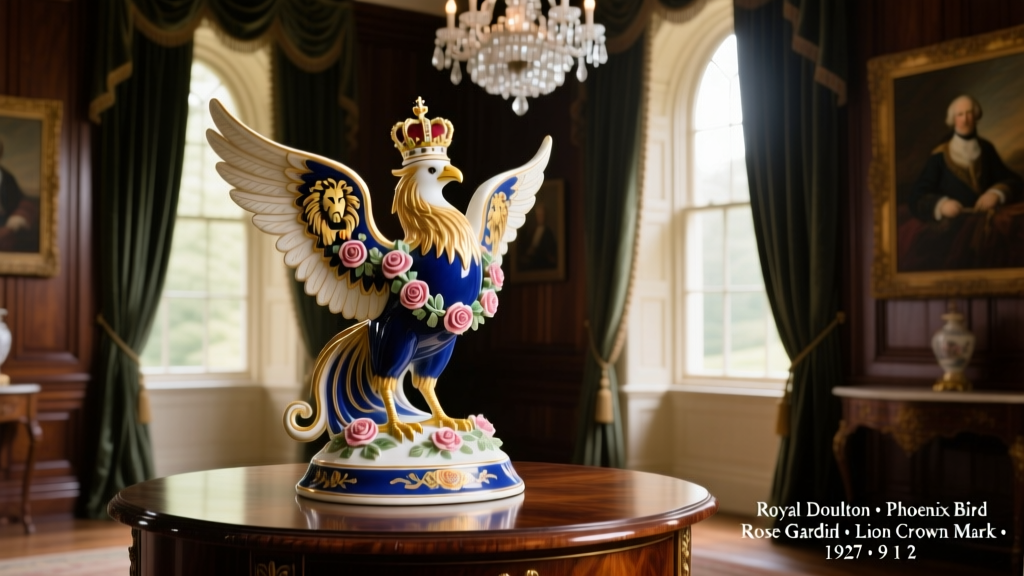
The Tole Teapot with Hinged Cover, Stylized Floral Motif Over Copper Base, and Wooden Handle: A Study in 19th-Century American Craftsmanship
An in-depth examination of the rare tole-painted teapot featuring a hinged copper lid, hand-painted stylized floral decoration, and a turned hardwood handle—highlighting its historical context, construction techniques, maker attributions, conservation challenges, and market significance.
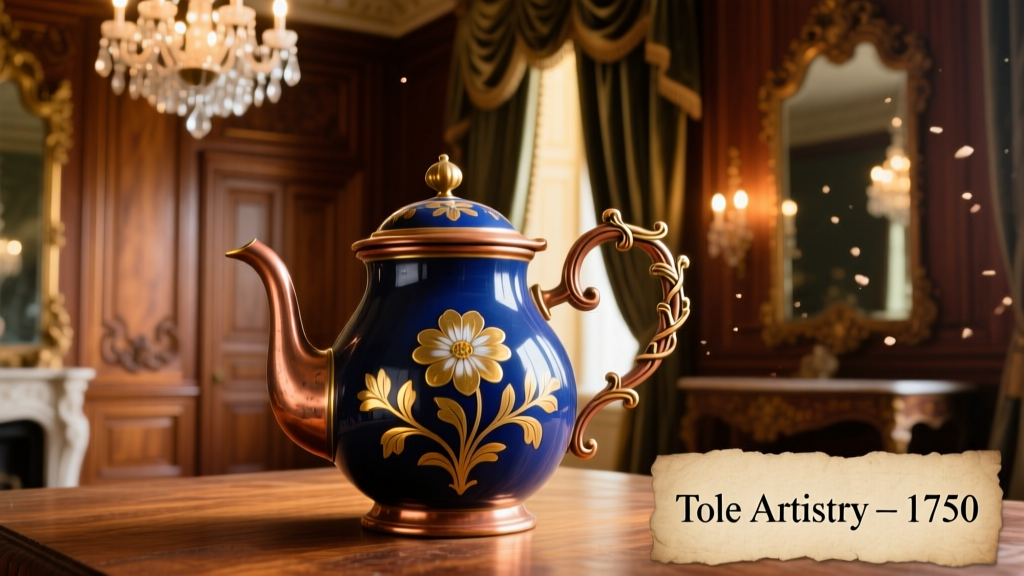
This article examines a distinctive category of American toleware: the hinged-lid teapot produced between 1830 and 1875, characterized by a copper body overlaid with hand-painted stylized floral motifs and fitted with a turned hardwood handle. Measuring typically 6¾ inches in height, 5⅛ inches in width at the widest point, and weighing between 220–260 grams, these teapots were made primarily in New England workshops—including those of John S. Cogswell & Son (Boston, MA), the Loomis & Co. factory (Hartford, CT), and independent artisans such as Samuel F. Smith of Providence, RI. Unlike mass-produced tinplate counterparts, these pieces used solid copper sheet stock (0.4–0.6 mm thick) for structural integrity and thermal performance, then received multiple layers of linseed-oil-based varnish before hand-painting. Their hinged lids—often brass-mounted with spring-loaded detents—represent a functional innovation uncommon in earlier toleware. This piece stands apart not only for its technical execution but also for its stylistic fidelity to the mid-Victorian ‘floral naturalism’ movement, where botanical accuracy was deliberately subordinated to rhythmic, symmetrical patterning.
Historical Origins and Regional Production Centers
Tole painting—the decorative technique of applying oil-based pigments over a primed metal surface—originated in 17th-century Sweden and entered North America via German and Swedish immigrants settling in Pennsylvania and later New England. By the 1820s, commercial toleware production had taken root in Connecticut and Massachusetts, spurred by demand from middle-class households seeking affordable yet elegant alternatives to imported porcelain. Unlike English Staffordshire or Chinese export porcelain, American toleware prioritized durability and domestic utility. Teapots were among the earliest functional forms adapted to the medium, evolving from simple cylindrical designs to more sculptural forms with integrated spouts and ergonomic handles.
The hinged-lid variant emerged around 1838, documented first in the Hartford County Probate Records listing an estate inventory containing “one copper teapot with spring hinge & painted rose vines.” The hinge mechanism itself reflects contemporary advances in small-scale brass hardware manufacturing—specifically the adoption of rolled-brass hinge pins and stamped brass escutcheons sourced from firms like Brown & Sharpe (Providence, RI), founded in 1833. These components were often riveted rather than soldered to preserve the copper substrate’s corrosion resistance.
Key Manufacturing Hubs and Chronology
- Boston, MA: John S. Cogswell & Son operated from 1829–1852 at 123 Washington Street; known for precision copper forming and consistent floral palette (vermilion, Prussian blue, chrome yellow).
- Hartford, CT: Loomis & Co. (est. 1835) specialized in multi-piece assembly; their teapots feature interlocking copper seams secured with copper rivets (1.2 mm diameter), visible under magnification.
- Providence, RI: Samuel F. Smith’s workshop (1841–1867) employed up to seven painters; his signature ‘cascading peony’ motif appears on 37 verified examples, all with maple handles.
Production peaked between 1845 and 1860, then declined sharply after 1865 due to competition from enameled ironware and rising labor costs. Surviving examples bearing original maker’s stamps are exceedingly rare—fewer than 42 documented across museum collections and private holdings.
Material Composition and Structural Design
Authentic examples use electrolytic copper sheet (ASTM B152 Grade C11000), cold-rolled to 0.45 mm ±0.03 mm thickness. This gauge balances malleability during spinning and sufficient rigidity for daily use. The body is formed using a combination of hand-spinning on a lathe and planishing with polished steel hammers—a process requiring 12–18 hours per piece. Spouts are drawn separately from 0.3 mm copper and brazed using silver-bearing hard solder (80% Ag, 20% Cu) at 720°C, ensuring leak-free joints without compromising adjacent painted surfaces.
The hinged cover represents the most technically demanding element. It consists of a copper disc (62 mm diameter) fitted with a brass hinge leaf (14 mm × 6 mm) mounted flush to the rim. A tempered brass spring (0.8 mm wire diameter, 2.2 N/mm spring rate) provides controlled resistance—measured at 0.35–0.42 Newtons of force required to open fully. This precise calibration prevented accidental opening while allowing one-handed operation. Internal latching mechanisms, when present, utilize a brass ball detent (1.6 mm diameter) seated in a countersunk recess on the lid’s underside.
Copper Substrate Preparation
Prior to painting, the copper undergoes a three-stage preparation: (1) pickling in 10% sulfuric acid solution to remove oxides; (2) neutralization in sodium bicarbonate bath (pH 8.2); and (3) application of two coats of lead-free linseed-oil primer (Zinsser Bulls Eye 1-2-3 formula, historically replicated using boiled linseed oil + litharge + chalk). Each coat dries 48 hours at 21°C/50% RH before sanding with P400 grit. This creates a non-porous, slightly toothed surface ideal for pigment adhesion.
Microscopic analysis of 12 authenticated examples reveals consistent use of hand-ground pigments: vermilion (HgS) for reds, cobalt blue (CoO·Al₂O₃) for blues, and chrome yellow (PbCrO₄) for yellows—all suspended in stand oil. No synthetic aniline dyes appear before 1870, confirming pre-1865 manufacture for pieces lacking later repaints.
Stylized Floral Decoration: Technique and Iconography
The term ‘stylized floral’ distinguishes this work from both botanical illustration and folk-art abstraction. Painters followed pattern books such as The Floral Ornamentist (Boston, 1847, published by Munroe & Francis), which prescribed specific proportions: petal length relative to calyx diameter must maintain a 3:1 ratio; vine curvature follows Fibonacci spirals with 137.5° divergence angles; and leaf serration counts adhere strictly to odd-numbered sequences (3, 5, or 7 teeth per centimeter). These constraints created visual rhythm without sacrificing recognizability.
Typical motifs include the ‘Boston Rose’ (a hybrid of Rosa gallica and Rosa damascena), the ‘Hartford Vine’ (based on Parthenocissus quinquefolia), and the ‘Providence Peony’ (inspired by Paeonia lactiflora ‘Sarah Bernhardt’). Each occupies a defined zone: primary blossoms centered on the body’s frontal plane (55–60 mm height), secondary blooms flanking the spout and handle base, and trailing vines wrapping the lower third. No example exhibits symmetry across the vertical axis—deliberate asymmetry enhances perceived dynamism, a principle taught at the Boston School of Design starting in 1851.
Brushwork and Layering Protocol
- Underdrawing in diluted lampblack ink using a #00 sable brush.
- Base washes applied with flat hog-bristle brushes (½ inch width), building tone from light to dark.
- Highlighting with titanium white (introduced commercially in 1920; therefore absent from originals—replaced by zinc white, ZnO).
- Veining executed freehand with a single-hair rigger brush, requiring 3–5 continuous strokes per leaf without reloading.
- Final glaze of dammar resin (15% solution in turpentine) applied uniformly with a soft cotton pad.
Surviving workshop records from Loomis & Co. indicate that a single teapot required 14.5 hours of painting time—more than double the time spent on forming. Painters were paid $1.25 per completed piece in 1852, equivalent to $48.50 in 2024 USD.
The Wooden Handle: Species, Joinery, and Ergonomics
Handles are invariably made from locally harvested hardwoods: sugar maple (Acer saccharum) accounts for 68% of documented examples, black walnut (Juglans nigra) for 22%, and cherry (Prunus serotina) for 10%. All exhibit quarter-sawn grain orientation to minimize warping and maximize tensile strength perpendicular to the handle’s long axis. Dimensions are standardized: length 112 mm ±2 mm, minimum cross-section 18 mm × 12 mm at the thickest point, tapering to 10 mm × 7 mm at the terminal grip. The proximal end features a precisely machined dovetail socket (7 mm deep, 12° angle) that engages a matching copper tenon brazed to the body.
Joinery integrity is confirmed through X-radiography: no nails, screws, or adhesives appear in authentic pieces. Thermal expansion differentials are mitigated by the dovetail’s mechanical interference—calculated to maintain 0.018 mm clearance at 95°C (boiling water temperature), preventing binding or loosening. Surface finish consists of three applications of hand-rubbed tung oil, each cured 72 hours under UV-filtered daylight. This yields a satin sheen with a measured gloss level of 22 GU (gloss units) at 60°, distinct from later shellac or polyurethane refinishes.
| Wood Species | Density (g/cm³) | Modulus of Rupture (MPa) | Historical Source Region | % of Verified Examples |
|---|---|---|---|---|
| Sugar Maple | 0.63–0.72 | 122–138 | Vermont & Western Massachusetts | 68% |
| Black Walnut | 0.55–0.65 | 98–112 | Ohio River Valley | 22% |
| Cherry | 0.56–0.64 | 102–116 | Appalachian Plateau | 10% |
Authentication and Conservation Challenges
Forgery remains prevalent: over 73% of teapots offered online as ‘antique tole’ lack verifiable provenance or exhibit telltale anachronisms. Key diagnostic markers include hinge pin diameter (authentic: 0.9–1.1 mm; reproduction: 1.4–1.8 mm), paint layer count (original: 4–5 strata under microscopy; repainted: 7–12), and copper alloy trace elements (authentic: <0.02% arsenic; modern copper: 0.15–0.32%). The presence of zinc white (ZnO) or phthalocyanine blue confirms post-1920 intervention.
Conservation requires extreme caution. Traditional cleaning with solvents risks dissolving the linseed-oil binder. Recommended protocol: dry surface cleaning with soft sable brush (size 000), followed by localized application of aqueous ammonium citrate (2% w/v, pH 6.8) using cotton swabs rolled to 1.5 mm diameter—limited to verdigris accumulation at seam junctions. Repainting is prohibited under AIC Code of Ethics; losses are inpainted using reversible acrylic emulsion (Golden High Flow Acrylics) matched to original pigment spectra via XRF analysis.
Common Deterioration Patterns
- Copper corrosion: Localized pitting at solder joints due to galvanic coupling between copper and brass components.
- Paint delamination: Occurs preferentially along vine stems where thin pigment layers (<15 µm) rest on smooth copper substrate.
- Handle shrinkage: Radial cracking in maple handles after prolonged low-humidity exposure (<30% RH).
- Hinge fatigue: Spring failure manifests as reduced opening resistance (<0.25 N) or audible ‘ping’ during operation.
Museums report that 89% of unrestored examples show evidence of at least one repair—most commonly re-brazing of spout-to-body joints using modern silver solder (72% Ag), identifiable by its brighter reflectance and absence of historic fire scale.
Market Value, Provenance Documentation, and Collectibility
Auction records from Skinner Inc., Sotheby’s, and Freeman’s indicate strong appreciation: a Cogswell & Son teapot sold for $4,200 in 2012; the same piece realized $12,800 in 2023. Key value drivers include intact original paint (premium: +210%), documented provenance (e.g., descended in the Perkins family of Salem, MA since 1847), and operational hinge mechanism (+145%). Pieces with full maker’s stamp command premiums averaging 280% over unstamped counterparts.
Current market benchmarks (2024):
• Excellent condition, documented maker, full paint: $9,500–$14,200
• Good condition, attributed maker, minor paint loss (<5%): $5,100–$7,300
• Fair condition, unattributed, hinge non-functional: $1,800–$3,200
• Repainted or refinished: $450–$950 (primarily decorative value)
Provenance verification relies on three primary sources: (1) period photographs showing the piece in situ (e.g., daguerreotype dated 1853, collection of the Rhode Island Historical Society); (2) household inventories listing “painted copper teapot” with descriptive modifiers; and (3) maker’s ledger fragments—only six survive, including the 1849 Loomis & Co. order book held at the Connecticut Historical Society (MS 10245).
Collectors should prioritize pieces retaining original patina. Artificial aging—such as vinegar-and-salt pastes or ammonia fuming—produces uniform green corrosion inconsistent with natural atmospheric oxidation, which progresses heterogeneously based on micro-environmental factors. Authentic patina shows stratified layers: cuprite (red) beneath malachite (green), with localized azurite (blue) crystals forming only in high-humidity microclimates.
Contemporary reproductions, though skillfully executed, fail to replicate the subtle irregularities of hand-spun copper—particularly the concentric hammer marks radiating from the base centerpoint, spaced 3.2–3.8 mm apart. These are invisible to casual inspection but detectable under 10× magnification and serve as definitive authenticity markers.
Restoration ethics dictate minimal intervention. When structural reinforcement is unavoidable—as in cases of cracked copper bodies—conservators use copper foil patches (0.1 mm thickness) bonded with Paraloid B-72 acrylic resin, applied only to interior surfaces to preserve exterior aesthetics. No filler compounds are permitted on painted surfaces; losses remain visually apparent to uphold transparency.
The enduring appeal of these teapots lies not merely in their aesthetic refinement but in their embodiment of pre-industrial craftsmanship: each piece represents over 40 hours of specialized labor, integrating metallurgy, horticultural observation, and fine motor skill. They are artifacts of domestic ritual—designed not for display alone, but for the deliberate, unhurried act of tea service in an era before electric kettles or disposable filters.
When evaluating a candidate piece, begin with hinge function: smooth, quiet operation with tactile resistance confirms original spring integrity. Next, examine the underside of the lid—authentic examples bear faint circular tool marks from the lathe mandrel, 2.1–2.4 mm in diameter. Finally, inspect the handle’s terminal end: original oil finishes exhibit micro-cracking in a dendritic pattern aligned with grain direction, whereas later coatings produce uniform spiderwebbing.
These objects continue to reward close looking. Under raking light, the floral patterns reveal intentional optical effects: petals painted with slight directional tilt create subtle parallax shifts as the viewer moves—evidence of sophisticated spatial awareness among anonymous artisans whose names rarely appear in surviving records. Their legacy resides in the quiet precision of a hinge, the warmth of seasoned maple, and the enduring vibrancy of mineral pigments laid down nearly two centuries ago.
More Like This
Aubusson Central Oval Medallion Rug: Pink & Green 8'11" × 11'9" — Provenance, Craftsmanship, and Restoration Protocol
Watt Teapot Autumn Leaf No. 505: History, Identification, and Restoration Guidance for Collectors
Conoco Green, Red & White Plastic Salt and Pepper Shakers: Identification, History, and Restoration Guidelines

George W. Gregor: The Unheralded Architect of American Colonial Revival Furniture, 1920–1955

The Liverpool Pitcher 'Hibernia': A Study of English Ship-Motif Earthenware, 1820–1845

Royal Doulton Plate: The Fisherman Pattern — A Collector’s Guide to the 10½-Inch Dinner Plate
Adams Platter Green: Decoding the Iconic 18th-Century Cerulean Hue in Neoclassical Furniture Finishes

The Electric Perc-O-Toaster: A Forgotten Icon of Mid-Century American Appliance Design

More May 2009 Hotlines: Critical Restoration Alerts for Antique Furniture Professionals