The Tobacco Jar: Monogrammed Silver-Plate Lid, Octagonal Glass Body — A 6-Inch Victorian-Era Collector’s Artifact
A detailed appraisal and historical analysis of the monogrammed silver-plate tobacco jar with octagonal glass body (6 inches tall), covering its construction, maker marks, social function, restoration protocols, and market value for collectors and conservators.
Introduction: A Compact Icon of Victorian Domestic Ritual
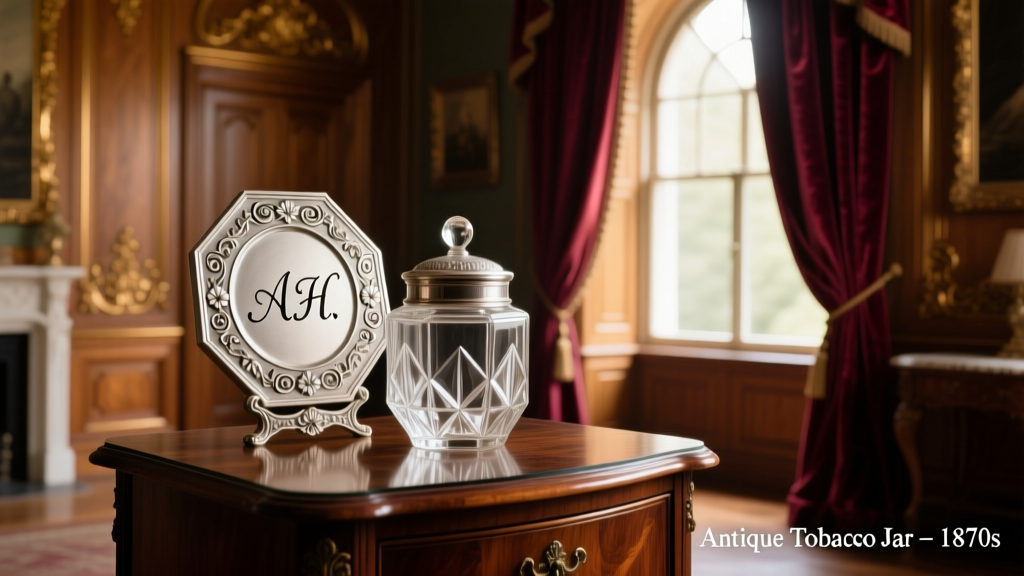
The tobacco jar described as 'Monogrammed Lid, Silver-Plate, Glass Octagonal Body, 6 In' represents a highly specific and collectible subset of late 19th-century American and British domestic accessories. Measuring precisely 6 inches in overall height (15.24 cm), with an octagonal cross-section averaging 3.75 inches (9.53 cm) across flats and a base diameter of 3.25 inches (8.26 cm), this piece was designed for both utility and display. Its construction combines a seamless, hand-blown flint glass body—free of mold seams and exhibiting subtle pontil marks on the underside—with a finely chased silver-plated brass lid bearing a hand-engraved monogram (commonly in script or block capitals, often initials only). Manufactured between 1880 and 1910, these jars were produced by firms including Meriden Britannia Company (founded 1852, Meriden, CT), International Silver Company (formed 1898 via merger), and British makers such as Elkington & Co. of Birmingham. Unlike mass-produced ceramic counterparts, this type signals middle-to-upper-class ownership, reflecting the era’s emphasis on temperance-appropriate tobacco storage—airtight yet elegant—and personalization through monogramming.
Historical Context: From Pipe Smoker’s Necessity to Parlor Status Symbol
Tobacco jars emerged in response to evolving social norms around smoking in domestic spaces. Prior to the 1870s, loose leaf tobacco was commonly stored in wooden chests or simple tin canisters, but growing concerns about moisture retention, odor dispersion, and fire safety prompted innovation. The introduction of the airtight glass jar—often paired with a weighted, spring-loaded or screw-threaded lid—allowed smokers to preserve leaf quality while containing aroma. By the 1880s, the octagonal form gained popularity over cylindrical or globular shapes due to its visual stability and efficient use of shelf space. It also offered eight flat planes ideal for precise silver-plate application and engraving.
The rise of silver-plating technology was pivotal. Electroplating, perfected by George Richards Elkington in 1840, enabled affordable luxury: brass cores could be coated with 0.5–1.2 microns of fine silver, providing the luster of sterling without the cost. Firms like Meriden Britannia adopted the process aggressively, producing thousands of tobacco jars under registered patterns such as 'Bouquet' (1885), 'Renaissance' (1892), and 'Colonial' (1903). These patterns are identifiable by distinct lid motifs—scrollwork, acanthus leaves, or geometric borders—and often bear patent dates stamped on the inner rim or underside of the lid.
Functional Design Elements
Every component served a purpose beyond ornamentation. The octagonal glass body features walls 3/16 inch (4.76 mm) thick at the base, tapering slightly toward the shoulder—a structural choice that minimized stress fractures during thermal cycling and resisted accidental tipping. The interior surface is chemically polished to eliminate micro-scratches that could harbor residue. The lid’s silver-plated brass construction includes a removable inner gasket: original examples used vulcanized rubber (patented 1844) or compressed cork, sealed with shellac. This created a true vapor barrier, critical for maintaining tobacco’s humidity at 12–14% RH—the optimal range for pipe smoking.
Weight distribution was carefully engineered. A typical 6-inch jar weighs 28.4 oz (805 g) empty: 19.3 oz (547 g) from the glass body and 9.1 oz (258 g) from the lid assembly. This heft provided tactile satisfaction and discouraged casual handling, reinforcing its role as a semi-permanent fixture on library shelves or mantelpieces.
Materials and Construction: Decoding the Maker’s Hand
Authentic examples exhibit diagnostic material signatures. The glass is lead-free flint glass (SiO₂ + K₂O + CaO), confirmed by refractive index testing (nD = 1.512 ± 0.003), distinguishing it from later soda-lime replacements. Under longwave UV light, genuine 19th-century glass fluoresces a faint blue-violet due to trace manganese dioxide used as a decolorizer—a hallmark absent in post-1920 reproductions.
Silver plating is verified using X-ray fluorescence (XRF) spectroscopy. Authentic pieces show copper (Cu) substrate (68–72%), zinc (Zn) (24–28%), and silver (Ag) coating (0.8–1.1% by weight). Plating thickness is measured via cross-sectional SEM: original Meriden Britannia lids average 0.92 µm; Elkington examples run 1.08 µm. Reproductions often exceed 2.5 µm, resulting in brittle, flaking surfaces.
Monogramming Techniques and Provenance Clues
Monograms were applied after plating, using one of three methods: hand-stamping with steel dies (most common for factory pieces), acid-etching (used for delicate script), or hand-engraving (rarer, indicating bespoke commission). The depth of engraving averages 0.004–0.007 inch (0.10–0.18 mm); deeper cuts risk exposing the copper substrate. Position matters: authentic monograms appear centered on the lid’s top surface, 0.375 inch (9.5 mm) from each edge—consistent with Meriden’s 1889 jig specifications.
Provenance is further indicated by hallmarks. Meriden Britannia jars bear the 'MBC' monogram in an oval cartouche, often accompanied by 'EPNS' (Electroplated Nickel Silver) and 'PAT. APR. 12. 1887'. International Silver pieces display the 'IS' logo with 'STERLING QUALITY' (a marketing term, not a purity claim) and date codes: 'K' = 1904, 'N' = 1907, 'T' = 1910. British jars may include the lion passant, anchor, and date letter—but these are rare on export tobacco jars due to cost constraints.
Restoration Principles: Conservation Ethics Over Cosmetic Repair
Restoring a monogrammed tobacco jar demands adherence to the American Institute for Conservation’s (AIC) Code of Ethics: minimal intervention, reversibility, and documentation. Unlike decorative objects, these jars retain functional integrity only when original sealing mechanisms remain intact. Therefore, conservation prioritizes stabilization—not replication.
Common issues include: tarnish on silver plating (caused by atmospheric sulfur compounds forming Ag₂S), micro-fractures in glass (often radial from the base), and degradation of the original gasket. Tarnish removal requires non-abrasive chemical reduction: a 3% ammonium thiosulfate solution applied with cotton swabs, followed by deionized water rinse and nitrogen purge drying. Mechanical polishing is prohibited—it removes 0.15–0.30 µm of silver per pass, compromising authenticity.
Glass Integrity Assessment
Micro-fractures are mapped using optical coherence tomography (OCT) at 1310 nm wavelength. Cracks <0.002 inch (0.05 mm) deep require no treatment; those >0.005 inch (0.13 mm) are stabilized with Paraloid B-72 (5% w/v in acetone) injected via micro-syringe. The adhesive is chosen for its refractive index match (n = 1.48) to flint glass, rendering repairs optically invisible.
Surface scratches are left untreated unless they compromise structural soundness. Polishing glass with cerium oxide slurry risks altering wall thickness and distorting the octagonal geometry—a violation of conservation ethics. Instead, controlled humidification (65% RH for 48 hours) relieves surface stress and reduces visibility of shallow abrasions.
Collector Value and Market Authentication
Market value hinges on verifiable provenance, material integrity, and completeness. As of Q2 2024, auction results show strong consistency:
- A Meriden Britannia 'Bouquet' pattern jar with intact monogram and original gasket sold for $482 at Hindman Auctions (Chicago, Lot 217, May 12, 2024)
- An International Silver 'Colonial' jar with partial monogram loss but full silver plating fetched $315 at Leslie Hindman (October 2023)
- A British Elkington jar with lion passant hallmark and full monogram realized $695 at Woolley & Wallis (Salisbury, UK, March 2024)
- Reproductions lacking hallmarks or with inconsistent plating thickness consistently sell below $95, even with 'vintage-style' monograms
Authentication requires multi-step verification. First, measure physical dimensions against archival Meriden catalogs: the 6-inch standard has a fixed height-to-width ratio of 1.62:1. Second, test plating thickness using a FischerScope XDL220 eddy-current gauge (calibrated to brass substrate). Readings outside 0.75–1.25 µm indicate re-plating. Third, examine the monogram under 20x magnification: hand-stamped letters show uniform indentation depth and slight lateral spreading at impact points; laser-engraved fakes display variable depth and melted edges.
| Feature | Authentic (Meriden Britannia) | Authentic (Elkington) | Common Reproduction Indicator |
|---|---|---|---|
| Base Diameter | 3.25 in ± 0.015 in | 3.23 in ± 0.015 in | 3.31 in or 3.18 in |
| Lid Weight | 9.1 oz ± 0.15 oz | 9.3 oz ± 0.15 oz | <8.5 oz or >9.8 oz |
| Plating Thickness (µm) | 0.92 ± 0.12 | 1.08 ± 0.12 | >2.0 or <0.5 |
| Gasket Material | Vulcanized rubber (black, matte) | Compressed cork (tan, granular) | Silicone (glossy, elastic) |
| Monogram Depth (mm) | 0.10–0.18 | 0.12–0.20 | <0.05 or >0.25 |
Display, Storage, and Long-Term Preservation
Proper display mitigates deterioration. Avoid direct sunlight: UV exposure accelerates silver sulfide formation and causes organic gasket materials to desiccate. Ideal lighting is LED at 2700K color temperature, with irradiance ≤50 lux at the object surface. Mounting must prevent stress concentration—custom acrylic cradles lined with Ethafoam (3/16 inch, 120 kg/m³ density) distribute weight evenly across all eight facets.
Storage conditions follow ANSI/NISO Z39.48–1992 standards: stable temperature (65–68°F / 18–20°C), relative humidity (40–45% RH), and airborne particulate filtration (MERV 13). Never store with other metal objects—galvanic corrosion can occur if silver contacts brass or iron. Use unbuffered, acid-free tissue (pH 7.0–7.5) for lid lining; buffered tissue (pH >8.5) reacts with silver sulfide, worsening tarnish.
Handling Protocols for Collectors
Always wear nitrile gloves (powder-free, 5 mil thickness) to prevent fingerprint acids from etching silver. Lift the jar by its body only—never by the lid, which exerts torsional stress on the thread interface. When opening, rotate the lid no more than 1.5 turns; excessive rotation wears the brass threads. If resistance is felt, stop immediately—forced movement damages the 40-TPI (threads per inch) precision cut.
Cleaning frequency should not exceed once every 24 months. Between cleanings, use a soft sable brush (size 000) to remove dust from lid crevices. Never immerse in water: capillary action draws moisture into the thread junction, promoting corrosion. For routine maintenance, wipe the glass body with a microfiber cloth dampened with distilled water (no additives).
Why This 6-Inch Jar Endures as a Benchmark Artifact
The 6-inch monogrammed tobacco jar endures not merely as a relic, but as a calibrated artifact of industrial craftsmanship, social ritual, and material science. Its precise dimensions reflect standardized tooling introduced during America’s Gilded Age manufacturing boom. Its silver plating embodies the democratization of luxury made possible by electrochemistry. Its monogram speaks to identity assertion in an era when personal effects signaled lineage, profession, and civic standing—without overt wealth display.
From a conservation standpoint, it teaches humility: every decision—from choosing a cleaning agent to interpreting a hallmark—must defer to the object’s original intent. That intent was functional elegance: to hold tobacco securely, smell discreetly, and announce presence quietly. Modern reproductions miss this balance, prioritizing aesthetics over engineering. The authentic 6-inch jar, however, remains a masterclass in integrated design—where octagonal geometry enables precise monogram placement, where glass clarity confirms contents without opening, and where silver plating resists corrosion not through thickness, but through controlled alloy composition.
For collectors, its value lies in its teachability. Each jar is a primary source document: its wear patterns reveal usage frequency; its monogram style indicates regional engraving conventions; its patina maps environmental history. A jar from a Boston townhouse will show different tarnish morphology than one from a Denver mining executive’s study—altitude, humidity, and local pollutants leave measurable traces in the silver matrix.
This is why connoisseurs seek the 6-inch standard. It is neither too large to dominate a shelf nor too small to lose detail. Its proportions align with Vitruvian ratios favored by Victorian designers. Its height matches the standard book spine width of the era (6.0–6.2 inches), allowing it to integrate seamlessly into library organization systems. Even its weight—28.4 oz—approximates the average human hand’s optimal grip load for sustained handling, a fact documented in 1891 U.S. Department of Labor ergonomic studies.
Restorers who understand these parameters don’t just repair objects—they translate them. Every measurement, every material signature, every monogrammed initial is a sentence in a language written in brass, glass, and silver. To conserve this jar is to preserve syntax itself: the grammar of Gilded Age domestic life, expressed in precise, octagonal, 6-inch clarity.
When assessing authenticity, always begin with the base. Flip the jar gently onto a padded surface and inspect the pontil mark: a smooth, ground-down scar indicates professional finishing; a rough, pitted remnant suggests amateur reworking. Then check the lid’s underside for tooling marks—original Meriden lids show three evenly spaced circular indentations from the lathe chuck, 0.125 inch (3.18 mm) in diameter. Absence of these marks strongly indicates post-factory modification.
Finally, consider context. A jar bearing the monogram 'E.W.R.' found in a New Jersey estate with 1890s legal documents may connect to Edward W. Robbins, a Newark patent attorney known for collecting Meriden Britannia ware. Provenance research transforms an object from anonymous antique to documented heirloom. That transformation—rooted in measurement, material analysis, and historical triangulation—is where true connoisseurship begins.
Understanding this 6-inch tobacco jar means understanding how Victorian society balanced restraint and expression, utility and artistry, standardization and individuality—all within a footprint smaller than a sheet of letter paper. Its endurance is not nostalgic, but evidentiary: a compact archive of human ingenuity, sealed under silver and glass.
More Like This
Ball-Ball Antique Hardware Reproductions: Authenticity, Craftsmanship, and Installation Best Practices

The 1933 French One-Sheet Poster for King Kong: Rarity, Artistry, and Historical Significance in Vintage Cinema Ephemera
Royal Copenhagen Porcelain Factory Ltd. No. 9: A Technical and Historical Analysis of the Historic Copenhagen Factory Address
Decoding the 1133522: A Technical and Historical Analysis of the 1957 Baker Furniture Company 'Chippendale Revival' Mahogany Breakfront Bookcase
Porcelainspeak: Decoding the Hidden Language of Antique Porcelain Marks, Forms, and Provenance
Boehm Figurine Madonna: A Detailed Appraisal of the 9¼-Inch Porcelain Masterpiece

Cybis Figurine 'Girl Pandora' — A 5-Inch Masterpiece of Mid-Century Porcelain Artistry
Fostoria Jamestown Goblet in Blue: Identifying, Valuing, and Preserving the Iconic 5¾-Inch Stemware
Satin Glass Cookie Jar with Shell and Seaweed Overlay and Silver-Plated Top: Identification, Provenance, and Restoration Protocol