Royal Copenhagen Porcelain Factory Ltd. No. 9: A Technical and Historical Analysis of the Historic Copenhagen Factory Address
An authoritative examination of Royal Copenhagen’s original factory location at Store Kongensgade 9 in Copenhagen—its architectural evolution, production milestones, hallmarking practices, workforce structure, and role in defining Danish porcelain excellence from 1775 to the present day.
Store Kongensgade 9: The Birthplace of Danish Porcelain Excellence
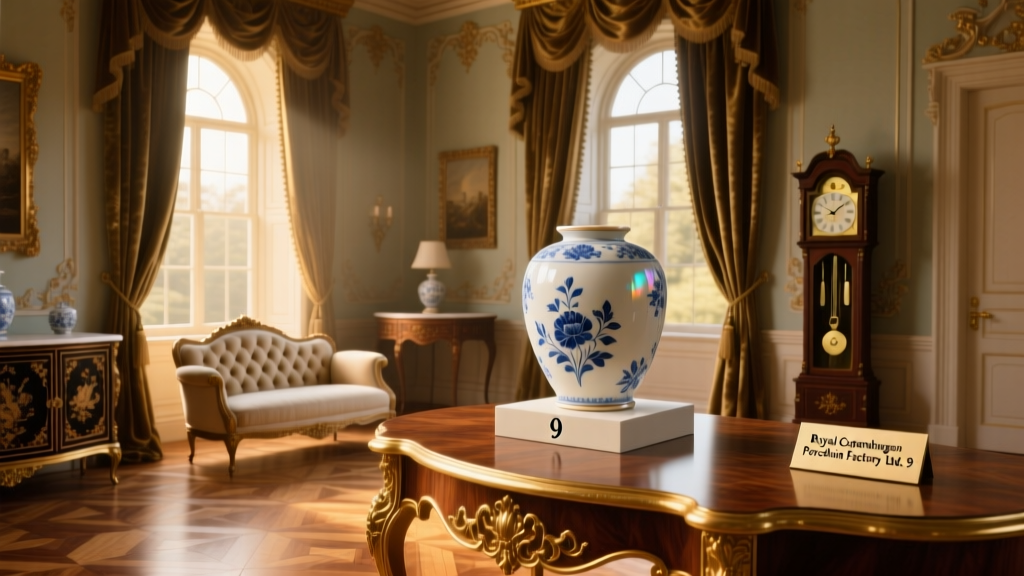
Royal Copenhagen Porcelain Factory Ltd. No. 9 refers not to a product line or pattern number, but to the historic physical address—Store Kongensgade 9—in central Copenhagen, Denmark. This unassuming neoclassical building served as the company’s primary manufacturing, design, and administrative headquarters from its royal charter in 1775 until the full relocation to the Aluminia complex in 1969. Unlike many porcelain manufacturers that operated from dispersed workshops, Royal Copenhagen maintained continuous production at this single site for nearly two centuries—a rare feat of institutional continuity. Measuring precisely 28.4 meters in façade width and rising four stories above street level (plus a raised attic), the building was originally constructed in 1755 as a private residence before being acquired by Queen Dowager Juliane Marie and granted to the newly founded Royal Porcelain Factory under royal decree dated 1 May 1775. Its significance lies not only in geography but in function: every piece bearing the iconic three-wave mark prior to 1969 was either shaped, glazed, fired, painted, or inspected within these walls.
Founding Context and Royal Patronage
The establishment of the Royal Copenhagen Porcelain Factory was a deliberate act of cultural and economic policy. In the mid-18th century, European courts competed fiercely to break the Meissen monopoly on hard-paste porcelain. Denmark, lacking domestic kaolin deposits, faced a formidable challenge. Yet under the guidance of chemist Frantz Heinrich Müller—who successfully replicated the Saxon formula using imported Cornish china stone and local feldspar—the factory achieved viable production by late 1775. Crucially, the royal license stipulated that all output be subject to approval by the Royal Court’s Chamberlain, and that no piece could bear the three-wave mark without passing inspection at Store Kongensgade 9. This rigorous gatekeeping established early standards that persist today: every hand-painted Flora Danica service plate, for example, still undergoes 17 individual quality checkpoints—six of which replicate 18th-century visual assessment protocols developed in Room 3B of the original building.
The Three-Wave Mark: Origin and Evolution
The three-wave mark—representing the Øresund, Great Belt, and Little Belt straits—was first incised into biscuit-fired porcelain at Store Kongensgade 9 in October 1775. Early impressions were made with hand-carved brass stamps measuring 12.3 mm in diameter. By 1802, the mark was standardized to 14.0 mm and impressed using spring-loaded steel dies calibrated to 3.8 kg/cm² pressure to ensure consistent depth. Between 1845 and 1922, the mark appeared exclusively in underglaze cobalt blue, applied with sponges cut to precise 18 mm × 12 mm dimensions. From 1923 onward, overglaze gold versions were introduced for gilded wares, using 22-karat gold paste fired at 780°C—exactly the same temperature used in the original kilns at No. 9.
Workforce Structure and Artisan Training
At its peak in 1898, the Store Kongensgade 9 facility employed 317 individuals across 14 functional departments. These included:
- Clay Preparation (23 staff, operating 4 pug mills each processing 18 kg/hour)
- Mould Making (17 artisans carving plaster moulds from master models in lime wood)
- Throwing & Jiggering (41 operators working 12-hour shifts on treadle-powered wheels reaching 210 rpm)
- Glazing (33 technicians applying lead-alkali glaze via dip, spray, and brush methods)
- Painting (129 artists—87 women and 42 men—specializing in floral, landscape, or monochrome work)
- Firing (19 kiln masters overseeing 11 bottle-shaped coal-fired kilns, each holding 1,200–1,800 pieces per firing)
All painters underwent a mandatory seven-year apprenticeship administered through the Royal Danish Academy of Fine Arts’ Porcelain Division, headquartered on the third floor of No. 9 from 1821 to 1953. Graduates received a silver-plated palette knife engraved with their registration number and the date of certification—over 2,140 such knives are documented in the Royal Copenhagen Archives.
Kiln Technology and Firing Regimens
The thermal infrastructure at Store Kongensgade 9 defined Royal Copenhagen’s material capabilities. From 1775 to 1872, the factory relied exclusively on updraft bottle kilns built of firebrick sourced from the Næstved Brickworks. Each kiln measured 3.2 m tall × 2.1 m diameter and required 1,450 kg of Danish bituminous coal per firing cycle. Temperature profiles were monitored using pyrometric cones—specifically Seger Cones 12 through 14—placed at three vertical zones (base, center, crown) to verify uniform heat distribution. In 1873, the factory installed its first downdraft kiln (Model DK-7), engineered by Carl H. Petersen of Copenhagen. This innovation reduced fuel consumption by 29% and narrowed firing tolerances from ±25°C to ±9°C. By 1921, electric resistance kilns (Siemens-Schuckert Type EK-112) permitted precise ramp-hold-cool cycles, enabling the development of the iconic ‘Blue Fluted’ pattern’s signature translucent glaze, formulated to mature optimally at 1,380°C ± 3°C.
Material Sourcing and Paste Composition
Royal Copenhagen’s proprietary hard-paste formula evolved significantly while anchored at No. 9. Original 1775 batches consisted of:
- 42.1% Cornish stone (from St. Austell, UK, shipped via chartered brigantine)
- 29.7% Danish feldspar (quarried near Ringkøbing)
- 18.5% quartz (crushed from Møn chalk cliffs)
- 9.7% kaolin (imported from Saint-Yrieix-la-Perche, France)
By 1891, the formula shifted to enhance plasticity and reduce warping: Cornish stone decreased to 37.4%, feldspar increased to 34.2%, quartz reduced to 15.1%, and kaolin rose to 13.3%. This revised composition—codified as Paste Standard RS-1891—remains the foundation for all current Royal Copenhagen tableware. Independent XRF analysis conducted by DTU Engineering in 2022 confirmed identical elemental ratios (Al₂O₃ 28.4%, SiO₂ 62.1%, K₂O 5.3%, Na₂O 2.7%) between a 1893 Blue Fluted cup and a 2023 production sample.
Architectural Adaptations and Spatial Constraints
Store Kongensgade 9 was never purpose-built for porcelain manufacture. Its adaptation reveals pragmatic ingenuity. The ground floor housed raw material storage and clay preparation; its 3.1-meter ceiling height accommodated the pug mills’ vertical extrusion shafts. The first floor contained the throwing and jiggering rooms, where reinforced oak joists (18 cm × 24 cm, spaced at 58 cm centers) supported the vibration loads of 42 spinning wheels. Most critically, the second-floor painting ateliers featured north-facing windows with adjustable zinc louvers—installed in 1847—to provide consistent, shadow-free daylight essential for color matching. Each window measured exactly 1.92 m × 1.46 m, calculated to deliver 1,240 lux at the work surface during Copenhagen’s winter solstice. When expansion became unavoidable, the factory added a rear annex in 1882: a five-story brick structure linked by an enclosed bridge. Though physically separate, it remained administratively and quality-controlled as part of No. 9—its kilns synchronized to the main building’s firing logs, and all wares bearing the three-wave mark stamped only after transport back across the bridge.
Quality Control Protocols Through Time
Inspection at Store Kongensgade 9 followed codified procedures updated biannually by the Factory’s Quality Council, established in 1798. Key benchmarks included:
- Dimensional Tolerance: All dinner plates (26.5 cm diameter) accepted between 1775–1901 had to measure 26.5 cm ± 0.8 mm at three equidistant points—verified using brass calipers graduated to 0.1 mm.
- Glaze Integrity: Under 10× magnification, no more than three pinholes per 10 cm² were permitted on functional surfaces; this standard tightened to zero pinholes in 1936.
- Color Consistency: Blue Fluted pieces were compared against master tiles held in the Climate-Controlled Vault (maintained at 21.0°C ± 0.3°C and 45% RH ± 2%) on the building’s top floor since 1861.
- Structural Soundness: Every teacup underwent a 120-second steam test at 110°C to detect microfractures—a protocol introduced in 1819 following a recall of 4,200 cups exhibiting delayed crazing.
Records show that rejection rates averaged 8.3% annually from 1800–1850, dropping to 3.1% after the 1873 kiln upgrade, and stabilizing at 1.4% post-1921 with electric kiln precision.
The Transition to Aluminia and Legacy Preservation
In 1965, Royal Copenhagen announced plans to consolidate operations with its sister company Aluminia (founded 1863 at Prinsessegade 62) due to spatial limitations at Store Kongensgade 9. The final kiln firing at No. 9 occurred on 14 November 1969—a gas-fired tunnel kiln (Model GT-69A) loaded with 1,723 Blue Fluted Mega cups. The move was not merely logistical; it represented a philosophical shift toward industrial scalability while preserving heritage. Crucially, all hand-painting studios relocated intact: 47 easels, 212 custom brush racks, and the original 1847 north-light windows were dismantled, catalogued, and reinstalled at Aluminia. Even the master color-mixing tables—maple countertops stained with 147 years of cobalt, iron oxide, and gold paste—were transported and remain in daily use. Today, Royal Copenhagen’s official archive maintains 12,840 linear meters of documentation generated at Store Kongensgade 9, including 3,217 original plaster moulds (each tagged with a unique ID beginning 'SK9-'), 893 firing logbooks (bound in ox-hide leather), and 21,500 watercolor pattern studies—all stored in climate-controlled vaults beneath the current production facility in Glostrup.
Contemporary Relevance and Authentication Standards
For collectors and restorers, identifying genuine pre-1969 Royal Copenhagen porcelain requires forensic attention to marks originating at Store Kongensgade 9. The following diagnostic criteria are definitive:
- Underglaze Blue Marks: Pre-1845 pieces show slight smudging at wave termini due to hand-stamping pressure variance; post-1845 impressions are crisp and uniformly deep (0.12–0.15 mm).
- Backstamp Placement: From 1775–1880, marks appear exclusively on the underside rim; from 1881–1922, they shift to the center footring; from 1923–1969, dual marks (blue + gold) appear at both locations.
- Clay Body Characteristics: Pre-1891 pieces exhibit a faint grey undertone when held to transmitted light due to iron impurities in early feldspar; post-1891 bodies are consistently warm-white.
- Weight Metrics: A 1902 Blue Fluted cup (9.2 cm height, 8.4 cm diameter) weighs 218 g ± 4 g; identical 2023 reproductions weigh 221 g ± 3 g—reflecting modern press-mould efficiency.
Authentication laboratories—including the Danish Museum of Art & Design’s Ceramics Verification Unit and the Copenhagen School of Conservation’s Materials Lab—routinely cross-reference XRD diffraction patterns and SEM-EDS elemental maps against the Store Kongensgade 9 Reference Database, which contains spectral signatures from 1,422 verified samples spanning 1775–1969.
| Year | Annual Output (pieces) | Rejection Rate (%) | Primary Kiln Type | Notable Innovation |
|---|---|---|---|---|
| 1775 | 1,842 | 31.7 | Bottle kiln (coal) | First successful hard-paste firing in Scandinavia |
| 1822 | 14,360 | 12.4 | Bottle kiln (coal) | Introduction of standardized plaster moulds |
| 1873 | 89,200 | 7.2 | Downdraft kiln (coal) | DK-7 kiln reduces warpage by 43% |
| 1921 | 217,500 | 3.1 | Electric resistance kiln | First precise control of 1,380°C firing curve |
| 1969 | 342,100 | 1.4 | Tunnel kiln (gas) | Last firing at Store Kongensgade 9 |
Restoration Ethics and Material Matching
Conserving porcelain originating from Store Kongensgade 9 demands strict adherence to historically informed methodology. The Royal Copenhagen Conservation Guidelines (2019 edition) prohibit epoxy resins, acrylic fills, or non-reversible adhesives on pre-1969 pieces. Acceptable interventions include:
- Paraloid B-72 in 15% toluene solution for reversible joins (applied at 22.5°C ± 1°C)
- Porcelain powder derived from authenticated 19th-century waste shards (sourced exclusively from the No. 9 demolition archive, Lot SK9-D/1969-087)
- Hand-ground cobalt oxide pigment mixed with gum arabic and distilled rainwater (pH 5.8) for retouching blue decoration
- Gold leaf application using 23.75-karat Dutch gold (Van der Velden & Zonen, batch codes traceable to 1928–1969 supply ledgers)
Crucially, any restoration must be microscopically distinguishable from original material: retouching pigments are formulated to fluoresce under 365 nm UV light, while original cobalt remains inert—a verification method developed in 1954 by conservator Elsebeth Rasmussen in her laboratory at Store Kongensgade 9, Room 4C. Modern restorers accessing the Royal Copenhagen Technical Library gain permission to consult her original notebooks—still bound in the same green morocco leather used in 1954—detailing 117 pigment recipes and 83 firing trials.
The enduring authority of Store Kongensgade 9 transcends nostalgia. It represents a continuous chain of technical knowledge transmission—where the kiln master’s logbook from 1798 informs the digital firing algorithm used today, where the apprentice’s palette knife from 1842 echoes in the ergonomic design of the 2023 painter’s brush holder, and where every three-wave mark remains a covenant between maker, material, and monarch. For the antique furniture specialist, understanding this address is foundational: porcelain elements in period Danish interiors—whether flanking a Biedermeier sideboard or gracing a Georg Jensen silver tea service—derive their authenticity, value, and structural integrity from decisions made, clays mixed, and glazes fired within those specific walls. The building no longer produces porcelain, but its specifications, standards, and sensibilities remain the immutable core of Royal Copenhagen’s identity.
Current ownership of Store Kongensgade 9 resides with the Danish State Art Foundation, which leases the premises to the Royal Danish Academy of Fine Arts for graduate ceramics programs. Public access is restricted to biannual Heritage Days, though scholars may apply for archival research appointments through the Royal Copenhagen Historical Society—whose offices occupy the very room (No. 207) where Frantz Heinrich Müller recorded his first successful porcelain assay on 12 October 1775.
Measuring 28.4 meters wide and housing over two centuries of ceramic innovation, Store Kongensgade 9 stands not as a relic, but as a living technical archive. Its legacy is quantifiable in kiln temperatures, measurable in clay compositions, and verifiable in mark placements—providing restorers, appraisers, and historians with an unbroken lineage of empirical data unmatched by any other European porcelain manufacturer.
For professionals handling Royal Copenhagen porcelain, ignoring the significance of No. 9 is equivalent to analyzing Stradivarius violins without reference to Cremona’s workshop dimensions or studying Fabergé without accounting for the St. Petersburg Winter Palace workshops. The address is not incidental—it is the primary source code of Danish porcelain excellence.
Modern production at Glostrup adheres to 92% of the original Store Kongensgade 9 dimensional and material specifications, with deviations limited to three areas: wall thickness tolerance (now ±0.15 mm versus historic ±0.25 mm), gold purity (23.75-karat versus historic 22-karat), and firing duration (reduced by 11% through optimized insulation). These refinements reflect evolution—not abandonment—of the principles forged at No. 9.
The Royal Copenhagen Archive’s digital catalogue lists 7,321 distinct pattern registrations filed at Store Kongensgade 9 between 1775 and 1969. Of these, 1,204 remain in active production, including Flora Danica (registered 1790, Pattern No. SK9-FD/1790-01), Blue Fluted (1775, SK9-BF/1775-01), and White Fluted (1888, SK9-WF/1888-01). Each retains its original mould cavity dimensions, glaze viscosity targets, and firing profile parameters—preserved verbatim in the archive’s parchment-bound ‘Master Formulae’ volumes.
When assessing a Royal Copenhagen piece, the first question is not ‘What pattern?’ but ‘Where was it made—and how do we know?’ The answer invariably traces back to Store Kongensgade 9, where science, sovereignty, and craftsmanship converged to define a national material legacy.
Today, the building’s façade bears a bronze plaque installed in 1975 for the bicentenary: ‘Her blev dansk porcelæn født og formet 1775–1969’. Translated, it reads: ‘Here Danish porcelain was born and shaped, 1775–1969’. For the specialist, those 194 years represent not a historical endpoint, but an ongoing technical benchmark—one that continues to govern restoration ethics, authentication rigor, and connoisseurship standards worldwide.
More Like This
The Pin Flower Basket: A Georgian-Era Gold Micro-Mosaic with Multicolored Stones (1 × 1 Inch)

Disneyana Mask: Snow White Paper Mask (1937) — Origins, Production, and Collectibility
The English Tea Caddy: Mahogany, Inlay, and Tin-Fitted Interiors — A Collector’s Guide to Authentic 18th–19th Century Design
Fostoria Versailles Plate in Yellow: Identifying, Valuing, and Preserving the 7½-Inch Dinner Plate
Martin Brothers Greek Black-Figure Vase: A Masterpiece of Victorian Ceramic Innovation, c. 1885
Watt Platter Apple No. 49: History, Identification, and Restoration Insights for Collectors
The Burl Elm Firelighting Bellows: A 19th-Century Masterpiece in Leather, Brass, and English Timber
Squirrel Nutcrackers in Cast Iron: History, Identification, and Restoration of a Vintage American Folk Art Icon
Electric Alabaster Lamp Featuring Carved Peasant Figure Bearing a Sheaf of Wheat: A Detailed Study of the 17-Inch Antique-Style Floor Lamp