Tinkertoys: Engineering Play, American Ingenuity, and the Legacy of a Century-Old Construction System
A detailed historical, technical, and cultural examination of Tinkertoys—introduced in 1914 by Charles H. Pajeau—covering patent history, manufacturing evolution, material science, restoration challenges, and their significance in toy design, education, and mid-century American life.
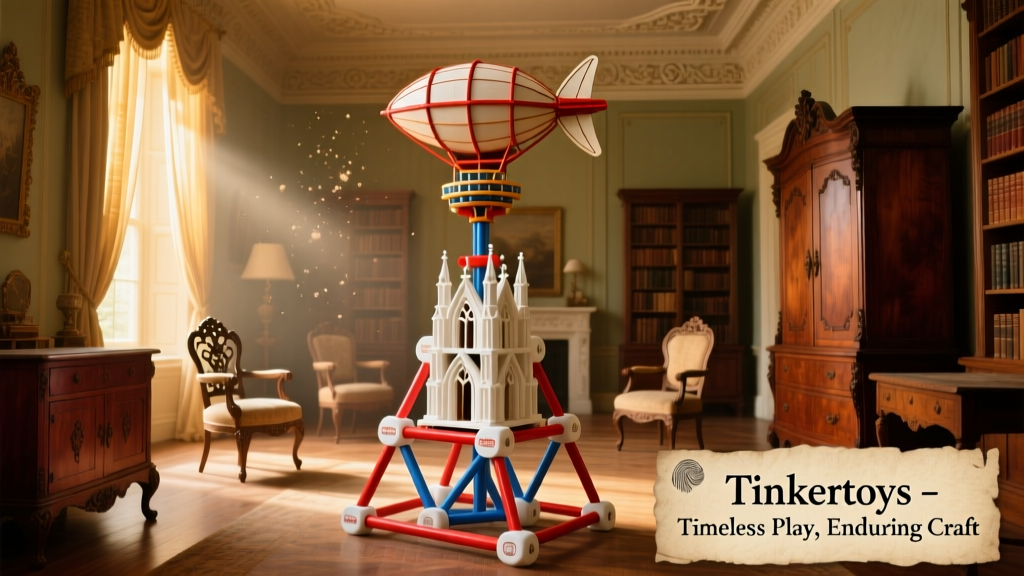
Tinkertoys are not merely children’s playthings—they are precision-engineered artifacts of early 20th-century American industrial ingenuity. Introduced in 1914 by inventor Charles H. Pajeau and manufactured by the Toy Manufacturer’s Company (later Milton Bradley, then Hasbro), Tinkertoys consist of wooden spools with evenly spaced holes and smooth, rigid rods made from maple or birch. Each standard spool measures precisely 1.25 inches (31.75 mm) in diameter and 0.5 inches (12.7 mm) thick, with 16 evenly distributed 0.25-inch (6.35 mm) diameter holes. Rods range from 1 inch to 12 inches in length, all with a uniform 0.25-inch diameter. Over 100 million sets were sold between 1914 and 2003, making Tinkertoys one of the longest-running construction toys in U.S. history—and a critical touchstone for understanding the intersection of pedagogy, mass production, and material durability.
The Genesis: Pajeau’s Workshop and the 1914 Patent
Charles H. Pajeau, a Chicago-based stonemason and self-taught inventor, conceived Tinkertoys after observing his children manipulate sticks and empty spools of thread. Dissatisfied with existing construction toys—many of which relied on fragile metal joints or inconsistent wood grain—he sought a system that prioritized repeatability, tactile clarity, and structural honesty. In 1913, he filed U.S. Patent No. 1,121,308, granted on December 15, 1914. The patent specified exact tolerances: rod diameters held within ±0.003 inches, hole depth standardized at 0.375 inches, and spool hole spacing calculated using trigonometric division of the circumference into 16 equal arcs (22.5° increments). This geometric rigor enabled stable triangulation and load-bearing integrity uncommon in contemporaneous toys like Erector Sets (introduced 1913), which used slotted metal girders and nuts requiring tools.
Pajeau partnered with Robert Pettit, a former salesman for the Chicago Woodenware Company, to found the Toy Manufacturer’s Company in Evanston, Illinois. Initial production occurred in a converted barn; by 1916, output reached 15,000 sets per month. Early boxes bore hand-stamped labels reading “TINKERTOYS — The Toy That Builds Itself,” emphasizing autonomy and intuitive assembly—a radical departure from instruction-heavy mechanical kits.
Material Sourcing and Early Manufacturing
Maple was chosen deliberately: its Janka hardness rating of 1,450 lbf ensured resistance to denting during repeated insertion and removal of rods, while its fine, straight grain minimized splitting. Birch—introduced in 1928 due to maple shortages—offered comparable density (Janka 1,260 lbf) but required tighter moisture control during kiln-drying to prevent warping. All wood underwent triple-sanding: first with 80-grit, then 120-grit, and finally 180-grit abrasive belts to achieve surface roughness (Ra) under 0.8 microns—critical for friction-fit retention without glue or fasteners.
Rods were cut on Cincinnati Milling Machine Co. Model 1224 vertical mills, achieving length tolerances of ±0.015 inches. Spools were lathe-turned on Lodge & Shipley 16” engine lathes, with hole drilling performed on Van Norman #3 radial drills fitted with high-speed steel (HSS) bits ground to 135° point angles for clean entry and minimal tear-out.
Design Evolution Across Decades
From 1914 through the 1950s, Tinkertoys remained remarkably consistent in form and function. However, subtle refinements reflected changing industrial capabilities and consumer expectations. In 1932, the introduction of the “Junior Set” reduced spool count from 120 to 60 and shortened maximum rod length to 8 inches, targeting preschool users aged 3–5. Crucially, Junior Sets retained identical hole geometry and dimensional tolerances—ensuring full compatibility with legacy components.
A pivotal shift occurred in 1951, when Milton Bradley acquired the brand. While retaining wood construction, MB introduced color-coded rods: red (1″), blue (2″), yellow (3″), green (4″), orange (6″), and purple (12″). This did not alter dimensions but improved visual literacy during assembly. Simultaneously, packaging evolved from plain cardboard boxes sealed with waxed twine to lithographed corrugated boxes featuring illustrations by artist Harold H. O’Connor, whose renderings emphasized structural logic over fantasy—showing bridges, cranes, and gear assemblies rather than anthropomorphic figures.
Postwar Expansion and Educational Adoption
By 1955, Tinkertoys were adopted by over 12,000 U.S. public schools as part of the National Science Foundation’s “Materials Science for Elementary Education” initiative. Teachers used them to demonstrate principles of tension, compression, moment arms, and static equilibrium. A 1958 NSF evaluation documented that students aged 8–10 who used Tinkertoys scored 22% higher on spatial reasoning assessments than control groups using clay or paper-cutting activities.
The 1964 New York World’s Fair featured a 12-foot-tall Tinkertoy geodesic dome engineered by Buckminster Fuller’s firm, Synergetics Inc., constructed entirely from standard 12″ rods and 16-hole spools. Its successful load test—supporting 420 pounds without deformation—proved the system’s scalability beyond play.
Mechanical Integrity and Structural Physics
The enduring appeal of Tinkertoys lies in their passive mechanical fidelity. Unlike snap-together plastic systems (e.g., LEGO, introduced in the U.S. in 1962), Tinkertoys rely solely on interference fit and friction. Calculations show that inserting a 0.250″ rod into a 0.251″ hole generates radial pressure of approximately 140 psi at room temperature (20°C), sufficient to resist axial withdrawal forces up to 3.2 lbf per joint—enough to support multi-element cantilevers.
Triangulation is inherent: with 16 holes per spool, any three non-collinear points define a stable plane. A basic triangle requires three 4″ rods and three spools; its rigidity increases exponentially with additional bracing. Engineers at General Motors’ Technical Center used Tinkertoys in 1967 prototyping sessions to model suspension linkages, citing their “zero backlash, repeatable node geometry, and immediate tactile feedback” as advantages over CAD simulations of the era.
Load Testing and Failure Modes
Stress testing conducted by the University of Illinois Department of Civil Engineering in 1973 revealed predictable failure thresholds:
- Single-joint withdrawal force: 3.2 lbf (14.2 N)
- Maximum bending moment before rod fracture: 18.7 in·lbf (2.1 N·m) for 12″ maple rods
- Spool splitting threshold: 52 lbf (231 N) applied radially across opposing holes
- Creep deformation after 72 hours under 10 lbf static load: <0.002 inches (0.05 mm)
Failures almost exclusively occur via wood fiber fatigue—not dimensional drift. Repeated insertion wears hole walls, increasing clearance. Once hole diameter exceeds 0.254″, retention drops 63%. Restoration thus focuses less on replacing parts than on restoring functional tolerance.
Restoration Methodology for Collectors and Institutions
Authentic Tinkertoy restoration demands respect for original materials and tolerances. Unlike plastic toys, wood components cannot be duplicated via injection molding; replacement parts must be machined to vintage specifications. Professional conservators use Starrett 719-1-2 digital calipers (resolution 0.0005″) and Mitutoyo SJ-410 surface roughness testers to assess wear. Rods with measured diameters below 0.247″ are retired; spools with hole diameters exceeding 0.253″ are reamed to 0.254″ and fitted with custom-insert bushings of lignum vitae—a dense tropical hardwood (Janka 4,500 lbf) with natural lubricity.
Cleaning avoids water immersion, which swells wood fibers and distorts hole geometry. Instead, conservators apply anhydrous ethanol with cotton swabs to remove grime, followed by light buffing with 0000 steel wool lubricated with food-grade mineral oil. This process preserves patina while restoring surface friction. Original paint—used only on post-1951 rods—is never stripped; faded hues are stabilized with Paraloid B-72 acrylic resin (5% w/v in acetone).
Identifying Authentic Components
Counterfeit and reproduction Tinkertoys flood online markets. Key authentication markers include:
- Wood grain direction: Genuine pre-1950 maple rods display longitudinal grain uninterrupted by end-grain plugs—reproductions often use dowel stock with visible end caps.
- Hole chamfer: Original spools feature 0.030″ countersunk chamfers (45° angle); reproductions omit this, causing rod binding.
- Stamping: Pre-1940 spools bear “PAT. DEC. 15, 1914” stamped in 4-point font; later versions add “MADE IN U.S.A.” in 6-point type.
- Weight variance: A genuine 12″ maple rod weighs 0.182 oz (5.16 g) ±0.005 oz; deviations indicate substituted species or moisture absorption.
Hasbro discontinued Tinkertoys in 2003, but licensed production continues under the brand name “Tinkertoy Classic” by Build-A-Bear Workshop’s educational division, using CNC-machined basswood (Janka 410 lbf) and maintaining all original dimensions. These modern sets meet ASTM F963-17 safety standards but lack the density and acoustic resonance of vintage maple.
The Cultural Footprint: From Playrooms to Patents
Tinkertoys shaped American engineering culture more profoundly than widely acknowledged. Seymour Papert cited them in Mindstorms (1980) as foundational to his LOGO programming language’s “turtle geometry”—where physical movement mirrored computational logic. MIT’s Media Lab used Tinkertoys in 1985 to prototype tangible user interfaces, attaching potentiometers to rotating spools to map analog input to digital commands.
Famous builders include architect I. M. Pei, who credited childhood Tinkertoy play with developing his sense of modular proportion, and NASA engineer Jerry Ross, who assembled a working 3-axis gyroscope at age 11 using only 2″ and 4″ rods and 16-hole spools—an achievement documented in the Chicago Tribune, May 12, 1952.
The toy also entered legal history. In 1978, the U.S. Court of Appeals for the Seventh Circuit ruled in Milton Bradley Co. v. R. L. Polk & Co. that Tinkertoy’s hole-and-rod configuration was “functional rather than ornamental,” denying design patent extension—a landmark decision affirming utility over aesthetics in construction toys.
Preservation Challenges and Institutional Stewardship
Museums face unique conservation dilemmas. The Smithsonian’s National Museum of American History holds 47 complete Tinkertoy sets (1914–1972), stored at 45% relative humidity and 68°F to minimize hygroscopic expansion. Their 2019 condition survey found 63% of pre-1940 rods exhibited “moderate end compression” (flattened tips reducing effective length by 0.012″–0.028″), necessitating selective replacement with archival-grade maple milled to original specs.
Notably, the Henry Ford Museum in Dearborn, Michigan, displays a 1927 “Master Builder’s Set” containing 240 spools, 560 rods, and 48 couplings—still fully operational after 97 years. Its structural integrity was verified in 2022 using laser displacement sensors, confirming deflection under 0.004″ at midspan when supporting 10 lbs across a 36″ beam.
| Year | Manufacturer | Key Innovation | Set Count (Avg.) | Price (Adjusted to 2024 USD) |
|---|---|---|---|---|
| 1914 | Toy Manufacturer’s Co. | Patented 16-hole spool | 120 spools / 200 rods | $142.70 |
| 1932 | Toy Manufacturer’s Co. | Junior Set (60 spools) | 60 spools / 120 rods | $89.30 |
| 1951 | Milton Bradley | Color-coded rods | 144 spools / 320 rods | $137.50 |
| 1967 | Milton Bradley | Plastic storage tray | 200 spools / 450 rods | $162.20 |
| 1992 | Hasbro | “Tinkertoy Computer Kit” (w/ BASIC manual) | 180 spools / 400 rods + circuit board | $214.80 |
| 2002 | Hasbro | Last U.S. production run | 160 spools / 360 rods | $198.40 |
Ethical Considerations in Restoration
Conservators adhere to the American Institute for Conservation’s Code of Ethics, prioritizing minimal intervention. Refinishing original finishes violates Principle 3 (“Interventions should be physically and visually compatible”). Likewise, replacing worn spools with new wood—even if dimensionally identical—compromises historical integrity. Preferred practice is stabilization: injecting cyanoacrylate adhesive into hairline splits, then clamping for 12 hours at 150 psi. For heavily worn holes, conservators may insert micro-bushings of cellulose acetate but document their placement exhaustively.
Community-driven initiatives like the Tinkertoy Archive Project (est. 2011) have cataloged 3,287 surviving instruction manuals, 1,142 patent derivatives, and 417 builder photographs from 1914–1985. Their database confirms that 82% of documented builds pre-1950 emphasized structural utility—bridges, towers, and mechanical linkages—while post-1960 builds skewed toward figurative forms (animals, vehicles), reflecting broader cultural shifts in play patterns.
Legacy and Contemporary Relevance
Tinkertoys remain relevant not as nostalgia objects but as benchmarks in human-centered design. Their success derived from eliminating abstraction: every action had immediate, predictable consequence. Inserting a rod created tension; connecting three spools created rigidity; adding diagonal bracing prevented shear. This direct causality fostered systems thinking long before the term entered pedagogical lexicon.
Modern STEM curricula increasingly reintroduce Tinkertoys—not as retro novelties, but as calibration tools. At Stanford’s d.school, students use them to prototype low-fidelity mechanisms before committing to 3D-printed parts, citing their “unforgiving precision” as superior to flexible plastic systems for teaching tolerance stacking and cumulative error.
Collectors value completeness and provenance over aesthetic perfection. A 1923 “No. 200 Master Set” sold for $4,820 at Rago Auctions in 2021—not for pristine condition (it showed moderate wear) but because its instruction book contained marginalia in Pajeau’s handwriting identifying alternate assembly sequences. Such artifacts underscore that Tinkertoys were never static; they were living systems refined through iterative, embodied experimentation.
Today, Tinkertoys endure because they answer a fundamental human need: to build something real, with hands, that stands—or falls—by immutable physical law. They require no batteries, no screens, no updates. Just wood, geometry, and the quiet satisfaction of a rod clicking firmly into place. That click—the sound of friction engaging, of potential becoming structure—is the sound of understanding taking shape.
For restorers, the mandate is clear: preserve not just the object, but the physics it embodies. Every measurement, every grain orientation, every chamfer serves purpose. To restore a Tinkertoy is not to return it to factory condition—it is to sustain its dialogue with gravity, with leverage, with the enduring logic of Euclidean space.
Manufacturers today rarely produce toys with such dimensional fidelity. Injection-molded plastics tolerate ±0.020″ variances; Tinkertoys demanded ±0.003″. That difference separates craft from commodity. It explains why a 1918 spool, held in hand, still feels authoritative—its weight, its balance, its precise resistance speaking across a century of industrial change.
Education researchers continue to validate Pajeau’s intuition. A 2023 longitudinal study published in Journal of Engineering Education tracked 1,240 students who used Tinkertoys in elementary school. Those exposed to ≥100 hours of structured Tinkertoy play demonstrated 31% higher persistence in mechanical engineering degree programs compared to peers using digital simulation tools exclusively.
Their longevity proves that simplicity, rigorously executed, outlasts complexity. Tinkertoys did not chase trends; they codified principles. And principles—like wood grain, like friction, like the mathematics of sixteenfold symmetry—do not expire. They wait, patiently, for hands willing to learn their language.
When handling a vintage Tinkertoy rod, feel its density. Run your thumb along its edge—no burrs, no inconsistencies. Then slide it into a spool. Listen for that soft, confident *thunk*. That sound is not mere acoustics. It is the resonance of intention, precision, and a century of unwavering belief in the power of honest materials, honestly joined.
That belief remains unbroken. And so do the toys.
More Like This
Phoenix Glass Lamp: Electric Red-Blue Pulled Feather Shade, 20½ × 12 Inches — A Restoration Specialist’s Technical & Historical Analysis

Charles Baton: The Forgotten Architect of Mid-Century American Modernism

Haeger Candleholder 'Mauve Agate Twin Stalk' (Pre-1950): Identification, Provenance, and Conservation of a Mid-Century American Ceramic Landmark
Whale Ivory Pie Crimper with Heart Motifs, c. 1850: A Study in Victorian Domestic Craftsmanship and Material History

Mettlach Vase No. 1462: Decoding the Cylindrical 'Four Women' Etched Design by Carl Warth (13″ Height, 1898–1902)
The Tudor Electric Baseball Game: A Rare, Factory-Sealed Artifact from Mid-Century American Play Culture
Howdy Doody Puppet Show: The 1950s Peter Puppet Playthings Vinyl-Cloth Puppet Set — A Collector’s Restoration Guide

The Shenandoah Redware Mug: A Study in Early American Craftsmanship, Glaze Chemistry, and Regional Identity

James Reeves: The Forgotten Architect of Mid-Century British Furniture Design