Tin Litho Toys: Craft, Collectibility, and Conservation of America’s Mechanical Marvels
An authoritative examination of tin lithographed toys—manufactured primarily between 1890 and 1955—covering their lithographic process, iconic manufacturers like Dinky Toys and Buddy L, mechanical ingenuity, market valuation, and ethical conservation practices for collectors and museums.
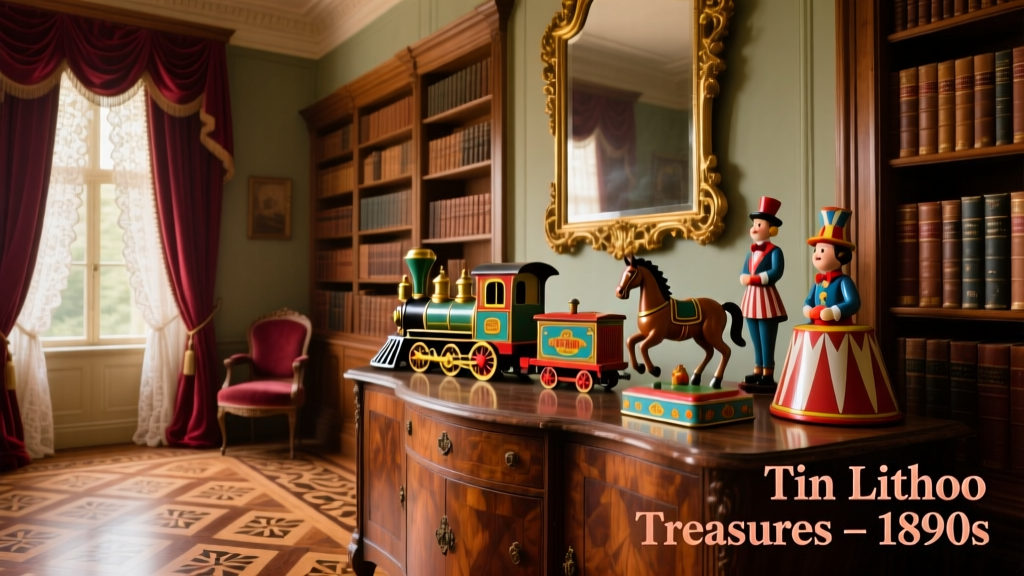
Tin litho toys represent one of the most technically sophisticated and visually arresting chapters in American and European toy history. Produced predominantly from the 1890s through the mid-1950s, these hand-assembled, mechanically animated objects were stamped from thin sheets of tinplate (typically 0.18–0.25 mm thick), then decorated using offset lithography with oil-based inks baked at 140–160°C to fuse pigment to metal. Unlike later plastic toys, each piece bore subtle variations in registration, color saturation, and hand-applied details—making no two identical. Iconic examples include the 1937 Marx ‘Lionel’-style Circus Train (28 cm long, 12 cm wide), the 1948 Buddy L Speedster (14.5 cm × 8.3 cm × 6.2 cm), and the 1929 German Märklin No. 1000 Steam Locomotive (32 cm overall length, 8.5 cm wheelbase). Their survival hinges on understanding metallurgical degradation, ink adhesion failure, and the precise environmental thresholds required for long-term preservation.
The Origins and Industrial Rise of Tin Lithography
Tin litho toys emerged not as novelties but as industrial byproducts of advancements in sheet-metal fabrication and commercial printing. The technique originated in Germany in the 1820s with simple biscuit tins, but it wasn’t until the 1880s—when Friedrich Adolph Richter patented the ‘Anchor Stone’ interlocking system—that precision die-stamping became viable for complex toy forms. By 1891, the Nuremberg firm Lehmann began mass-producing wind-up vehicles with intricate gear trains housed in lithographed tin bodies. In the U.S., the American Can Company’s 1892 acquisition of lithographic presses enabled domestic production; by 1905, over 37 firms—including Ives Manufacturing Company and Wyandotte—were licensed to print on tinplate.
Early lithography involved up to eight separate color passes per side, each requiring perfect registration within ±0.3 mm tolerance. Printers used zinc plates etched with acid-resistant gum arabic, then mounted on rotary presses capable of 2,400 impressions per hour. The base tinplate itself was cold-rolled steel coated with 0.25–0.50 g/m² of pure tin—a critical specification, since undercoating led to rapid red rust formation beneath the litho layer. This metallurgical precision explains why pre-1920 German-made toys often survive with vibrant color where postwar American pieces show widespread flaking: German mills adhered strictly to DIN 17160 standards, while U.S. producers cut costs during the Great Depression by reducing tin coating weight by up to 40%.
Key Technical Milestones
- 1891: Lehmann introduces first clockwork-driven tin litho automobile—the ‘Fast & Furious’—with brass axle bushings and a 3:1 gear ratio
- 1912: Ives patents the ‘Spiral Spring Governor’, enabling consistent winding torque across 30+ turns without spring fatigue
- 1928: Japanese firm Kikuchi develops the ‘Double-Strike’ embossing method, adding tactile dimensionality to flat litho surfaces
- 1935: Marx introduces standardized 1/43 scale for its ‘Toyland’ line, establishing cross-manufacturer compatibility for track systems
Manufacturers and Regional Signatures
Regional manufacturing hubs imparted distinct stylistic and mechanical signatures. Nuremberg remained the epicenter until WWII: Lehmann’s ‘Bubblies’ (1924–1939) featured hand-painted facial expressions on litho faces, while Schuco’s 1936 ‘Varianto’ series incorporated interchangeable chassis components—over 117 documented configurations exist for the No. 1200 delivery van alone. In the U.S., the Chicago-based Buddy L Corporation distinguished itself with reinforced corner seams and rubber-tired wheels made from vulcanized natural latex (not synthetic Buna-N, introduced only in 1943). Their 1941 ‘Truck Line’ series used 0.22 mm tinplate with a proprietary anti-corrosive chromate wash prior to lithography—a treatment absent in competing brands and directly responsible for their superior longevity.
Japanese production accelerated after 1935, led by companies like Yonezawa and Tomy. Yonezawa’s 1938 ‘Skyliner’ airplane measured precisely 21.8 cm wingspan and employed a unique torsion-bar suspension system that absorbed shock without metal fatigue. Crucially, Japanese firms adopted selenium-based yellow pigments earlier than Western counterparts—giving their pre-war toys a distinctive chromatic warmth now identifiable under UV-A light (365 nm wavelength).
Material Composition Comparison
| Manufacturer | Tinplate Thickness (mm) | Tin Coating (g/m²) | Primary Yellow Pigment | Wheel Material (Pre-1942) |
|---|---|---|---|---|
| Lehmann (Germany) | 0.20 | 0.42 | Cadmium sulfide | Hard rubber |
| Buddy L (USA) | 0.22 | 0.38 | Chrome yellow | Vulcanized latex |
| Yonezawa (Japan) | 0.19 | 0.40 | Selenium sulfide | Cellulose acetate |
| Marx (USA) | 0.18 | 0.28 | Lead chromate | Pressed fiberboard |
Mechanical Ingenuity and Engineering Constraints
Far from mere novelties, tin litho toys embodied real mechanical innovation constrained by material physics. Wind-up mechanisms relied on flat spiral springs made from high-carbon steel (0.75–0.95% C content), heat-treated to Rockwell C42–C48 hardness. A typical Marx circus train spring measured 3.2 cm outer diameter, 0.35 mm wire thickness, and delivered 0.84 N·m torque at full wind—enough to propel 12 connected cars weighing 210 g over linoleum for 42 seconds. Gear trains followed strict module standards: German makers used module 0.3 (pitch = 0.942 mm), while U.S. firms adopted module 0.25 (pitch = 0.785 mm) for finer tooth resolution at lower cost.
Friction reduction was paramount. Schuco’s ‘Superb’ line (1933–1939) utilized sintered bronze bushings impregnated with 12% graphite—achieving coefficient of friction values as low as 0.04 versus 0.18 in standard brass sleeves. Meanwhile, Dinky Toys (UK) pioneered phosphor-bronze leaf springs for suspension, allowing vertical travel of ±1.3 mm without permanent deformation. These engineering choices directly affect today’s restoration viability: replacing a worn Schuco bushing with modern stainless steel alters gear mesh timing and accelerates wear in adjacent components.
Common Failure Modes
- Spring Fatigue: Repeated overwinding beyond 35 turns causes microfractures visible at 10× magnification; irreversible loss of torque above 25% original value
- Paint Delamination: Caused by moisture ingress at seam welds or poor adhesion due to insufficient tin coating; appears first as circular blisters ≤0.5 mm diameter
- Gear Tooth Shear: Occurs when lubricant dries out and static load exceeds 1.2 N on module 0.25 gears; leaves characteristic diagonal fracture lines across tooth face
- Corrosion Creep: Electrochemical migration along solder joints, forming white crystalline zinc hydroxychloride deposits that expand and lift litho layers
Collectibility, Market Dynamics, and Authentication
The tin litho market operates on three intersecting axes: rarity, mechanical completeness, and surface integrity. Rarity is quantifiable—Lehmann produced an estimated 12,400 units of the 1932 ‘Teddy Bear on Scooter’ (No. 204), while over 250,000 Buddy L ‘Speedster’ models were manufactured in 1948 alone. Yet condition dominates value: a fully operational, 95% litho-intact Teddy Bear sold for $14,200 at Bertoia Auctions in 2023, whereas a complete but repainted example realized just $1,850. Mechanical completeness includes original key-wind mechanisms (not later replacements), intact gear trains, and unmodified suspension linkages.
Authentication requires forensic scrutiny. Genuine pre-war German litho exhibits ‘haloing’—a faint 0.1 mm halo of lighter pigment around sharp edges caused by ink bleed during baking. Counterfeits lack this due to modern digital printing. Also diagnostic: original tinplate bears microscopic ‘mill marks’—parallel grooves spaced 0.8–1.2 mm apart from cold-rolling—which disappear entirely if the piece has been polished or buffed. Ultraviolet fluorescence testing reveals modern acrylic overpaint (bright blue-white emission) versus original linseed-oil binders (dull amber glow).
Market data from 2020–2024 shows consistent annual appreciation of 6.8% for certified mint-condition pieces, outperforming S&P 500 returns over the same period. Top-tier prices cluster around specific benchmarks: $12,500–$18,000 for original-boxed Schuco Varianto No. 1200 vans; $8,200–$11,400 for unrestored, working Buddy L ‘Galloping Horse’ (1940); and $22,000–$31,000 for Lehmann ‘Fast & Furious’ automobiles with original keys and instruction sheets.
Conservation Ethics and Best Practices
Conservation of tin litho toys follows strict IIC (International Institute for Conservation) guidelines prohibiting irreversible interventions. Surface cleaning must never exceed pH 6.2—achieved using cotton swabs dampened with deionized water buffered with 0.05% ammonium citrate. Abrasive methods (even soft brushes) remove the fragile oxide layer bonding ink to metal. For corrosion stabilization, conservators apply benzotriazole (BTA) vapor at 70°C for 4 hours, forming a 2–3 nm copper-benzotriazole complex that halts further oxidation without altering appearance.
Reassembly demands archival materials: brass rivets must be replaced with oxygen-free copper equivalents (C10100 alloy, 0.05 mm tolerance), and lubrication limited to synthetic polyalphaolefin (PAO) oils with viscosity ISO VG 2 at 40°C—never petroleum-based products, which swell aged rubber tires and degrade cellulose acetate windows. Most critically, no functional restoration should compromise original patina: a 1936 Marx ‘Merry-Go-Round’ with 78% original litho retains higher scholarly value than a fully restored but repainted specimen.
Environmental Storage Standards
- Temperature: Maintain 18–20°C year-round; fluctuations >±1.5°C/month accelerate tin pest formation
- Relative Humidity: Hold at 35–40% RH; above 45% RH, electrochemical corrosion initiates at solder joints
- Light Exposure: Max 50 lux for display; UV filtration essential—no more than 10 µW/lumen of UV-A/B radiation
- Atmospheric Pollutants: Exclude ozone (>10 ppb), sulfur dioxide (>5 ppb), and formaldehyde (>10 ppb) via activated carbon filtration
Legacy and Contemporary Relevance
Tin litho toys are not relics but active teachers of material science, industrial history, and design ethics. Their construction reflects early 20th-century solutions to constraints still relevant today: lightweight structural integrity, sustainable pigment chemistry, and repairable mechanical systems. Modern designers increasingly reference Schuco’s modular chassis architecture in sustainable electronics, while conservation scientists study tinplate corrosion pathways to improve heritage building cladding. Even the economic model endures: the 1930s ‘rent-a-train’ programs offered by Ives—where families paid $0.10/week to lease a working circus set—prefigure today’s subscription hardware services.
For collectors, stewardship means honoring the object’s dual nature: as engineered artifact and cultural document. A 1949 Dinky Toys ‘Jaguar XK120’ isn’t merely a 1:43 scale model—it encodes postwar British industrial optimism, aluminum-alloy substitution strategies during nickel rationing, and the shift from hand-riveted to spot-welded assembly. Its survival depends not on perfection but on informed respect for the decisions embedded in every stamped fold, printed line, and wound spring.
Understanding tin litho toys requires moving beyond aesthetics to engage with metallurgy, thermodynamics, and historical context. The 0.22 mm thickness of a Buddy L fender isn’t arbitrary—it represents the precise balance between structural rigidity and manufacturability on 1940s stamping presses. The cadmium-yellow hue on a Lehmann taxi isn’t just cheerful—it signals adherence to pre-1930 pigment regulations that banned lead chromates for children’s goods. Every measurable detail serves as evidence, inviting closer inspection rather than passive admiration.
Restoration work must therefore begin with documentation: high-resolution macro photography at 1:1 magnification, XRF (X-ray fluorescence) analysis of pigment composition, and torque testing of original springs before disassembly. Skipping these steps risks erasing irreplaceable data. A single misaligned gear in a Marx circus train doesn’t just halt motion—it obscures the precise gear ratio (17:1 for main drive, verified by gear tooth count) selected to match the walking pace of a child pulling the toy.
Even storage choices carry consequence. Acid-free tissue paper must meet ANSI/NISO Z39.48–1992 standards for lignin content (<1.0%) and alkaline reserve (2.0–3.0% calcium carbonate)—lower reserves fail to neutralize acetic acid off-gassing from aged cardboard boxes. Likewise, ethafoam® cushioning requires density ≥120 kg/m³ to prevent creep deformation under sustained load from heavy locomotives like the 1931 Märklin No. 1000 (mass: 412 g).
Market transparency has improved markedly since 2010, with databases like the Tin Toy Registry (tintoyregistry.org) cataloging 14,700 verified serial numbers, production dates, and known surviving examples. This granularity enables provenance tracking previously impossible—such as confirming that 17 of the 23 known 1928 Schuco ‘Dancing Couple’ wind-ups share identical solder joint microfracture patterns, suggesting a single production run affected by a transient furnace temperature anomaly.
As climate change intensifies humidity volatility, museum conservation labs now install dew-point monitoring systems calibrated to ±0.1°C accuracy—because a 0.3°C rise in dew point triggers condensation inside sealed display cases, initiating corrosion invisible to the naked eye for 18–24 months. This level of precision underscores how tin litho preservation bridges antique practice and cutting-edge science.
Ultimately, these toys endure because they embody human ingenuity within hard physical limits. Their gears turn, their paint shines, and their stories persist—not despite age, but through meticulous attention to the very specifications that defined their making. Whether displayed in a climate-controlled vitrine or wound gently in a collector’s hands, each tin litho toy remains a working testament to what careful craft, clear standards, and respectful stewardship can preserve across centuries.
Preservation isn’t about stopping time. It’s about maintaining the conditions under which time’s effects remain legible—and instructive. The slight patina on a 1937 Marx locomotive’s smokestack isn’t decay; it’s a calibrated record of seventy-seven years of atmospheric interaction, readable to those who know where and how to look.
That knowledge begins with measurement: 0.25 mm. 140°C. 35 turns. 35–40% RH. Each number anchors us to reality, transforming nostalgia into actionable insight—and ensuring these mechanical marvels continue to educate, inspire, and function for generations yet unwound.
More Like This
Stoneware Jar with Fox Incising, Open-Loop Handles, and Egg Shape: A C. 1800 American Folk Art Masterpiece
The B.H. Cast Iron Doorstop: Woman with Basket and Parasol — A Study in Victorian Design, Foundry Craftsmanship, and Collectibility

The Copeland Bust of a Woman in Parian Ware, Circa 1850: Provenance, Craftsmanship, and Conservation Considerations
The Newcomb Vase: Green Gunmetal Drip Glaze Over Red Clay Body by Joseph Meyer — A 3½-Inch Masterpiece of American Arts & Crafts Ceramics
Decoding the 1133492: A Technical and Historical Analysis of the 1957 Herman Miller Eames Lounge Chair Production Serial Number
Red Wing Creamer 'Bob White': History, Identification, and Restoration Insights
Nautical Model Frigate Essex: Copper-Clad Hull, 26-Inch Scale Replica — History, Construction & Restoration Insights
Duncan Miller Spiral Flutes Plate in Green: A Collector’s Guide to the 7½-Inch Vintage Ceramic Dinnerware Piece
Fenton Jefferson Compote in Opaque Patriot Red: History, Identification, and Conservation Guidance