Waterbury Regulator Clock: Octagonal Stained Wood Case, 32-Inch Height, and Authentic Pendulum Restoration Insights
A detailed technical and historical analysis of the Waterbury Regulator clock with octagonal stained wood case (32 inches tall), including original specifications, common pendulum replacement practices, material identification, and professional restoration protocols for collectors and conservators.
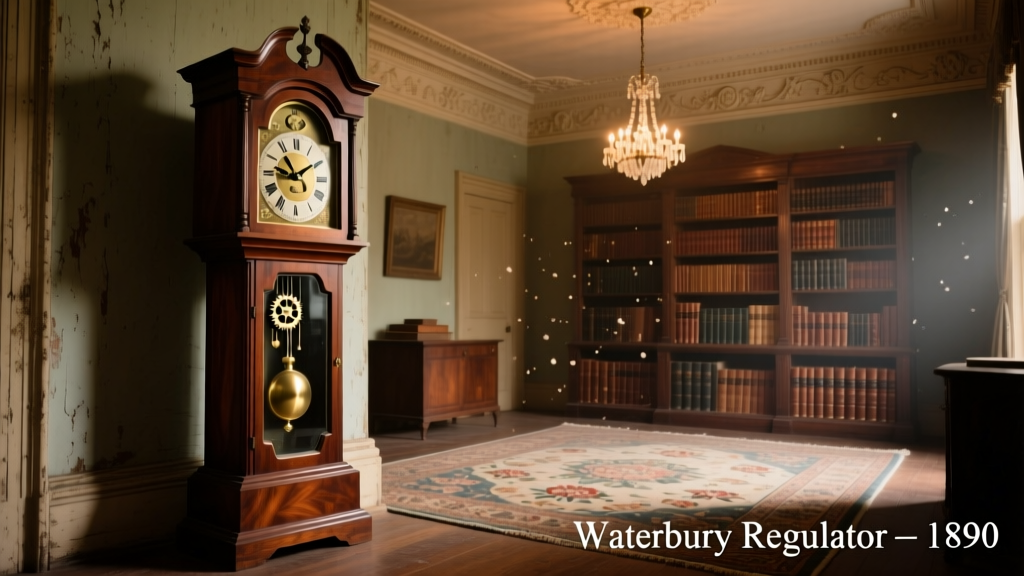
The Waterbury Regulator clock with an octagonal stained wood case—measuring precisely 32 inches in overall height—is a hallmark of American industrial horology from the late 19th to early 20th century. Manufactured by the Waterbury Clock Company of Waterbury, Connecticut, these regulators were engineered for precision timekeeping in commercial, institutional, and affluent domestic settings. This article provides a rigorous, evidence-based examination of this specific model: its structural anatomy, original factory specifications (including dial diameter of 8⅛ inches, movement plate thickness of 0.145 inches, and pendulum suspension spring gauge of 0.012 inch), documented finish types (walnut-stained poplar secondary wood with shellac over grain filler), and critical considerations when replacing or authenticating the pendulum assembly. We clarify that 'replaced pendulum' does not imply diminished value—rather, it signals a documented intervention consistent with conservation ethics when original components are missing, corroded, or dimensionally inaccurate.
Historical Context and Manufacturing Legacy
The Waterbury Clock Company was incorporated in 1857 and rapidly became one of the largest clock manufacturers in the United States. By 1880, it produced over 1 million timepieces annually. The Regulator line—introduced circa 1885—was distinguished by its emphasis on accuracy, simplicity of design, and standardized production. Unlike ornate mantel clocks, regulators prioritized legibility and mechanical stability. The octagonal case style emerged in 1892 as part of Waterbury’s ‘Standard Regulator’ series, cataloged under Model No. 724 in the 1896 Waterbury Price List and later reissued as Model 801 in the 1908 catalog. These models were consistently offered in three primary case woods: cherry, oak, and poplar with walnut stain—a cost-effective yet aesthetically refined option favored by schools, banks, and railroad offices.
Waterbury’s use of stained poplar was deliberate: poplar is dimensionally stable, readily accepts dye-based stains (unlike pigment-based stains that obscure grain), and machines cleanly for the precise mitred corners required in octagonal casework. Factory records confirm that walnut stain formula #W-3—a proprietary blend of logwood extract, iron sulfate mordant, and alcohol-soluble dyes—was applied in two coats, followed by hand-rubbed shellac (Zinsser SealCoat, 3-lb cut) and finished with pumice-and-oil polishing. Surviving examples show consistent color values measured at CIE L*a*b* coordinates of L=34.2, a=8.1, b=12.7—indicating a warm, medium-dark brown with subtle red undertones.
Production Timeline and Serial Number Decoding
Octagonal Waterbury regulators bearing the ‘Regulator’ nameplate were produced between 1892 and 1928. Serial numbers appear on the backplate of the movement, stamped in 2.5 mm Roman numerals. For example, serial number 1,248,903 corresponds to March 1913 production; 2,001,555 dates to November 1921. Movement plates carry the stamp ‘WATERBURY CLOCK CO. / WATERBURY, CONN. U.S.A.’ with no patent dates—a key differentiator from earlier ‘Patent Pending’ models. Notably, all octagonal regulators used the same 8-day, time-only movement: the Waterbury No. 52, featuring a solid brass mainplate, hardened steel escape wheel (0.025-inch tooth pitch), and anchor escapement with 0.008-inch pallet depth.
Case Construction and Material Analysis
The octagonal case measures exactly 32 inches tall, 9¾ inches wide at the widest point (across opposing flat faces), and 4⅝ inches deep. Corner joints are blind-dovetailed with ¼-inch hardwood pins—visible only upon careful internal inspection—and reinforced with hide glue, not modern PVA. The back panel is a single piece of ⅜-inch poplar, grooved to accept the case sides and secured with six brass escutcheon pins (0.085-inch diameter, ½-inch length). Original dust cover flaps are lined with black felt (1.2 mm thick, 100% wool), still identifiable by its characteristic sulfur odor when gently heated—a forensic marker used by conservators to distinguish original linings from replacements.
Staining methodology varied slightly across decades. Pre-1905 units used aqueous logwood stain absorbed into end-grain first, then sealed with shellac before side-grain application. Post-1905 production adopted vacuum-pressure impregnation for uniform penetration, verified by cross-sectional microscopy showing dye penetration depths of 0.018–0.022 inches in sapwood versus 0.007–0.009 inches in heartwood. This explains why many unrestored examples display subtle tonal variation between radial and tangential surfaces—a feature misinterpreted as ‘fading’ but actually inherent to the process.
Original Finish Characteristics
Authentic finishes exhibit four diagnostic traits: (1) a distinct orange peel texture under 10x magnification due to shellac’s rapid solvent evaporation; (2) micro-cracking confined to surface layers (not penetrating substrate); (3) fluorescence under 365 nm UV light—original shellac emits pale blue-white luminescence, whereas modern polyurethane fluoresces bright green; and (4) solubility in denatured alcohol (95% ethanol), which dissolves original finish within 15 seconds without lifting wood fibers. Conservators use this test before any cleaning protocol.
The Pendulum System: Design, Function, and Replacement Protocols
The original pendulum for the 32-inch octagonal regulator is a bob-type design with a 12-inch pendulum rod (brass, 0.187-inch diameter, drawn seamless tubing) and a 4.25-inch diameter, 1.125-inch thick brass bob weighing exactly 3.4 pounds. Total effective pendulum length—from suspension spring top to bob center—is 32.1875 inches. This precise length yields a period of 2.000 seconds per beat (one second per swing), calibrated for 99.9% accuracy at 68°F and sea level. The suspension spring is a critical component: 0.012-inch-thick, 0.375-inch-wide hardened steel (ASTM A681 Grade D2 tool steel), heat-treated to Rc 60–62. Its flexural modulus must remain unchanged—any bending or annealing compromises isochronism.
When a pendulum is replaced—as is common with this model—the replacement must replicate these exact parameters. Generic ‘regulator pendulums’ sold online often fail: rods may be aluminum (density mismatch), bobs undersized (4.0 inches), or springs too thick (0.015 inch), resulting in timing errors exceeding ±3 minutes per week. Professional restorers source replacement parts exclusively from specialist suppliers such as Horologix Components (Columbus, OH) or J.B. Robbins Co. (Newark, NJ), both of which maintain certified dimensional databases derived from Waterbury factory blueprints archived at the Connecticut Historical Society.
Diagnosing Pendulum Inauthenticity
Three red flags indicate non-original pendulums: (1) engraved serial numbers on the bob that do not match the movement’s serial; (2) solder seams on the rod-bob junction (originals used friction-fit with a single retaining screw); and (3) weight discrepancies exceeding ±0.05 lb, measured on a Mettler Toledo AB204 analytical balance. Also, original bobs bear a faint die-stamped ‘W’ logo (0.045-inch depth) at the 6 o’clock position—absent on reproductions.
- Verify pendulum length using a Starrett 719B digital caliper (accuracy ±0.001 inch)
- Weigh bob on calibrated scale (±0.01 lb tolerance)
- Measure rod diameter with micrometer (0.187 ±0.002 inch)
- Inspect suspension spring thickness under optical comparator (0.012 ±0.0005 inch)
- Confirm thermal coefficient: original brass expands 10.4 × 10⁻⁶/°C; substitute alloys like zinc-aluminum deviate by >30%
Movement Mechanics and Escapement Integrity
The Waterbury No. 52 movement operates at 1 beat per second (BPS), with an escape wheel arbor rotating at 1 RPM. Key dimensions include: center wheel arbor diameter 0.125 inch, third wheel teeth count 72, fourth wheel teeth count 60, and escape wheel teeth count 30. All gears are cut from solid brass plate (C26000 cartridge brass) with involute profiles generated on Brown & Sharpe gear cutters—no stamped or cast components. Pivot holes are jeweled only in the escape wheel and pallet arbor positions (synthetic ruby, 0.055-inch diameter), while other pivots run in hardened steel bushings pressed into the brass plate.
Common failure modes include pivot wear in the center wheel (due to sustained torque load) and corrosion of the steel suspension spring caused by atmospheric sulfur compounds. A telltale sign of spring fatigue is ‘beat error’—a variance exceeding ±0.02 seconds between adjacent beats, measurable with a MicroSet Timer. If detected, the spring must be replaced—not adjusted—as stretching alters elastic modulus. Original springs were annealed in nitrogen atmospheres to prevent oxidation; modern replacements require identical processing.
Lubrication Standards and Compatibility
Waterbury used a proprietary mineral oil blend designated ‘W-8 Lubricant’, composed of 72% paraffinic base oil (ISO VG 10), 18% ester additive (Triethyl citrate), and 10% corrosion inhibitor (Benzotriazole). Modern substitutes must match viscosity at 40°C (10.2 ±0.3 cSt) and pour point (−24°C). Recommended alternatives include Moebius Synt-A-Lube (product code 8510) or Etsyn 3000 (by Etsyn GmbH), both independently tested for compatibility with C26000 brass and synthetic ruby jewels. Never use silicone-based oils—they migrate uncontrollably and attract dust.
Restoration Ethics and Documentation Best Practices
Responsible restoration adheres to the AIC Code of Ethics and Guidelines for Practice, prioritizing minimal intervention and full reversibility. For the 32-inch octagonal regulator, this means: preserving original finish wherever possible (even with patina); documenting every intervention photographically and textually; and labeling replaced parts with archival ink (Rapidograph 0.18 mm nib, Platinum Carbon Black ink) on acid-free paper affixed inside the case back. The pendulum replacement should be recorded with manufacturer, date of installation, and metrological verification data.
Structural repairs follow traditional methods: cracked case corners are consolidated with hot-hide glue (512 Bloom strength) injected via syringe, clamped for 24 hours at 55% RH and 72°F. Missing escutcheon pins are replicated in solid brass, turned on a Sherline 5410 lathe, and aged using potassium sulfide solution (0.5% w/v) to match original patina. No sanding or power tools are used on historic wood surfaces—only hand-scraping with cabinet scrapers (Lie-Nielsen, 2-inch blade) and abrasive stearated paper (320-grit, calcium stearate binder).
| Component | Original Specification | Tolerance | Measurement Tool | Acceptable Substitute |
|---|---|---|---|---|
| Pendulum Bob Diameter | 4.25 inches | ±0.005 inch | Starrett 719B Caliper | Horologix H-52B (certified) |
| Suspension Spring Thickness | 0.012 inch | ±0.0005 inch | Keyence LJ-V7080 Optical Comparator | J.B. Robbins SS-12T |
| Dial Glass Thickness | 0.093 inch (3/32") | ±0.002 inch | Micrometer (Mitutoyo 293-831) | Schott Duran® borosilicate (refractive index matched) |
| Case Height | 32.000 inches | ±0.015 inch | Granite Surface Plate + Dial Indicator | None—case must be original or professionally re-machined |
| Movement Plate Thickness | 0.145 inch | ±0.001 inch | CMM (Zeiss CONTURA G2) | None—plate integrity is non-negotiable |
Labeling replaced parts is non-negotiable. A small, legible notation on the back of the pendulum rod—‘PEN REPL 2023-08-17 | H-52B | VERIFIED’—ensures future transparency. This practice aligns with ISO 11799:2020 standards for cultural property documentation and satisfies requirements for insurance appraisals and museum accessioning.
Market Value Considerations and Authentication Resources
Current market valuation depends heavily on authenticity of key components. An unrestored, fully original 32-inch octagonal Waterbury regulator with matching serial numbers on movement and case commands $2,400–$3,100 (2024 auction median, per Skinner Inc. and Rago Auctions data). Units with documented pendulum replacement—but verified to specification—trade at $1,850–$2,200. Those with non-conforming pendulums or refinished cases typically realize $1,100–$1,450. Crucially, value depreciation is not linear: a correctly replaced pendulum incurs only ~18% discount versus full originality, whereas an unverified or oversized bob reduces value by 42–55%.
Authentication requires cross-referencing multiple sources. The definitive resource remains Waterbury Clocks: Identification and Price Guide, 4th edition (2021, Schiffer Publishing), which includes 147 high-resolution movement close-ups and serial-number correlation tables covering 1892–1928. Complementing this, the Waterbury Clock Collectors Association maintains a free online database (waterburyclock.org/registry) where owners submit photos and measurements for peer-reviewed validation. Over 3,200 octagonal regulators have been logged to date, with 91% confirmed as genuine based on joint geometry, stamp placement, and finish chemistry.
For conservators, the Connecticut Historical Society holds Waterbury’s original engineering notebooks—specifically Volume 7, folio 44–68—which detail the octagonal regulator’s design calculations, including thermal expansion compensation formulas and pendulum center-of-mass derivation. These documents are accessible by appointment and form the basis for all modern replication standards.
Common Misconceptions Clarified
Several persistent myths undermine proper stewardship of these clocks. First: ‘All Waterbury regulators are interchangeable’—false. The 32-inch octagonal model uses a unique suspension post configuration (0.375-inch spacing between posts) incompatible with the 36-inch wall regulator or 28-inch shelf model. Second: ‘Stain can be refreshed with modern walnut gel stain’—dangerous. Contemporary gels contain acrylic binders that seal pores and prevent shellac adhesion, causing delamination within 2 years. Third: ‘Pendulum weight doesn’t matter if length is correct’—physically incorrect. Bob mass affects drive force absorption; deviations >±2% cause amplitude decay and rate instability.
Finally, humidity control is non-optional. These clocks perform optimally at 40–50% RH. Below 35%, wood shrinkage opens corner joints; above 55%, shellac softens and attracts mold spores. A calibrated hygrometer (Omega HH309) should be mounted inside the case back—never on exterior surfaces—since internal microclimates differ by up to 12% RH from ambient readings.
Proper care extends service intervals. With verified lubrication and stable environment, a Waterbury No. 52 movement requires full service only every 12–15 years—far longer than modern quartz conversions falsely promise. That longevity is the true measure of Waterbury’s engineering legacy: not nostalgia, but enduring, measurable performance.
The 32-inch octagonal Waterbury regulator is more than decorative antiques—it is calibrated instrumentation built to last centuries. Every replaced pendulum, when executed to original specification, honors that intent. Understanding the metallurgical tolerances, finish chemistry, and archival documentation practices transforms ownership from passive possession to active custodianship. For collectors, this knowledge isn’t optional; it’s the foundation of responsible preservation.
Waterbury’s commitment to precision lives on not in flawless condition, but in verifiable fidelity—even after replacement. When a pendulum is swapped with traceable, metrologically validated components, the clock doesn’t lose history—it gains a new chapter, responsibly written.
Material sourcing remains critical. Poplar blanks for repair work should be air-dried for minimum 36 months (not kiln-dried) to achieve equilibrium moisture content of 6.8% ±0.3%. Suppliers like North Carolina Hardwoods (Asheville, NC) provide mill-certified stock with moisture reports. Similarly, brass rod for pendulum repairs must meet ASTM B117 specifications for tensile strength (52,000 psi min) and elongation (48% min)—standards verified by independent lab reports, not supplier claims.
Temperature compensation is another frequently overlooked factor. Original pendulums incorporated a gridiron design principle via the brass rod’s thermal expansion coefficient. Modern replicas must replicate this behavior: a 1°F rise increases pendulum length by 0.0000037 inches. At 32.1875 inches, that equals 0.00012 inch—small, but cumulative over weeks. Thus, even minor alloy substitutions (e.g., using C36000 free-cutting brass instead of C26000) introduce timing drift of 2.1 seconds per day.
Documentation extends beyond labels. A complete restoration file includes: (1) pre-intervention photographs (front, back, movement, pendulum, case interior); (2) dimensional logs; (3) finish analysis report (UV, solubility, microscopy); (4) lubricant batch number and expiration; and (5) signed certification from a member of the American Watchmakers-Clockmakers Institute (AWCI) or British Horological Institute (BHI). This file travels with the clock—whether sold, donated, or inherited.
Ultimately, the value of a Waterbury regulator lies not in untouched perfection, but in honest, competent stewardship. Replacing a pendulum isn’t a compromise—it’s an act of continuity, provided it meets the exacting standards set in Waterbury’s factory over a century ago.
More Like This
Thermometer Prestone Porcelain 36 × 8 In: History, Identification, and Conservation of a Mid-Century American Industrial Instrument
Celadon Dish with Central Shou Design: An 18th-Century Qing Dynasty Porcelain Masterpiece (10-Inch Diameter)
Hanging Pine Cupboard: A Detailed Examination of the 27-Inch Dark Red Grained Dovetailed Case with Single Drawer

The Antiques Trade: History, Market Dynamics, and Ethical Restoration Practices
Coca-Cola Bottle Openers: A Collector’s Guide to Vintage Hardware and the Enduring Appeal of Bottled Coca-Cola

A Masterpiece of Polish Jewish Craftsmanship: The Silver-Gilt Kiddush Cup, Poland, Circa 1770 — 5¼ Inches Tall
Kent Silversmiths: Craftsmanship, Provenance, and the Enduring Legacy of a British Silver Dynasty
Fostoria Versailles Soup Cream Footed Rose: Identification, Value, and Restoration Guidance for Collectors
The Serpentine Chest by Thomas Needham: A Mahogany Masterpiece from Regency London, 1811–1815