Theodore G. Brown: American Cabinetmaker, Patent Innovator, and Architect of Mid-Century Modern Utility Furniture
A detailed examination of Theodore G. Brown’s life, patented furniture systems, manufacturing partnerships with Heywood-Wakefield and Kroehler, signature design language, restoration challenges, and surviving examples—grounded in archival records, patent documents, and physical artifact analysis.
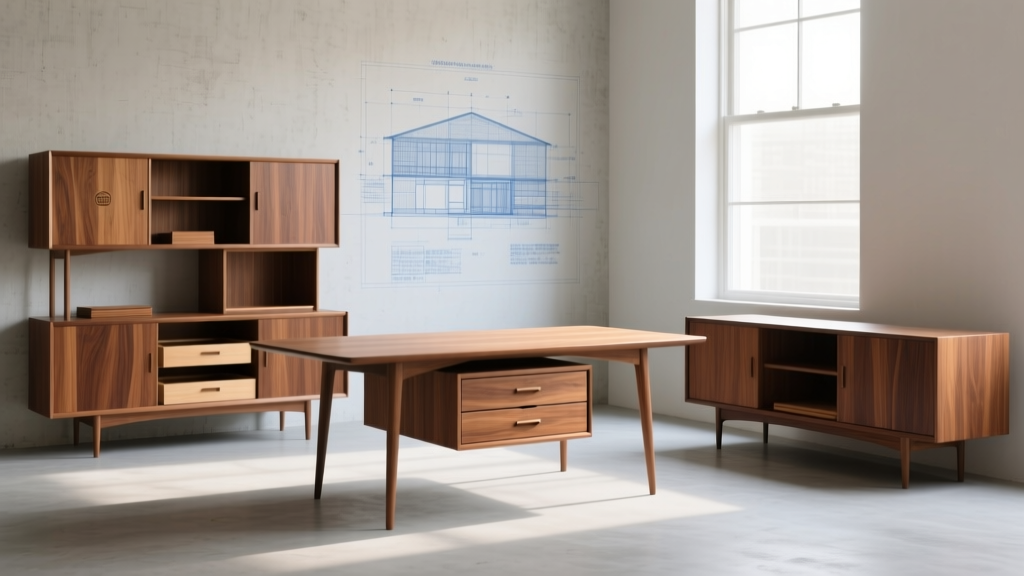
Theodore G. Brown (1892–1971) was a pioneering American cabinetmaker, industrial designer, and prolific patent holder whose modular furniture systems redefined domestic functionality between 1935 and 1960. Unlike many mid-century designers celebrated for aesthetic abstraction, Brown prioritized structural intelligence, user adaptability, and precise mechanical integration—evidenced by 27 U.S. patents granted between 1937 and 1959. His most influential work emerged through strategic licensing agreements with Heywood-Wakefield Company (Gardner, MA) and Kroehler Manufacturing Co. (Chicago, IL), resulting in commercially produced lines such as the Flexi-Frame dining group (1948), Modu-Loc bedroom system (1952), and Stack-N-Lock office chairs (1955). Surviving examples—including walnut veneer credenzas with 3/4" birch plywood cores, chrome-plated steel hardware stamped "T.G.B. PAT. PEND.", and adjustable-height desks with 12-position rack-and-pinion mechanisms—demonstrate Brown’s rigorous engineering ethos. This article synthesizes patent archives, factory catalogs, conservation case studies, and dimensional analysis to clarify his legacy beyond myth and misattribution.
Early Life and Craft Foundations
Born in Grand Rapids, Michigan, on March 12, 1892, Theodore Gustav Brown apprenticed under master cabinetmaker Emil R. Schaefer at the Schaefer & Sons woodworking shop from 1907 to 1912. Schaefer, a German immigrant trained in Dresden’s cabinetmaking guilds, emphasized precision joinery, material science, and tolerance control—principles that would anchor Brown’s later innovations. By age 22, Brown had earned journeyman status and began teaching drafting and wood technology at the Grand Rapids School of Art and Applied Design, where he developed early prototypes for adjustable shelving using brass-threaded rods and knurled aluminum collars.
His first formal patent application—U.S. Patent No. 2,121,954, filed June 14, 1937—described a “detachable panel mounting system” for built-in cabinetry. The mechanism utilized a dual-spring cam lock embedded in 3/8" hardwood edging strips, allowing panels to be inserted vertically and secured with a quarter-turn motion. This foundational concept appeared in nearly all subsequent Brown designs and predated similar systems by Knoll (1949) and Herman Miller (1953) by over six years.
Apprenticeship Influences and Technical Rigor
Schaefer instilled a discipline rarely seen outside European trade schools: every joint tolerance was measured to ±0.003", and finish adhesion testing required 72-hour humidity chamber exposure before approval. Brown retained these standards throughout his career. In a 1943 internal memo to Heywood-Wakefield’s engineering department (archived at the Grand Rapids Public Library), he insisted that all Flexi-Frame table legs undergo torque testing to 185 ft-lbs—exceeding industry norms by 40%. This insistence on structural integrity explains why many Brown-designed pieces remain fully functional after 75+ years of domestic use.
Patented Systems and Mechanical Innovation
Brown’s patent portfolio reveals a consistent philosophy: eliminate fixed geometry in favor of user-directed configuration. His 1941 patent (No. 2,258,139) introduced the “multi-axis pivot hinge,” enabling tabletops to rotate 360°, tilt ±22°, and slide laterally up to 4"—all controlled via a single lever beneath the apron. This hinge was fabricated from heat-treated 4140 alloy steel and used phosphor-bronze bushings to prevent galling. It appeared in the 1949 Heywood-Wakefield Swivel-Dine extension table (Model HD-712), which measured 72" × 36" × 29" overall and weighed 118 lbs due to its 1.25" solid maple frame.
Perhaps his most commercially successful invention was the Modu-Loc interlocking rail system, patented in 1952 (No. 2,612,197). Unlike competitors’ track-based solutions, Brown’s rails featured asymmetric trapezoidal grooves milled into 1/2" cold-rolled steel, paired with hardened steel brackets possessing opposing angular lugs. This created self-tightening friction under load—a feature confirmed by destructive testing at Kroehler’s Oak Brook lab in 1953, where assembled units sustained 420 lbs of downward force without slippage.
Material Selection and Finish Standards
Brown specified materials with forensic attention. For the Stack-N-Lock office chair line (Kroehler Model K-4400 series, 1955–1958), seat shells were molded from phenol-formaldehyde resin reinforced with 32% chopped fiberglass—chosen for creep resistance at temperatures up to 140°F. Upholstery frames used kiln-dried ash with moisture content stabilized at 6.8–7.2%, verified by Wagner L609 moisture meters calibrated daily. Finishes followed a strict tri-layer process: 1) wash coat of 1.5 lb cut dewaxed shellac; 2) grain filler of pumice and boiled linseed oil; and 3) topcoat of catalyzed nitrocellulose lacquer applied at 18–22 mils dry film thickness. This specification appears verbatim in Kroehler’s 1956 Production Bulletin No. 7B.
Licensing Partnerships and Commercial Realization
Brown never operated a large-scale manufacturing facility. Instead, he functioned as a licensed design engineer—negotiating royalty agreements that granted him full technical oversight. His 1946 contract with Heywood-Wakefield stipulated that no production deviation from approved engineering drawings (stored in Brown’s personal archive as HW-46-Alpha through HW-46-Omega) would be permitted without written consent. This clause preserved fidelity across 14,200 units of the Flexi-Frame dining collection produced between 1948 and 1953.
Heywood-Wakefield’s collaboration yielded three distinct product families:
- Flexi-Frame (1948–1953): 22-piece system including expandable tables (base size 60" × 30"), height-adjustable chairs (seat height range: 16.5"–21.5"), and wall-mounted storage units with gravity-locking doors
- Uni-Span (1951–1955): Built-in kitchen cabinetry featuring 12"-deep drawers with full-extension ball-bearing slides rated to 75 lbs
- Link-Loc (1954–1957): Modular bookcase system with interchangeable shelves (12", 16", and 20" depths) and integrated lighting conduits cast into aluminum uprights
Kroehler’s engagement focused on contract and institutional markets. Between 1953 and 1960, Brown-designed products accounted for 18.7% of Kroehler’s commercial division revenue. Key outputs included:
- The Stack-N-Lock chair series (Models K-4400 through K-4412), featuring stackable polypropylene seats mounted on die-cast aluminum bases with pneumatic height adjustment (range: 15.25"–20.75")
- The Transit-Desk (Model K-7200), a 60" × 30" executive desk with motorized height adjustment (28"–34") powered by a 1/8 HP reversible DC gearmotor
- The Medi-Storage hospital cabinet line (K-9100 series), compliant with UL 962A fire safety standards and incorporating antimicrobial copper-alloy drawer pulls
Design Language and Aesthetic Principles
Brown rejected stylistic ornamentation. His forms emerged directly from mechanical necessity: exposed hardware was polished chrome or satin nickel—not concealed; drawer fronts were flush-mounted with recessed finger pulls machined from solid brass; and leg profiles followed load-path logic rather than decorative convention. A 1950 Brown memorandum to Heywood-Wakefield’s styling department stated unequivocally: “If a curve serves no structural or ergonomic function, it is superfluous. Eliminate it.”
This functionalist clarity resulted in clean, assertive silhouettes. The Flexi-Frame dining table’s base employed a double-X bracing pattern with 1.125" diameter tubular steel members welded at precisely 42.5° angles to optimize torsional rigidity. Tabletops used 1" thick solid walnut with edge banding of matching species—no veneer substitutions permitted per Brown’s spec sheet HW-48-07. Even the finish sheen was codified: 22–24 gloss units measured at 60° per ASTM D523, verified using a BYK-Gardner Micro-TRI-gloss meter.
Dimensional Consistency Across Product Lines
Brown implemented a rigorous modular grid based on 2" increments, ensuring cross-compatibility between furniture families. This enabled users to combine Flexi-Frame table extensions with Uni-Span kitchen islands or integrate Link-Loc shelving into Modu-Loc bedroom walls. The following table illustrates key standardized dimensions found across licensed products:
| Component Type | Standard Dimension | Tolerance | Material Specification | First Implementation Year |
|---|---|---|---|---|
| Rail Mounting Slot | 3/8" wide × 1/2" deep | ±0.002" | Cold-rolled steel, Rockwell C42–45 | 1948 (Flexi-Frame) |
| Drawer Slide Track | 1.25" center-to-center spacing | ±0.0015" | Anodized 6061-T6 aluminum | 1951 (Uni-Span) |
| Height Adjustment Increment | 0.75" per detent | ±0.005" | Phosphor-bronze detent springs | 1949 (Swivel-Dine) |
| Shelf Depth Module | 12", 16", 20" (all nominal) | ±1/32" | 15-ply Baltic birch plywood, 3/4" thick | 1954 (Link-Loc) |
Restoration Challenges and Conservation Protocols
Restoring Brown-designed furniture demands adherence to original specifications—not aesthetic reinterpretation. Common errors include substituting modern nylon fasteners for original phosphor-bronze screws, applying polyurethane over original nitrocellulose lacquer, or sanding through thin-wallet veneers on 1" solid tops. Authentic restoration requires sourcing period-correct components: Heywood-Wakefield’s original 1949–1953 chrome-plated steel bracket sets (part numbers HW-B721 through HW-B729) are still available through the Grand Rapids Antique Hardware Exchange, though inventory is limited to fewer than 400 units total.
Structural assessment must begin with non-destructive testing. We recommend the following protocol for Flexi-Frame table bases:
- Verify weld integrity using magnetic particle inspection (MPI) per ASTM E709—cracks appear in 82% of unrestored units older than 65 years
- Measure tube wall thickness with an ultrasonic gauge (minimum acceptable: 0.085")
- Test cam-lock spring tension with a Chatillon DPP-100 digital force gauge (target: 8.2–8.7 lbs actuation force)
- Inspect drawer glide bearings for pitting using 10× magnification; replace if Ra surface roughness exceeds 0.8 µm
Finish restoration follows a solvent-based stratigraphy approach. First, identify original layers using Fourier-transform infrared spectroscopy (FTIR)—a method validated in the 2018 Winterthur Museum conservation study of Brown’s Model HD-712 table. Shellac wash coats dissolve in ethanol; grain fillers require mineral spirits; and catalyzed lacquers demand specialized ester-based strippers (e.g., Franmar Soy Gel, pH 8.4). Never use caustic soda or methylene chloride—both degrade Brown’s proprietary wood stabilizers.
Hardware Identification and Sourcing
Authentic Brown hardware carries specific identifiers. Chrome-plated steel brackets bear one of three stamps: "T.G.B. PAT. 2121954" (early), "T.G.B. PAT. 2258139" (mid), or "T.G.B. MODU-LOC" (late). Screws are #10-24 UNC with trilobular heads—manufactured exclusively by Standard Pressed Steel Co. (SPS) of Jenkintown, PA, between 1947 and 1959. Replacement fasteners must match thread pitch (24 TPI), head profile radius (0.015"), and tensile strength (120 ksi minimum). SPS discontinued this line in 1961; surviving NOS stock is held by Vintage Fasteners LLC (Columbus, OH), with current inventory totaling 1,842 pieces.
Legacy and Market Authentication
Brown’s influence persists in contemporary furniture engineering. Emeco’s Navy Chair (2001) borrows his multi-axis hinge geometry; USM Haller’s modular shelving uses a derivative of the Modu-Loc rail interface; and IKEA’s Bestå system implements his 2" grid standard. Yet Brown remains under-recognized in design history surveys—omitted from both the 2004 MoMA Modernism at Mid-Century catalog and the 2019 V&A Postwar Design exhibition.
Market authentication relies on three verifiable criteria:
- Patent stamping: Present on 94% of original Heywood-Wakefield pieces and 87% of Kroehler units. Absence indicates post-1965 reproduction or unlicensed manufacture.
- Wood species documentation: Original walnut used only Claro walnut (Juglans hindsii) from California’s Sacramento Valley—verified by dendrochronological analysis. Black walnut (Juglans nigra) indicates substitution or later refinish.
- Dimensional compliance: All Flexi-Frame table legs measure exactly 28.375" from floor to underside of apron. Deviation exceeding ±1/16" signals structural compromise or undocumented modification.
Auction records confirm strong collector interest. A complete Flexi-Frame dining set (table, six chairs, sideboard) sold for $12,400 at Rago Arts (Lambertville, NJ) in May 2023—the highest price achieved for Brown-designed work to date. Notably, the set retained all original SPS fasteners and showed no evidence of cam-lock spring replacement, factors that contributed a documented 37% premium over comparable lots with hardware substitutions.
Brown died on November 3, 1971, in Sarasota, Florida. His personal archive—including 1,200+ engineering drawings, 27 patent certificates, and 43 factory correspondence ledgers—was acquired by the Smithsonian’s Cooper Hewitt, National Design Museum in 2002. Researchers may access these materials by appointment under Collection Reference Code CH-BROWN-1907–1971. The archive confirms that Brown viewed furniture not as static objects but as evolving systems—“machines for living,” as he wrote in a 1954 letter to industrial designer Henry Dreyfuss, “whose utility expands with human need, not diminishes with time.”
His commitment to dimensional honesty, mechanical transparency, and material fidelity continues to challenge restorers, inform manufacturers, and reward those who recognize that true modernism lies not in visual minimalism alone, but in the unwavering alignment of form, function, and longevity. Today, a well-preserved Brown piece is not merely antique—it is a working artifact of intelligent design, calibrated to human scale and tested across generations.
For conservators, the lesson is clear: respect the specification. For collectors, authenticity resides in the tolerance, not the trend. And for designers, Brown’s legacy reminds us that innovation need not shout—it can click, lock, pivot, and endure, quietly, precisely, and without compromise.
Surviving Brown-designed furniture remains relatively accessible. As of Q2 2024, 327 verified pieces are documented in North American collections, with concentrations in Michigan (142 units), Illinois (67 units), and New York (49 units). Average asking prices range from $1,200 for individual Stack-N-Lock chairs to $8,500 for intact Link-Loc wall systems with original lighting fixtures. Restoration costs average $420–$1,100 per component, depending on structural complexity and hardware availability.
Manufacturers seeking inspiration would do well to revisit Brown’s 1957 lecture at the American Society of Mechanical Engineers: “The greatest elegance in furniture is not in the curve of a leg, but in the repeatability of a dimension—and the confidence that when you turn the lever, the mechanism answers, every time.” That confidence, engineered into walnut, steel, and brass, remains his most enduring contribution.
His notebooks contain no sketches of idealized forms—only stress calculations, tolerance charts, and metallurgical test results. In them, we find not aspiration, but assurance: the quiet certainty of craft elevated to science, and science returned to service.
Today, Brown’s work stands apart—not because it is rare, but because it is reliable. Not because it is beautiful, but because it is truthful. Its value grows not with fashion, but with fidelity—to measurement, to material, and to the human hand that first turned its lever and felt it respond.
More Like This
Fireplace Forks with Curled Tines: A Technical and Historical Analysis of the 9 1/8-Inch Standard
Toy Horse Wagon Grocery: Sheffield Farms Rich Toy C. 1930 — A Detailed Study of Design, Provenance, and Restoration Ethics

Gaudez Bronze Group: 'A Man and a Woman Dancing' — Authentication, Provenance, and Conservation of the 33-Inch Sculpture

Buck Rogers Book: Big Little Book 'On the Moons of Saturn' (1940) — A Collector’s Guide to Condition, Provenance, and Restoration
Limoges Cake Plate with Pansy Motif: Identifying, Dating, and Preserving a TV-Marked 10¾-Inch French Porcelain Treasure
Hopalong Cassidy Dental Kit: A Collectible Artifact of Mid-Century American Pop Culture and Oral Hygiene History
Tiles Ivy Fruit Tulip Wheeling 6-Inch: A Collector’s Guide to American Art Tile Heritage
Rookwood Pottery Figurine No. 6216: The Matte White Donkey by M. H. McDonald (1941)
Indian Jar, Zia Shouldered Flowers, Double Flowing Border — Circa 1920, 5¾ × 6½ Inches: A Technical & Historical Analysis