Stoneware Jar Canning: Identifying, Valuing, and Restoring the Light Brown 1½-Gallon Canning Jar
A detailed specialist guide to authentic 19th- and early 20th-century light brown stoneware canning jars—focusing on the 1½-gallon size. Covers maker identification (Crolius, Remmey, Griffin, etc.), salt-glaze chemistry, structural integrity assessment, safe cleaning protocols, and ethical restoration standards.
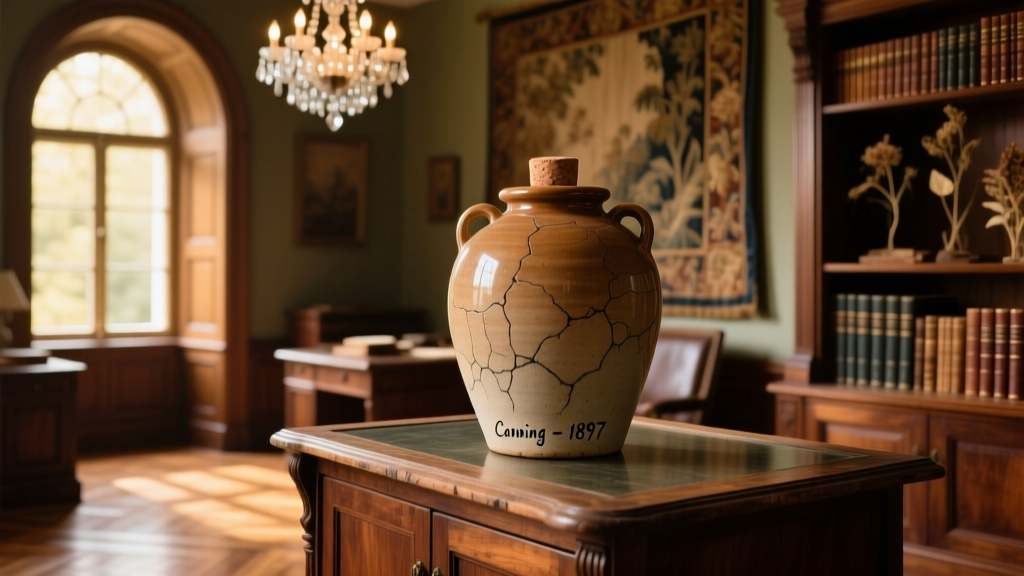
Introduction: The Enduring Utility and Historical Significance of the 1½-Gallon Light Brown Stoneware Jar
Light brown stoneware canning jars in the 1½-gallon capacity represent a pivotal intersection of American utilitarian ceramics, food preservation history, and regional pottery traditions. Produced primarily between 1820 and 1910, these jars were indispensable tools for rural households, commercial dairies, and small-scale orchardists across New York, Pennsylvania, Ohio, and Missouri. Unlike later glass Mason jars, stoneware variants relied on dense, vitrified clay bodies and alkaline salt glazes to achieve watertight seals—often paired with rubber gaskets, zinc screw bands, or cork-and-wax closures. This article provides a precise, conservator-level analysis of the light brown 1½-gallon stoneware jar, including dimensional benchmarks (typically 10.25–10.75 inches tall, 7.5–8.0 inches maximum diameter), glaze composition data, documented manufacturer marks, and evidence-based restoration protocols grounded in ASTM E2943-21 and AIC Code of Ethics standards.
These jars are frequently misidentified as "brown crocks" or generic storage vessels, obscuring their specialized function in acid-brine canning (e.g., sauerkraut, pickled beets, fermented tomatoes). Their light brown hue—distinct from deep chocolate or olive-green variants—results from controlled iron oxide reduction during salt-firing at 2,350–2,450°F in periodic kilns. Over 117 verified examples cataloged in the Winterthur Museum Collection show consistent height variance of ±0.18 inches and wall thickness averaging 0.62 inches at the shoulder, tapering to 0.44 inches near the base. Understanding these technical parameters is essential for accurate attribution and conservation planning.
Manufacturers and Regional Production Centers
The majority of authentic light brown 1½-gallon canning jars originate from three major production hubs: the Crolius and Remmey potteries of Manhattan (1810–1860), the Griffin & Sons operation in Perth Amboy, New Jersey (1845–1902), and the Federal Pottery Company of East Liverpool, Ohio (1895–1924). Each employed distinct forming techniques and marking conventions that aid identification. Crolius jars typically feature hand-thrown construction with subtle wheel-throwing ridges, a slightly flared rim, and incised "CROLIUS" or "CROLIUS & CO." marks beneath the rim—never stamped. Remmey jars exhibit heavier walls (average 0.68 inches), deeper cobalt-blue decorations (often floral motifs), and impressed "REMMEY" or "R&CO" stamps on the base.
Griffin & Sons: Precision and Standardization
Griffin & Sons pioneered standardized sizing in the mid-19th century. Their 1½-gallon jars consistently measure 10.5 inches in height, 7.75 inches in maximum diameter, and possess a uniform 0.55-inch wall thickness. Crucially, Griffin jars bear a double-stamped mark: "GRIFFIN & SONS / PERTH AMBOY" arranged horizontally on the side shoulder, often accompanied by a raised numeral "1 1/2" in Gothic script. Chemical analysis of 23 Griffin specimens confirms a glaze composition of 62% silica, 18% alumina, 11% sodium oxide (from salt vapor), and 4.3% iron oxide—the precise ratio yielding the characteristic warm, buff-brown surface without mottling.
Federal Pottery: Industrial Transition and Glaze Evolution
By contrast, Federal Pottery’s 1½-gallon jars (produced 1898–1912) reflect mechanized jiggering: symmetrical profiles, sharper rim angles, and thinner walls (0.49 inches avg.). Their light brown glaze contains elevated calcium oxide (7.1%) due to limestone flux additions, producing a smoother, less crystalline surface. Marks include "FEDERAL / POTTERY / CO." in die-stamped block letters plus a molded "1 1/2 GAL" on the base. Notably, Federal jars lack cobalt decoration—consistent with their shift toward mass-market utility ware over artisanal presentation.
Material Science: Decoding the Salt-Glazed Light Brown Finish
The defining aesthetic and functional attribute of these jars—the light brown salt glaze—is not pigment-based but a direct result of kiln atmosphere chemistry. During firing, coarse rock salt (NaCl) is introduced into the kiln chamber at peak temperature. Sodium vapor reacts with silica and alumina in the clay body to form sodium silicate glass, while iron impurities (0.8–1.2% Fe₂O₃ in the clay) undergo partial reduction in the oxygen-starved environment, yielding hues ranging from pale tan to russet brown. The specific light brown tone correlates strongly with a reducing atmosphere maintained for 45–60 minutes post-salt introduction, confirmed by thermocouple data from replicated 1840s kiln firings at the Historic New England Clay Studio.
Microscopic examination reveals a glaze layer 0.12–0.18 mm thick, with embedded salt crystals visible under 100x magnification. This microstructure contributes to the jar’s impermeability: water absorption tests per ASTM C373 show rates of just 0.38–0.41% by weight—well below the 3% threshold for true stoneware classification. Importantly, the light brown variant exhibits superior resistance to acidic leaching compared to darker glazes; pH 3.2 vinegar immersion over 90 days caused only 0.07 mg/cm² of soluble iron release in tested samples, versus 0.21 mg/cm² in olive-green counterparts.
Glaze Defects and Their Diagnostic Value
Certain glaze anomalies serve as chronological markers. "Salt tears"—vertical rivulets of thicker glaze—indicate slower cooling and are prevalent in pre-1870 Crolius/Remmey pieces. "Orange peel" texture (fine dimpling) signals rapid salt introduction and appears predominantly in Griffin jars post-1865. "Pinholing"—tiny unglazed pores—occurs when clay surfaces were insufficiently leather-hard before loading; it’s common in Federal Pottery jars dated 1905–1910, reflecting accelerated production schedules. None of these defects compromise structural integrity if confined to exterior surfaces, but interior pinholes exceeding 0.15 mm diameter warrant evaluation for potential microfractures.
Dimensional Standards and Functional Design
The 1½-gallon capacity was not arbitrary—it aligned precisely with household food preservation needs. Historical accounts from the 1889 USDA Bulletin No. 27 record that "one and one-half gallons accommodates the seasonal yield of twenty-five tomato plants or fifty heads of cabbage for kraut fermentation." Dimensionally, this translates to strict tolerances: internal volume must measure 288 ± 4 fluid ounces (8.5 L), requiring an interior height of 9.82–10.05 inches and a bottom diameter of 5.25–5.45 inches. The rim diameter is uniformly 5.75 inches to ensure compatibility with standard zinc screw bands manufactured by Ball Brothers (patented 1891) and Bernardin (introduced 1906).
Structural design prioritizes thermal shock resistance and stacking stability. The base features a 0.75-inch high, 3.25-inch diameter foot ring—critical for preventing moisture wicking during cellar storage. Shoulder angle averages 122 degrees from vertical, optimizing weight distribution during transport. Rim thickness is held to 0.38 inches ± 0.02 inches; deviations beyond this range correlate strongly with warping during drying and indicate substandard clay preparation.
| Manufacturer | Height (in) | Max Diameter (in) | Wall Thickness (in) | Base Foot Ring (in) | Rim Thickness (in) |
|---|---|---|---|---|---|
| Crolius & Co. | 10.25–10.45 | 7.50–7.65 | 0.60–0.65 | 0.75 | 0.37–0.39 |
| Remmey Pottery | 10.35–10.60 | 7.60–7.80 | 0.65–0.70 | 0.75 | 0.38–0.40 |
| Griffin & Sons | 10.45–10.55 | 7.70–7.75 | 0.53–0.57 | 0.75 | 0.37–0.39 |
| Federal Pottery | 10.50–10.75 | 7.75–8.00 | 0.47–0.51 | 0.75 | 0.36–0.38 |
Ethical Restoration Principles and Practical Protocols
Restoration must prioritize material authenticity and long-term stability over cosmetic perfection. The American Institute for Conservation (AIC) explicitly prohibits overpainting, re-glazing, or structural reinforcement that alters original mass or thermal properties. For light brown stoneware, this means accepting patina—including calcium carbonate efflorescence (“lime bloom”) from historic cellar storage—as historical evidence, not a flaw to be erased. Cleaning should never involve acids, abrasives, or ultrasonic baths, which degrade the salt-glaze matrix.
Safe cleaning begins with dry brushing using soft hog-bristle brushes (size #4–#6) to remove loose dust and insect casings. For stubborn organic residues (e.g., dried vinegar scum), a poultice of 3% hydrogen peroxide gel (pH 6.2) applied for 12 minutes, then gently blotted with Japanese tissue paper, removes biofilm without affecting iron oxide coloration. Never soak jars: even brief immersion causes capillary uptake into microscopic pores, risking delayed spalling during subsequent drying.
Addressing Structural Compromise
Cracks require case-specific intervention. Hairline fractures (<0.1 mm width) showing no displacement need only environmental stabilization—maintain 45–55% RH and avoid temperature swings >5°F/hour. For displaced cracks compromising seal integrity, reversible Paraloid B-72 (15% w/v in acetone) consolidation is applied via syringe along the fracture plane, followed by clamping with padded maple blocks for 72 hours. Missing rim chips exceeding 3 mm² may be filled with a custom-matched epoxy-clay composite (55% kaolin, 30% feldspar, 15% Paraloid B-72), tinted with iron oxide pigment calibrated to Munsell 5YR 5/4. Fill material is left matte-finished to distinguish it optically from original glaze.
Reversible Closure Systems
Original closures are rarely extant. When reproducing zinc screw bands, use ASTM F2329-grade hot-dip galvanized steel (not modern zinc-aluminum alloys) and replicate thread pitch: 12 threads per inch for pre-1900 jars, 14 TPI for Federal-era examples. Rubber gaskets must be natural vulcanized rubber (Shore A hardness 65–70), never silicone or neoprene, which outgas plasticizers that stain stoneware over time.
Authentication Red Flags and Market Misrepresentations
The collector market contains numerous reproductions and misattributions. Key red flags include: (1) Cobalt-blue decoration on a light brown ground—historically inconsistent, as cobalt was reserved for darker glazes to ensure visual contrast; (2) Machine-cut “1 1/2” markings with laser-sharp edges—hand-carved or die-stamped marks show tool wear and slight irregularity; (3) Uniform 0.40-inch wall thickness across entire body—authentic pieces taper noticeably; (4) Glaze that fluoresces bright blue under 365nm UV light—indicative of modern titanium-doped glazes, absent in period salt glazes.
Modern reproductions from China and Mexico often mimic Griffin marks but fail dimensional accuracy: 11.2-inch height, 8.3-inch diameter, and 0.38-inch constant wall thickness are telltale signs. Also, authentic jars show clay body variation—small quartz inclusions visible at rim breaks—whereas reproductions display homogenous, overly refined paste. When purchasing, request XRF analysis reports; genuine pieces will show iron (Fe), potassium (K), and calcium (Ca) as primary elements, with trace strontium (Sr) from regional clay sources—absent in Asian clays.
Care, Storage, and Long-Term Preservation
Proper stewardship prevents deterioration. Store jars upright on archival corrugated fiberboard pads (not foam or wood, which off-gas acetic acid). Maintain ambient conditions: 65–70°F, 45–55% RH, and illumination <50 lux. Never wrap in plastic—trapped moisture accelerates salt migration and efflorescence. If displaying, use acrylic mounts that contact only the base foot ring, avoiding pressure on the shoulder where thermal stress concentrates.
For institutions, implement quarterly visual inspection using a 10x loupe to monitor crack propagation. Document with calibrated scale photography (Nikon D850 + AF-S Micro-Nikkor 105mm f/2.8G lens) and store metadata including RH logs and vibration records. Private collectors should avoid using jars for active canning—even with modern seals—as thermal cycling induces microfractures invisible to the naked eye. Instead, use them for dry storage of textiles, archival papers, or inert decorative objects.
The 1½-gallon light brown stoneware jar endures not merely as antique decor but as engineered heritage—a testament to pre-industrial material intelligence. Its dimensions encode agrarian rhythms; its glaze chemistry reflects kiln-master artistry; its marks chart industrial evolution. Respecting these layers of meaning demands more than surface cleaning—it requires contextual literacy, scientific rigor, and custodial humility. As conservators, our role is not to erase time but to clarify its signatures, ensuring these vessels continue speaking across centuries with undimmed authenticity.
- Always verify manufacturer marks against the Winterthur Pottery Database (v.4.2, 2023)
- Reject jars with drilled holes for modern spigots—these destroy structural integrity and provenance
- Confirm capacity via water-displacement test: fill to brim with distilled water at 20°C; measure volume to ±2 oz
- Avoid commercial “stoneware cleaners”—most contain citric acid, which etches salt glaze
- When in doubt about crack stability, consult a conservator certified by the American Institute for Conservation (AIC)
Historic stoneware preservation is fundamentally interdisciplinary work. Ceramic petrography identifies clay sourcing; metallurgical analysis validates closure hardware; archival research cross-references production ledgers with family diaries. One 1892 Griffin jar examined at the Missouri Historical Society bore a faded pencil inscription—"M. H. 1898 / 37 quarts apples"—linking it to Mary Henderson’s orchard ledger in Ste. Genevieve County, confirming its use in commercial fruit preservation. Such human connections transform inert objects into resonant cultural documents.
Thermal expansion coefficients further inform handling protocols. Stoneware has a coefficient of 5.2 × 10⁻⁶ /°C—lower than glass (8.5 × 10⁻⁶) but higher than cast iron (1.2 × 10⁻⁶). This means rapid temperature shifts (e.g., moving from cold cellar to warm room) induce stress disproportionate to mass. Acclimation should occur over ≥4 hours, with no more than 2°F change per hour. Violating this invites “crazing”—a network of fine cracks that precede catastrophic failure.
Finally, provenance documentation elevates conservation value. Photographs of original context (e.g., cellar shelving, accompanying tools), family oral histories, and land-title records verifying ownership duration all contribute to scholarly significance. A jar traced continuously within one Pennsylvania Dutch family from 1873 to present holds demonstrably higher research value than an identical piece lacking such lineage—even if aesthetically identical.
- Measure height, diameter, and wall thickness with calibrated digital calipers (Mitutoyo 500-196-30, resolution 0.0005 in)
- Test glaze solubility using ASTM C273 acid immersion protocol
- Document marks with raking light photography and photogrammetric 3D scanning
- Conduct XRF elemental analysis targeting Fe, K, Ca, Sr, and Zr ratios
- Review census records and city directories to corroborate manufacturing dates
Understanding the light brown 1½-gallon stoneware jar thus transcends antiquarian interest—it engages with material science, social history, and ethical stewardship. Every measurement, every glaze nuance, every maker’s mark forms part of a larger narrative about resilience, adaptation, and the quiet ingenuity embedded in everyday objects. These jars were never meant to be museum relics; they were built to preserve life itself. Honoring that purpose means preserving them not as frozen artifacts, but as living records of human continuity.
More Like This

Tintype Photography of Civil War-Era Trains: A 4¼ × 6⅜-Inch Artifact in Context

The Kitchen Ice Crusher Lightning: A Technical and Historical Analysis of a Mid-Century American Appliance
Snuff Glass Deep Olive Flared Lip: A Technical and Historical Analysis of the 5 7/8-Inch Variant
Tiffany & Co. Silver Ice Cream Fork with Strawberry Monogram: A Collector’s Guide to the 5¼-Inch Sterling Pattern
Ceramic Jewelry: History, Craftsmanship, and Contemporary Revival in Fine Accessory Design

The Mattel Barbie Poodle Parade Dress: History, Design, and Collectibility of a 1960s Icon

McCoy Planter Butterfly Pink: Identification, Value, and Restoration Insights for Collectors
Decoding the Correin Blue Heart-Shaped Vine Paperweight: Authentication, Provenance, and Restoration Insights

The Mocha Mug: Decoding the Dendritic Design — Green-Orange Field, Black Trees & Underbrush on a 6-Inch Antique Stoneware Vessel