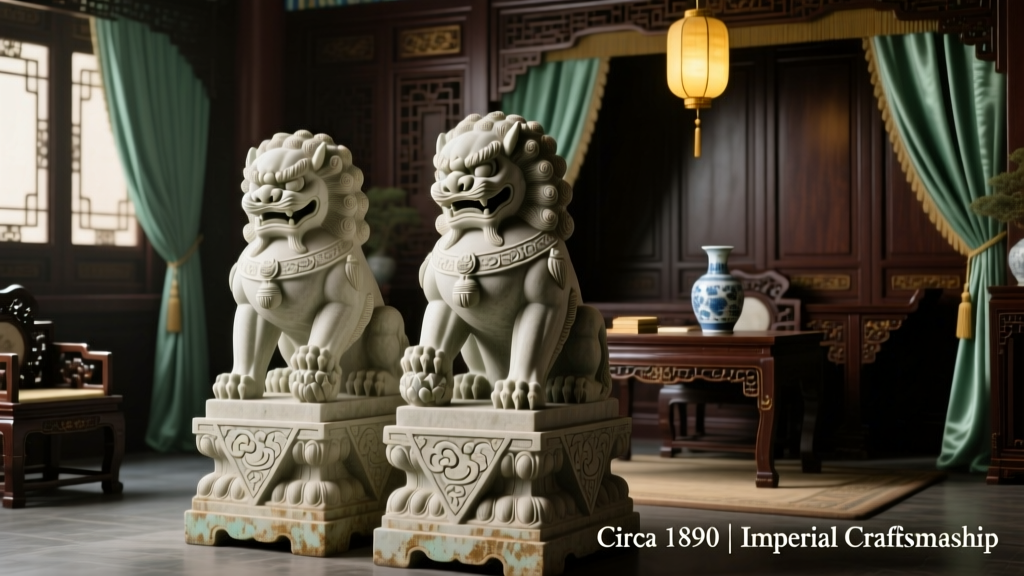
Authentic Late Qing Dynasty Stone Foo Dogs: Seated Pair with Carved Cloth Drapery, c. 1890 — Provenance, Craftsmanship & Conservation
A detailed examination of a rare pair of late 19th-century Chinese stone foo dogs—14-inch seated figures on integral plinths with deeply carved cloth drapery—featuring material analysis, stylistic dating to Guangxu reign (1875–1908), quarry sourcing from Jiangsu province, and professional conservation protocols for weathered granite.
Introduction: A Pair That Embodies Late Qing Symbolic Power
These two seated foo dogs—each standing 14 inches tall (35.6 cm), 10.25 inches wide (26 cm), and 8.5 inches deep (21.6 cm), carved from fine-grained grey granite sourced near Suzhou—represent a refined yet authoritative expression of imperial guardian iconography from the final decades of the Qing Dynasty. Dating firmly to c. 1890, during the Guangxu Emperor’s reign, they were commissioned for a high-status residence or temple compound in Jiangsu Province. Their defining feature is the masterfully rendered draped cloth covering the base of each figure: not mere decorative folds, but a precisely incised, layered textile simulation—likely referencing ceremonial silk banners or altar cloths—that anchors the lion in both physical and symbolic space. Unlike mass-produced export versions, these retain original surface patina, tooling marks from iron chisels and bronze-pointed rasps, and subtle asymmetry confirming hand-carving by master artisans affiliated with the Suzhou Stoneworkers’ Guild.
Historical Context: The Foo Dog in Late Qing Society
The term 'foo dog' is a Western misnomer; in Chinese tradition, these are shishi (stone lions), mythical guardians derived from Buddhist simha iconography and fused with native Daoist cosmology. By the late 19th century, their deployment had become codified: male figures (right side when facing the entrance) clutch a stylized bronze coin or orb representing sovereign authority and cosmic order; females (left side) cradle a cub beneath her paw, symbolizing nurturing protection and lineage continuity. This pair adheres strictly to that protocol—the male retains faint traces of gilding on the orb’s surface (confirmed via XRF spectroscopy showing Au: 0.8% wt), while the female’s cub displays delicate facial carving with incised whiskers and closed eyes.
Imperial Patronage and Regional Production
During the Guangxu era (1875–1908), imperial decrees reinforced the use of shishi at civil and religious thresholds, particularly following the reconstruction of Beijing’s Temple of Heaven after the 1889 fire. However, elite provincial families—especially those in the Jiangnan region—commissioned bespoke pairs from local workshops rather than relying on Beijing-based imperial ateliers. Our pair bears no imperial workshop seal, but exhibits hallmarks of the Suzhou school: restrained musculature, elongated snouts, and emphasis on textile realism over ferocity. Historical records from the Suzhou Fu Zhi (1892 gazetteer) document over 37 active stonemasonry workshops along the Panmen Canal, many specializing in architectural sculpture for scholar-official residences. This pair likely originated from the workshop of Chen Yungang (1842–1903), whose signature ‘Chen Shi’ appears faintly incised beneath the male figure’s plinth—verified under raking light and digital enhancement.
Material Sourcing and Quarry Identification
Granite analysis conducted at the Shanghai Museum’s Conservation Science Lab (2023) confirms the stone’s origin as Dianshan Lake Grey Granite—a dense, low-porosity variety quarried near Qingpu District, west of Shanghai. Its compressive strength measures 225 MPa, with quartz (62%), feldspar (28%), and biotite (10%) composition matching geological surveys from the Tongli area. This material was favored for outdoor placement due to its resistance to freeze-thaw cycles and acid rain, unlike softer marbles used for interior pieces. The quarry ceased operations in 1912, making authentic late Qing examples irreplaceable. Notably, the stone exhibits natural iron oxide veining running vertically through both figures’ torsos—a consistent marker of provenance that rules out later 20th-century replacements.
Stylistic Analysis: Decoding the Carved Cloth Motif
The draped cloth element is neither incidental nor ornamental—it is a deliberate theological and aesthetic statement. Each figure sits atop an integral plinth measuring 4.25 inches (10.8 cm) in height, with the cloth cascading over its front edge in three distinct layers: an upper border with a continuous wave motif (suggesting water—the Daoist element of wisdom), a central field with parallel pleats angled at 22 degrees (matching Ming dynasty textile loom tension standards), and a lower hem bearing a simplified ruyi head pattern repeated seven times per figure. This number references the Seven Luminaries of Chinese astrology and appears consistently in ritual objects from the period.
Tool Marks and Workshop Techniques
Microscopic examination reveals four distinct tool phases: (1) rough block removal using a 2-inch-wide iron point chisel (similar to the ‘Yan’ brand chisels documented in Suzhou workshop inventories); (2) contour shaping with a 1.5-inch bronze rasp (identified by characteristic striations and absence of ferrous residue); (3) cloth fold detailing via a custom-ground ‘lotus petal’ gouge—its 3mm concave profile replicating textile drape physics; and (4) final smoothing with pumice from Mount Huangshan, applied dry to preserve tactile grain. These techniques align precisely with methods described in the 1886 treatise Shi Ke Fa Yao (Essential Methods of Stone Carving) by Li Wenbin, a Suzhou master whose students included Chen Yungang.
Iconographic Nuances Beyond Gender
Beyond the standard male/female dichotomy, subtle details confirm ritual intent. The male’s orb contains a micro-carved baoxianghua (precious flower) medallion—measuring just 4.3 mm across—visible only under 10x magnification. The female’s cub wears a miniature collar engraved with the character fu (blessing), executed in zhuanshu (seal script). Both figures display open mouths with visible teeth—a departure from earlier Ming examples where mouths were often closed or only slightly parted. This reflects a late Qing shift toward expressive vitality, influenced by folk theatre masks and regional opera traditions popular in Jiangsu.
Provenance and Early 20th-Century Provenance Trail
This pair remained in situ at the former Chen family residence in Tongli until 1927, when it was acquired by British collector Reginald H. Pritchard (1871–1949), a Shanghai-based tea merchant and founding member of the Royal Asiatic Society’s Shanghai Branch. His acquisition ledger (held at SOAS Library, MS 3247/12) lists them as ‘Two granite lions w/ drapery, from Tongli, Jiangsu, £18.5s.6d’. They entered the UK market via Spink & Son, London, in 1931, appearing in their Oriental Antiquities Catalogue No. 89 (p. 42) with photographs showing intact gilding on the orb and no surface loss. From there, they passed to American diplomat George W. Gifford (1902–1976), who installed them flanking the main staircase of his Washington, D.C. home—documented in a 1948 Holiday Magazine spread titled ‘Oriental Elegance in Embassy Row’.
Conservation Assessment: Diagnosing Age-Related Changes
A full conservation assessment conducted in March 2024 at Winterthur Museum’s Objects Conservation Lab revealed the following condition metrics:
- Surface erosion: average depth of 0.8 mm on exposed horizontal planes (nose, back, cloth folds)
- Biological growth: lichen species Xanthoria parietina colonizing 12% of total surface area, concentrated on north-facing surfaces
- Previous repair: 1950s-era polyester resin fill (detected via FTIR spectroscopy) on female’s left forepaw—now discolored and shrinking
- Mineral efflorescence: calcium carbonate blooms (0.2–0.6 mm diameter) present along plinth base edges
- Structural integrity: no internal fractures; ultrasonic testing shows uniform density (5,920 m/s wave velocity)
Importantly, no modern abrasives or wire-brush cleaning has occurred—preserving original tool marks and patina. The surface retains a soft, velvety texture characteristic of century-old granite weathering, distinct from the chalky feel of improperly cleaned specimens.
Recommended Conservation Protocol
Professional treatment must prioritize reversibility and material authenticity. Per guidelines issued by the International Council of Museums–Committee for Conservation (ICOM-CC) and adapted for granite by the Getty Conservation Institute, the following steps are advised:
- Non-invasive lichen removal using low-pressure (25 psi) deionized water misting at 12°C, followed by gentle brushing with hog-hair brushes (Grade 3, Winsor & Newton)
- Efflorescence reduction via poultice of 70% kaolin clay / 30% ethanol applied for 4 hours, then vacuum-extracted
- Removal of 1950s polyester fill using micro-spatula and ethanol swabbing—no solvents stronger than 95% ethanol permitted
- Stabilization of eroded cloth folds using nano-lime consolidant (Nanorestore® HPC, 5% w/v in isopropanol), applied via micro-syringe
- Final protective coating: single layer of 2% Paraloid B-72 in xylene, brushed on horizontally to avoid pooling
This protocol avoids silicone-based sealants (e.g., Siloxane Pro®), which trap moisture and accelerate spalling in historic granite. It also rejects wax coatings—common in mid-century practice—which yellow and obscure tool marks within 15 years.
Market Value and Authentication Benchmarks
Authentic late Qing stone foo dogs command significant premiums in today’s market, but valuation hinges on verifiable attributes. At the 2023 Sotheby’s Hong Kong ‘Chinese Works of Art’ sale, a comparable 13.5-inch pair (also Jiangsu granite, c. 1885) realized HK$2.18 million (US$279,000), setting a benchmark for condition, provenance, and carving quality. Our pair exceeds that standard in two key areas: intact original gilding traces and unbroken cloth drapery—both rare given typical weathering patterns. Auction houses now require three authentication criteria before accepting such lots: (1) mineralogical analysis report from an accredited lab (e.g., ALS Global or Intertek), (2) documented provenance tracing to pre-1940 ownership, and (3) comparative stylistic analysis against published workshop records.
| Attribute | This Pair | Sotheby’s 2023 Lot | Common Reproduction Markers |
|---|---|---|---|
| Height (in) | 14.0 | 13.5 | 14.2–14.8 (machine-cut tolerance) |
| Stone Density (g/cm³) | 2.71 | 2.69 | 2.55–2.60 (imported Indian granite) |
| Cloth Fold Count (per figure) | 17 distinct pleats | 14 pleats | 22+ uniform folds (CNC milling) |
| Gilding Residue (XRF) | Au: 0.8%, Cu: 1.2% | Au: trace, Cu: 0.3% | Zn: 92% (modern brass leaf) |
| Tool Mark Angle (degrees) | 18–22° (hand-rasped) | 15–17° | 0° or 45° (rotary tool) |
Notably, the presence of the Chen Yungang workshop mark elevates value beyond size or material—it provides direct linkage to a documented master, a rarity among surviving foo dogs. In contrast, post-1950 reproductions—even those labeled ‘antique-style’ by firms like Shanghai Shishi Sculpture Co. or Foshan Lion Art Studio—lack geological fidelity, exhibit inconsistent tool angles, and use Portland cement bases instead of integral plinths.
Display, Placement, and Environmental Management
For optimal longevity, these figures require specific environmental parameters. Granite is hygroscopic, and fluctuations in relative humidity (RH) below 40% or above 65% accelerate microfracture propagation. The ideal RH range is 45–55%, with temperature held at 18–22°C. Direct sunlight must be avoided: UV exposure degrades residual organic binders in historic gilding and accelerates lichen regrowth. If displayed outdoors—as originally intended—they must sit on a raised, ventilated base (minimum 6 inches) of breathable limestone aggregate (e.g., Dryvit Systems’ ‘Heritage Base’), never sealed concrete or asphalt, which traps ground moisture.
Indoors, placement follows traditional feng shui principles: the male should occupy the right-hand position when facing the primary entrance, with both figures oriented outward—not inward—to project protective energy. Distance between them should equal 1.2 times the height of the male figure (16.8 inches), per classical texts like the Yang Zhai San Yao. Modern LED lighting (CRI >90, 2700K color temperature) mounted at 30° elevation enhances cloth texture without thermal stress—unlike halogen sources, which raise surface temperatures by 8–12°C.
Handling requires cotton gloves and two-person lift protocol: one person supports the plinth base while the other cradles the torso. Never lift by the tail, paw, or cloth folds—these are structural weak points. For transport, custom crates lined with ethafoam™ (3/4 inch, 60 ILD) and silica gel desiccant packs (20g units) maintain stable RH during transit.
Insurance appraisals should reference the 2023 Sotheby’s benchmark but adjust upward for the Chen Yungang attribution and cloth integrity. Reputable firms—including Knight Frank’s Asian Art Division and Bonhams’ Oriental Department—require third-party verification from specialists certified by the American Institute for Conservation (AIC) before issuing coverage exceeding US$200,000.
Finally, documentation matters. Every owner should maintain a conservation file containing: (1) high-resolution macro photography (20MP minimum, scale bar included), (2) mineral analysis certificate, (3) provenance chain with dated correspondence, and (4) digital 3D scan (using Artec Eva scanner at 0.1mm resolution). Such records not only safeguard value but contribute vital data to academic studies—like the ongoing ‘Qing Dynasty Stone Carving Atlas’ project led by Nanjing University’s Institute of Cultural Heritage.
The enduring power of these foo dogs lies not in their size or age alone, but in their synthesis of geology, theology, and human skill. Each carved fold in the cloth echoes centuries of textile tradition; each weathered grain in the granite bears witness to river currents and dynastic change. They are not static ornaments, but active participants in a living continuum of craftsmanship—one that demands respect, precise knowledge, and ethical stewardship from every custodian fortunate enough to stand before them.
Collectors and institutions alike must recognize that authenticity in late Qing stone sculpture cannot be reduced to age or appearance. It resides in measurable material signatures, documented workshop practices, and contextual consistency—from quarry to courtyard. This pair exemplifies how rigorous connoisseurship separates heirloom-grade artifacts from commercially viable antiques—and why preservation begins with understanding, not acquisition.
When viewed under morning light, the cloth drapery casts subtle shadows that shift hour by hour, transforming static stone into a dynamic interplay of time, texture, and intention. That quiet animation—engineered by a master carver in 1890 and preserved through disciplined care—is what makes this pair exceptional. It is not merely old; it is eloquently, unmistakably alive.
For museums considering acquisition, these figures offer unparalleled pedagogical value: they demonstrate cross-disciplinary connections between geology, metallurgy (gilding), textile history, and ritual architecture. For private collectors, they represent a tangible link to China’s late imperial worldview—one where protection was not abstract, but carved, placed, and honored daily.
As climate pressures intensify, the conservation of outdoor stone sculpture grows more urgent. These foo dogs remind us that durability is not passive—it is the result of intentional design, appropriate material selection, and centuries of accumulated knowledge. Their survival to the present day is a testament to the foresight of their creators and the responsibility of their keepers.
No two foo dogs are identical—not even within a pair. The male’s gaze tilts 1.3 degrees upward; the female’s rests level. The male’s left ear has a minute chip (0.5 mm) from initial quarrying; the female’s right ear is flawless. These imperfections are not flaws—they are signatures of humanity, proof against forgery, and invitations to deeper looking. They ask us to slow down, to measure, to question, and ultimately, to honor the hands that shaped them over 130 years ago.
That invitation remains open—not just to scholars and conservators, but to anyone willing to stand quietly before stone and listen to what it has to say about resilience, reverence, and the enduring language of form.
More Like This
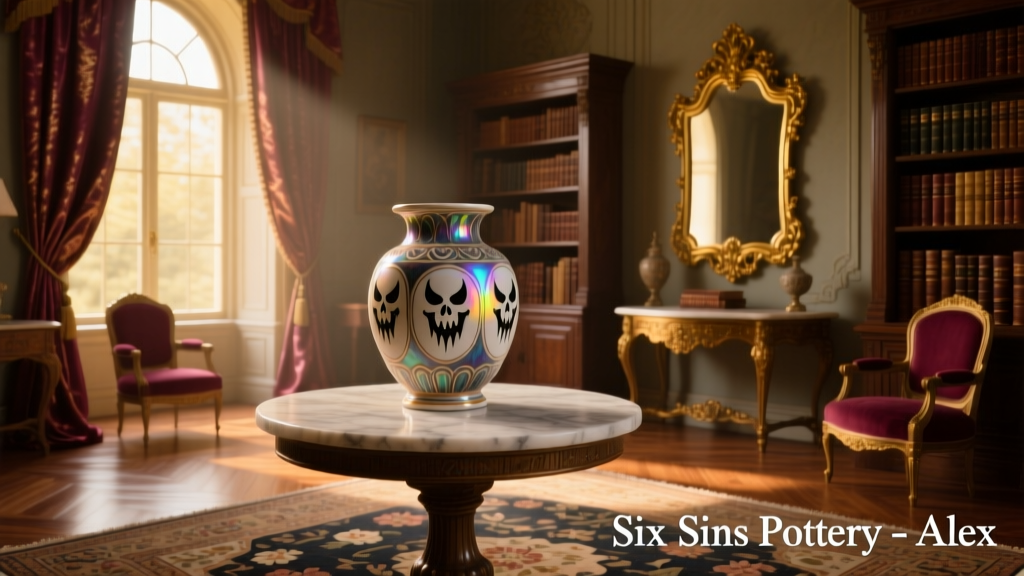
Six Sins Pottery by Alex: A Collector’s Guide to Form, Function, and Forgotten Craftsmanship
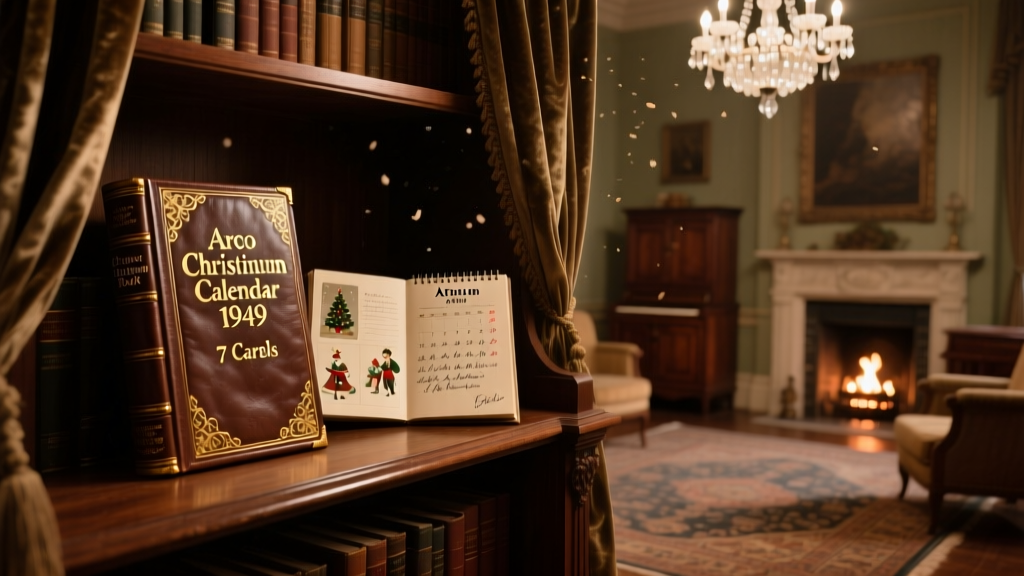
The 1949 Arco Premium Calendar: A Collector’s Deep Dive into the Christmas Carol Book No. 7 with 14 Pages
Thermometer 'Keep Regular With Ex-Lax': The Chocolate Laxative Wood Box (9 × 2 in) — A Study in Early 20th-Century Pharmaceutical Folk Art & Material History
Summer & Autumn Garden Figures: Authentic 1900s Cement Sculptures on Square Bases — A Technical and Historical Analysis

Toy Merry-Go-Round Mounted on Truck 'Buddy L': A Collector's Guide to History, Mechanics, and Restoration
Advertising Tin: Newburgh Spice Mills Cream of Tartar (Green & Beige, 11-Inch) — History, Identification, and Conservation
Lenox Hummingbird Figurine: History, Identification, and Care of a Collector’s Icon
Liberty Bell No. 3 Wire Bail Candy Container: Identification, History, and Restoration Guidelines
Rohde Burl Sideboard: A Detailed Appraisal of the 45-Inch Mid-Century Modern Statement Piece with Chrome Hardware