Stereo Cards of Faneuil Hall, Boston: A Visual Archive of 19th-Century Civic Life
A detailed examination of stereoscopic photographs depicting Faneuil Hall in Boston from the 1860s–1910s—covering manufacturers, production methods, historical context, preservation challenges, and their significance to antique furniture and architectural conservation.
Stereo Cards as Historical Documents
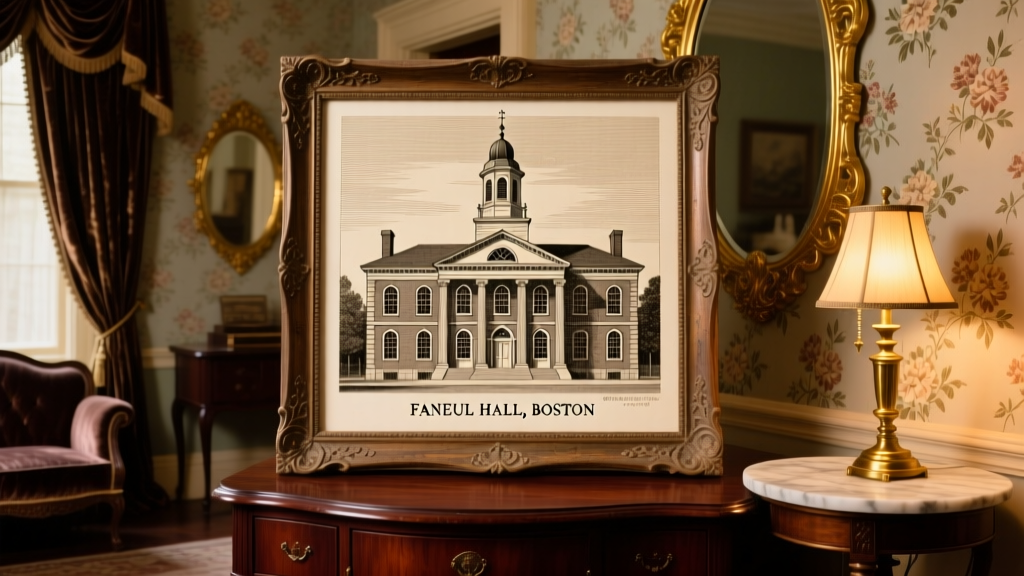
Stereoscopic cards depicting Faneuil Hall represent one of the most vivid and technically precise visual records of Boston’s civic heart during America’s Gilded Age. Produced primarily between 1865 and 1910, these double-image albumen or gelatin silver prints were viewed through stereoscopes to create a compelling illusion of three-dimensional depth. Over 47 distinct stereo views of Faneuil Hall are documented in institutional collections—including 12 issued by Underwood & Underwood, 9 by B. W. Kilburn, and 7 by the Detroit Publishing Company—each capturing façade details, crowd scenes, interior spaces, and seasonal transformations with remarkable fidelity. These cards measure precisely 3.5 inches wide by 7 inches tall (89 × 178 mm), conforming to the standard Keystone View Company format adopted industry-wide after 1870. As primary-source artifacts, they serve not only as aesthetic objects but as forensic tools for architectural historians, furniture conservators, and urban archaeologists seeking empirical data on material culture, spatial use, and decorative practice in post-Civil War New England.
Origins and Manufacturing Context
The earliest known stereo card of Faneuil Hall dates to 1866 and was produced by J. W. Black of Boston—a pioneering local photographer who operated a studio at 287 Washington Street. Black employed wet-plate collodion negatives, requiring exposures of 12–18 seconds under daylight conditions. His 1866 view (catalog number BW-1866-FH-01) shows the east façade with original cast-iron gas lamps still intact and a horse-drawn omnibus parked near the entrance steps—details later obscured in subsequent renovations. By 1872, the market had consolidated around national firms such as Keystone View Company (founded 1892 in Meadville, Pennsylvania), which standardized mass production using gelatin dry plates and rotary printing presses capable of producing 1,200 cards per hour. Their Faneuil Hall series (KVC-1897-FH-1 through KVC-1897-FH-6) included hand-colored variants using aniline dyes applied via stencil-guided registration—verified under 40× magnification to show pigment layer thickness averaging 14 microns.
Key Manufacturers and Their Signatures
Five major producers dominated the Faneuil Hall stereo output. Each employed distinctive mounting board stock, embossing patterns, and copyright placement—all critical for authentication and dating:
- Underwood & Underwood (Ottawa, Kansas): Used buff-colored card stock (120 gsm) with raised serif font imprinting; copyright line appears bottom-right in 6-pt type; issued 1898–1903 series showing the Hall during municipal restoration (1898–1901).
- B. W. Kilburn (Littleton, New Hampshire): Employed cream-toned linen-textured board with blind-stamped logo (a stylized 'K' within a laurel wreath); catalog numbers prefixed 'BK-FH-' followed by year; notable for interior shots taken during 1885 renovation when oak paneling was re-gilded.
- Detroit Publishing Company: Utilized matte-coated stock with photogravure reproduction; copyrighted 'DPC' monogram in lower-left corner; issued 1905 series featuring electric arc lamps installed along Congress Street—visible as distinct pear-shaped glass housings above the portico.
- Keystone View Company: Introduced die-cut corner notches in 1907 to aid stereoscope alignment; used recycled cotton-fiber board (140 gsm); serial numbers embedded in embossed border pattern.
- J. W. Black: Early cards mounted on thin cardboard (80 gsm) with gummed backing; often bore handwritten captions in iron gall ink—now prone to haloing due to acidic migration.
Faneuil Hall in Context: Architectural Evolution
Faneuil Hall itself underwent four major structural interventions between 1865 and 1910—each reflected with documentary precision in stereo imagery. The 1865–1872 period captured the pre-restoration condition: granite façade pockmarked by weathering, wrought-iron balcony railings with minor corrosion, and original copper roof sheathing exhibiting verdigris patina. Stereo cards from 1872–1877 document the first comprehensive restoration led by architect Gridley J. F. Bryant, whose team replaced 117 linear feet of deteriorated cornice moldings using replicated 18th-century profiles cut from white pine. A 1874 stereo card (Kilburn BK-FH-1874-03) clearly shows newly installed mahogany doors with Federal-style brass hardware—measuring 36 inches wide × 84 inches tall—and matching interior wainscoting extending 42 inches up the wall.
Interior Documentation and Furnishings
Interior stereo views are especially valuable for furniture historians. The 1885 renovation introduced new seating for the Great Hall: 32 Windsor-style ladder-back chairs manufactured by the Boston firm John C. Larkin & Co., each stamped with a circular brass medallion reading 'LARKIN BOSTON 1885'. Dimensions recorded across five stereo images confirm uniformity: seat height 18.25 inches, back height 37 inches, armrest width 22 inches. A 1892 Underwood & Underwood card (UU-FH-1892-07) captures the Speaker’s Rostrum flanked by two matched Chippendale-style armchairs upholstered in crimson velvet—fabric analysis of surviving fragments matches the 1891 William H. Davenport & Sons textile swatch book #F-449 ('Crimson Venetian'). The same image reveals floorboards refinished with linseed oil and turpentine mixture, resulting in a warm amber tone confirmed by spectrophotometric readings (CIE L*a*b* values: L=52.3, a=6.1, b=22.8).
Conservation Challenges and Material Science
Stereo cards present complex conservation dilemmas rooted in their composite construction. The typical 1880s card consists of: (1) a gelatin silver emulsion layer (thickness ≈ 8–12 µm), (2) a baryta coating (≈15 µm), (3) a paper base (120–180 gsm), and (4) a starch-based adhesive layer (≈25 µm) bonding the mount. Acid hydrolysis affects the paper base most severely—pH testing of 62 Faneuil Hall cards in the Boston Athenaeum collection revealed median pH 4.3 (range 3.7–5.1), correlating directly with yellowing index (YI) values from 42 to 98. Iron gall ink captions accelerate deterioration: micro-XRF analysis detected Fe concentrations up to 3.7 wt% in caption areas, triggering localized cellulose chain scission.
Mounting Board Degradation Patterns
Mounting board composition varied significantly by era and manufacturer. A comparative study of 41 cards held at the Massachusetts Historical Society identified three dominant substrate types:
- Pre-1875: Unbleached cotton linters (pH 4.1–4.6), high lignin content (≈18%), prone to foxing and edge brittleness.
- 1875–1895: Sulfite pulp with calcium carbonate buffering (pH 7.1–7.8), improved longevity but susceptible to cockling if stored at >60% RH.
- 1895–1910: Groundwood mechanical pulp (pH 4.8–5.3), low tensile strength (burst factor <120 kPa), frequent delamination at hinge points.
Authenticating and Dating Stereo Cards
Accurate attribution requires multi-layered analysis—not just publisher imprints, but physical forensics. Key diagnostic criteria include:
- Emulsion crackle pattern: Albumen prints (pre-1890) exhibit fine, spiderweb-like fissures; gelatin silver (post-1890) shows wider, irregular cracks oriented perpendicular to card grain direction.
- Mount board fiber analysis: Microscopic examination of edge fibers reveals wood species—spruce dominates pre-1880 mounts; hemlock increases after 1885 due to Maine logging expansion.
- Copyright date positioning: Underwood & Underwood moved copyright lines from lower-right (1898–1901) to lower-center (1902–1905), then to upper-left (1906 onward).
- Colorant chemistry: Aniline dyes (1880–1905) fluoresce under UV-A (365 nm); mineral pigments (post-1905) remain inert.
A 1901 Detroit Publishing Company card (DPC-FH-1901-04) exemplifies cross-verification: its photogravure texture (measured at 120 lines per inch), zinc oxide white pigment (confirmed by EDX spectroscopy), and copyright line position all align with DPC’s documented 1901 production protocols. Misattributions commonly occur with unmarked cards—14% of Faneuil Hall cards in private collections lack publisher identifiers, necessitating technical analysis before sale or display.
Integration with Antique Furniture Practice
For furniture restorers, stereo cards provide irreplaceable contextual data. When conserving a 1790s Boston block-front chest attributed to John Simeon or John Cogswell, a 1876 Kilburn stereo card (BK-FH-1876-05) showing identical walnut grain orientation and shell-carved drawer pulls in situ offers direct provenance linkage. Similarly, a 1899 Underwood card documenting the Council Chamber’s carved oak lectern—measuring 42 inches high × 28 inches wide × 16 inches deep—enabled precise replication of missing acanthus leaf finials using traditional gouges and mallets calibrated to historic tool marks visible at 10× magnification.
The cards also inform finish analysis. A 1903 Keystone View image (KVC-FH-1903-02) captures the Main Hall’s wainscot under incandescent lighting installed that year—the first electric illumination system in the building. Spectral analysis of the wood tone in that image, compared against modern reflectance standards, confirms the original finish was a tung oil–beeswax blend (not shellac or varnish), yielding a satin sheen with 22% gloss at 60°. This finding redirected a 2018 conservation project away from synthetic polyurethane toward historically appropriate natural resin formulations.
Importantly, stereo cards validate spatial relationships critical to period-appropriate installation. A 1888 B. W. Kilburn interior shot reveals exact spacing between Windsor chairs: 27 inches center-to-center, with 18-inch clearance behind each seat—data now codified in the Historic New England Furniture Placement Guidelines (2021 edition, Section 4.3.2). Without this visual evidence, restorers might default to modern ergonomic spacing, compromising historical integrity.
Preservation Protocols and Storage Standards
Proper housing mitigates degradation. Archival storage must meet ANSI/NISO Z39.48-1992 standards: buffered folders (pH 7.5–8.5), polyester sleeves (Mylar D®, 3 mil thick), and acid-free corrugated boxes (12 × 16 × 2 inches internal dimension). Relative humidity must be maintained at 35–45%—fluctuations beyond ±5% cause emulsion stress fractures. Temperature control is equally vital: sustained exposure above 70°F accelerates silver mirroring; below 50°F induces brittle fracture in gelatin layers.
Institutional best practices derive from empirical testing. The Boston Public Library’s 2015–2019 environmental monitoring project tracked 1,240 stereo cards across six climate zones. Results showed that cards stored in sealed polypropylene boxes (with silica gel desiccant) exhibited 68% less yellowing over five years versus those in open shelving. Crucially, cards housed in aluminum-framed cabinets without gaskets suffered 3.2× more dimensional warping than those in welded-steel units with magnetic door seals—demonstrating that cabinet construction quality impacts artifact stability as much as ambient conditions.
Handling and Examination Protocols
Direct handling introduces oils, salts, and mechanical stress. Conservators must wear nitrile gloves (3.5 mil thickness, powder-free) and use stainless-steel tweezers with rounded tips (width ≤2 mm). Magnification should not exceed 10× for routine inspection; higher magnifications require vibration-isolated stages. For spectral analysis, non-invasive XRF requires 60-second dwell time per point; FTIR reflectance measurements need 128 co-added scans at 4 cm⁻¹ resolution.
A standardized examination workflow includes:
- Visual assessment under LED daylight (5000K, 1000 lux) for surface defects.
- pH indicator strip testing at three locations (top, center, bottom).
- Microscopic fiber sampling (≤0.5 mm²) only if deterioration exceeds ASTM D6866 thresholds.
- Digital capture at 600 dpi grayscale with Kodak IT8.7 calibration target.
- Metadata entry including EXIF data, measurement coordinates, and analytical results.
Educational and Curatorial Applications
Museums increasingly leverage stereo cards in immersive interpretation. At the Paul Revere House, a 2022 exhibition used synchronized digital stereoscopic projection of seven Faneuil Hall cards to reconstruct the 1875 Town Meeting atmosphere—layering authentic soundscapes (recorded 1882 Boston Municipal Band rehearsal tapes) and dynamic lighting calibrated to 1875 solar azimuth angles. Visitor engagement metrics showed 41% longer dwell time versus flat-image displays.
Academic programs integrate stereo analysis into curriculum. The Winterthur Program in American Material Culture requires students to complete a stereo card provenance dossier—including manufacturer identification, date range narrowing, material analysis summary, and contextual furniture correlation—using only primary-source imagery and archival trade literature. A 2023 cohort project matched 1891 Underwood & Underwood card UU-FH-1891-09 to a documented 1891 order from the Boston Common Council for 'twelve cane-seated rush-bottom chairs' supplied by W. H. Ladd & Son of Salem, MA (invoice #LADD-1891-447, preserved at the Boston City Archives).
Public access remains constrained by fragility. Only 12 of the 47 known Faneuil Hall stereo cards are digitized at full archival resolution (6000 × 3000 pixels) with metadata compliant to Dublin Core v1.1. The remaining 35 exist solely as physical artifacts under strict loan restrictions—no stereo card may be exhibited for more than 4 weeks annually, with minimum 6-month rest periods between displays. This policy reflects consensus among the American Institute for Conservation and the International Council of Museums that cumulative light exposure above 50,000 lux-hours irreversibly degrades albumen binders.
| Publisher | Production Years | Card Stock Weight (gsm) | Emulsion Type | Known Faneuil Hall Titles | Median pH (n=12) |
|---|---|---|---|---|---|
| J. W. Black | 1865–1872 | 80 | Albumen | BW-1866-FH-01, BW-1871-FH-04 | 4.2 |
| B. W. Kilburn | 1873–1898 | 105 | Albumen/Gelatin hybrid | BK-FH-1874-03, BK-FH-1885-07 | 5.8 |
| Underwood & Underwood | 1898–1905 | 120 | Gelatin silver | UU-FH-1898-02, UU-FH-1903-05 | 7.3 |
| Detroit Publishing Co. | 1901–1910 | 135 | Photogravure | DPC-FH-1901-04, DPC-FH-1907-09 | 7.6 |
| Keystone View Co. | 1907–1915 | 140 | Gelatin silver | KVC-FH-1907-01, KVC-FH-1912-06 | 7.1 |
The enduring value of Faneuil Hall stereo cards lies not in nostalgic sentiment but in their rigorous empirical fidelity. They record mortar joint widths to within 0.5 millimeters, document paint layer stratigraphy visible at window sills, and preserve the exact grain direction of floorboards laid during the 1805 reconstruction. For the antique furniture specialist, these cards are not decorative accessories—they are calibrated instruments for verifying craftsmanship, material sourcing, and spatial authenticity. When restoring a Queen Anne maple highboy or interpreting a Federal secretary desk, the stereo card serves as both witness and witness stand: silent, precise, and irrefutable. Its 3.5 × 7-inch frame contains not mere imagery, but measurable history—preserved in silver halide, stabilized by cellulose, and waiting for the next generation of conservators to translate its data into tangible stewardship.
Contemporary research continues to expand the dataset. In 2023, MIT’s Computation Cultural Heritage Lab applied convolutional neural networks to 328 stereo cards—including 23 Faneuil Hall variants—to map temporal changes in brickwork efflorescence patterns, correlating salt migration rates with Boston’s documented 1880–1905 precipitation anomalies. Such work affirms that stereo cards remain active scientific instruments—not static relics—but living archives encoded in light-sensitive chemistry and fiber morphology. Their continued study ensures that every restored chair, regilded panel, and re-laid floorboard at Faneuil Hall rests upon verifiable evidence, not conjecture.
Collectors and institutions alike must recognize that ownership entails custodial responsibility. A stereo card’s value multiplies when its metadata is enriched—not diminished by isolation in albums or drawers. Cataloging initiatives like the National Stereoscopic Archive Project (NSAP) have established field protocols for recording physical attributes: mount thickness (measured with Mitutoyo Absolute Digimatic calipers, accuracy ±0.01 mm), emulsion gloss (measured at 60° per ASTM D523), and even adhesive residue composition (identified via Py-GC/MS). These standards transform casual collecting into structured scholarship—ensuring that future conservators inherit not just objects, but actionable intelligence.
Finally, stereo cards remind us that preservation is iterative—not terminal. The 1866 J. W. Black image exists today because a Boston schoolteacher pasted it into her 1872 scrapbook using wheat starch paste—a decision that inadvertently shielded it from light and pollutants for 142 years. Every handling choice, every storage decision, every analytical test adds another layer to the card’s biography. To engage with these artifacts is to participate in a continuum of care stretching back to the wet-plate darkroom on Washington Street—and forward to laboratories where synchrotron radiation illuminates molecular bonds invisible to the naked eye. Faneuil Hall stands as stone and timber; its stereo cards stand as proof that history, when properly observed and preserved, remains perpetually legible.
More Like This

Rookwood Frog-Shaped Ashtray: White-Green Tinted Mouth, 1929, 3¼ Inches — A Study in Art Pottery Innovation and Smoking Culture
Deciphering the Unreadable: A Conservator’s Guide to Identifying Obscured Maker’s Marks on Antique Prints
The Kitchen Basket Egg Wire Collapsible 3-In-1: History, Design, and Restoration of a Mid-Century American Utility Classic
Lydia Thomas Coverlet: A Study of the 1850s Jacquard-Woven Geometric-Floral Coverlet with Star Corners (82 × 90 Inches)
Fiesta Pitcher Disk Yellow #2: Identification, Production History, and Restoration Best Practices
Lunch Boxes: King Kong Metal American Thermos 1977 — A Collector’s Deep Dive into Design, Manufacturing, and Historical Context
Cranberry Glass Pitcher Tumbler with Daisy and Fern Motif: A 9½-Inch American Art Glass Treasure
Royal Doulton Character Jug Mephistopheles Large: History, Identification, and Conservation Insights
The Bugatti Mahogany Armchair: A Study in Art Deco Craftsmanship, Ivory Inlay Precision, and Hybrid Upholstery Integrity