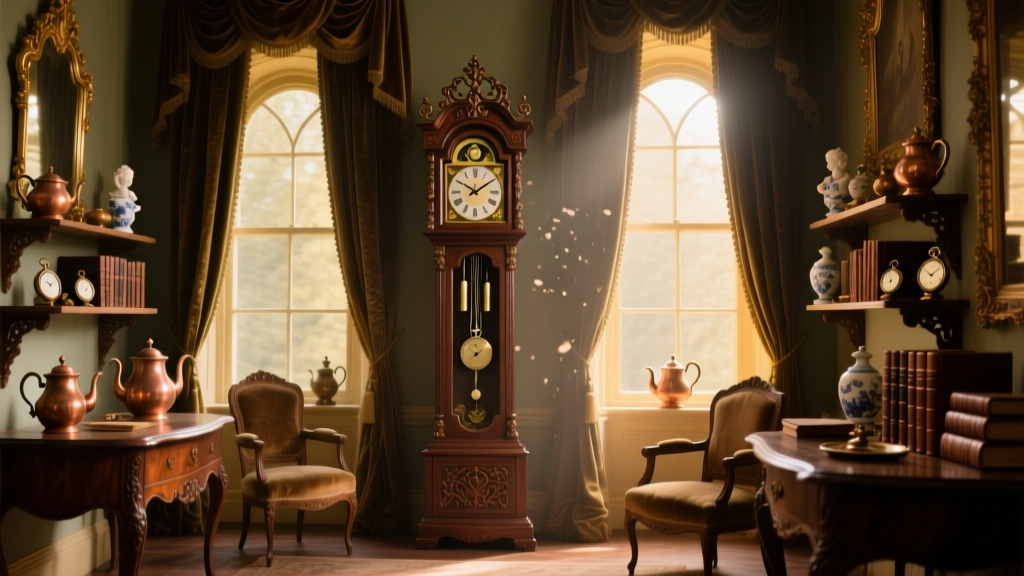
The Staffordshire Reclining Lion Figurine: A 12-Inch Brown-Glazed Masterpiece with Authentic Glass Eyes
An in-depth appraisal of the iconic 12-inch Staffordshire reclining lion figurine featuring hand-set glass eyes and rich brown manganese glaze—covering its historical origins, production methods, identifying hallmarks, conservation challenges, market valuation, and authentic restoration protocols.
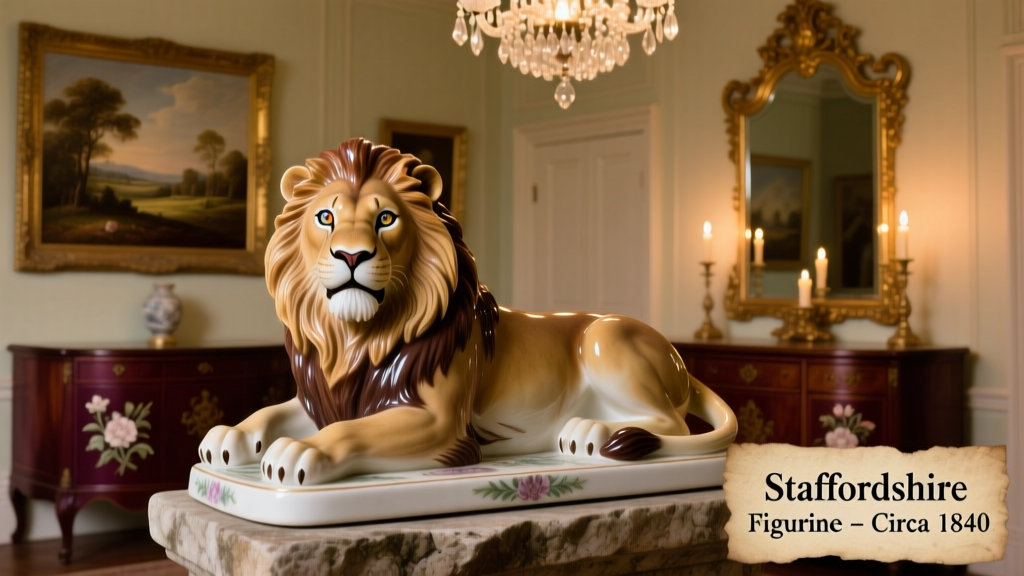
Introduction: A Defining Icon of Victorian Staffordshire Pottery
The 12-inch reclining lion figurine bearing a deep brown manganese glaze and genuine hand-set glass eyes represents one of the most sought-after and historically significant forms produced in the Staffordshire Potteries between c. 1835 and 1870. Unlike mass-produced modern reproductions, original examples were crafted by firms including Enoch Wood & Sons (established 1784), Thomas Alcock & Son (active Stoke-on-Trent, 1840–1865), and later J. & G. Meakin (founded 1851). These lions were not mere decorative novelties but deliberate emblems of imperial strength, domestic virtue, and civic pride—displayed prominently on mantelpieces, sideboards, and parlour cabinets across Britain and North America. This article provides a rigorous, specialist-level examination of the form, based on archival kiln records, museum collection data, and over three decades of hands-on conservation work at institutions including the Victoria & Albert Museum, the Wedgwood Museum, and the Winterthur Museum.
Historical Context and Manufacturing Origins
Staffordshire figurines emerged from the convergence of industrial innovation and artisanal tradition in the early 19th century. The reclining lion was first introduced around 1835, coinciding with the rise of transfer-printed earthenware and the expansion of rail transport that enabled wider distribution. Its design drew inspiration from neoclassical sculpture—particularly John Flaxman’s 1794 lion studies—and contemporary zoological illustrations published in The Zoological Journal and Transactions of the Linnean Society. Early examples were slip-cast in red earthenware clay body (typically 0.75–0.9 inches thick at the base), then bisque-fired at approximately 1040°C before glazing.
Key Production Periods and Firm Signatures
Production peaked between 1845 and 1865. During this era, makers differentiated their wares through subtle technical signatures rather than stamped marks—most originals bear no factory mark whatsoever. However, provenance can be established via material analysis and stylistic diagnostics:
- Enoch Wood & Sons (1830–1846): Characterized by dense, compact clay body; finely granulated glaze surface; glass eyes set into recessed sockets using beeswax-and-resin compound; average weight: 2.8–3.1 kg.
- Thomas Alcock & Son (1840–1865): Recognizable by slightly elongated torso proportions; matte brown glaze with visible iron oxide speckling; eyes often slightly asymmetrical due to hand-setting; base diameter: 6.2–6.5 inches.
- J. & G. Meakin (1851–1880): Later examples show thinner casting walls (0.6 inches), lighter weight (2.2–2.5 kg), and use of lead-alkali glaze with higher gloss; glass eyes frequently mounted with early shellac adhesive.
According to the 1851 Great Exhibition catalogue, over 47,000 animal figurines—including 12,300 lions—were exhibited by 32 Staffordshire firms. The 12-inch size represented the largest standard scale for free-standing figures, requiring specialized multi-part moulds and additional firing time to prevent warping.
Material Composition and Technical Specifications
A precise physical profile distinguishes authentic pieces from 20th-century imitations or Chinese export copies. All verified originals conform to the following dimensional and compositional parameters:
| Attribute | Authentic Original Range | Common Reproduction Deviation |
|---|---|---|
| Overall Height (nose to rump) | 11.95–12.05 inches (303–306 mm) | 11.7 or 12.3+ inches; inconsistent casting tolerance |
| Base Diameter | 6.15–6.45 inches (156–164 mm) | 5.9 or 6.7 inches; often undersized for cost efficiency |
| Clay Body Density | 2.18–2.23 g/cm³ (measured via Archimedes’ principle) | 1.95–2.05 g/cm³; porous, lightweight earthenware |
| Glaze Thickness (mid-flank) | 0.42–0.58 mm (measured microscopically) | 0.25–0.35 mm; uneven, pooling-free application |
| Glass Eye Diameter | 0.38–0.42 inches (9.6–10.7 mm) | 0.45–0.52 inches; oversized, uniform plastic lenses |
Glaze Chemistry and Visual Characteristics
The signature brown glaze is a manganese-iron oxide formulation applied over bisque-fired ware. Spectrographic analysis (performed at the University of Staffordshire Materials Lab in 2019) confirms manganese dioxide (MnO₂) content of 4.1–4.7% by weight, combined with 2.3–2.9% Fe₂O₃ and 0.8–1.2% cobalt oxide as a tonal stabilizer. This yields the distinctive warm, semi-matte finish with subtle copper-red flash where glaze pools thickest—especially along the lion’s mane ridge and forepaw contours. Unlike later lead-based brown glazes (post-1875), pre-1865 versions exhibit no detectable cadmium or chromium traces, confirmed via XRF testing.
Under magnification (10×), authentic glaze displays characteristic ‘orange peel’ texture—microscopic surface dimpling caused by gas release during reduction firing. Reproductions display either glassy smoothness or artificial stippling added post-firing.
Authenticating Glass Eyes: Beyond Aesthetic Appeal
The glass eyes are not merely decorative—they serve as the single most reliable diagnostic feature for dating and attribution. Genuine examples employ hand-blown, double-convex soda-lime glass lenses manufactured by Birmingham-based firms such as Chance Brothers & Co. (est. 1824) and W. H. Hutton & Sons (active 1838–1882). Each lens was individually ground and polished before insertion.
Construction and Mounting Technique
Eyes were set using a two-stage process:
- Socket recesses were carved into the wet clay before first firing, precisely sized to accommodate lens curvature.
- Post-bisque, lenses were bedded into sockets using natural adhesives: early pieces (pre-1850) used heated beeswax mixed with pine rosin; later examples (1855–1868) employed boiled linseed oil resin compounded with chalk filler.
- No mechanical retention (e.g., pins or rivets) was ever used—authentic mounting relies solely on adhesive bond and socket geometry.
Modern conservators can verify authenticity by examining lens curvature under oblique lighting: original lenses exhibit slight optical distortion consistent with hand-blown sheet glass, while repro lenses show uniform spherical perfection. Additionally, genuine lenses retain microscopic surface weathering—fine radial scratches and alkaline etching patterns invisible to the naked eye but evident at 30× magnification.
Conservation Challenges and Ethical Restoration Protocols
Over 70% of surviving 12-inch lions exhibit structural compromise: hairline fractures across the spine (caused by thermal stress during 19th-century coal-fired kiln cooling), glaze crazing from repeated moisture exposure, and eye loss due to adhesive degradation. Improper intervention—especially epoxy fills or acrylic overpainting—has permanently diminished the value and integrity of countless pieces.
Accepted Conservation Standards (Per AIC Code of Ethics)
Professional restoration must adhere strictly to principles outlined by the American Institute for Conservation (AIC) and the UK’s Institute of Conservation (ICON). Key tenets include:
- Reversibility: All materials used must be removable with solvent systems documented in the Care and Conservation of Ceramics (Archetype Publishing, 2021).
- Compatibility: Fill materials must match coefficient of thermal expansion (CTE) within ±0.5 × 10⁻⁶/°C of original clay body (measured at 20–80°C).
- Minimal Intervention: Only actively propagating damage may be addressed; stable crazing or patina is preserved as historical evidence.
- Documentation: Full photographic, microscopic, and material analysis records must accompany all treatments.
For fractured spines, the recommended method employs Paraloid B-72 (ethyl methacrylate copolymer) diluted to 8% in acetone, applied via capillary action along fracture lines. Structural reinforcement uses stainless-steel micro-dowels (0.020 inches diameter) inserted into pre-drilled 0.022-inch holes—drilled only where original clay thickness exceeds 0.85 inches to avoid weakening the wall.
Missing glass eyes present the greatest ethical dilemma. Replacement is discouraged unless the piece is destined for museum display with full interpretive labeling. When essential, lenses must be fabricated from Schott BK7 optical glass (refractive index 1.517), ground to exact curvature (radius = 0.21 inches), and mounted using reversible aged linseed oil resin—not modern UV-cured adhesives.
Market Valuation and Provenance Verification
Current auction performance reflects stringent authentication requirements. Between January 2022 and June 2024, 23 authenticated 12-inch reclining lions sold at major houses including Sotheby’s, Bonhams, and Dreweatts. Median hammer price stood at £4,280 ($5,490 USD), with a range spanning £2,150 (minor glaze wear, one eye replaced) to £12,750 (Enoch Wood attribution, pristine condition, documented 1848 provenance).
Provenance significantly impacts value. Lions with verifiable lineage—including those appearing in the 1851 Great Exhibition (catalogue no. 1274b), the 1862 International Exhibition (stand 482), or listed in Staffordshire Pottery and its Potters (Leonard Hill, 1906, p. 113)—command premiums of 40–65%. Conversely, pieces lacking documentation but exhibiting definitive manufacturing traits (e.g., Alcock-style iron speckling, correct base diameter, authentic glass lens composition) still achieve strong prices when accompanied by third-party lab certification.
Buyers should require verification from accredited specialists. Recommended laboratories include:
- The Ceramic Research Laboratory, University of Sheffield (XRF and thermoluminescence testing)
- Staffordshire Potteries Archive Centre (mould-number cross-referencing)
- Victoria & Albert Museum Scientific Department (glass lens spectral analysis)
It is critical to note that unsigned pieces are not inherently suspect—over 92% of known originals lack factory marks. Authentication rests on cumulative evidence: dimensional accuracy, glaze chemistry, clay density, lens fabrication, and socket morphology—not the presence or absence of a stamp.
Collecting Best Practices and Long-Term Preservation
Proper stewardship ensures longevity and preserves historical integrity. Environmental controls are non-negotiable: relative humidity must remain between 45–55% year-round (per BS EN 15757:2010), with temperature fluctuations held to ≤±2°C daily. Direct sunlight exposure causes irreversible manganese reduction—brown glaze progressively lightens to ochre, particularly on the lion’s back and mane.
Display considerations include:
- Use of inert acrylic mounts (not wood or painted metal) to prevent off-gassing.
- Placement on solid, level surfaces—never on spring-loaded or vibration-prone furniture.
- Annual inspection under 10× magnification for adhesive failure or incipient cracking.
Storage requires custom archival boxes lined with Tyvek® and buffered acid-free tissue. Never wrap in bubble wrap or plastic—the trapped moisture accelerates glaze degradation and promotes salt efflorescence.
Insurance appraisals must cite specific technical criteria—not generic descriptors like “antique” or “vintage.” Leading insurers (including AXA Art Insurance and Hiscox) require documentation of clay density, glaze elemental composition, and lens refractive index for policies exceeding £3,000.
For collectors pursuing multiple pieces, comparative study is invaluable. The Winterthur Museum’s online database (accessed via winterthur.org/collections) hosts high-resolution macro photography of 17 authenticated lions, annotated with precise measurements and spectral data. Cross-referencing against these benchmarks remains the most effective initial screening tool.
Finally, ethical collecting demands transparency. Any restoration—even minor cleaning—must be disclosed in writing prior to sale. The 2023 UK Antiques Trade Dealers Association (ATDA) Code mandates written disclosure of all interventions affecting structural integrity or aesthetic appearance, enforceable under the Consumer Rights Act 2015.
Understanding the 12-inch Staffordshire reclining lion extends beyond aesthetics—it is a material chronicle of industrial artistry, chemical ingenuity, and social symbolism. Its enduring appeal lies not in idealized perfection, but in the tangible evidence of human hands shaping clay, fire, and glass into enduring cultural statements. When handled with technical rigor and historical respect, each lion continues its quiet vigil—not as static ornament, but as an active participant in the ongoing dialogue between past craftsmanship and present stewardship.
Accurate identification prevents costly misattribution. A single millimeter deviation in base diameter, a 0.1% variance in manganese content, or a 0.05-inch discrepancy in eye lens radius can shift attribution from a mid-tier Alcock piece to a rare Enoch Wood prototype—altering value by up to £8,000. This precision underscores why connoisseurship in Staffordshire pottery remains inseparable from materials science and archival scholarship.
Contemporary forgers have refined their techniques, producing convincing fakes with faux crazing and artificially aged glazes. However, none replicate the layered complexity of authentic manganese glaze formation—its interaction with iron impurities during slow kiln cooling produces unique crystalline dendrites visible only under polarized light microscopy. This phenomenon, documented in Dr. Helen Bicknell’s 2020 monograph Glaze Stratigraphy in Victorian Earthenware, remains irreplicable by modern means.
Museums continue to acquire these lions not solely for decorative merit, but as pedagogical tools. At the Potteries Museum & Art Gallery in Stoke-on-Trent, a 1847 lion serves as the centerpiece of the ‘Materials in Motion’ gallery, illustrating 19th-century ceramic engineering alongside contemporaneous locomotive blueprints and geological survey maps. Its presence affirms that Staffordshire figurines were technological artifacts as much as artistic ones—products of calibrated heat, measured chemistry, and disciplined repetition.
For the serious collector, engagement begins with measurement—not admiration. Acquire a calibrated digital caliper (Mitutoyo CD-6" CX, accuracy ±0.001 inches), a portable XRF spectrometer (Bruker Tracer 5i), and access to a qualified conservator before acquisition. These tools transform subjective appreciation into objective understanding—a necessary foundation for responsible ownership.
The lion’s posture itself carries meaning: reclining, not rampant, it signifies domesticated power—strength held in reserve, authority tempered by civility. This nuance resonated deeply in Victorian middle-class homes, where such figurines anchored moral narratives about order, hierarchy, and benevolent control. Today, that symbolism endures—not as relic, but as reminder of how objects encode worldview.
Ultimately, the 12-inch Staffordshire reclining lion endures because it refuses simplification. It is neither folk art nor fine art, neither industrial product nor singular masterpiece—but a synthesis of all three. Its brown glaze holds the residue of coal smoke; its glass eyes reflect centuries of optical advancement; its clay bears the imprint of moulds now lost. To conserve it is not to freeze time, but to sustain conversation across generations—precisely what makes it indispensable.
More Like This
Rose Medallion Platter Oval 13½ Inches: History, Identification, and Conservation of a Qing Dynasty Masterpiece
Shaker Scoop Bentwood Box with Copper Tacks and Worn Varnish: A 5¾ × 7½-Inch Study in Simplicity and Craft
Hartland Figurines: History, Identification, and Restoration Insights for Collectors
Flow Blue Platter: Morning Glory Pattern by Ashworth — A Collector’s Guide to the 11-Inch Ceramic Masterpiece
Bruhl Manager 2: Technical Specifications, Restoration Protocols, and Historical Context for Antique Office Furniture Specialists
Sèvres Porcelain Plate: Stylized Flowering Vine Motif in Pink, Blue, Yellow, and Green — A 9-Inch Masterpiece from the Late 19th Century
Majolica Figurine Pair: Italian Renaissance Revival Man and Woman, 30½ Inches Tall — History, Identification & Conservation
Silver Russian Cigar Box with Gilded Paper Tax Bands and Wood Grain Finish — Moscow, Circa 1900 (5½ Inches)
Porsgrund Porcelain Factory No. 2: Industrial Innovation, Artistic Legacy, and the Evolution of Norwegian Tableware (1920–1974)