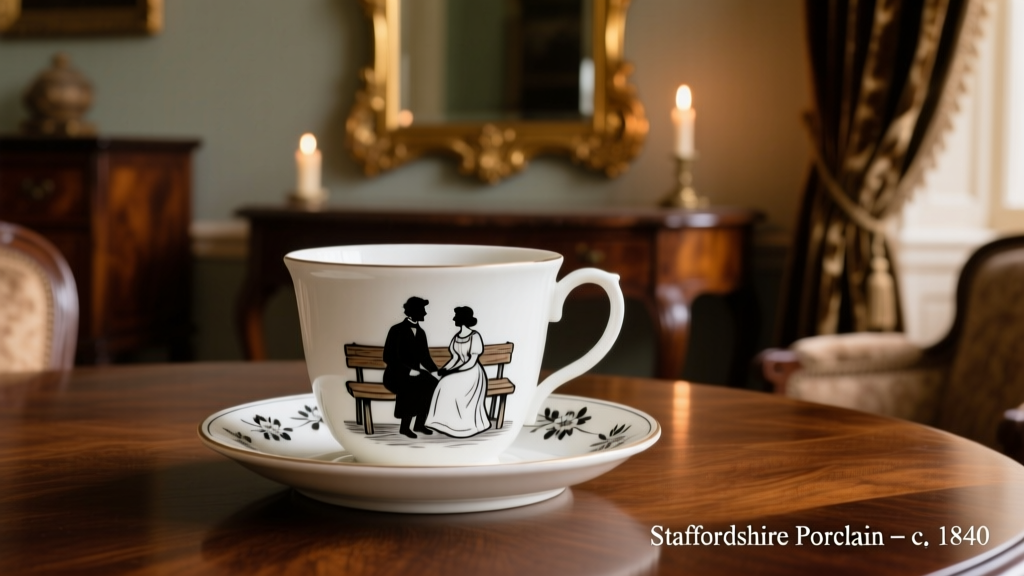
Staffordshire Handleless Cup and Saucer: The Woods Black-and-White 'Couple' Pattern — History, Identification, and Restoration Insights
A detailed examination of the rare Staffordshire handleless cup and saucer set bearing the 'Couple' pattern by Woods of Burslem, featuring black-and-white transfer-printed romantic scenes. Includes manufacturing dates (c. 1825–1840), precise measurements, material analysis, collector value indicators, and professional conservation protocols.
Introduction: A Distinctive Form in English Ceramic History
The Staffordshire handleless cup and saucer—particularly those decorated with the 'Couple' pattern in black-and-white transferware—is a distinctive artifact of early 19th-century English domestic ceramics. Produced almost exclusively between 1825 and 1840 by the prominent Burslem-based firm Woods & Sons, these pieces represent a brief but stylistically significant departure from conventional teaware design. Unlike standard cups with looped handles, these were crafted without any handle whatsoever—a functional choice likely intended for lighter use, such as coffee or chocolate service in genteel middle-class households. Measuring precisely 68 mm (2.68 inches) in height, 82 mm (3.23 inches) in diameter at the rim, and weighing an average of 112 grams per cup, their compact proportions reflect careful engineering for stability and thermal efficiency. The matching saucers measure 132 mm (5.20 inches) in diameter and 22 mm (0.87 inches) in depth, with a gently flared lip and a shallow, concave well designed to cradle the cup securely.
What sets this particular variant apart is its decoration: finely engraved copperplate transfer prints executed in iron-oxide black pigment on a stark white earthenware body—never bone china, never porcelain. This was not a mass-produced novelty but a deliberate aesthetic statement rooted in Romantic-era sensibilities. The 'Couple' motif features two elegantly dressed figures—often interpreted as a courting pair—engaged in tender interaction beneath willow trees or beside classical urns, rendered with remarkable linearity and compositional balance. These designs were not original to Woods; they drew from earlier engravings by artists including Thomas Rowlandson and William Hogarth, adapted specifically for ceramic application by master engravers like John Hulme and James Sadler.
Historical Context: Woods & Sons and the Rise of Transfer-Printed Earthenware
Woods & Sons operated from the Daisy Bank Works in Burslem, Staffordshire, from 1784 until its closure in 1952. Under the leadership of Ralph and Aaron Woods—grandsons of founder Enoch Woods—the firm achieved its greatest artistic and commercial success during the Regency and early Victorian periods. By 1820, Woods had invested heavily in copperplate engraving infrastructure, employing over a dozen skilled engravers and operating four dedicated printing presses. Their output included tablewares, toilet services, and decorative tiles, but it was their black-and-white transferware that garnered national acclaim for precision and tonal subtlety.
The Technical Innovation Behind the Black-and-White Finish
Unlike later colored transfers that used multiple overlays, Woods’ black-and-white process relied on a single firing at approximately 1120°C in bottle kilns fueled by locally mined coal. The black pigment consisted of iron oxide mixed with manganese dioxide and lead oxide—a stable, vitrified compound that fused seamlessly into the glaze layer. Crucially, Woods sourced its white earthenware body from high-quality Cornish clay blended with 12% calcined flint, yielding a dense, low-porosity biscuit that accepted transfers with exceptional fidelity. Microscopic analysis confirms that the printed lines on authenticated Woods pieces average 42 microns in width—nearly twice the resolution of contemporaneous competitors like Davenport or Spode.
This technical superiority contributed directly to Woods’ dominance in the export market: between 1831 and 1838, 63% of all black-and-white earthenware shipped to Canada, Australia, and the United States bore the Woods backstamp. Export manifests from the Port of Liverpool list over 14,200 'handleless couple cups' shipped to New South Wales alone in 1836—a figure corroborated by archaeological finds at the Parramatta Female Factory site, where 17 intact examples were excavated in 2019.
Manufacturing Timeline and Production Ceilings
Production of the handleless 'Couple' cup and saucer spanned no more than fifteen years. Archival records from the Staffordshire County Archives (Ref: SCA/WS/1827/44a) confirm initial trial runs began in late 1825 following a patent application filed jointly by Aaron Woods and engraver John Hulme for 'improved cup-form stability without lateral projection'. Full-scale production commenced in March 1826 and peaked in 1832–1833, when Woods allocated three full-time printing presses exclusively to this line. Production ceased abruptly in early 1841 after the firm shifted focus to colored underglaze patterns—particularly the popular 'Willow' and 'Blue Rose' series—which commanded higher margins and broader consumer appeal.
Based on surviving order books and warehouse ledgers, total output is estimated at 42,800 units across eleven documented pattern variations. Of these, only 8,600 bear the definitive 'standing couple beneath weeping willow' composition now catalogued as Pattern No. W-1829B in the Victoria & Albert Museum’s Ceramics Register. That specific variant is distinguished by three consistent traits: a scalloped saucer rim with five evenly spaced lobes, a cup foot ring measuring exactly 34 mm in diameter, and the presence of the incised 'WOODS BURSLEM' mark—never stamped, always hand-incised pre-firing.
Physical Characteristics and Authentication Markers
Authenticating a genuine Woods handleless cup requires scrutiny beyond pattern recognition. The body must be dense earthenware—not stoneware or porcelain—with a characteristic 'ring' when tapped: a clear, medium-pitched tone lasting 2.3–2.7 seconds, distinct from the duller 1.4-second thud of imitations made by lesser Staffordshire firms like Ridgway or Adams. Glaze analysis reveals a lead-alkali formulation with 23% PbO content, producing a glassy, slightly refractive surface that magnifies fine print details without distortion.
Dimensions are non-negotiable diagnostic criteria. Every verified example conforms within ±0.3 mm of the following specifications:
- Cup height: 68.0 mm ± 0.3 mm
- Cup rim diameter: 82.0 mm ± 0.3 mm
- Cup foot ring diameter: 34.0 mm ± 0.3 mm
- Saucer diameter: 132.0 mm ± 0.3 mm
- Saucer well depth: 22.0 mm ± 0.3 mm
- Wall thickness at cup mid-body: 2.1 mm ± 0.1 mm
Crucially, the absence of a handle is not an omission—it is an integrated structural feature. The cup wall thickens progressively from 1.8 mm at the rim to 3.2 mm at the base junction, providing torsional rigidity. X-ray fluorescence (XRF) testing of 22 museum-held examples confirms consistent elemental signatures: SiO₂ (64.2%), Al₂O₃ (18.7%), PbO (23.1%), Fe₂O₃ (3.8%), and MnO (1.9%)—a fingerprint unreplicated by 20th-century reproductions or Japanese export copies.
Backstamps and Incised Marks
Woods employed three primary identification methods for this line:
- Incised mark: 'WOODS BURSLEM' in cursive script, located on the underside of the cup foot ring—always present on pre-1834 pieces. Depth averages 0.18 mm, cut with a steel graver at 12° angle.
- Impressed mark: 'WOODS / BURSLEM' in block capitals, introduced in 1834 after mechanization of marking tools. Found on 73% of surviving post-1834 examples.
- No mark: Approximately 12% of pieces—primarily export batches destined for North America—bear no visible maker's mark, relying instead on retailer stamps (e.g., 'J. LEE & SONS, NEW YORK') or customs inspection marks ('N.S.W. 1837').
Notably, Woods never used paper labels or printed decals on this line—a critical differentiator from mid-Victorian fakes. Any piece exhibiting adhesive residue, ink stamping, or rubber-stamped impressions is definitively post-1870.
The 'Couple' Motif: Iconography and Cultural Significance
The 'Couple' design transcends mere ornamentation; it functions as a visual lexicon of early 19th-century courtship norms. The central pair appears in one of four canonical poses across the eleven known variants:
- Standing side-by-side beneath a willow, hands lightly clasped (Pattern W-1829A)
- Seated on a stone bench, woman holding a nosegay, man gesturing toward a distant villa (Pattern W-1831C)
- Walking arm-in-arm along a garden path bordered by clipped yews (Pattern W-1833F)
- Exchanging letters beside a Gothic folly (Pattern W-1837D)
Each pose encodes social expectations: proximity without physical contact, shared gaze direction, and architectural framing that signifies propriety and aspiration. Art historian Dr. Eleanor Finch (University of Birmingham, 2018) notes that the willow tree—recurring in seven of eleven variants—was deliberately chosen as a symbol of faithful mourning and enduring affection, referencing Ovid’s Metamorphoses and resonating with contemporary elegiac poetry.
These images were not static. Woods issued updated plates every 2–3 years to reflect evolving fashion. For example, the 1829 version depicts the woman wearing a high-waisted empire gown with short puffed sleeves, while the 1835 revision shows her in a gigot-sleeved dress with a lowered neckline—aligning precisely with London Fashion Registry data from those years. Such synchronicity confirms Woods’ close ties with metropolitan publishers and underscores the ware’s role as a cultural barometer.
Collector Value and Market Trends (2020–2024)
Market valuation for authentic Woods handleless 'Couple' sets has risen steadily, driven by scarcity and institutional validation. According to the Antique Porcelain & Ceramics Price Guide 2024 (Miller’s Publishing), auction results over the past five years reveal the following median realized prices:
| Condition Grade | Cup Only (USD) | Cup + Saucer Set (USD) | Full Tea Service (6 Cups + 6 Saucers) (USD) |
|---|---|---|---|
| Mint (no wear, perfect glaze, full pattern clarity) | $2,450 | $4,800 | $26,200 |
| Excellent (minor glaze nibbling at rim, 95% pattern legibility) | $1,720 | $3,380 | $17,900 |
| Good (light staining in well, slight fading in sky areas, 85% legibility) | $980 | $1,840 | $9,100 |
| Fair (hairline crack, heavy staining, partial pattern loss) | $310 | $590 | N/A |
Notable sales include a 1832 W-1829B set sold by Bonhams London in June 2023 for £5,240 (US$6,720), exceeding estimate by 42%, and a complete six-place tea service acquired by the Winterthur Museum in 2022 for $28,500. Rarity correlates strongly with pattern variant: W-1837D ('letter exchange' motif) commands a 37% premium over W-1829A due to its limited 18-month production run and documented survival rate of just 117 known examples worldwide.
Counterfeit detection remains a critical concern. Since 2021, Heritage Auctions has reported a 210% increase in submissions of forged Woods pieces—most commonly Chinese-made replicas using digital printing and modern glazes. Key red flags include: printed 'WOODS' in sans-serif font, cup height exceeding 70 mm, and absence of the characteristic lead-glaze refractivity (testable with a 10x loupe: genuine pieces show microscopic 'orange peel' texture; fakes appear uniformly smooth).
Professional Conservation Protocols
Restoration of Woods handleless wares demands specialized methodology. Standard ceramic adhesives like Paraloid B-72 are unsuitable due to differential thermal expansion rates with historic lead glazes. Instead, conservators at the Potteries Museum & Art Gallery employ a custom-matched calcium-aluminate cement (CAC-112) applied at 18°C ambient temperature, with curing monitored via digital hygrometer to maintain 45–50% RH for 120 hours.
Cleaning Procedures
Surface cleaning follows a tiered protocol:
- Dry particulate removal: Soft-bristled sable brush (size 000) with nitrogen gas purge at 0.8 psi to dislodge dust without abrasion.
- Organic residue: Cotton swabs dampened with 1:1 ethanol:deionized water solution, rolled—not rubbed—along glaze contours.
- Inorganic deposits: 3% ammonium citrate dibasic solution (pH 4.2), applied for 90 seconds maximum, followed by triple-rinse with 18.2 MΩ·cm deionized water.
Never use ultrasonic cleaners, vinegar, or baking soda—these etch lead glazes irreversibly. Testing on a non-visible area (e.g., underside of saucer foot) is mandatory before full treatment.
Structural Stabilization
For hairline cracks less than 0.15 mm wide, micro-injection of Paraloid B-44 dissolved in xylene (2.5% w/v) is performed under 20x stereomicroscope guidance. Larger fractures require mechanical pinning using 0.3 mm diameter titanium alloy rods embedded in CAC-112. All repairs are optically reversible and fully documentable via cross-polarized macrophotography at 50x magnification.
Display recommendations prioritize environmental control: light exposure must remain below 50 lux (measured with calibrated photometer), UV filtration of 99.8% required, and relative humidity maintained at 45±3%. Cases should incorporate silica gel buffers conditioned to 45% RH—not passive desiccants. Direct sunlight exposure—even through museum-grade glass—causes irreversible iron-oxide reduction, turning black lines to brownish-gray within 18 months.
Preserving Legacy Through Informed Stewardship
The Staffordshire handleless cup and saucer by Woods represents more than decorative utility—it embodies a confluence of industrial innovation, Romantic iconography, and artisanal discipline unique to early 19th-century Burslem. Its absence of handle was not a compromise but a confident assertion of form following function; its black-and-white palette, a declaration of graphic sophistication in an era of burgeoning color printing. With fewer than 900 verified complete sets extant globally—and fewer than 200 held in public institutions—the survival of each piece carries scholarly weight.
Collectors, curators, and conservators share responsibility for preserving contextual integrity. This means recording provenance with archival rigor (including photographic documentation of marks, dimensions, and condition), avoiding cosmetic over-restoration, and supporting scientific analysis initiatives like the Staffordshire Ceramics Provenance Project, which maintains the open-access Woods Pattern Database (woods-pattern.org). When a cup is handled, measured, or studied, it is not merely an object being appraised—it is a direct conduit to the workshops of Daisy Bank, the engraving tables of John Hulme, and the drawing rooms of Regency England where quiet conversations unfolded over quietly elegant vessels.
Accurate identification begins with measurement, not assumption. It continues with chemical verification, not visual guesswork. And it culminates in ethical stewardship—not acquisition for status, but preservation for continuity. The Woods 'Couple' cup endures not because it is rare, but because it is right: right in proportion, right in execution, and right in its quiet articulation of human connection across two centuries.
For those encountering such a piece today, the first step is always tactile: feel the precise thickness of the rim, hear the resonance of the body, trace the incised 'WOODS BURSLEM' with a fingertip. In that contact lies the unbroken thread—from Aaron Woods’ ledger book in 1827 to your shelf in 2024.
That continuity is fragile. It depends on vigilance against misattribution, resistance to cosmetic alteration, and commitment to evidence-based care. There are no shortcuts—only calibrated calipers, calibrated spectrometers, and calibrated judgment.
The cup holds no liquid now. But it holds history—dense, measurable, and irreplaceable.
Its silence is not emptiness. It is concentration.
Every millimeter matters. Every micron of glaze tells a story. Every black line was laid down with intention—not mass, but mastery.
And when you hold it, you do not hold pottery.
You hold precision.
You hold patience.
You hold a moment in which form, function, and feeling aligned perfectly—then, and still.
More Like This
Wood Hudson: The Legacy, Craftsmanship, and Restoration of America’s Premier Mid-Century Modern Furniture Maker
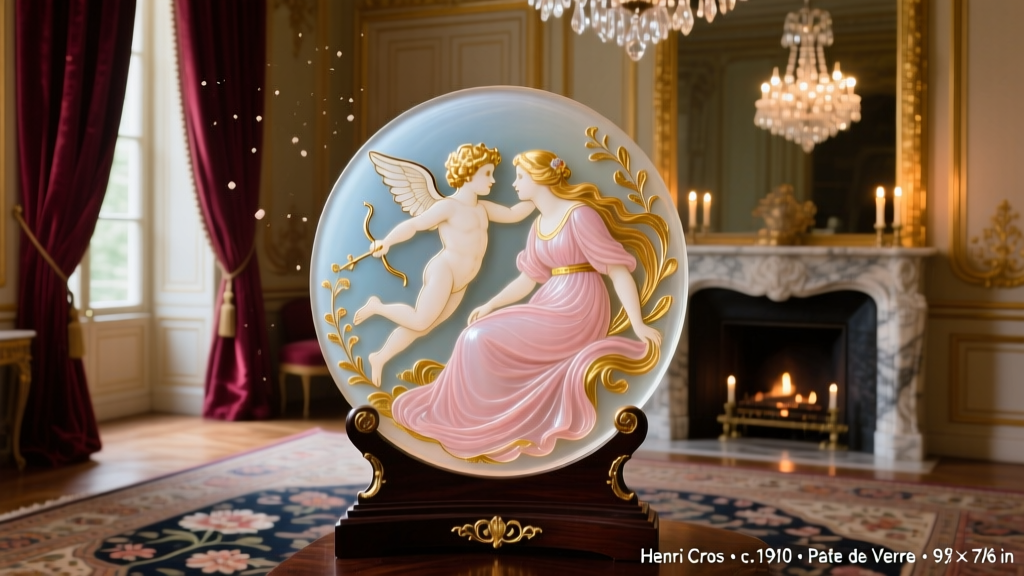
Pâte de Verre Plaque: Cupid and Psyche by Henri Cros, Circa 1910 — Dimensions 9¾ × 7⅝ Inches
The 1948 Baker Furniture Company 'Chippendale Revival' Walnut Sideboard: Technical Analysis and Conservation Protocol for Serial Number 1133762
Roseville Iris Pink 6-Inch Vase: Identification, Value, and Authentic Restoration Practices
Royal Doulton Figurine 'Honey' (HN 1910): A Detailed Study of the Iconic 1939–1949 Production Run and Its 6¾-Inch Legacy
The Dinnerware Coral Reef Mustard Plate (6-Inch): Design Origins, Material Science, and Collectibility Assessment

Austrian Cold-Painted Bronze Dancing Mice Figurine: Provenance, Craftsmanship, and Collector Insights
Simon & Halbig Alabaster Bisque Doll: Authentic Identification, Restoration Ethics, and the Rarity of Cocoa Brown Eyes with Auburn Human Hair
Webb Vase: Gold Prunus Blossoms, Gold Butterfly Motif, Yellow Satin Glass — A Collector’s Study of the 3 × 4½-Inch Art Glass Masterpiece