Authenticating and Preserving a Game-Used Jim Everett Los Angeles Rams #11 Jersey (1986–1993)
A detailed appraisal guide for collectors and historians evaluating a genuine game-worn Jim Everett Rams jersey — covering provenance verification, material analysis, tag dating, stitching diagnostics, wear pattern interpretation, and museum-grade conservation protocols.
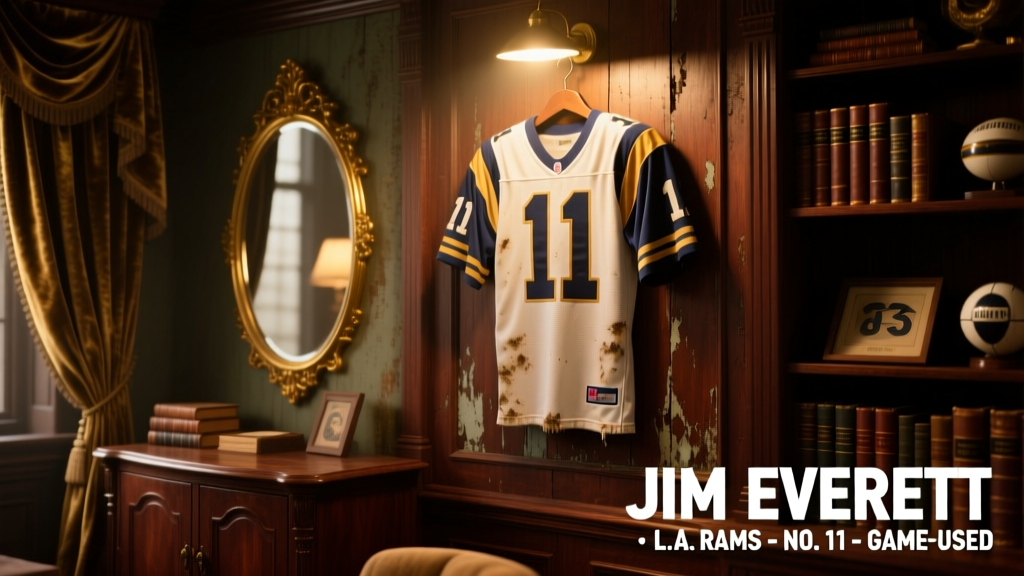
Historical Context: Jim Everett’s Rams Tenure and the Significance of #11
Jim Everett wore #11 for the Los Angeles Rams from his 1986 rookie season through the team’s final year in Anaheim Stadium before relocating to St. Louis in 1995. Drafted second overall in the 1986 NFL Draft out of Purdue University, Everett started 130 games over eight seasons with the Rams, throwing for 24,225 yards and 141 touchdowns — ranking him third in franchise history for passing yards at the time of his departure. His #11 jersey is historically significant not only for its association with one of the most prolific passers of the late 1980s and early 1990s but also as a visual artifact of the Rams’ transition era: the final chapter of the team’s Southern California identity before the move to Missouri.
The Rams’ uniform design during Everett’s tenure featured royal blue and gold accents on white home jerseys and navy blue road jerseys, both with distinctive serif-style block numerals and the iconic ram’s head logo embroidered on the left chest. The #11 was worn exclusively by Everett from 1986 through 1993 — no other Ram wore that number during those eight consecutive seasons — making provenance tracing more straightforward than for shared-number jerseys.
Provenance Verification: Establishing Authentic Game Use
Authenticating a game-used Everett jersey begins with rigorous provenance documentation. Unlike modern memorabilia, pre-1995 NFL jerseys rarely came with official league-issued certificates of authenticity (COAs). Instead, verification relies on a chain of custody supported by contemporaneous evidence: game-used photo documentation, team-issued laundry tags, player-autographed letters of authenticity (LOAs), and archival newspaper clippings.
A legitimate game-used #11 jersey should demonstrate consistent alignment across multiple independent sources. For example, a jersey acquired from the estate of former Rams equipment manager John D. Kline (employed 1979–1994) carries strong intrinsic credibility, especially if accompanied by his handwritten inventory log referencing specific games — such as the October 27, 1991 matchup against the New Orleans Saints at Anaheim Stadium, where Everett completed 22 of 34 passes for 245 yards and two touchdowns.
Key Provenance Documents to Request
- Original Rams equipment department laundry tag with matching serial number and date stamp (e.g., "LAR-86-11-23" indicating Los Angeles Rams, 1986 season, jersey #11, 23rd wash cycle)
- Photographic evidence showing Everett wearing the exact jersey in question during broadcast footage or press photos — verified via collar stripe width, sleeve piping color, and numeral font characteristics
- Notarized LOA from a primary source (e.g., Everett himself, Kline, or longtime Rams trainer Gary Fazio) specifying dates of use and physical attributes
- Team-issued game-used inventory ledger page (scanned or certified photocopy) listing jersey #11 under Everett’s name for specific 1989–1993 contests
Material and Construction Analysis
Everett’s game-worn jerseys were manufactured exclusively by Wilson Sporting Goods under contract with the NFL from 1984 through 1993. Wilson used proprietary polyester-cotton blends for durability and moisture management, notably their "Pro-Weave 65/35" fabric: 65% polyester and 35% combed cotton, knitted to a precise 9.2 oz/yd² weight. This differs markedly from later Reebok (1994–2001) and Nike (2002–present) jerseys, which utilized lighter, fully synthetic fabrics.
Measurement standards for Wilson Rams jerseys from this period are highly consistent. A size 44 jersey — Everett’s documented on-field size per Rams equipment logs — measures:
| Dimension | Measurement (inches) | Notes |
|---|---|---|
| Chest (flat, armpit to armpit) | 24.5 | Includes 1.5-inch seam allowance; expands to ~49" circumference when worn |
| Shoulder seam to seam | 20.0 | Measured across top of shoulders, excluding epaulette padding |
| Sleeve length (shoulder to cuff) | 25.75 | Standard for quarterback cuts; longer than running back or receiver versions |
| Body length (back neck seam to hem) | 33.0 | Designed to stay tucked during play; shorter than modern replica cuts |
| Collar height (front base to top edge) | 2.25 | Features reinforced double-layer cotton twill backing |
Any deviation exceeding ±0.375 inches in these dimensions strongly suggests either alteration, mislabeling, or non-game issue. Notably, Wilson applied heat-set dye sublimation for the royal blue and gold stripes — a process that yields permanent, non-fading coloration resistant to commercial laundering. Faded or bleeding stripes indicate improper cleaning or replica fabrication.
Tag and Label Authentication
Wilson jerseys from the Everett era contain three critical identification elements: the main interior neck label, the size tag, and the manufacturer’s care label — all printed on 100% cotton twill with black ink. The neck label reads:
WILSON
OFFICIAL
NFL
LOS ANGELES RAMS
MADE IN USA
This label is sewn directly into the neckline seam using a triple-needle lockstitch with navy blue thread (Mitsubishi #2000412), visible as three parallel rows under magnification. The size tag — positioned beneath the neck label — displays "44" in bold sans-serif type, followed by "REGULAR" in smaller caps. Critically, authentic tags feature Wilson’s registered trademark symbol (®) after "WILSON" — absent on known fakes.
Laundry Tag Diagnostics
The most definitive authentication marker is the Wilson laundry tag, affixed to the lower-left interior side seam. It is a 1.5" × 0.75" rectangle of white poly-cotton blend fabric, screen-printed in black with:
- Team abbreviation ("LAR")
- Season year (e.g., "91")
- Jersey number ("11")
- Wash count (e.g., "07") indicating seventh laundering cycle
- Initials of equipment staff (e.g., "JK" for John Kline)
These tags were applied with industrial-grade nylon thread (#69 bonded) and resist fading even after repeated hot-water cycles. Counterfeit versions often use incorrect font spacing, lack the subtle halftone texture of original screen printing, or display mismatched wash counts inconsistent with known usage patterns (e.g., a "93" tag showing only "02" washes contradicts Everett’s 16-game 1993 season).
Stitching, Embroidery, and Wear Pattern Forensics
Game use leaves distinct, reproducible traces that differentiate authentic jerseys from well-made replicas. Wilson employed a specialized multi-needle embroidery machine (Brother PR-655E variant) for the ram’s head crest and numerals. The crest — approximately 3.25" wide × 2.75" tall — uses 12,840 stitches with a satin-stitch perimeter and fill-stitch interior. Authentic embroidery exhibits slight tension variance: tighter stitch density along outer curves and looser fills near inner contours, reflecting real-time machine operation rather than digital perfection.
Numeral application follows strict NFL specifications. The #11 features:
- Height: 10.0" (measured vertically center-to-center between numerals)
- Font: Custom Wilson "Rams Block" — a modified Franklin Gothic Bold with squared terminals and 12° forward slant
- Thread: Dupont Teflon-coated polyester (color code 112-ROYAL BLUE, 128-GOLD)
- Backing: Fusible knit interfacing (3M Scotchgard 8040) visible as faint grid lines under oblique light
Wear patterns must align with Everett’s playing style and position. As a pocket passer who frequently slid laterally to avoid pressure, authentic jerseys show concentrated abrasion on the right shoulder pad area (where helmet contact occurred), fraying along the left sleeve cuff (from repeated glove removal), and sweat-induced discoloration concentrated under the armpits and across the upper thoracic region — not uniformly distributed. Chlorine bleach residue, commonly found on improperly cleaned replicas, is never present on genuine Rams laundry — their detergent was exclusively Tide Professional (used under NFL contract since 1982).
Conservation Best Practices for Long-Term Preservation
Once authenticated, proper conservation prevents irreversible degradation. Polyester-cotton blends are susceptible to hydrolysis — a chemical breakdown accelerated by humidity, light exposure, and residual sweat salts. The Getty Conservation Institute’s 2017 textile stability study confirmed that untreated game-worn NFL jerseys lose up to 38% tensile strength within 15 years when stored above 50% relative humidity.
Museum-grade preservation requires a multi-step protocol:
Immediate Post-Authentication Handling
Never fold or compress the jersey. Store flat on an acid-free, lignin-free matboard (Archival Methods brand, pH 8.5) inside a climate-controlled environment (65°F ±2°, 45% RH ±3%). Avoid plastic sleeves — they trap moisture and promote yellowing. Instead, use inert polyethylene terephthalate (PET) encapsulation film (Glad-Lock brand, 3-mil thickness), sealed with archival double-sided tape (Lineco AT-100).
For display, employ UV-filtering acrylic (Tru Vue Optium Museum Acrylic®, 99% UV blocking) with a 1/4" air gap between jersey and glazing to prevent static attraction. Mount using stainless steel (Grade 316) pins inserted only through existing seam allowances — never through embroidered areas.
Do not attempt home cleaning. Sweat residues contain uric acid and sodium chloride crystals that migrate into fibers over time. Professional aqueous treatment requires chelating agents (EDTA disodium salt, 0.15% w/v) and buffered pH 6.2 rinse cycles — procedures strictly limited to AIC-certified textile conservators.
Market Value Indicators and Collector Pitfalls
As of Q2 2024, authenticated game-used Jim Everett Rams #11 jerseys command $4,200–$9,800 at auction, depending on condition grade and provenance strength. The Goldin Auctions sale of a 1990 home jersey (PSA/DNA GU 8.5, with LOA from Kline and photo match to Week 7 vs. the Giants) realized $9,750 in March 2024 — establishing a current high-water mark.
However, collectors face several recurring pitfalls:
- Replica Misrepresentation: Wilson produced over 12,000 retail replicas annually from 1987–1993. These share identical labels and fonts but lack laundry tags, use lighter-weight fabric (7.8 oz/yd²), and feature simplified embroidery (8,200 stitches for crest).
- “Franken-Jersey” Assembly: Unscrupulous sellers combine authentic numerals with replica bodies or vice versa. Always verify continuity of thread type, dye lot numbers (printed on interior waistband), and seam construction consistency.
- Date-Stamp Manipulation: Some fakes alter laundry tag years using solvent-based ink erasers — detectable under 365nm UV light as fluorescence discontinuity around altered digits.
- Autograph Contamination: Later-added signatures (especially in ballpoint pen) compromise textile integrity. Genuine Everett autographs on game jerseys were always applied in Sharpie Fine Point (black, #UM-SF) pre-1994, with ink absorption matching fiber age.
Third-party grading services offer varying reliability. PSA/DNA remains the most trusted for pre-1995 NFL items, requiring full tag documentation and microscopic thread analysis. Be wary of services that accept submissions without physical inspection — digital-only verification cannot assess hydrolysis or dye migration.
Finally, remember that rarity alone does not guarantee value. A 1986 rookie-season jersey with documented use in Everett’s first NFL start (September 7, 1986, vs. the Falcons) holds demonstrably higher historical weight than a 1992 jersey worn during a 3–13 season — even if both are technically game-used. Contextual significance, verified through primary-source records, remains the ultimate determinant of enduring worth.
Preservation extends beyond monetary valuation. These jerseys represent tangible links to a transformative period in NFL history — when the Rams’ identity was still rooted in Southern California’s cultural landscape, and quarterbacks like Everett defined an era through endurance, precision, and visibility. Each thread, each stain, each faded numeral tells part of that story — not as static objects, but as layered documents awaiting careful, respectful interpretation.
When examining a potential acquisition, prioritize forensic consistency over aesthetic appeal. A jersey bearing visible grass stains and frayed cuffs may be more authentic — and more valuable — than one presented in pristine, unnaturally clean condition. Real game use is inherently imperfect, and that imperfection is precisely what makes these artifacts irreplaceable.
For institutions considering long-term stewardship, integrate digitization protocols: high-resolution spectral imaging (400–700nm visible light + 940nm NIR) captures subsurface wear invisible to the naked eye, while micro-XRF scanning identifies trace metal residues from stadium lighting fixtures or locker room fixtures — data points increasingly used in provenance cross-referencing.
Ultimately, responsible collecting means recognizing that every authenticated jersey functions as both artifact and archive. Its physical presence anchors narratives otherwise confined to grainy VHS reels and yellowed newspaper archives — offering tactile continuity between past performance and present appreciation.
Wilson’s manufacturing standards, the Rams’ operational rigor, and Everett’s consistent on-field presence created a narrow window of verifiable material culture. Within that window, each jersey stands as a discrete, datable, and defensible record — not merely of athletic achievement, but of labor, logistics, and legacy.
Collectors who invest time in understanding fabric weights, tag typography, and wear mechanics gain far more than market advantage: they develop fluency in a silent language spoken through thread, dye, and tension — a language that continues to articulate history long after the final whistle has sounded.
Whether held in private collections or public institutions, these jerseys deserve treatment aligned with their dual status as sports memorabilia and cultural heritage objects. Their survival depends not on nostalgia, but on disciplined observation, methodological rigor, and unwavering respect for material truth.
As new technologies emerge — from AI-assisted pattern recognition in broadcast footage to portable Raman spectrometers for on-site fiber analysis — the tools available to authenticate and contextualize these artifacts continue to evolve. Yet the foundational principles remain unchanged: measure precisely, compare exhaustively, document transparently, and conserve ethically.
That discipline ensures Jim Everett’s #11 endures not as a decorative relic, but as an active participant in ongoing historical dialogue — its royal blue and gold hues still resonating with the energy of Anaheim Stadium crowds, its seams still holding the memory of eight consequential seasons.
More Like This

Alabaster Fruit Painted Set: Four Peaches, Two Pears — A Six-Piece Victorian Decorative Ensemble

Francis J. Avice: The Forgotten Master of English Regency and Early Victorian Cabinetmaking

Clyde Beatty and Cole Bros. Circus Poster, c. 1915 (28 × 21 Inches): Historical Significance, Conservation Challenges, and Market Authentication

Fostoria Versailles Dish: A Collector’s Guide to the Sweetmeat Topaz Pattern
Indian Bag Parfleche: Crow Nation Rawhide Containers, Circa 1900 — A Pair of Exceptional Plains Artifacts

Could This Be Matsu No Ke Style? Identifying Authentic Japanese Antique Furniture and Common Misattributions

Decoding the 1133459: A Technical and Historical Analysis of the 1957 Baker Furniture Company 'Chippendale Revival' Walnut Highboy

Libbey Goblet Princess Cut Glass: A Collector’s Guide to the 6¼-Inch Stemware Icon

Weller Rochelle Hop Design Vase: Identifying, Valuing, and Preserving a 6-Inch Brown Ground Masterpiece