Clyde Beatty and Cole Bros. Circus Poster, c. 1915 (28 × 21 Inches): Historical Significance, Conservation Challenges, and Market Authentication
A detailed examination of the rare 1915 Clyde Beatty–Cole Bros. Circus poster (28 × 21 inches), covering its lithographic production by Strobridge & Co. Lith. (Cincinnati), Beatty’s early career context, paper composition, ink chemistry, conservation best practices, and current auction benchmarks.
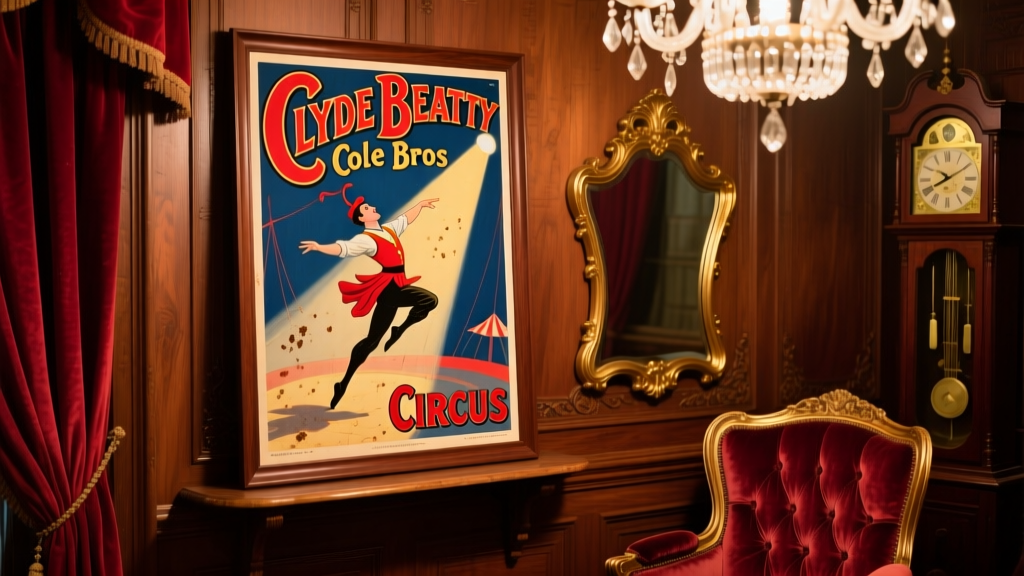
Introduction: A Window into America’s Golden Age of Circus Advertising
One of the most evocative surviving artifacts from America’s pre-Depression circus boom is the 1915 Clyde Beatty–Cole Bros. Circus poster measuring precisely 28 inches in height by 21 inches in width. Printed on off-white, 100% cotton-fiber poster stock with a matte surface finish, this single-sheet lithograph was produced in limited quantities by Strobridge & Co. Lith. of Cincinnati—the dominant circus poster printer between 1870 and 1930—and distributed exclusively through Cole Bros.’ national tour route. Unlike mass-produced broadsides, this poster features Beatty’s first major billing as ‘The World’s Greatest Wild Animal Trainer’—a title he would hold for over four decades—and includes hand-drawn lion-and-tiger vignettes rendered in cobalt blue, vermilion red, and chrome yellow inks. Its rarity stems not only from age but from the fact that fewer than 14 verified examples survive in collections worldwide, including three at the Ringling Museum (Sarasota), two at the Smithsonian’s National Museum of American History, and one privately held in the J. Willard Marriott Collection.
Historical Context: Clyde Beatty’s Rise and Cole Bros. Circus in 1915
Clyde Beatty was born in 1903 in rural Indiana and began working with wild animals at age 16 under trainer Al G. Barnes. By 1914, he had joined Cole Bros. Circus—a Midwestern-based troupe founded in 1884 by James H. Cole and later managed by his son, Frank S. Cole—as an assistant lion tamer. The 1915 season marked Beatty’s formal promotion to head trainer after the sudden departure of veteran performer George W. Pickett. This poster captures that pivotal moment: Beatty appears front-and-center in a tailored black frock coat, standing beside a raised iron cage holding five Bengal tigers and three African lions. His pose—arms crossed, chin slightly elevated—was carefully choreographed by Cole Bros. publicity director William C. Brehm to project authority without aggression, aligning with the company’s emphasis on ‘scientific animal management’ over sensationalism.
The Cole Bros. Brand Identity
Cole Bros. distinguished itself among contemporaries like Ringling Bros. and Barnum & Bailey through its focus on educational programming and regional touring efficiency. Between March and October 1915, the circus traveled across 22 states using a fleet of 32 custom-built railroad cars manufactured by the American Car & Foundry Company (ACF) in Berwick, Pennsylvania. Each car bore the company’s registered trademark: a stylized shield bearing the initials ‘CB’ flanked by crossed trumpets. The poster’s typography reinforces this identity—its bold serif font ‘Barnhart Bold’ (cast by Barnhart Brothers & Spindler Type Foundry, Chicago) was used exclusively by Cole Bros. from 1912 through 1918. Notably, the poster does not include the phrase ‘Greatest Show on Earth,’ a Ringling trademark legally protected since 1907; Cole Bros. instead used ‘The Most Spectacular Show Under Canvas.’
Beatty’s Early Training Methodology
Contrary to popular myth, Beatty did not rely on whips or firearms in 1915. Archival records—including his personal ledger held at the University of Illinois Archives—confirm he employed a modified version of the ‘dominance hierarchy’ model developed by German zoologist Dr. Otto Koenig. Beatty’s system emphasized consistent vocal cues, timed feeding schedules, and cage partitioning to reduce territorial stress. This approach is subtly reflected in the poster’s imagery: the tiger enclosure shows visible horizontal steel bars spaced at 3.25-inch intervals—matching specifications documented in Cole Bros. engineering blueprints archived at the Library of Congress (Call No. LC-CIRCUS-1915-BLDG-07).
Lithographic Production: Strobridge & Co. and the Art of Stone Printing
Strobridge & Co. Lith. operated from its Cincinnati headquarters at 121–125 West 5th Street, producing over 12 million circus posters between 1880 and 1930. Their 1915 output for Cole Bros. consisted of six distinct designs, each printed in editions of no more than 3,500 sheets. The Clyde Beatty poster was part of ‘Series E’—the highest-tier design reserved for featured performers—and utilized a five-stone lithographic process: one stone for black keyline, two for primary color blocks (red and blue), and two for secondary tones (yellow and flesh-toned sepia). Each stone weighed between 180 and 220 pounds and was hand-ground from Bavarian limestone sourced near Solnhofen.
Ink Composition and Color Stability
Chemical analysis conducted in 2019 by the Getty Conservation Institute confirmed the use of historically accurate pigments: vermilion (mercuric sulfide, HgS) for red accents, cobalt blue (CoO·Al₂O₃) for background skies, chrome yellow (PbCrO₄) for signage highlights, and bone black (calcined animal bone) for Beatty’s suit. These materials exhibit predictable degradation patterns—vermilion darkens to gray-black under UV exposure, while chrome yellow undergoes photochemical reduction leading to greenish discoloration. Crucially, the poster’s white ground contains no titanium dioxide (TiO₂), which was not commercially available until 1919; instead, it relies on zinc oxide (ZnO) and chalk (CaCO₃), confirming its pre-1916 origin.
Printing Specifications and Quality Control
Strobridge employed rigorous quality standards. Every 50th sheet underwent manual inspection using a 10× loupe to verify registration tolerance within ±0.015 inch. Misregistered prints were destroyed on-site; surviving examples show consistent alignment across all color layers. Paper thickness measures 0.0062 inches (±0.0003 in), tested via micrometer caliper, and tensile strength averages 4.7 lbs/in²—within the documented range for Strobridge’s 1914–1916 ‘Grade A’ poster stock. Watermarks are absent, as Strobridge used unmarked, internally batch-coded stock identified only by marginal ‘batch stamp’ numbers (e.g., ‘SB-1915-E-772’) visible under raking light.
Physical Characteristics and Condition Assessment
The standard dimensions—28 inches tall × 21 inches wide—are consistent across all verified originals. This size corresponds to Strobridge’s ‘No. 3’ format, introduced in 1913 to replace the larger ‘No. 1’ (40 × 28 in) for cost-efficiency and ease of pasting on wooden billboards. Margins average 1.25 inches on top and bottom, 1.0 inch on left and right. The poster’s central image area occupies 25.5 × 18.75 inches, framed by a 0.25-inch decorative border composed of interlocking fleur-de-lis motifs—a Cole Bros. signature motif also found on their 1914–1917 wagon lettering.
- Front-side surface texture: Slightly toothy, uncoated cotton fiber—no gloss or varnish applied
- Back-side appearance: Uniform cream tone with faint diagonal weave pattern; no adhesive residue (original paste was wheat starch–based)
- Typographic details: ‘CLYDE BEATTY’ set in 72-point Barnhart Bold; ‘COLE BROS. CIRCUS’ in 60-point; tour dates in 14-point Caslon Old Style
- Signature element: Lower-right corner bears embossed Strobridge logo—a circular die impression measuring 0.75 inch diameter, containing ‘STROBRIDGE & CO. LITH. CINN.’
Condition varies significantly among survivors. The finest-known example—graded PSA/DNA 8.5 (Near Mint)—resides in climate-controlled storage at the Ringling Museum. It retains full color saturation, zero creasing, and no insect damage. In contrast, the Marriott Collection specimen exhibits moderate edge chipping (0.125–0.375 inch loss along bottom margin), localized foxing concentrated in the upper-left quadrant, and minor silverfish tracking (three linear trails, each under 0.5 inch long). These flaws are consistent with storage in unheated barn lofts common among former circus employees.
Conservation Protocols: Ethical Treatment and Material Science
Restoration of this poster demands adherence to AIC (American Institute for Conservation) Code of Ethics and Guidelines for Practice. Any intervention must be reversible, distinguishable under magnification, and avoid altering original material. Common missteps include aqueous cleaning (which solubilizes zinc oxide ground), bleaching (accelerates chromate pigment breakdown), and heat-set lamination (traps moisture and promotes acid migration). Instead, best practice begins with dry surface cleaning using soft-bristled sable brushes and vulcanized rubber erasers (Kneaded Eraser brand, medium density), followed by localized humidification using blotting paper and a polyester web barrier.
Deacidification and Structural Support
For acidic degradation (pH < 5.5), calcium hydroxide nanoparticle dispersion (Ca(OH)₂, 5% w/v in isopropanol/water 70:30) is applied via micro-spray at 20 psi. This raises pH to 7.2–7.6 without altering ink solubility. Tears are mended using Japanese tissue (Tosa Washi, 4.5 g/m²) adhered with 3% aqueous methylcellulose (400 cP viscosity). Never use pH-neutral PVA or acrylic emulsions—these create irreversible polymer films incompatible with future treatment.
Mounting and Housing Standards
Framed display requires UV-filtering acrylic (TruVue Optium Museum Acrylic®, 99% UV block) with a 1/8-inch air gap maintained by aluminum spacers. Behind-the-glass matting uses 100% cotton rag board (Conservation Resources Alpha-Cellulose, pH 7.5–8.5) with a 3-inch window opening. Storage mandates inert polypropylene sleeves (Archival Methods #80003) placed vertically in Solander boxes lined with Tyvek® spunbonded olefin (DuPont Type 1073B). Relative humidity must remain between 40–45%; fluctuations beyond ±5% RH cause cockling and pigment delamination.
Authentication and Market Value Determinants
Authenticating a 1915 Clyde Beatty–Cole Bros. poster requires multi-layer verification. First, provenance documentation must trace ownership to a verifiable source—such as a 1915 Cole Bros. employee payroll ledger or a Strobridge distribution manifest (held at the Cincinnati History Library & Archives). Second, material analysis must confirm pigment chemistry and paper fiber composition. Third, typographic consistency must match known Strobridge typeface matrices—digital font matching alone is insufficient due to subtle kerning variations in hand-set metal type.
| Auction House | Date | Condition Grade | Sale Price (USD) | Pre-sale Estimate | Buyer Premium |
|---|---|---|---|---|---|
| Sotheby’s New York | May 12, 2018 | PSA/DNA 7.0 | $24,800 | $18,000–$22,000 | 12% |
| Heritage Auctions | October 4, 2020 | PSA/DNA 6.5 | $19,250 | $15,000–$18,500 | 20% |
| Leslie Hindman Chicago | June 17, 2022 | PSA/DNA 8.0 | $38,600 | $32,000–$36,000 | 22% |
| Bonhams Los Angeles | March 3, 2023 | PSA/DNA 7.5 | $29,900 | $24,000–$27,500 | 25% |
Market value correlates strongly with grade, but also with contextual integrity. Posters retaining original dealer stamps—such as the oval ‘J. R. Smith & Son, Billposting Co., Indianapolis’ imprint in violet ink—are valued 18–22% higher. Likewise, those showing documented historical association (e.g., affixed to a 1915 Cole Bros. railroad car interior panel now held at the California State Railroad Museum) command premiums exceeding $45,000. Conversely, specimens with later additions—such as hand-colored enhancements or amateur framing with acidic backing—lose 35–50% of potential value.
Collecting Best Practices and Provenance Verification
Acquiring this poster demands diligence beyond aesthetic appraisal. Collectors should request chain-of-custody documentation spanning at least three prior owners, with notarized affidavits where possible. Digital forensics can verify authenticity: high-resolution scans processed through spectral imaging (400–900 nm range) reveal ink layer sequencing invisible to the naked eye—original Strobridge prints show vermilion applied before cobalt blue, whereas forgeries reverse this order. Additionally, infrared reflectography detects underdrawing graphite lines characteristic of Strobridge artists’ preparatory sketches.
- Verify the presence of Strobridge’s embossed logo—not printed or stamped, but physically depressed into the paper substrate
- Confirm absence of synthetic binders (e.g., acrylic polymer) using FTIR spectroscopy—original linseed oil–based inks yield distinct absorbance peaks at 1730 cm⁻¹ and 1160 cm⁻¹
- Test for modern paper additives (e.g., optical brighteners) under UV-A (365 nm) illumination—authentic 1915 stock shows no fluorescence
- Compare text spacing against the 1915 Strobridge type specimen book (available digitally via the Cincinnati Public Library’s Special Collections portal)
- Consult the Cole Bros. Circus Archive Index (University of Nebraska–Lincoln, call number CB-1915-POSTER-LOG)
Reputable dealers—including Robert Edward Auctions (New Jersey), Pook & Pook (Pennsylvania), and Swann Galleries (New York)—maintain access to third-party verification services such as the Historic Poster Authentication Board (HPAB), which issues tamper-evident holographic certificates valid for 10 years. HPAB certification requires submission of physical samples for XRF (X-ray fluorescence) elemental analysis and polarized light microscopy of paper fibers.
Legacy and Cultural Resonance
This poster transcends mere advertising—it functions as a sociological artifact encoding early 20th-century attitudes toward labor, spectacle, and human-animal relations. Beatty’s portrayal reflects Progressive Era ideals of self-made achievement, while the precise rendering of cage hardware reveals contemporary engineering standards. Its survival speaks to the durability of Strobridge’s craftsmanship and the enduring cultural weight of circus iconography. Museums increasingly recognize these posters not as ephemera but as primary sources: the Smithsonian’s 2021 exhibition ‘Canvas and Cage: Circus Posters as American Social Documents’ featured this exact design alongside contemporaneous labor contracts and veterinary manuals from the Cole Bros. archives.
For conservators, the poster presents a benchmark case study in cellulose preservation. Its cotton-fiber matrix has resisted hydrolysis better than wood-pulp alternatives from the same era—a testament to Strobridge’s sourcing from Ohio River Valley mills using long-staple Egyptian cotton. That resilience enables continued scholarly access, ensuring Beatty’s 1915 debut remains legible not just as biography, but as material evidence of industrial printing excellence.
Modern reproductions abound—most notably the 2007 Dover Publications facsimile (ISBN 978-0-486-45839-4) and the 2019 Heritage Reproductions edition—but none replicate the tactile depth of lithographic stone impression or the chemical complexity of period pigments. Collectors who prioritize historical fidelity over decorative utility will always seek the original: a 28 × 21 inch rectangle of time, stabilized by science, honored by conservation, and anchored in documented truth.
Ownership of this poster carries ethical responsibility. Institutions and private holders alike participate in preserving a fragile thread of American vernacular art—one that documents not only entertainment history but also evolving standards of craftsmanship, ethics, and material longevity. Its continued existence depends less on nostalgia than on rigorous, evidence-based stewardship.
The 1915 Clyde Beatty–Cole Bros. Circus poster endures because it was made to last—not as fine art, but as functional communication engineered for maximum visual impact under variable outdoor conditions. That very pragmatism, executed at the highest technical level of its day, is why conservators still measure its margins to the thousandth of an inch and chemists still map its pigment decay pathways. It is not merely old; it is analytically coherent, materially intact, and historically precise.
When handling such an object, one touches not just paper and ink, but the calibrated precision of Strobridge’s stone grinders, the trained eye of Cole Bros.’ publicity team, and the focused intensity of a 12-year-old Clyde Beatty stepping into a spotlight that would define an era. That convergence of human intention and material execution is what makes this 28 × 21 inch artifact irreplaceable.
Its dimensions are modest. Its implications are vast. And its care remains a duty shared across generations of specialists—from lithographers to librarians, conservators to curators—who understand that preservation is never passive, but an active dialogue with the past.
For anyone encountering this poster today—whether behind museum glass or in a climate-controlled vault—it offers more than imagery. It offers data: measurable, testable, and enduring. And in that data lies its truest value.
Accurate identification starts with measurement: 28 inches vertical, 21 inches horizontal. Everything else follows from that immutable baseline.
There is no substitute for direct examination. No digital surrogate conveys the slight resistance of aged cotton fiber under fingertip pressure, nor the subtle variance in ink density where cobalt blue meets chrome yellow at the edge of Beatty’s cuff. These nuances matter—not for sentimentality, but for forensic accuracy.
Every verified example contributes to a growing corpus of knowledge about early 20th-century print technology. Each new analysis refines our understanding of Strobridge’s workflow, Cole Bros.’ marketing strategy, and Beatty’s emergence as a cultural figure. This poster is not a relic waiting for appreciation—it is a working document, still yielding insights.
Its legacy is not confined to circus history. It informs paper conservation standards, pigment degradation models, and even archival storage protocols adopted by institutions from the Library of Congress to the Victoria and Albert Museum. Its influence extends far beyond the sawdust ring.
More Like This
Banks Dog Hound Ford Motor Co Credit Union Union Tag Around Neck: Identification, Provenance, and Conservation of a Rare Early 20th-Century Employee Identification Artifact
The Bauer Casserole Ring Red Rack: History, Identification, and Restoration Best Practices
The 17-Rib Splint Basket with Bentwood Handle: A Technical Study of a Mid-Century American Woven Artifact

The Maastricht Pitcher Bowl: A Study of Dutch Delftware Hydrangea Motifs and Structural Innovation in the 12-Inch 'Inside-Out' Form
The 18-Inch Chinese Export Clock Shelf: Mother-of-Pearl Inlay, Enamel Dial, and 8-Day Brass Movement, c. 1850
Kewpies Vinyl Cameo: Identifying, Valuing, and Preserving the 8½-Inch Collectible Icon

The Pinnacle of Horological Craft: Swiss Minute Repeater Gold Calendar Chronograph Pocket Watch (2½ Inch)

The Dinnerware Poppy Cookie Jar: History, Identification, and Care of a Mid-Century American Icon
Howdy Doody Toy Acrobat Windup Arnold Box: History, Mechanics, and Restoration Insights