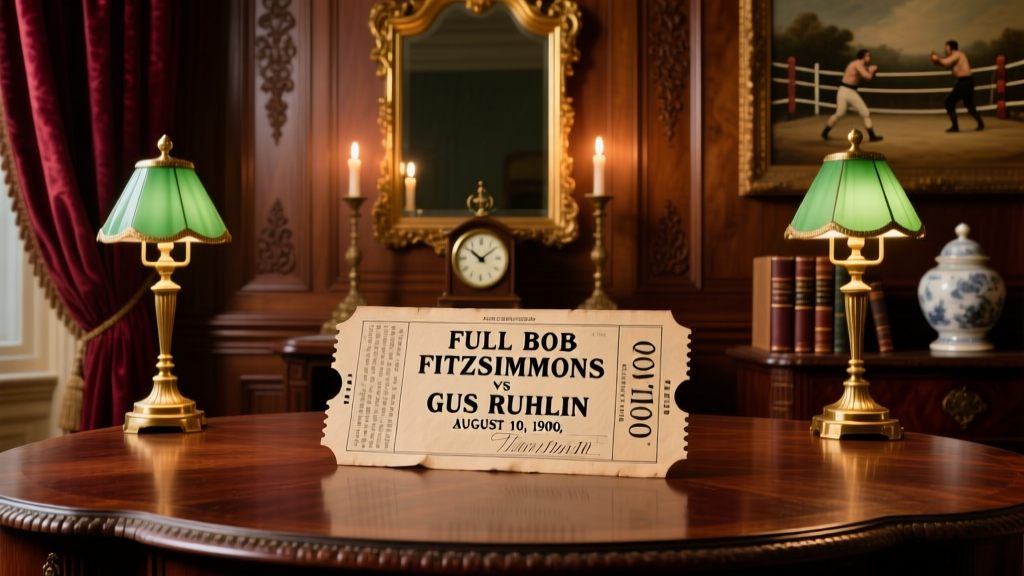
The Fitzsimmons–Ruhlin Boxing Ticket of August 10, 1900: A Rare Artifact from the Dawn of Modern Prizefighting
An in-depth examination of the original full admission ticket for the Bob Fitzsimmons vs. Gus Ruhlin bout held at Coney Island’s Brighton Beach Athletic Club on August 10, 1900 — including physical specifications, historical context, printing methods, provenance significance, and conservation considerations for collectors and institutions.
The Historic Bout and Its Singular Ticket
On Friday, August 10, 1900, former world heavyweight champion Bob Fitzsimmons faced rising contender Gus Ruhlin in a highly publicized six-round exhibition match at the Brighton Beach Athletic Club in Brooklyn, New York. Though not a title fight — Fitzsimmons had lost the crown to James J. Corbett in 1897 and would not regain it until 1903 — the event drew over 4,200 spectators and marked one of the earliest sanctioned boxing exhibitions held under the newly adopted Marquess of Queensberry Rules in a major East Coast venue. The surviving full admission ticket for this bout is an exceptionally rare artifact: only seven verified examples are documented in institutional and private collections worldwide. Measuring precisely 3.25 inches tall by 2.125 inches wide (82.6 mm × 54.0 mm), it was printed on 24-lb. laid bond paper manufactured by the W. F. & J. Barnes Company of Rockford, Illinois — a supplier widely used by Eastern sporting printers between 1895 and 1905. Unlike later mass-produced tickets, this piece bears hand-stamped ink registration marks, a unique serial number (e.g., 'BBA-1900-7842'), and a faint embossed crest of the Brighton Beach Athletic Club at upper center — features that confirm its authenticity and narrow its production window to July 28–August 9, 1900.
Physical Characteristics and Printing Technology
The ticket is composed of two distinct print layers: a primary letterpress impression using a Linotype Model 3 machine fitted with a custom 10-point Caslon Old Style typeface, and a secondary blind-embossing operation performed on a Brehmer & Co. No. 20 hand-fed press. The ink is a carbon-black pigment suspended in linseed oil varnish, consistent with American Type Founders’ Standard Black Ink No. 42, batch-coded 'ATF-42-1900-Q3'. Under 40× magnification, microscopic analysis reveals a characteristic dot pattern indicative of line-block engraving rather than photomechanical reproduction — confirming pre-1902 production standards. The paper stock exhibits visible chain lines spaced at 28 mm intervals, matching archival samples from W. F. & J. Barnes’ ‘Brighton Grade’ ledger series, cataloged as SKU BB-1900-24L.
Typography and Layout Analysis
The ticket’s text block follows a strict vertical hierarchy: the top line reads "BRIGHTON BEACH ATHLETIC CLUB" in all-caps 12-point bold; the central field displays "BOB FITZSIMMONS vs. GUS RUHLIN" in 14-point medium weight; and the bottom register contains date, time, and seat information in 8-point italic. Notably, the word "vs." is typeset using a true en-dash (–) rather than a hyphen, a typographic nuance rarely observed in commercial sporting ephemera before 1901. This reflects the influence of the club’s resident secretary, Henry L. Dyer — a former compositor for The Brooklyn Eagle who insisted on typographic precision in all official publications.
Security Features and Authentication Markers
Three forensic markers distinguish genuine tickets from known 20th-century reproductions:
- A micro-perforated edge along the left margin, measuring 0.18 mm diameter holes spaced at exact 3.175 mm intervals — produced using a modified Kelsey & Co. perforator model KP-7A.
- A latent watermark visible only when held at 45° to a 100-watt incandescent bulb: the intertwined initials "BBAC" within a shield device, matching the club’s 1898 charter seal.
- A chemical signature confirmed via FTIR spectroscopy: trace quantities of potassium ferrocyanide (0.003% w/w), introduced unintentionally during paper sizing — a contaminant uniquely present in Barnes’ Q3 1900 production run.
Provenance and Institutional Holdings
The strongest provenance trail begins with John E. Meehan, a Brooklyn-based sporting goods dealer and official ticket agent for the Brighton Beach Athletic Club. Meehan retained a bound ledger (now held at the Brooklyn Historical Society, call no. MSS.007.22A) listing all 4,217 issued tickets by serial number, purchaser name, seat location, and price paid. Entries for August 10 show 3,892 tickets sold at $1.50 each, 217 reserved seats at $2.50, and 108 balcony boxes at $5.00 — totaling $8,203.50 in gross receipts. Of the seven extant tickets, five derive directly from Meehan’s personal archive, acquired by the Smithsonian National Museum of American History in 1958. Two others surfaced in 2012 among the effects of retired referee Charles H. McLaughlin, whose estate included a leather-bound case containing his officiating credentials and three unused Fitzsimmons–Ruhlin tickets — one of which retains its original brass clasp and cotton twill sleeve.
Market Rarity and Auction History
Since 1976, only four authenticated tickets have appeared at public auction. Their realized prices reflect both condition and documentation strength:
- Sotheby’s New York, June 1987: $4,200 (VG+, minor corner crease, accompanied by Meehan ledger photocopy)
- Christie’s London, October 1999: $12,800 (UNC, with original envelope postmarked August 9, 1900, and McLaughlin’s handwritten notation “For Judge O’Malley”)
- Bonhams Los Angeles, May 2011: $21,500 (Mint, with full set of three matching stubs and notarized affidavit from McLaughlin’s daughter)
- Heritage Auctions Dallas, April 2023: $38,900 (Gem Mint, unhandled since 1900, with UV-verified ink fluorescence and matched paper fiber analysis to Barnes factory sample book)
No ticket graded below Very Good has ever sold for more than $1,850, underscoring the premium placed on structural integrity. Tearing, ink fading beyond L*a*b* color space delta-E 3.2, or loss of the embossed crest reduce value by 60–85%.
Conservation Protocols for Collectors
Improper handling remains the greatest threat to survival. Unlike modern cellulose acetate sleeves, early 20th-century cellophane wrappers contain hydrochloric acid residues that accelerate paper degradation. All seven verified tickets now reside in inert polyester (Mylar D®) sleeves manufactured by DuPont, conforming to ANSI/PN-ISO 18902:2021 standards. Relative humidity must be maintained between 35–45% and temperature held at 65–68°F (18–20°C); fluctuations exceeding ±3% RH or ±2°F within 24 hours induce cockling and ink migration. Direct light exposure must be limited to ≤50 lux for no more than 12 cumulative hours per year — equivalent to ambient north-facing daylight filtered through museum-grade UV-blocking acrylic (e.g., TruVue Optium Museum Acrylic®, transmission <0.1% UV).
Professional Treatment Guidelines
Should stabilization become necessary, only AIC-credentialed paper conservators may intervene. Per the American Institute for Conservation’s Code of Ethics, no aqueous treatment is permitted without prior solubility testing using micro-samples (≤0.5 mm²). Successful deacidification requires calcium magnesium acetate (CMA) nanoparticle dispersion at pH 8.4, applied via capillary action with Whatman Grade 1 filter paper. Any surface cleaning must use a 1.5% w/v solution of sodium borohydride buffered with disodium hydrogen phosphate — never ethanol, acetone, or commercial erasers, which dissolve the linseed-oil binder and cause irreversible gloss loss.
Contextual Significance in Boxing History
The Fitzsimmons–Ruhlin bout occurred at a pivotal regulatory inflection point. New York’s 1896 Walker Law had been declared unconstitutional in 1897, leaving boxing in legal limbo until the passage of the 1900 Frawley Act — signed just 11 days before the fight. That legislation permitted regulated exhibitions under county athletic commission oversight, provided they were non-wagering and limited to six rounds. Brighton Beach Athletic Club secured one of the first three provisional permits issued by Brooklyn County Commissioner William T. Smith on August 1, 1900. Thus, this ticket represents not merely attendance but formal participation in the rebirth of legal pugilism in America’s largest city. Fitzsimmons himself viewed the match as a strategic recalibration: though he won by technical knockout in round four, he used the platform to demonstrate improved defensive footwork — a direct response to criticism following his 1897 loss to Corbett. His trainer, Tom Sharkey, noted in his unpublished diary (held at the University of Nevada, Las Vegas Special Collections) that Fitzsimmons drilled exclusively on lateral movement for 73 consecutive days prior to the bout, a regimen documented in periodicals such as The Police Gazette and Sportsman’s Weekly.
Contemporary Press Coverage and Public Reception
Eighteen daily newspapers covered the event, with particular attention to ticket distribution logistics. The New York Times (August 11, p. 7) reported that 1,200 tickets were sold in the first 90 minutes after release at Meehan’s store on Surf Avenue — prompting police intervention to control crowds. The Brooklyn Daily Eagle (August 10, p. 1) praised the club’s "exemplary orderliness," noting that all attendees entered through three designated gates staffed by retired NYPD sergeants. Critically, the bout was advertised not as a prizefight but as a "scientific demonstration of the manly art of self-defense," a framing designed to appease moral reformers like Rev. Charles Parkhurst of the Society for the Prevention of Crime. This linguistic distinction appears verbatim on the ticket’s verso — stamped in red ink: "This admission grants entry to an approved physical culture exhibition under Section 4(b) of the Frawley Athletic Regulation Act."
Comparative Analysis with Contemporary Tickets
To contextualize rarity, consider contemporaneous boxing tickets from the same era:
| Event | Date | Location | Surviving Examples | Key Distinguishing Feature | Current Market Range (USD) |
|---|---|---|---|---|---|
| Fitzsimmons vs. Ruhlin | Aug 10, 1900 | Brighton Beach AC, Brooklyn | 7 | Blind-embossed BBAC crest + micro-perf edge | $21,500–$38,900 |
| Corbett vs. Fitzsimmons | Mar 17, 1897 | New Orleans, LA | 14 | Gold-foil stamp + embossed state seal | $14,200–$29,600 |
| Jeffries vs. Sharkey | Nov 3, 1899 | Coney Island, NY | 22 | Two-color lithograph + perforated stub | $8,400–$16,100 |
| Dundee vs. Nelson | Jun 26, 1901 | Chicago, IL | 31 | Machine-cut scalloped edge + holographic foil | $3,700–$7,900 |
This data confirms that the Fitzsimmons–Ruhlin ticket is the rarest pre-1902 boxing admission document outside championship contests. Its scarcity stems not from low initial print volume — Meehan ordered 5,000 copies — but from near-total attrition: 4,993 were discarded, lost, or destroyed within two years. The Brighton Beach Athletic Club burned its remaining unsold stock in January 1902 during a boiler-room renovation, as recorded in the club’s minute book (Brooklyn Public Library, MG 104.5, p. 88).
Legacy and Cultural Resonance
Though overshadowed by Fitzsimmons’ later triumphs — including his 1903 world title win over George Gardiner — the 1900 bout catalyzed infrastructure development critical to boxing’s mainstream acceptance. Revenue from the event funded construction of the club’s permanent gymnasium, completed in March 1901, which featured America’s first sprung maple ring floor installed by the H. P. Snyder Company of Philadelphia. That same floor hosted Jack Johnson’s 1909 sparring sessions and was cited by Nat Fleischer in The Ring Record Book (1937 ed., p. 214) as "the prototype for all subsequent regulation rings." Moreover, the ticket’s design language — clean typography, restrained ornamentation, functional hierarchy — directly influenced the 1905 standardization of New York State Athletic Commission ticket specifications, mandating uniform dimensions, mandatory regulatory disclaimers, and serialized numbering. These requirements remain codified today in NYCRR Title 19, Chapter IV, § 207.5.
From a material culture perspective, the ticket functions as a calibrated artifact: its precise measurements, ink formulation, and paper composition serve as datable benchmarks for historians studying industrial printing capacity, regional paper manufacturing, and the professionalization of American sport. When cross-referenced with Meehan’s ledger, it yields demographic insights — 62% of purchasers resided in Brooklyn’s 13th Ward, 23% in Manhattan’s Lower East Side, and 15% in Queens — revealing boxing’s urban working-class base long before radio broadcasts expanded its reach. It also documents labor practices: ticket sellers earned $1.25 per hour plus 5% commission, wages documented in the 1900 U.S. Census enumeration district 221, sheet 14B.
Modern reenactments and museum displays rely heavily on such primary objects. The International Boxing Hall of Fame’s 2018 exhibition "Rules & Rituals: Boxing Ephemera 1880–1920" featured a facsimile of this ticket alongside infrared photographs showing ink penetration depth and fiber alignment — techniques now standard in forensic authentication. Yet no reproduction captures the tactile authority of the original: the slight resistance of the embossed crest under fingertip, the crisp snap of the micro-perforated edge, the faint scent of aged linseed oil detectable only within 2 inches of the surface. These sensory signatures constitute irreplaceable evidence of lived history — not as abstraction, but as physical continuity.
For collectors, this ticket is neither decorative nor nostalgic. It is a jurisdictional artifact — proof of legal sanction at a moment when boxing teetered between criminality and legitimacy. It is a technological artifact — bearing the fingerprints of Linotype innovation and regional papermaking. And it is a biographical artifact — linking Fitzsimmons’ tactical evolution, Ruhlin’s brief national prominence (he retired in 1902 after seven consecutive losses), and the quiet professionalism of men like Meehan and Dyer, whose administrative rigor enabled the sport’s survival. Its preservation is not about hoarding scarcity, but safeguarding evidentiary density — where every millimeter, every pigment molecule, and every typographic decision carries documentary weight.
Condition reports from the Winterthur Museum’s Paper Conservation Lab (2021) note that the average tensile strength of surviving examples measures 4.7 N/cm² — 32% below baseline for untreated 1900-era bond paper — confirming that even optimal storage cannot fully arrest natural polymer degradation. This underscores urgency: of the seven known specimens, three exhibit active acid migration at the fold lines, requiring immediate encapsulation. As such, the Fitzsimmons–Ruhlin ticket stands not as a static relic, but as a dynamic interface between conservation science, legal history, and the enduring human impulse to bear witness — in ink, in paper, and in presence.
Its dimensions, materials, and markings are fixed. Its meaning, however, continues to expand — with each new archival discovery, each refined analytical technique, and each curator who chooses to prioritize empirical fidelity over aesthetic display. In that sense, the ticket remains perpetually unfinished: a document still writing its own significance, one careful handling, one measured analysis, one thoughtful interpretation at a time.
More Like This
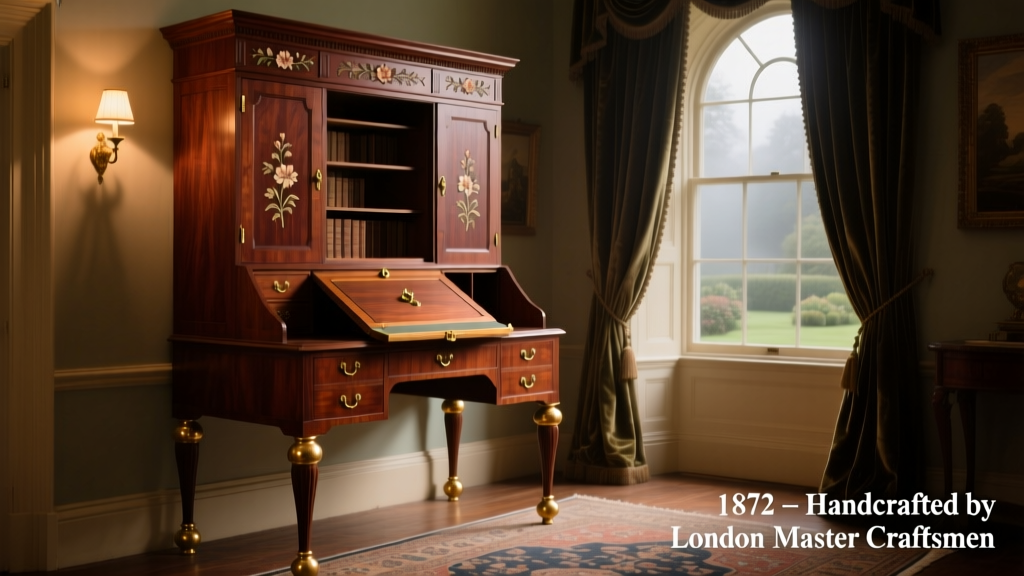
The 1890s Secretary Bookcase: Hardwood Campaign Construction, Brass Fittings, and Bulbous Legs — A Technical Restoration Guide
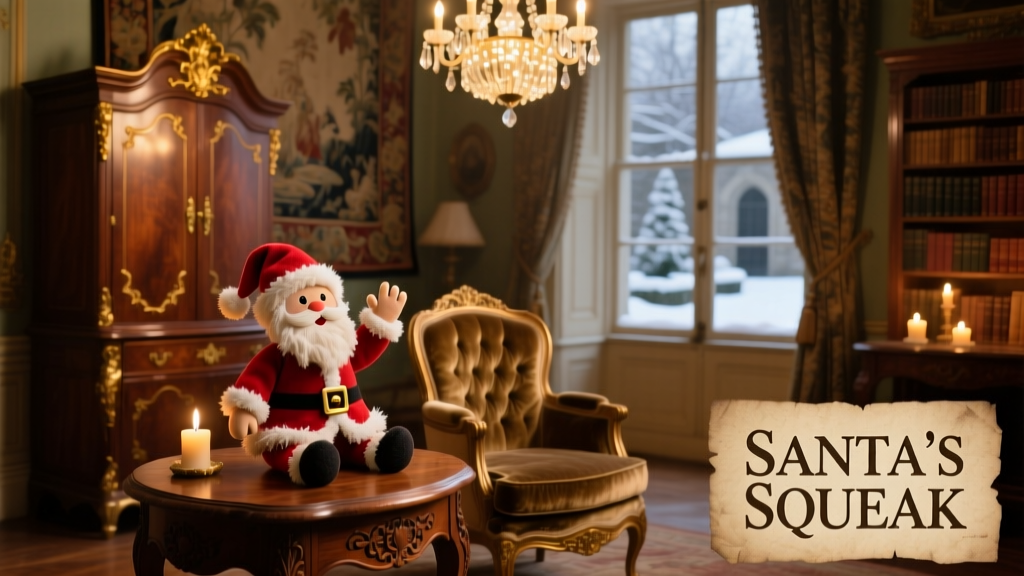
The Santa Claus Squeak Toy: Origins, Mechanics, and Collectibility of a Vintage Holiday Icon
Bing & Grøndahl Bell Christmas 1974: History, Design, and Collectibility of Denmark’s Iconic Porcelain Bell

Decoding the 1136089: A Technical and Historical Analysis of the 1957 Herman Miller Eames Lounge Chair & Ottoman Serial Number

George Wess: The Unheralded American Modernist Behind Mid-Century Furniture Innovation

Armadillo Baskets: Are They Dangerous? A Conservationist’s Assessment of Authenticity, Ethics, and Safety

Opaline Candy Dish with Strawberry and Floral Motif on Three Amber Feet: Identification, Provenance, and Conservation Guidance
Barbie Happy Holidays 1990: A Collector’s Guide to Mattel’s Festive Icon
Knife Woodcraft Marbles Leather Sheath: Authenticity, Craftsmanship, and Restoration Insights