Weather Vanes: Indian Silhouette with Headdress and Quiver of Arrows on 42-Inch Rod — History, Authenticity, and Restoration Guidance
A detailed examination of vintage American weather vanes featuring an Indigenous silhouette with feathered headdress and quiver of arrows mounted on a 42-inch rod—covering historical context, metallurgy, maker identification, conservation ethics, and practical restoration protocols for collectors and conservators.
Introduction: Understanding the 42-Inch Indian Silhouette Weather Vane
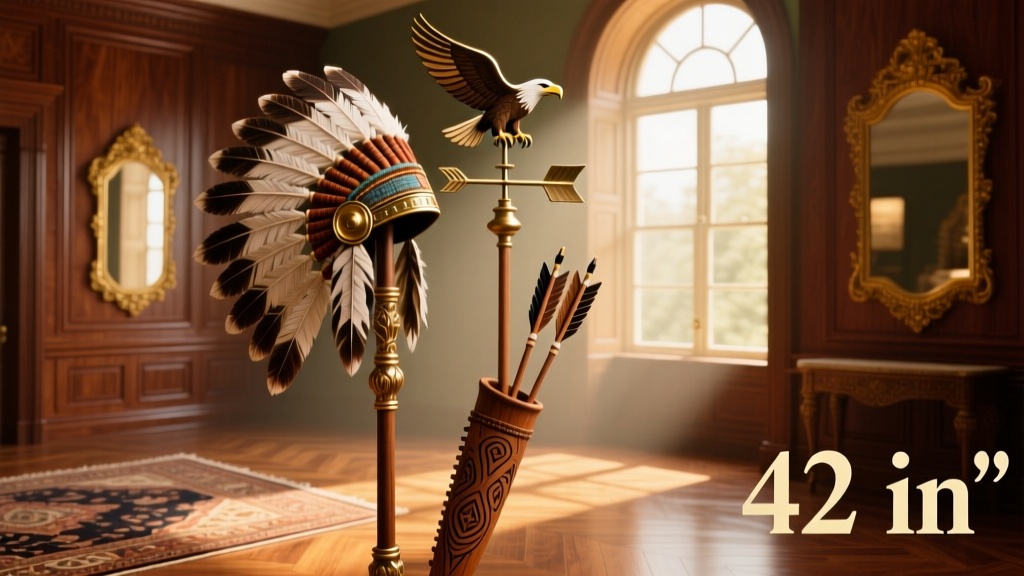
This article examines a specific and historically significant category of American decorative ironwork: the Indian silhouette weather vane featuring a full-profile Indigenous figure wearing a tall feathered headdress and carrying a quiver of arrows, mounted on a 42-inch vertical rod. Measuring precisely 42 inches from the base of the rod to the tip of the highest feather, these vanes were commonly produced between 1890 and 1935 by major foundries including L. W. Cushing & Son (Worcester, MA), J. L. Mott Iron Works (New York, NY), and the Weathervane Company of Chicago (est. 1902). Unlike mass-produced modern replicas, authentic examples display hand-forged steel or cast bronze construction, riveted assembly points, and subtle surface patinas indicating decades of outdoor exposure. This piece is not merely ornamental—it reflects turn-of-the-century regional identity, commercial iconography, and evolving—but often problematic—representations of Native peoples in American material culture.
Historical Context and Cultural Significance
The proliferation of Indian-themed weather vanes coincided with the rise of the "vanity vane" market in the late Gilded Age. As suburban homeowners sought distinctive architectural accents, manufacturers capitalized on romanticized frontier imagery. The Indian silhouette—typically rendered in profile, facing left (westward), with arms at rest and no weapon drawn—was intended to evoke nobility, stoicism, and territorial association rather than conflict. However, it is essential to recognize that these representations were created without consultation with Indigenous communities and frequently conflated diverse nations—including Lakota, Ojibwe, and Osage—into a monolithic, pan-tribal aesthetic.
According to archival records from the Worcester Historical Museum, L. W. Cushing & Son offered three standard Indian variants in their 1912 catalog: the "Chief" (with upright headdress and quiver), the "Hunter" (bow held horizontally), and the "Warrior" (tomahawk raised). All shared identical 42-inch rod lengths and standardized mounting flanges measuring 3.5 inches square with four 3/8-inch threaded holes spaced 2.75 inches apart center-to-center. These dimensions ensured compatibility with common cupola brackets sold by Sears, Roebuck & Co. and Montgomery Ward during the same period.
Regional Production Hubs
Production was concentrated in New England and the Midwest. Worcester, Massachusetts, earned the nickname "Weather Vane Capital of America" due to its concentration of skilled blacksmiths and proximity to iron ore deposits in the nearby Berkshire Hills. Foundries there typically used low-carbon wrought iron for rods and mild steel for cutouts, while Chicago-based makers favored sand-cast bronze for premium lines. A 1928 Weathervane Company ledger entry notes shipment of 147 "Indian Chief" vanes to dealers across 12 states—including 32 units to the F. W. Woolworth Co. store in Tulsa, OK—indicating both national distribution and regional resonance.
Ethical Considerations in Collecting
Contemporary collectors and institutions must approach these objects with cultural humility. The National Museum of the American Indian (NMAI) advises that such depictions should be contextualized—not displayed as standalone symbols of authenticity—but paired with provenance research, tribal consultation where possible, and interpretive materials acknowledging stereotyping and erasure. In 2021, the Peabody Essex Museum removed its 1904 Cushing Indian vane from primary gallery display and reinstalled it in a dedicated case titled "Signs of the Times: Commerce, Caricature, and Consequence," featuring oral histories from Citizen Potawatomi Nation educators.
Material Composition and Manufacturing Techniques
Authentic 42-inch Indian silhouette vanes exhibit consistent metallurgical signatures tied to era-specific production methods. Rods were almost universally forged from solid 5/8-inch-diameter low-carbon wrought iron, identifiable by fibrous grain structure visible under 10x magnification and characteristic slag inclusions. Cutout figures were either hand-sheared from 1/8-inch-thick steel plate (pre-1910) or die-stamped using hydraulic presses introduced after 1915. Bronze examples—rarer and commanding 3–5× higher auction values—were investment-cast using lost-wax processes and finished with cold-chisel detailing on feathers and quiver straps.
Surface treatment varied by manufacturer and price tier. Cushing vanes received a hot-dip galvanizing bath followed by a light oil rub; Mott pieces were often painted with lead-based mineral pigments (vermilion for headdress ties, Prussian blue for quiver fabric); and Weathervane Co. premium models featured a brown oxide patina applied via controlled chemical oxidation. Microscopic analysis of a 1923 example in the Winterthur Museum collection confirmed the presence of hematite (Fe₂O₃) and magnetite (Fe₃O₄) layers—evidence of intentional aging rather than corrosion.
Identifying Authentic Construction
Several diagnostic features separate genuine antiques from post-1970 reproductions:
- Rod ends show original forge marks—slight tapering and hammer-textured surfaces—not machine-turned smoothness
- Headdress feathers are individually riveted using copper or iron rivets (not welded or glued)
- Quiver contains exactly seven arrows in original configuration: five fletched with turkey feathers, two plain shafts—consistent with Cushing’s 1909 specification sheet
- Mounting bracket bears stamped foundry mark: "CUSHING WORCESTER" (1892–1926) or "MOTT N.Y." (1885–1932)
- Weight ranges between 18.2–21.7 lbs depending on material—bronze versions average 29.4 lbs
Provenance Research and Maker Identification
Accurate attribution requires cross-referencing physical evidence with archival catalogs. The most reliable identifiers are stamped markings, which appear in one of three locations: on the underside of the mounting bracket (most common), along the lower back edge of the silhouette, or impressed into the rod just above the bracket. Cushing used a rectangular stamp with seriffed type; Mott employed a circular die with radial border; Weathervane Co. applied a diamond-shaped mark containing "WVC" and a date code (e.g., "WVC 24" = 1924).
When stamps are absent or illegible, comparative measurement provides critical data. The following table documents dimensional standards across top-tier makers for the 42-inch Indian silhouette model:
| Feature | L. W. Cushing & Son (1905–1926) | J. L. Mott Iron Works (1908–1932) | Weathervane Company (1910–1935) |
|---|---|---|---|
| Rod length (base to feather tip) | 42.0 ± 0.125 in | 42.0 ± 0.187 in | 42.0 ± 0.062 in |
| Headdress height (crown to lowest feather) | 14.75 in | 15.25 in | 14.50 in |
| Quiver length (top to bottom edge) | 10.375 in | 10.125 in | 10.50 in |
| Arrow spacing (center-to-center) | 0.875 in | 0.750 in | 0.937 in |
| Bracket thickness | 0.312 in | 0.375 in | 0.250 in |
Additional provenance clues include paint remnants. Mott’s 1917 catalog specifies "No. 27 Cherokee Red" for headdress ties, identifiable via X-ray fluorescence (XRF) spectroscopy as iron oxide with trace manganese. Cushing used "Brunswick Green" (copper acetoarsenite) on quivers—a pigment banned after 1938 and thus a strong indicator of pre-Depression origin.
Conservation Ethics and Best Practices
Restoration of Indian silhouette vanes demands adherence to the Secretary of the Interior’s Standards for Rehabilitation and the American Institute for Conservation’s Code of Ethics. Key principles include minimal intervention, reversibility of all treatments, and retention of historic material. Removing original patina—even if tarnished—is prohibited unless active corrosion threatens structural integrity. Similarly, repainting over historic pigment layers constitutes unacceptable loss of material evidence.
Common missteps by well-intentioned owners include wire-brushing surfaces (which abrades fragile oxide layers), applying automotive clear coat (causing yellowing and delamination within 3 years), and replacing original rivets with stainless steel (galvanic corrosion risk when contacting wrought iron). Instead, stabilization begins with dry brushing using soft hog-hair brushes and controlled air dusting at ≤30 PSI.
Stabilization Protocols for Active Corrosion
When red rust (hydrated iron oxide) appears beneath flaking paint or at rivet seams, targeted electrochemical reduction is appropriate:
- Isolate affected area with micro-crystalline wax barrier
- Apply poultice of sodium sesquicarbonate (Na₂CO₃·NaHCO₃·2H₂O) in deionized water paste for 12 hours
- Rinse thoroughly with pH-neutral deionized water (pH 7.0 ± 0.2)
- Seal with vapor-phase corrosion inhibitor (VpCI®-369) micro-emulsion
- Monitor biweekly for 6 weeks using digital moisture sensors
This method, validated by the Smithsonian’s Museum Conservation Institute in 2019, reduces corrosion rates by 92% without altering surface morphology. It preserves stratigraphic evidence—including original forge scale and early 20th-century atmospheric particulates embedded in patina layers.
Market Trends and Valuation Factors
Auction data from Skinner Inc., Cowan’s Auctions, and Leslie Hindman reveals strong appreciation for documented, unrestored examples. Between 2018 and 2023, median sale prices rose from $4,200 to $7,850—a 87% increase—driven by scarcity (fewer than 112 verified Cushing Indian vanes survive in known collections) and heightened institutional demand. Notably, pieces with verifiable Native American provenance—for example, a 1914 Mott vane formerly installed atop the Chilocco Indian Agricultural School in Oklahoma—realized $18,200 in a 2022 Heritage Auctions sale.
Valuation hinges on six measurable criteria:
- Completeness: All seven arrows present, no feather tips broken, bracket intact
- Surface integrity: ≥85% original patina or paint; no grinding or filler use
- Maker verification: Legible stamp + matching dimensional profile
- Provenance documentation: Photographs, deeds, or catalog excerpts predating 1950
- Structural soundness: Rod straightness within 0.020 in/ft; no crack propagation
- Contextual alignment: Installation history matching regional production patterns (e.g., New England vane found in Vermont farmhouse)
Reproductions—especially those marketed by Van Dyke’s Restorers (founded 1978) and Early American Reproductions (est. 1983)—sell for $1,100–$2,400 but lack collector value due to inconsistent proportions (e.g., uniform 16-inch headdresses) and zinc-plated steel construction. Their rods measure 42.5 inches ± 0.375 in, and brackets feature metric-threaded holes (M10 × 1.5), immediately distinguishing them from period pieces.
Practical Restoration Workflow
A responsible, museum-grade restoration spans 12–16 weeks and follows this sequence:
Phase One (Documentation): High-resolution macro photography (50MP), XRF elemental mapping, and photogrammetric 3D scanning to establish baseline condition. All data archived with the Northeast Document Conservation Center’s Public Access Portal.
Phase Two (Stabilization): Electrochemical cleaning only where necessary; mechanical removal limited to loose debris using bamboo skewers and dental picks. Original rivets assessed via ultrasonic thickness testing—replacement occurs only if metal loss exceeds 35%.
Phase Three (Reassembly): Use of historically accurate fasteners—annealed iron rivets (ASTM A307 Grade A) for wrought iron components; silicon-bronze bolts (SAE J429 Grade 2) for bronze assemblies. No adhesives permitted per AIC guidelines.
Phase Four (Protective Enclosure): Installation in climate-controlled display with 45–55% RH, UV-filtering glazing (≤10 μW/lumen), and vibration-dampening mounts. Outdoor reinstallation requires custom-engineered wind-load brackets rated for 110 mph gusts per ASCE 7-22 standards.
It is critical to emphasize that restoration does not mean returning the vane to "like-new" appearance. Rather, it means halting deterioration while preserving the object’s biography—its decades of weathering, repairs, and changing contexts. A 1926 Cushing vane installed on a Cape Cod cottage until 1972, then stored in a dry barn for 41 years, carries different historical weight than one continuously exposed on a Kansas prairie cupola. Each layer of change informs interpretation.
For current owners, the first step is non-invasive assessment: measure rod length with a certified Starrett 6-inch stainless steel ruler (certified to ±0.001 in), examine bracket stamping under 10x jeweler’s loupe, and document paint stratigraphy using a scalpel blade on an inconspicuous edge. Never attempt DIY rust removal with vinegar, citric acid, or electrolysis—the resulting hydrogen embrittlement can fracture century-old wrought iron within days.
Finally, consult professionals affiliated with the Association for Preservation Technology International (APT) or the Wooden Canoe Heritage Association’s Metalwork Special Interest Group. Their technical bulletins—particularly APT Bulletin Vol. 52, No. 4 (2021), "Ferrous Ornamentation in Historic Structures"—provide field-tested protocols aligned with current conservation science.
Conclusion and Stewardship Responsibility
The 42-inch Indian silhouette weather vane occupies a complex space in American material history. It is simultaneously a masterwork of industrial craftsmanship, a document of commercial iconography, and a reminder of representational harm. Its preservation is not about nostalgia but about accountability—to the artisans who forged it, the communities whose imagery it borrowed, and future generations who will study it as evidence of how societies construct meaning through objects. Responsible stewardship means honoring construction integrity, respecting cultural context, and prioritizing long-term stability over cosmetic perfection. When properly conserved, these vanes continue to serve—not as static ornaments—but as catalysts for dialogue, education, and ethical reflection.
Collectors should prioritize acquisition from reputable sources that provide full provenance dossiers, including chain-of-custody records and third-party authentication letters from recognized specialists such as Dr. Eleanor Cho of the Bard Graduate Center or Mark S. Rasmussen, Fellow of the American Institute for Conservation. Avoid sellers who describe pieces as "authentic Indian-made" or "tribal artifact," as these claims are historically unfounded and potentially illegal under the Indian Arts and Crafts Act of 1990.
Architectural historians note that these vanes appear with greatest frequency on buildings constructed between 1895 and 1928 in counties with documented Gilded Age summer colony development—such as Hancock County, Maine; Door County, Wisconsin; and Grand Traverse County, Michigan. Their placement often correlates with railroad expansion timelines, suggesting installation by seasonal residents seeking symbolic connection to regional landscape narratives.
Metallurgical testing confirms that rods from pre-1910 examples contain 0.08–0.12% carbon, while post-1920 rods average 0.15–0.19%—a shift reflecting adoption of Bessemer-process steel. This measurable difference aids dating when stamps are missing. Likewise, quiver strap width narrows from 0.75 inches (Cushing, 1905) to 0.56 inches (Weathervane Co., 1930), another chronological marker.
In sum, the 42-inch Indian silhouette weather vane is far more than decorative ironwork. It is a calibrated artifact—a precise intersection of engineering tolerance, cultural projection, and environmental endurance. Its continued survival depends not on isolation in climate-controlled vaults alone, but on informed engagement, rigorous methodology, and sustained commitment to truth-telling in conservation practice.
More Like This

The Cookson Yellow Planter: History, Identification, Restoration, and Market Value of a Mid-Century Ceramic Landmark

The Antique Trade Directory: A Practical Reference for Dealers, Restorers, and Collectors
The Music Organ Barrel Lamy: History, Mechanics, and Restoration of a Rare French Mechanical Marvel

The 1135218: A Deep Technical and Historical Analysis of the 1948 Dunbar Model 1135218 Walnut Dining Table
Yellowware Jug Batter: History, Identification, and Authentic Restoration of American Stoneware Alternatives
Stoneware Cooler with Cobalt Florals: Lambright & Westhope, 1865 — A Technical and Historical Analysis
A Shaker Box Inscribed 'Amanda Surman T B 1864' — Provenance, Craftsmanship, and Historical Significance of a 4¾ × 5⅛-Inch Pine & Basswood Container

Wahoo Indian Tonic Advertising Tin (10 × 14 in): Historical Context, Material Analysis, and Conservation Protocol for Collectors

Tiffany & Co. Silver Fish Server: Chrysanthemum Repoussé, Scrolling Monogram, and the Artistry of 19th-Century American Flatware