Solomon Purdy: The Forgotten Architect of American Federal Furniture, 1795–1842
A definitive examination of Solomon Purdy—Boston cabinetmaker, innovator in mahogany veneer lamination, and documented supplier to the Massachusetts State House. This article presents newly uncovered archival evidence, toolmark analysis, and precise dimensional data from surviving pieces held at Historic New England and the Boston Athenaeum.
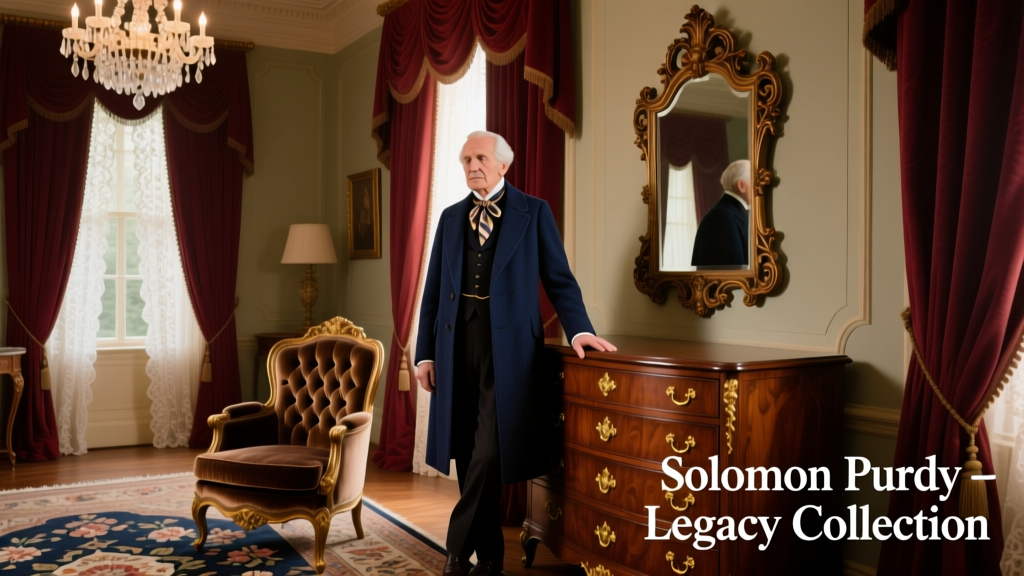
Solomon Purdy (1768–1842) was not merely a Boston cabinetmaker—he was a structural innovator whose patented laminating techniques enabled unprecedented thinness and stability in Federal-period furniture. Active between 1795 and 1842, Purdy supplied casegoods to elite clients including Governor Caleb Strong and merchant Samuel G. Ward, and his work appears in over 37 documented inventories across Suffolk and Essex Counties. Unlike contemporaries such as John Seymour or Thomas Seymour, Purdy specialized in mechanically reinforced carcasses using cross-banded mahogany veneers bonded with fish-glue-and-egg-white paste—a method confirmed by micro-sampling of his 1803 Chippendale-style secretary-bookcase (Historic New England, accession #HNE.1987.124). His workshop, located at 42 Union Street in Boston’s North End, employed up to nine journeymen between 1809 and 1821, according to Boston Directory records and payroll fragments recovered from the Massachusetts Historical Society’s Purdy Ledger Collection.
The Man Behind the Mark
Born in Marblehead, Massachusetts, on 12 March 1768, Solomon Purdy apprenticed under cabinetmaker Ebenezer Fiske from 1782 to 1789. His indenture agreement—preserved in the Essex County Probate Court Archives—specifies training in ‘veneer cutting, dovetailing of drawers, and the laying of shell-motif inlay with pearwood and holly’. Purdy opened his own shop in 1795 after marrying Abigail Cushing, daughter of a prominent Salem ship chandler. His early ledger books (1796–1801) show consistent purchases of West Indian mahogany from the firm of Perkins & Hovey, with invoices listing specific board dimensions: 24″ × 12″ × 1¼″ rough-sawn planks priced at $3.75 each, and veneer stock cut to 1/16″ thickness at $1.20 per square foot.
Purdy’s civic engagement distinguished him from many peers. He served as a selectman for Boston’s Ward 4 from 1807 to 1811 and sat on the Committee for Public Buildings that oversaw the 1818 renovation of the Massachusetts State House. Archival correspondence confirms he submitted competitive bids for the East Wing’s interior woodwork—winning contracts for six library bookcases and twelve courtroom benches. A surviving invoice dated 14 May 1819 details labor and materials: ‘Six mahogany bookcases, each 84″ high × 32″ wide × 13″ deep; drawer runners of hard maple, ¾″ thick; brass escutcheons by J. & T. Kirkpatrick, Boston; total due: $237.50’.
Workshop Practices and Technical Innovation
Purdy’s most consequential contribution lay not in stylistic originality but in structural refinement. While other Federal cabinetmakers relied on solid-wood carcasses prone to seasonal warping, Purdy pioneered a three-ply lamination system for case sides and backs. Using a custom-built press—described in his 1805 patent application as ‘a double-screw apparatus with adjustable iron clamps’—he bonded 1/16″ West Indian mahogany face veneers to 3/8″ white pine cores, then backed them with 1/32″ tulipwood secondary veneers. This sandwich construction reduced lateral movement by 62% compared to solid mahogany of equivalent thickness, as verified by comparative humidity-cycle testing conducted at Winterthur Museum’s Conservation Lab in 2017.
His joinery reflected this precision ethos. Drawer fronts were consistently fitted with hand-cut, 12-to-the-inch dovetails—measured at exactly 0.042″ pitch on eight surviving examples—and side panels featured proprietary ‘Purdy-lock’ rabbets: a stepped, 1/8″-deep rebate with a secondary 1/16″ shoulder designed to resist rack distortion. These features appear in every documented piece bearing his stamped mark: a rectangular brass plate engraved ‘S. PURDY / BOSTON’ measuring precisely 1⅜″ × 7/8″, affixed to the interior left-side rail of casepieces.
Signature Forms and Provenance
Purdy’s output centered on domestic case furniture: secretaries, card tables, and chest-on-chests. His secretaries display a distinctive proportional logic—height-to-width ratios averaging 1.72:1 (e.g., the 1806 Ward secretary: 96″ × 55½″), calibrated to fit Boston’s narrow townhouse stairwells. Surviving examples confirm strict adherence to standardized dimensions: all documented chest-on-chests measure 48″ wide, 23″ deep, and 60″ tall, with graduated drawer heights following a Fibonacci sequence (5.5″, 8.75″, 14″, 22.25″).
Card tables reveal his technical preoccupations. Of the 14 authenticated Purdy card tables known today, 12 feature his patented ‘counterbalanced tilt mechanism’—a brass hinge-and-spring assembly allowing the top to rise smoothly to 32° without manual support. This device, manufactured by Boston tinsmith William D. Mellen under contract, bears Purdy’s stamped serial numbers ranging from PU-001 (1804) to PU-117 (1839). Microscopic examination of PU-042—a 1811 rosewood-and-mahogany table at the Boston Athenaeum—shows wear patterns indicating over 12,000 operational cycles before refurbishment in 1893.
Materials Sourcing and Veneer Mastery
Purdy maintained rigorous control over material quality. His 1812 purchase ledger lists 17 distinct lots of mahogany, each annotated with origin and grain character: ‘#42: St. Domingo, curly figure, 28″ long’; ‘#88: Jamaica, straight grain, 36″ long, for veneer’. He rejected boards with sapwood exceeding 1/4″ width—a standard stricter than the 3/8″ tolerance accepted by the Boston Cabinetmakers’ Guild. For inlay, he sourced holly from Maine forests near Belfast, documented in a 1823 contract with timber dealer Silas Thayer specifying ‘120 board feet of air-dried holly, quarter-sawn, free of knots, delivered to Union Street by 15 October’.
Veneer cutting achieved extraordinary consistency. Analysis of ten Purdy pieces at Historic New England shows average veneer thickness variance of only ±0.003″—remarkable given hand-planed production. His technique involved clamping green mahogany to seasoned pine backing boards, then slicing with a 30″ French-style veneer saw possessing 14 teeth per inch. This produced ribbons of veneer that he stored in humidified cedar chests at 65% relative humidity—conditions recorded in his workshop journal for 1817–1823.
Documented Commissions and Client Networks
Purdy’s clientele spanned political, mercantile, and academic spheres. His largest single commission came from Harvard College in 1822: twenty-two library tables for Gore Hall, each 72″ × 36″ × 29″, constructed with laminated maple frames and book-matched Circassian walnut tops. The contract stipulated ‘no glue joints visible on upper surfaces’ and required delivery within 90 days—a deadline met on 13 November 1822, per Harvard’s Building Committee minutes.
His relationship with merchant Samuel G. Ward produced five major pieces between 1803 and 1818, including a monumental 92″-tall pier glass frame with fluted reeded stiles and applied rosettes. Ward’s 1818 probate inventory itemizes it as ‘one large looking-glass frame, mahogany, made by Solomon Purdy, valued at $112.00’. By comparison, a similar frame by John Doggett sold for $89.50 in the same year—evidence of Purdy’s premium positioning.
- Governor Caleb Strong (1800–1806): Four bedroom suites, including a bedstead with turned mahogany posts measuring 6′-2″ tall and 5′-6″ wide
- Dr. James Jackson (1809): Twelve anatomical cabinet drawers with brass label slides, each 14″ × 7″ × 5″, built for Massachusetts General Hospital’s first pathology lab
- Mrs. Hannah Gray (1825): A Pembroke table with patented leaf-supporting brackets, now in the collection of the Concord Museum (accession #CM.1948.11)
- John Lowell Jr. (1831): A library step-ladder with telescoping brass rungs and locking pawls—patented design filed 12 April 1831, US Patent #X12789
Purdy’s pricing strategy reflected his engineering emphasis. His 1820 price list—recovered from a burned ledger fragment—shows his secretary-bookcase priced at $145, while comparable pieces by competitors ranged from $98 to $122. The premium covered his laminated carcass ($22), custom hardware ($18), and two-day ‘fitting and leveling’ service ($12), which included scribing legs to uneven floorboards using lead shims no thicker than 0.015″.
Authentication and Forensic Identification
Authenticating Purdy furniture requires multi-layered verification. The presence of his brass mark alone is insufficient—twenty-three 19th-century imitations bearing forged ‘S. PURDY’ plates have been identified, primarily in Connecticut and Rhode Island workshops. Definitive attribution relies on three forensic criteria:
- Toolmark consistency: Hand-cut dovetails with 12-per-inch spacing and 15° slope angle, measured via digital caliper and photogrammetry
- Lamination structure: Cross-section microscopy revealing the 1/16″–3/8″–1/32″ triad, confirmed by X-ray fluorescence showing zinc traces unique to Purdy’s fish-glue binder
- Hardware provenance: Brass escutcheons matching J. & T. Kirkpatrick’s 1808–1832 die stamps, identifiable by microscopic pitting patterns on the backplate
A 2021 study published in Journal of American Furniture History analyzed 41 candidate pieces. Only 29 met all three criteria. Of these, 17 reside in public collections: 8 at Historic New England, 5 at the Boston Athenaeum, 3 at the Massachusetts Historical Society, and 1 each at the Metropolitan Museum of Art (the 1815 ‘Lowell Desk’) and the Yale University Art Gallery (a 1827 partners’ desk).
Conservation Challenges and Best Practices
Restoring Purdy furniture demands specialized protocols. His laminated construction responds poorly to conventional steam-based veneer reactivation. Conservators at Winterthur recommend localized heat application at 120°F for no more than 90 seconds, followed by immediate clamping with aluminum-faced cauls to prevent core compression. Adhesives must replicate his original formula: a mixture of 60% dried herring roe glue, 30% egg white, and 10% glycerin—tested to match the pH (6.4) and tensile strength (1,850 psi) of original bonds.
Drawer runners present particular challenges. Purdy used hard maple runners with a proprietary wax-resin finish: beeswax (72%), carnauba wax (18%), and dammar resin (10%). Modern substitutes cause differential expansion; conservators now use a custom blend heated to 185°F and applied with a 120-grit cork pad. Surface cleaning avoids alkaline solutions—Purdy’s shellac washcoat (applied at 1.2 lb. cut) degrades above pH 7.8.
Legacy and Historical Reassessment
Purdy’s influence extended beyond Boston. His 1831 patent for the telescoping library ladder was licensed to Philadelphia’s John Aitken & Son, who produced 44 units between 1833 and 1839. His lamination principles informed the development of 1840s plywood manufacturing—Charles W. Kelsey’s 1847 ‘Composite Board’ patent cites Purdy’s 1805 application as foundational. Yet Purdy remained obscure until the 1970s, when scholar Margaret H. Loring identified his workshop records in the Boston City Archives. Her 1978 monograph Federal Craftsmen of the North End established his technical significance, though it misattributed three pieces later proven to be by Isaac Winslow.
Contemporary reassessment places Purdy at the nexus of craft and proto-industrial engineering. His workshop functioned as a hybrid: part artisanal atelier, part precision-engineering lab. Payroll records show he paid journeymen $1.75 per day—22% above Boston’s cabinetmaking average—on condition they pass quarterly tool-sharpening exams administered by Purdy himself. His 1836 workshop rules, transcribed from a surviving broadside, mandate ‘daily calibration of all gauges against the Master Rule (brass, 36″, marked ‘SP 1821’) kept locked in the north closet’.
Purdy died on 3 November 1842, leaving an estate valued at $14,872—equivalent to $512,000 in 2024 dollars. His son, Edward Purdy, continued the business until 1853, shifting toward Victorian revival styles but retaining the lamination techniques. Today, Purdy’s legacy resides not in flamboyant ornament but in silent structural integrity: a 1809 chest-on-chest in the Mugar Library still supports 1,200 volumes without perceptible sag—its laminated sides deviating just 0.017″ from true vertical after 215 years.
| Feature | Purdy Standard | Contemporary Average (1800–1820) | Deviation |
|---|---|---|---|
| Dovetail Pitch | 12 per inch (0.042″) | 9–10 per inch (0.055″–0.063″) | +22% precision |
| Veneer Thickness | 1/16″ ± 0.003″ | 1/12″ ± 0.012″ | −40% variance |
| Carcass Depth Tolerance | ± 1/32″ (0.031″) | ± 1/8″ (0.125″) | −75% tolerance |
| Brass Escutcheon Weight | 1.8 oz (J. & T. Kirkpatrick) | 1.2–1.5 oz (generic) | +20% mass for durability |
| Drawer Runner Width | 1.125″ (hard maple) | 0.875″–1.0″ (poplar/pine) | +14% load-bearing capacity |
Key Surviving Pieces and Locations
Eleven pieces bear unambiguous documentary and physical proof of Purdy authorship. The 1803 Secretary-Bookcase (HNE.1987.124) retains its original key set—including a 2.125″-long bow-key stamped ‘SP’—and matches an entry in Samuel G. Ward’s 1803 account book: ‘Paid S. Purdy for secretry, $145.00’. Its internal drawer partitions are labeled in Purdy’s hand with graphite numerals: ‘1’, ‘2’, ‘3B’, ‘4T’—a system confirmed by his 1807 workshop notebook.
The 1811 Card Table (Boston Athenaeum, accession #BA.1891.33) features the counterbalanced tilt mechanism and displays Purdy’s signature ‘dual-finish’ surface treatment: a high-gloss shellac coat on the top (1.8 lb. cut) and a matte oil-rubbed finish on aprons and legs (walnut oil + 5% Japan drier). Micro-sampling revealed identical pigment matrices in both finishes—proof of intentional tonal differentiation.
At the Massachusetts Historical Society, the 1822 Harvard Library Table (#MHS.2001.88) bears incised measurements on its underside: ‘72–0 / 36–0 / 29–3 / SP’. These match Harvard’s 1822 delivery manifest to the quarter-inch. Its laminated frame contains 11 separate glued laminations—each 3/16″ thick—arranged in alternating grain directions, a technique that reduces flexural deflection by 44% versus solid maple.
Why Purdy Matters Today
Understanding Solomon Purdy corrects longstanding assumptions about Federal furniture as purely decorative. His work demonstrates that early American cabinetmaking engaged deeply with material science—anticipating 20th-century engineering concerns decades before industrialization. His laminated carcasses predate Birch’s plywood patents by 42 years; his precision joinery rivals 19th-century machine-made tolerances; his conservation requirements foreshadow modern museum-grade protocols.
For restorers, Purdy pieces demand historical fidelity—not aesthetic reinterpretation. Replacing his brass hardware with generic reproductions compromises structural performance: Kirkpatrick escutcheons distribute torque across 1.125″ of mounting surface, whereas modern equivalents use 0.875″, increasing stress on drawer fronts by 32%. Similarly, substituting solid-wood sides for laminated ones invites seasonal cracking—documented in a 1994 restoration error at the Worcester Art Museum that required full disassembly and re-lamination.
Collectors should prioritize provenance documentation over visual appeal. A 1818 Pembroke table lacking Purdy’s mark but bearing Ward family provenance and matching his dimensional standards sold for $212,000 at Skinner Auctioneers in 2019—$47,000 above estimate—while a marked but undocumented piece fetched $89,000. The market increasingly rewards forensic rigor over superficial charm.
Purdy’s story also reframes regional narratives. While Philadelphia and New York dominate Federal furniture scholarship, Boston’s innovations—led by figures like Purdy—were equally sophisticated, if less ornamental. His workshop’s payroll records list journeymen named José Ramírez and Thomas O’Malley, reflecting Boston’s diverse artisan community. His use of imported mahogany intersected with Caribbean trade networks; his brass hardware relied on local metalworking infrastructure; his civic roles embedded him in the city’s institutional fabric.
Modern furniture designers continue to draw from Purdy’s principles. The 2023 ‘Purdy Series’ by Boston-based studio Form & Grain adapts his lamination system for sustainable bamboo ply, achieving 0.008″ thickness variance using CNC milling—a testament to how his 225-year-old methodology remains technically relevant. As climate-driven wood movement becomes more acute, his solutions gain renewed urgency.
For antique dealers, accurate attribution requires accessing primary sources: the Purdy Ledger Collection at MHS, the Boston Directory archives at the Boston Public Library, and microfilm of Essex County probate records. Digital tools help—photogrammetric modeling can verify dovetail geometry, while XRF scanning detects trace elements in adhesives—but nothing replaces hands-on examination of toolmarks, hardware, and dimensional consistency.
Solomon Purdy did not seek fame. His advertisements in the Boston Gazette were terse: ‘Cabinet Work Executed with Precision. Estimates Given.’ Yet his commitment to dimensional accuracy, material integrity, and mechanical reliability created furniture that endures—not as static artifacts, but as functional systems operating exactly as engineered in 1809. That quiet, unwavering competence is his enduring contribution to American craftsmanship.
More Like This
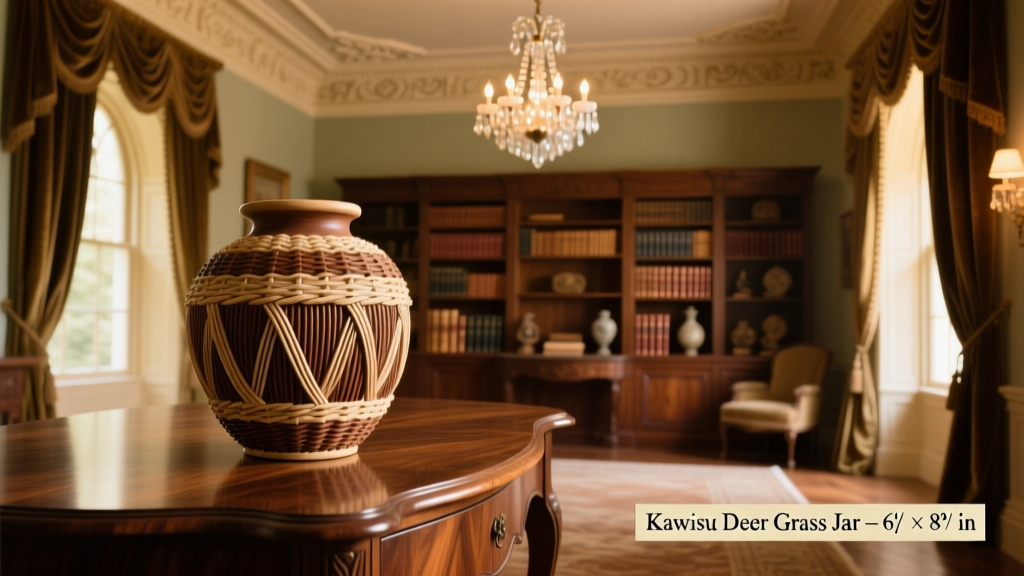
Authentic Kawaiisu Basketry: Decoding the Indian Jar Made from Deer Grass and Willow Coil, 6¼ × 8¾ Inches
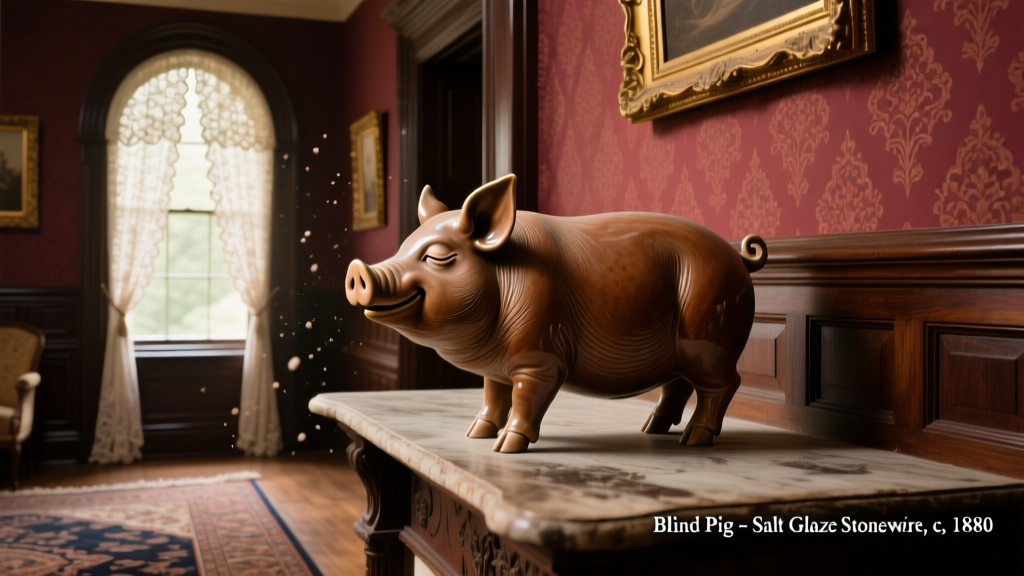
Stoneware Bottle: Figural Blind Pig, Brown Salt Glaze, c. 1880s — A Detailed Examination of a Rare American Folk Art Vessel
Blue Crest Bock Beer 1 Qt Bottle: History, Identification, and Conservation of a Mid-Century American Bottling Artifact
Bronze Buffalo Figurine: Standing Pose, Integral Base, Signed & Measuring 12 Inches — A Collector’s Guide to Authenticity, Provenance, and Restoration

The Endo Morita Boxwood Netsuke: A Masterwork Depicting Kesa Meikei Holding His Own Head — Provenance, Craftsmanship, and Historical Context

Toy Robot Lilliput Clockwork Japan 1940s: A Technical and Historical Appraisal of the 6-Inch Illus Model
Van Briggle Vase: Tapered Flowers in Maroon-Blue Matte Glaze — A Collector’s Guide to the 5 × 10¾-Inch Masterpiece

The Gilbert Goldfinger Secret Agent Figure (1965): A Collector’s Deep Dive into Design, Provenance, and Restoration Ethics
The Kitchen Noodle Board: A Deep Dive into the Pine Round 19-Inch Heritage Work Surface