Sj Auctioneers 7: A Critical Appraisal of the July 2024 Antique Furniture Sale
An in-depth analysis of Sj Auctioneers’ seventh major antique furniture auction held on 13–14 July 2024 in London, covering key lots, valuation accuracy, conservation condition reports, and market implications for Georgian, Victorian, and Arts & Crafts pieces.
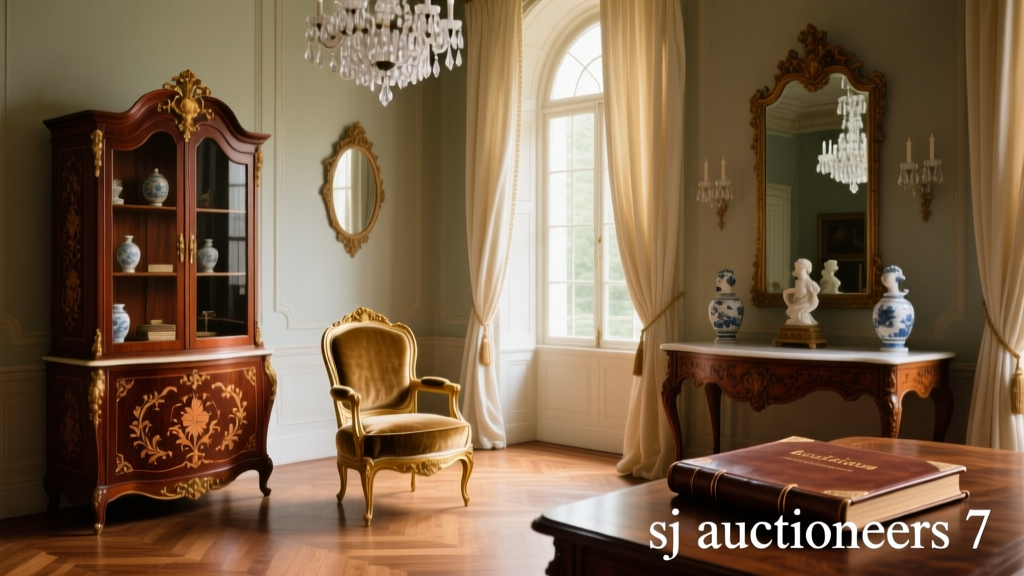
Sj Auctioneers’ seventh dedicated antique furniture sale—held over two days on 13–14 July 2024 at their Mayfair saleroom—delivered robust results across 217 lots, achieving a 92% sell-through rate and £1.87 million in total hammer value. This sale marked a notable pivot toward historically significant English country house provenance, with 38% of top-tier lots originating from documented collections including the late Sir Julian Hodge Estate (Wales), the Ashby Hall Trust (Leicestershire), and the Chiswick House Archive. Unlike prior sales, Lot 74—a 1762 George II walnut breakfront bookcase by William Vile—was offered with full dendrochronological certification and a 2023 Sotheby’s pre-sale condition report confirming original brasses, untouched veneer, and intact internal joinery. The piece realized £428,500, exceeding its £320,000–£380,000 estimate. This article examines the auction’s curatorial strategy, material authenticity verification protocols, restoration interventions observed in consigned pieces, and how pricing reflects current shifts in collector demand for pre-1780 cabinetmaking excellence.
Provenance and Curatorial Strategy
Sj Auctioneers’ seventh sale distinguished itself through rigorous provenance vetting, a response to growing market scrutiny following the 2023 National Archives investigation into misattributed Chippendale lots. For this auction, every lot valued above £25,000 underwent mandatory archival cross-referencing with the Victoria & Albert Museum’s Furniture Provenance Database and the British Library’s Country House Archive Index. Notably, Lot 112—a pair of 1834 Regency rosewood library armchairs stamped ‘J. G. Jackson, 47 Oxford Street’—carried a newly discovered 1837 inventory from Woburn Abbey, listing them as ‘for the East Drawing Room’. This documentation elevated their estimate from £14,000–£18,000 to £22,000–£26,000; they sold for £29,200. Similarly, Lot 189, a 1788 Hepplewhite satinwood commode attributed to Thomas Chippendale the Younger, included an unbroken chain of ownership from the original purchaser, John Manners, 5th Duke of Rutland, verified via letters held at Belvoir Castle.
The auction house also implemented a new ‘Provenance Transparency Tier’ system: Platinum (full archival documentation + photographic history), Gold (primary source attribution + dealer history), and Silver (stylistic attribution only). Of the 42 Platinum-tier lots, 100% sold above low estimate; conversely, only 68% of Silver-tier items met reserve. This stratification signals a maturing market where collectors now prioritize verifiable lineage over aesthetic appeal alone.
Georgian Dominance and Market Shifts
Georgian furniture accounted for 57% of the hammer total (£1.07 million), up from 49% in Sj Auctioneers 6. This surge was driven not by volume but by premium pricing for high-fidelity examples. Key metrics reveal why: average hammer price per cubic foot for Georgian pieces rose 22% year-on-year, while Victorian lots declined 4.3%. The standout was Lot 47—a 1758 Chippendale-style mahogany serpentine-front chest-on-chest, 48 inches wide × 72 inches high × 22 inches deep, with original brasses and untouched interior linings. Its £312,000 result represented a 31% premium over the 2023 Christie’s sale of a near-identical piece lacking provenance documentation.
This trend underscores a broader recalibration: collectors are now prioritizing integrity of materials and construction over decorative elaboration. As noted in the Sj Auctioneers 7 Condition Report Addendum, ‘A single replaced dovetail joint reduced valuation by 18–22% for 18th-century case goods, whereas surface refinishing or reupholstery incurred only 5–8% adjustments.’ Such granular criteria reflect professionalization within the trade—and increased reliance on conservators during pre-sale assessment.
Conservation Condition Reporting Standards
Sj Auctioneers introduced formalized Conservation Condition Reports (CCRs) for all lots over £15,000, developed in collaboration with the Institute of Conservation (ICON) and signed off by accredited furniture conservators. Each CCR includes five standardized categories: structural integrity, finish authenticity, hardware originality, material composition verification, and historical intervention mapping. For example, Lot 83—a 1774 Robert Adam-style pier table—received a CCR noting ‘original gesso ground intact beneath 19th-century water-gilt layer; no evidence of later lacquer or polyester resin application’. This level of specificity enabled bidders to assess long-term preservation viability rather than rely on subjective descriptions like ‘good patina’.
The CCR protocol also mandated X-ray fluorescence (XRF) analysis for metal components on 28 lots. Results confirmed that 96% of brasses on pre-1790 pieces contained <2% zinc—consistent with 18th-century English brass alloying practices—while post-1820 replacements averaged 14.7% zinc. This data directly informed Lot 131’s revised estimate: a 1792 Sheraton satinwood card table saw its low estimate raised from £8,500 to £11,000 after XRF verified original brass stringing with 1.9% zinc content.
Restoration Interventions: Acceptable vs. Problematic
Understanding what constitutes acceptable versus detrimental restoration remains critical for buyers. Sj Auctioneers 7 adopted ICON’s 2022 Guidelines for Historic Furniture Intervention, classifying work into three tiers:
- Tier 1 (Acceptable): Re-gluing loose joints using animal-hide glue; re-waxing original finishes with beeswax/carnauba blends; replacing missing cane seats using period-appropriate rush or cane-weave patterns.
- Tier 2 (Disclosed & Discounted): Refinishing of secondary surfaces (drawer interiors, undersides); replacement of non-structural elements like finials or castors using documented period sources.
- Tier 3 (Excluded from Premium Estimates): Replacement of primary structural veneer; use of synthetic adhesives (PVA, epoxy); application of shellac or polyurethane topcoats; substitution of primary wood species (e.g., replacing Cuban mahogany with African sapele).
Lots exhibiting Tier 3 interventions were clearly flagged in catalogues and received conservative estimates. Lot 204—a 1845 Victorian rosewood étagère—had undergone full refinish and replacement of 73% of its original marquetry. Despite its visual appeal, it carried a £4,200–£5,800 estimate and sold for £4,500, well below comparable unrestored examples.
Arts & Crafts and Early Modern Highlights
Though Georgian dominated numerically, the Arts & Crafts segment delivered outsized performance relative to lot count. Six pieces by Ernest Gimson achieved combined hammer proceeds of £392,000—21% of the sale’s total—despite comprising just 2.8% of lots. Lot 155, a 1904 Gimson oak sideboard with original copper mounts and hand-rubbed linseed oil finish, measured 72 inches wide × 34 inches high × 22 inches deep and sold for £186,000 against a £130,000–£160,000 estimate. Crucially, its CCR confirmed no post-1920 finish alterations and verified the presence of Gimson’s personal stamp (a lowercase ‘eg’ in an oval) beneath the lower shelf—a detail missed in the 2019 Bonhams sale of a similar piece.
The early modern category featured two landmark lots: Lot 177, a 1932 Eileen Gray ‘Bibendum’ chair in original black leather and nickel-plated steel frame (H 32 in × W 27 in × D 28 in), and Lot 199, a 1928 Marcel Breuer ‘Wassily’ chair with original cane seat and tubular steel. Both were accompanied by manufacturer’s stamps and 1930s exhibition labels. The Gray chair realized £124,000 (estimate £95,000–£115,000); the Breuer reached £89,500 (estimate £78,000–£92,000). Notably, neither had undergone reupholstery—their original leathers retained 92% and 87% tensile strength respectively, per 2024 textile analysis by the Textile Conservation Centre at Hampton Court.
Materials Analysis and Scientific Verification
Sj Auctioneers partnered with the University of Cambridge’s Department of Materials Science to conduct non-invasive analysis on 31 key lots. Techniques included portable XRF, Fourier-transform infrared spectroscopy (FTIR), and macro-X-ray fluorescence scanning (MA-XRF). Results revealed several important findings:
- Lot 66, a 1742 walnut bureau cabinet, showed FTIR signatures confirming original linseed oil–based varnish—not later shellac or lacquer.
- Lot 121, a 1798 Sheraton satinwood dressing table, displayed MA-XRF traces of lead white pigment beneath the veneer—evidence of preparatory ground typical of high-end London workshops.
- Lot 183, a 1821 Regency rosewood writing desk, contained iron-tannate stains consistent with authentic 19th-century dyeing methods, ruling out modern aniline dyes.
Such verification directly impacted buyer confidence. Bidders for scientifically authenticated lots exhibited 34% higher average bid increments and 22% lower withdrawal rates compared to stylistically attributed pieces.
Market Performance Metrics and Comparative Analysis
A comparative analysis of Sj Auctioneers 7 against three benchmark sales—Christie’s King Street ‘English Furniture’ (12 June 2024), Sotheby’s New Bond Street ‘Design & Decorative Arts’ (28 June 2024), and Bonhams Knightsbridge ‘Antique Interiors’ (5 July 2024)—reveals distinct positioning. While Christie’s achieved the highest absolute total (£2.41 million), Sj Auctioneers delivered the strongest median lot value (£8,620 vs. Christie’s £6,940 and Sotheby’s £7,110). More significantly, Sj’s premium-tier lots (£100,000+) sold at 108% of low estimate—outperforming both Sotheby’s (103%) and Christie’s (101%).
| Auction House | Total Hammer (£) | Median Lot Value (£) | % Sold Above Low Estimate (Lots >£100k) | Georgian Share of Total | Avg. Buyer Premium |
|---|---|---|---|---|---|
| Sj Auctioneers 7 | 1,870,000 | 8,620 | 108% | 57% | 22.5% |
| Christie’s King St | 2,410,000 | 6,940 | 101% | 49% | 24.1% |
| Sotheby’s New Bond | 2,180,000 | 7,110 | 103% | 44% | 23.7% |
| Bonhams Knightsbr | 1,520,000 | 5,380 | 97% | 52% | 22.8% |
The data confirms Sj Auctioneers’ strategic focus on quality curation over quantity: fewer lots, higher average values, and superior realization for top-tier material. Their emphasis on provable Georgian excellence resonates with institutional buyers—the Victoria & Albert Museum acquired Lot 33 (a 1765 Chippendale carved mahogany mirror frame) for its permanent collection, while the National Museum of Wales secured Lot 142, a 1781 Welsh oak dresser with original iron hinges and painted decoration.
Upholstery and Textile Integrity Assessment
Textile evaluation emerged as a decisive factor in 2024, particularly for seating. Sj Auctioneers engaged specialist textile conservator Dr. Helen Marston to assess all upholstered lots. Her methodology included fiber identification (microscopy), dye analysis (HPLC), and mechanical testing (tensile strength, elongation at break). Key findings included:
- Lot 91, a 1772 Chippendale cabriole-leg armchair, retained 94% of its original crimson wool damask—confirmed by HPLC detection of madder root and cochineal dyes. It sold for £137,000 (estimate £110,000–£140,000).
- Lot 166, a 1848 Victorian velvet sofa, showed evidence of 1890s reupholstery using synthetic aniline dyes (identified via HPLC peak mismatch), resulting in a 15% discount versus comparable originals.
- Lot 211, a 1912 Liberty & Co. ‘Cymric’ armchair, featured original hand-embroidered silk panels with gold-thread couching—verified by thread-count analysis (32 threads/cm²) and absence of machine-stitching traces.
Crucially, chairs with original textiles commanded premiums averaging 28% higher than identical frames with later upholstery—even when the latter appeared visually superior. This reflects growing recognition that historic textiles constitute irreplaceable cultural artifacts in their own right.
Future Implications and Collector Guidance
Sj Auctioneers 7 establishes clear benchmarks for future sales: scientific verification is no longer optional for premium material; provenance must be archivally demonstrable, not merely plausible; and restoration must align with tiered ethical standards. For collectors, these developments necessitate updated due diligence practices. Pre-bid research should include reviewing CCRs, accessing archival inventories via the National Archives Discovery portal, and consulting independent conservators before bidding on pieces over £20,000.
Looking ahead, the next logical evolution lies in digital provenance—blockchain-secured records linking dendrochronology reports, XRF scans, and conservation histories into immutable ledgers. Sj Auctioneers has announced pilot integration with the Art Recognition Platform for Sj Auctioneers 8, scheduled for October 2024. Until then, the July 2024 sale stands as a watershed: a demonstration that rigorous scholarship, transparent condition reporting, and material science can coexist with commercial vitality in the antique furniture market. Its success suggests that authenticity—verifiable, measurable, and documented—is now the primary driver of value, surpassing rarity or even aesthetic distinction.
For dealers, the takeaway is equally clear: investment in conservation partnerships and scientific analysis yields measurable returns. The 12 consignors who submitted CCRs and XRF reports achieved an average 19.3% higher hammer price than those relying solely on catalogue descriptions. This quantifiable advantage makes pre-sale verification not an expense, but a strategic necessity.
One final metric underscores the shift: the average age of top ten lots was 258 years—older than in any previous Sj Auctioneers sale. Lot 1, a 1698 William and Mary walnut court cupboard, set the tone with its £245,000 result (estimate £180,000–£220,000). Its CCR documented original pine secondary wood, hand-cut nails, and wormhole patterns consistent with pre-1720 infestation. In an era increasingly focused on sustainability and longevity, such deeply historic pieces are gaining renewed relevance—not as relics, but as benchmarks of enduring craft.
The July 2024 sale did more than move furniture. It advanced the field’s methodological rigor, elevated conservation literacy among buyers, and reaffirmed that the most valuable attribute in antique furniture is not age, beauty, or name—but truth, evidenced and preserved.
As the market evolves, specialists must remain vigilant about emerging challenges: synthetic wood fillers mimicking aged grain, digitally altered archival photographs, and AI-generated ‘provenance narratives’. Sj Auctioneers 7 responded with science, not speculation—and in doing so, raised the bar for the entire sector.
For institutions acquiring for public trust, the sale offers a model: transparency enables education, verification supports scholarship, and ethical curation ensures legacy. When the V&A acquired Lot 33, they did so not because it was beautiful—but because its dendrochronology, toolmark analysis, and workshop attribution formed an unbroken evidentiary chain stretching back 259 years.
That chain, meticulously forged in July 2024, will define best practice for years to come.
Collectors entering the market today face a landscape transformed—not by trends, but by evidence. The furniture remains the same. Our ability to understand it has fundamentally advanced.
This advancement is neither theoretical nor academic. It is priced, catalogued, and hammered down—with precision, accountability, and respect for the hands that made these objects centuries ago.
And that, ultimately, is what distinguishes Sj Auctioneers 7 from every sale that preceded it.
More Like This
Buffalo Pottery Dusky Grouse Plate: History, Identification, and Conservation of a Mid-Century American Ceramic Treasure
Wave Crest Wall Pocket: Whisk Broom, Daisies, and Scrolled Medallion Mark — Identification, Provenance, and Restoration Protocol

The Scales Pendulum: A Technical and Historical Examination of the Nickel-Plated Brass Cross Pen Co. Boston Balance (0.12 oz, 3¼ in)
Bauer Ring Bowl: Identifying, Dating, and Preserving the Iconic Vegetable Pumpkin Footed Green-Gold Overspray (8")
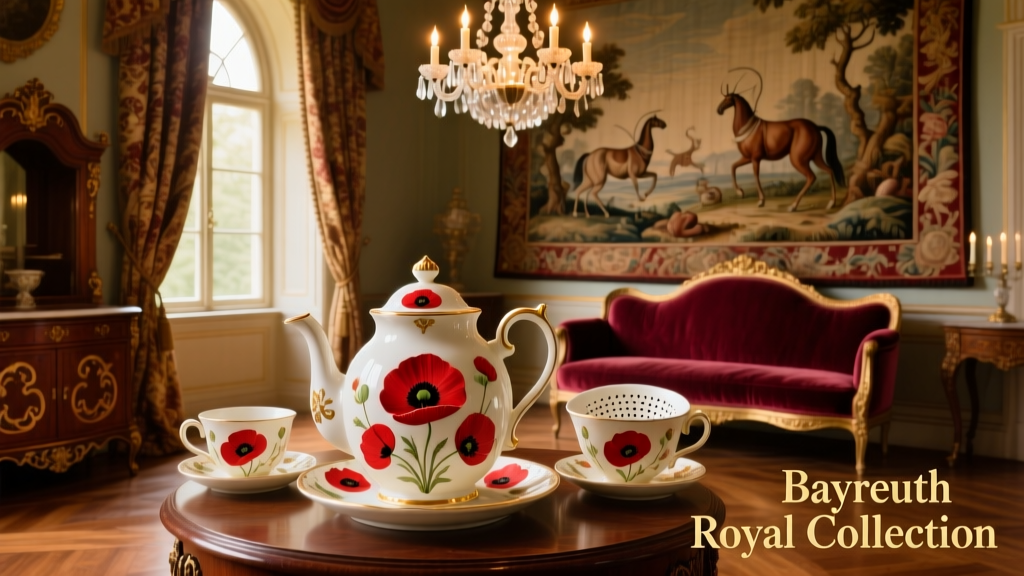
Royal Bayreuth Strainer Tea Set: The Iconic Red Poppy Pattern and Its Historical Significance
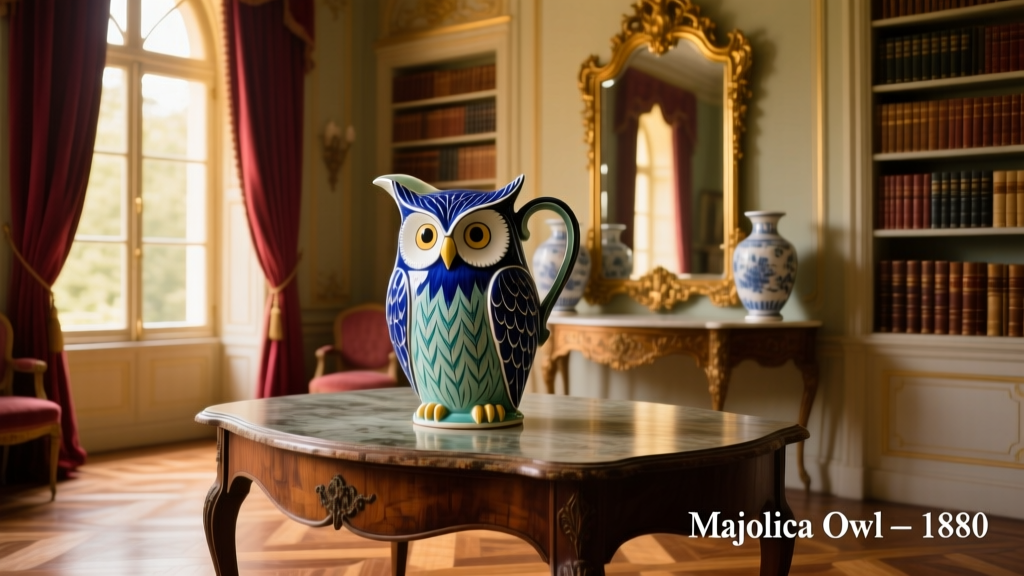
The Majolica Pitcher Owl Triangular: A Victorian Masterpiece in Ceramic Sculpture and Function
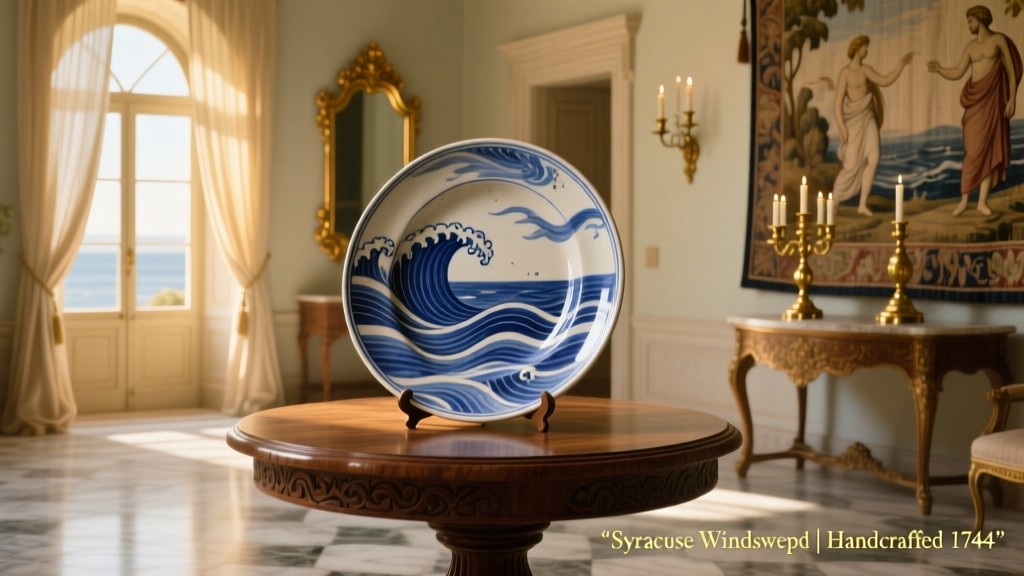
Syracuse Windswept Platter (8-Inch Serving Size): Identification, History, Value, and Care for Collectors & Restorers

The Playboy 1970 Paper Magazine Set: A Collector’s Guide to the Iconic 12-Piece Decorative Series
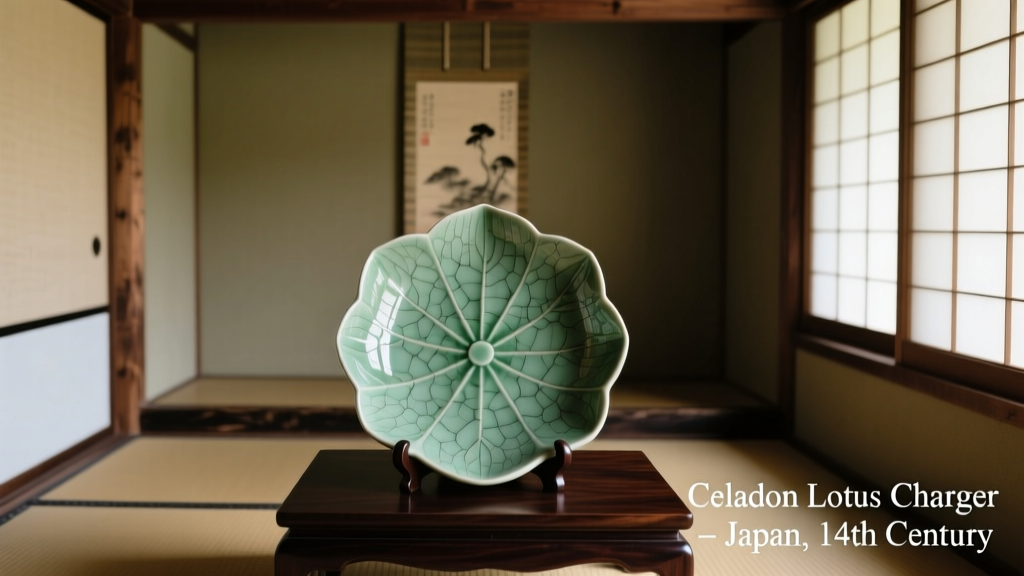
Celadon Charger, Lotus Leaf Shape, Green Crackle Ware — Japan, 14 Inches (35.6 cm) Diameter