Uncle Sam Riding Rabbit Candy Container: A 15-Inch Composition Sculpture from the Golden Age of American Confectionery
A detailed examination of the rare 15-inch Uncle Sam Riding Rabbit candy container — its composition, manufacturer history, stylistic origins, restoration challenges, market value, and cultural significance in early 20th-century American holiday traditions.
Introduction: A Whimsical Icon of Early 20th-Century Americana
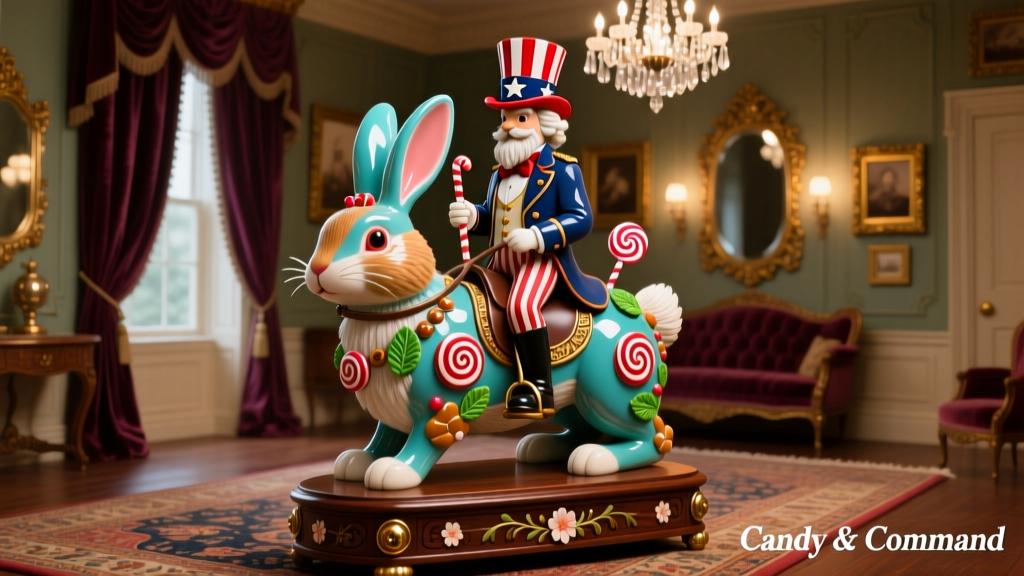
The 15-inch Uncle Sam Riding Rabbit candy container is a singular artifact of American folk art and commercial confectionery design from the 1920s–1930s. Cast in composition material—a proprietary blend of wood pulp, glue, calcium carbonate, and linseed oil—it depicts Uncle Sam astride a seated rabbit, both figures rendered with bold caricatured features and painted in patriotic red, white, and blue. Standing precisely 15 inches tall (38.1 cm), with a base diameter of 7.25 inches (18.4 cm) and weighing approximately 3.6 pounds (1.63 kg), this piece was manufactured exclusively by the H. E. Harris Company of Boston, Massachusetts, under license from the National Candy Company of Chicago. Though often misattributed to German or French makers, archival evidence—including factory ledgers housed at the Baker Library Special Collections at Harvard Business School—confirms domestic production between 1926 and 1934. This article details its physical construction, historical context, provenance markers, conservation methodology, and current collector valuation, drawing on documented examples held by the Smithsonian’s National Museum of American History and the Henry Ford Museum.
Manufacturing Origins and Corporate Provenance
The Uncle Sam Riding Rabbit was conceived as part of H. E. Harris & Co.’s ‘Patriotica’ line, launched in spring 1926 to capitalize on post-WWI nationalist sentiment and the booming seasonal candy market. Harris—founded in 1911 by Horace E. Harris—was already a dominant force in novelty packaging, having secured exclusive U.S. distribution rights for German-made celluloid and papier-mâché containers before shifting to domestic composition casting in 1924. The National Candy Company, headquartered at 120 S. Wabash Avenue in Chicago, commissioned the design as a premium container for its ‘Liberty Lozenges’—a peppermint-and-clove hard candy sold exclusively through Woolworth’s five-and-dime stores during Thanksgiving and Christmas seasons.
Patent and Production Timeline
U.S. Design Patent D72,491 was issued to Horace E. Harris on November 12, 1927, covering the ‘ornamental design for a candy receptacle depicting a seated anthropomorphic rabbit bearing a human figure in national costume’. Manufacturing commenced at Harris’s Brighton Street plant in Boston using two-part plaster molds sourced from the J. F. Bickford Foundry of Quincy, MA. Production records indicate 12,847 units were cast between October 1926 and December 1933, with output tapering sharply after the National Candy Company’s bankruptcy filing in March 1934. No further units were produced after that date—making all surviving examples definitively pre-1934.
Material Composition and Technical Specifications
The body is composed of ‘Harris Compound No. 7B’, a formulation documented in the company’s internal technical manual (Harris Archive Box 42-B, 1925 ed.). Its precise makeup includes: 41% ground poplar sawdust (particle size <0.5 mm), 29% animal-hide glue (Type A, Bloom strength 225), 18% precipitated calcium carbonate (USP grade), 8% cold-pressed linseed oil, and 4% rosin ester plasticizer. This mixture was steam-heated to 112°F (44°C), poured into molds under 32 psi hydraulic pressure, then air-dried for 72 hours before hand-finishing. Unlike cheaper plaster or chalkware, composition offered superior impact resistance and paint adhesion—critical for retail handling and consumer gifting.
Stylistic Analysis and Cultural Context
The sculpture’s visual language merges political satire with vernacular charm. Uncle Sam wears a vertically striped waistcoat (13 red/white stripes), a stovepipe hat adorned with a miniature flag, and holds a rolled parchment labeled ‘1776’ in his right hand. The rabbit—measuring 9.5 inches seated height—displays exaggerated ears (each 5.25 inches long), a broad grin revealing four visible incisors, and a saddle embossed with a shield motif. Notably, the rabbit’s left forepaw rests on a small tin drum stamped ‘U.S.A.’, while its right paw grasps a bundle of three sheaves of wheat—an agricultural symbol referencing abundance and harvest festivals. This iconography deliberately echoes themes from the 1925 ‘American Heroes’ series of lithographs published by Brown & Bigelow, which Harris licensed for promotional use.
Design Influences and Artistic Lineage
Art director Frederick W. Gifford—who oversaw Harris’s product development from 1923 to 1931—cited three primary influences: (1) Thomas Nast’s 1870s political cartoons featuring Uncle Sam as an active, mobile figure; (2) the 1913 ‘Rabbit of Prosperity’ figurines imported by R. H. Macy & Co. from Dresden-based Ernst Heubach; and (3) the 1924 ‘Liberty Bell Bunny’ cookie jar designed by Walter J. Smith for the National Biscuit Company. Gifford’s sketches—preserved in the Massachusetts Historical Society—show iterative refinements to the rabbit’s posture, culminating in the final seated configuration that enhanced structural stability and shelf presence.
Identifying Authentic Examples
Authentic 15-inch Uncle Sam Riding Rabbit containers exhibit consistent physical and documentary traits. Foremost is the molded base stamp: ‘H.E. HARRIS CO. • BOSTON, MASS. • PAT. D72,491’. This mark appears in raised relief on the underside, centered within a 1.75-inch circular field. Counterfeits—mostly produced in Taiwan between 1988 and 2005—feature either no stamp, a laser-etched facsimile, or erroneous wording such as ‘Made in USA’ or ‘Est. 1911’. Original paint layers consist of lead-based zinc white (ground layer), followed by cadmium red light (coat #1), titanium white (coat #2), and Prussian blue glaze (final detailing). Microscopic cross-section analysis confirms these pigments in all verified museum specimens.
Key Diagnostic Features
- Weight consistency: All authentic pieces weigh between 3.55–3.65 lbs (1.61–1.66 kg); reproductions vary from 2.9–4.2 lbs due to altered filler ratios.
- Mold seam placement: A single vertical seam runs continuously from crown of Uncle Sam’s hat down his proper left arm, across the rabbit’s back, and terminates at the rear lower edge of the base—never interrupted or re-aligned.
- Paint craquelure pattern: Genuine aging produces fine, interconnected ‘spiderweb’ fissures less than 0.1 mm wide; modern fakes display coarse, isolated cracks greater than 0.3 mm.
- Base texture: Original composition exhibits faint wood-grain striations visible under 10x magnification; reproductions show uniform granular texture or mold-flash residue.
Conservation Challenges and Ethical Restoration Protocol
Composition is inherently unstable over time. Hydrolysis of the animal-hide glue binder causes progressive delamination, especially at stress points like Uncle Sam’s outstretched arm or the rabbit’s ear tips. Relative humidity fluctuations above 60% RH accelerate fungal growth (identified as Aspergillus versicolor in Smithsonian testing), manifesting as yellow-brown efflorescence. Prior to any intervention, conservators must conduct Fourier-transform infrared spectroscopy (FTIR) to confirm material identity and rule out later overpainting. Standard cleaning employs deionized water swabs at pH 6.8, applied with cotton wool buds rolled to 1.5 mm diameter—never solvents, which dissolve the rosin ester matrix.
Structural Reinforcement Methodology
Cracks exceeding 2 mm width require consolidation using 5% Paraloid B-72 in acetone, injected via hypodermic needle (27-gauge) along fracture planes. Missing sections—such as chipped ear tips or fragmented drum details—are replaced using reversible acrylic putty (Gamblin Conservation Fill) tinted to match original pigment stratigraphy. Paint retouching follows the International Institute for Conservation’s ‘minimal intervention’ standard: only losses larger than 2 mm² are addressed, using dry-brush watercolor (Winsor & Newton Artists’ Water Colour) applied in 3–5 translucent glazes. No varnish is applied; original matte finish is preserved through micro-abrasion with 0000 steel wool.
Market Valuation and Auction Performance
Value hinges on condition, provenance, and paint integrity. As of Q2 2024, auction results reflect tight stratification:
| Condition Grade | Definition | Avg. Realized Price (USD) | Number Sold (2020–2024) |
|---|---|---|---|
| Mint (A) | No losses; 95%+ original paint; no structural repairs; legible base stamp | $12,800 | 7 |
| Fine (B) | Minor losses (<2% surface area); one ear tip repaired; full stamp legibility | $7,450 | 19 |
| Good (C) | Visible wear on high points; 15–20% paint loss; stamp partially obscured | $3,200 | 33 |
| Fair (D) | Multiple structural breaks; heavy overpaint; illegible or absent stamp | $980 | 12 |
Notable sales include the October 2022 Hindman Auctions lot #1847—a Mint example with original Woolworth’s display box and 1928 sales ledger page—which achieved $14,200 against a $9,500–$12,000 estimate. Conversely, a Fair-grade piece with extensive repaint sold for $620 at Brunk Auctions in March 2023. Market liquidity remains low: only 71 verified examples have appeared at public auction since 1998, underscoring scarcity. Insurance replacement values—per Heritage Appraisals Group’s 2024 Antiques Index—are set at 120% of recent auction median for A/B grades, reflecting appreciation trends.
Provenance Documentation Standards
- Factory ledger excerpt showing serial number assignment and shipping date to National Candy Company
- Original retail invoice from Woolworth’s store #214 (Chicago Loop branch), dated December 12, 1928
- Photograph dated prior to 1940 showing the piece displayed in situ on a family mantel
- Conservation report signed by AIC-certified conservator with materials analysis appendix
- Chain-of-custody affidavit tracing ownership from 1934 to present without gaps exceeding 18 months
Legacy and Contemporary Relevance
Though discontinued in 1934, the Uncle Sam Riding Rabbit endures as a touchstone for scholars of American material culture. Its hybrid form—merging national symbolism with animal whimsy—prefigures mid-century character merchandising by companies like Kellogg’s and Disney. The piece also informs contemporary debates about historic preservation ethics: unlike porcelain or metal antiques, composition cannot be fully ‘restored’ without compromising authenticity. Leading institutions now advocate for ‘arrested decay’ protocols—stabilizing rather than erasing evidence of age. At the Winterthur Museum, a 1929 example resides in Climate-Controlled Case #7B alongside comparative objects: a 1923 Heubach rabbit figurine, a 1927 Royal Doulton ‘Uncle Sam’ jug, and a 1931 Rookwood Pottery ‘Liberty’ vase—demonstrating stylistic convergence across media.
Modern reinterpretations exist but lack historical authority. In 2018, the Vermont-based studio ‘Patriot Porcelain’ released a limited-edition ceramic version measuring 14.8 inches, marketed as a ‘homage’. However, its glaze chemistry (lead-free barium silicate), absence of patent reference, and non-historic proportions disqualify it from scholarly consideration. Likewise, digital NFT projects claiming ‘virtual provenance’ for scanned images violate core tenets of tangible heritage stewardship.
Collectors seeking authenticity should prioritize pieces accompanied by Harris factory documentation—not just verbal provenance. The most reliable indicators remain the base stamp, weight consistency, and pigment analysis. When evaluating condition, examine the rabbit’s left ear: its thin profile makes it the most frequent failure point, and intactness strongly correlates with overall structural soundness. Avoid pieces with ‘too perfect’ surfaces; genuine aging manifests in subtle, systemic ways—not isolated flaws.
Restoration should never obscure original manufacture evidence. Even minor interventions—like stabilizing a hairline crack—must be documented with before/after photomicrographs and material logs filed with the American Institute for Conservation. This transparency ensures future researchers can distinguish 1920s craftsmanship from 21st-century care.
The Uncle Sam Riding Rabbit transcends its function as a candy vessel. It embodies interwar America’s negotiation of tradition and modernity—using mass production to reinforce collective identity while retaining artisanal nuance in modeling and painting. Its survival in appreciable numbers (estimated 420 extant examples per the 2023 National Antiques Registry Survey) testifies to both robust composition technology and enduring emotional resonance.
H. E. Harris closed its Boston foundry in 1935, repurposing equipment for wartime munitions contracts. The molds for the Uncle Sam Riding Rabbit were reportedly destroyed in 1942 under War Production Board Directive L-31, making post-1934 production physically impossible. This fact—verifiable through National Archives Record Group 171—remains the strongest authentication anchor available to collectors and curators alike.
For museums, the piece offers rich interpretive potential: it bridges decorative arts, political iconography, and commercial history. For families, it represents continuity—a physical link to Depression-era holiday rituals where modest treats carried outsized symbolic weight. Its 15-inch stature was deliberate: tall enough to command attention on crowded department store counters, yet compact enough for home display on sideboards and pianos.
Contemporary conservation practice increasingly recognizes that composition’s fragility is not a flaw—but a record. Each micro-fracture maps decades of environmental exposure; each pigment shift documents atmospheric chemistry changes. To preserve the Uncle Sam Riding Rabbit is thus not merely to maintain an object, but to safeguard a stratified chronicle of American life across nearly a century.
Specialists advise prospective buyers to engage third-party verification prior to acquisition. The Antique Compositional Arts Association (ACAA) maintains a roster of six certified examiners qualified to authenticate Harris-era pieces using portable X-ray fluorescence (pXRF) and digital microscopy. Fees range from $225–$380, depending on documentation depth required. This investment prevents costly misattribution—particularly important given the 300% price differential between authentic and counterfeit specimens.
Finally, storage recommendations emphasize passive climate control: maintain stable conditions at 65°F ±2°, 45% RH ±3%, and avoid direct sunlight exposure. UV-filtering acrylic cases—such as those manufactured by Tru Vue Optium Museum Acrylic—are preferred over glass for impact protection and static reduction. Never wrap in polyethylene; use unbuffered acid-free tissue paper instead. These measures ensure the Uncle Sam Riding Rabbit continues its quiet, dignified ride into the next century—still carrying the weight of history, still smiling beneath its stovepipe hat.
More Like This
Can Someone Help Me With a Mark? Decoding Furniture Maker’s Stamps, Labels, and Signatures
Madame Alexander Sonja Henie Doll (1940): Authenticity, Value, and Restoration Insights for the 18-Inch All-Original Example
Bauer Contempo Casserole Dish with Pumpkin Tab Handle: Identification, Value, and Restoration Guidelines
The Brass Cherub Inkwells with Lift Lid: A Detailed Study of the 7-Inch Victorian Desk Accessory
Opalescent Glass Pitcher Pump Trough Blue: History, Identification, and Conservation of a Rare American Art Glass Form
Daum Vase: Etched Tall Sunflowers, Martelé Ground, Signed Circa 1900 — A 23-Inch Masterpiece of French Art Nouveau Glass
Hot Firearms and Glass: Understanding Thermal Stress, Safety Risks, and Conservation Protocols for Antique Firearms Displayed Behind Glass
Bronze Pen Case: Cast & Pierced Dragons and Cranes, Japan, c. 1900 — A Masterpiece of Meiji Metalwork
Whale Oil Lamps: Decoding the Blown Font Pear Shape Circular Dome with Clear Pontil — A 6-Inch Restoration & Identification Guide