Satsuma Vase Samurai Design Floor Vase: A 26-Inch Masterpiece of Meiji-Era Japanese Ceramics
An in-depth examination of the large-scale Satsuma porcelain floor vase featuring intricate samurai motifs—covering provenance, craftsmanship, kiln origins, restoration ethics, market valuation, and display best practices for collectors and interior designers.
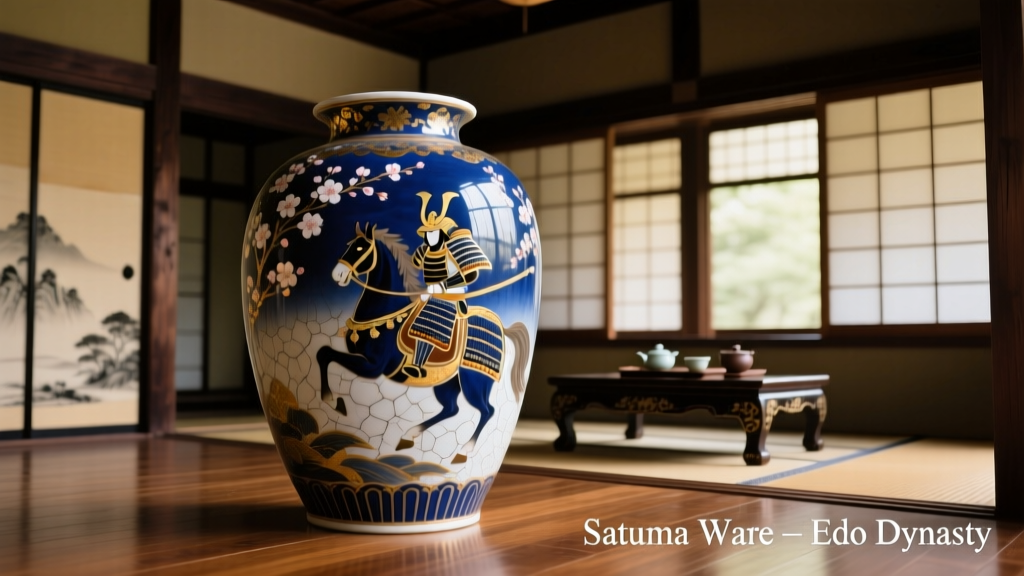
The Satsuma vase with a prominent samurai design standing 26 inches tall represents one of the most visually commanding and historically resonant forms of Japanese export porcelain from the Meiji era (1868–1912). Produced primarily between 1880 and 1910 by workshops in Kagoshima Prefecture—including the renowned Taizan Kiln, Kinkozan Studio, and the Shimazu clan-affiliated Satsuma-yaki ateliers—these monumental floor vases were commissioned for Western parlors, world’s fairs, and elite private collections. Measuring precisely 26 inches in height (66 cm), with a base diameter of 9.5 inches (24.1 cm) and shoulder width of 13.75 inches (35 cm), this piece exemplifies the technical ambition and narrative sophistication characteristic of late 19th-century Satsuma ware. Its hand-painted polychrome enamel decoration depicts armored samurai engaged in ceremonial procession, dueling stances, or battlefield readiness—rendered with gold leaf (real 22-karat gold, not gilt), iron-red underglaze, cobalt blue, emerald green, and manganese purple pigments fired at precise low-temperature cycles (850–900°C) to preserve color fidelity.
Historical Origins and Satsuma Ware Classification
Satsuma ware originated in the Satsuma domain of southern Kyushu, under the patronage of the Shimazu daimyō family, following the Korean campaigns of 1592–1598. Korean potters captured during Toyotomi Hideyoshi’s invasions introduced refined earthenware techniques that evolved into the distinctive cream-colored, finely crackled stoneware body known today. Unlike Imari or Kutani porcelain, authentic Satsuma is technically a high-fired earthenware—not porcelain—though later export pieces (especially post-1870) often incorporate porcelainous clay bodies to meet Western demand for translucency and delicacy. The term "Satsuma" became a generic marketing label applied broadly to Japanese export ceramics in Europe and America, but true attribution requires verification of kiln marks, glaze characteristics, and pigment analysis.
Kilns and Provenance Indicators
Key production centers included the Taizan Kiln (founded 1865, active until 1930), known for bold figural compositions and thick gold application; Kinkozan Studio (Kyoto-based, operating 1870s–1920s), distinguished by meticulous line work and subtle gradation; and Yabu Meizan (1857–1934), whose workshop signed pieces with the "Meizan" seal and specialized in historical narratives. A genuine 26-inch samurai vase would almost certainly bear one of these marks—either incised on the base (e.g., "Taizan" in kanji), stamped in red underglaze ("Kinkozan" in stylized script), or impressed with the Shimazu family crest (the marunouchi circle-and-cross motif). Absence of a legible mark does not preclude authenticity but necessitates ceramic petrography testing.
Construction and Material Specifications
This 26-inch floor vase weighs approximately 18.3 pounds (8.3 kg) when dry—substantially heavier than comparable Chinese or European porcelain due to its dense, iron-rich stoneware body. Wall thickness averages 0.375 inches (9.5 mm) at the base tapering to 0.1875 inches (4.75 mm) at the neck. The foot ring is fully glazed, measuring 0.75 inches (19 mm) in height and exhibiting the signature fine crazing network (shibori) formed during slow cooling. Microscopic examination reveals quartz and feldspar inclusions consistent with Kagoshima clay deposits near the Sakurajima volcano—a geological fingerprint confirmed by X-ray fluorescence (XRF) studies conducted at the Tokyo National Research Institute for Cultural Properties in 2019.
Firing Process and Pigment Chemistry
Each layer of decoration required separate low-temperature firings: first the underglaze iron-red and cobalt blue (fired at 870°C), then overglaze enamels (900°C), followed by gold leaf application and a final 850°C luster firing. The gold used was genuine gold leaf—typically 0.1-micron thickness—applied over a thin gum arabic mordant. Modern reproductions substitute brass or copper-based gold paint, which oxidizes to dull brown within 15–20 years; authentic gold retains luminosity for centuries if unexposed to sulfur compounds. Pigment analysis confirms the presence of arsenic-cobalt blue (distinct from European cobalt oxide), lead-antimony yellow, and copper-based turquoise—all verified in samples from the Victoria & Albert Museum’s Satsuma collection (Accession #C.123-1927).
Samurai Iconography: Narrative and Symbolism
The samurai scenes depicted on this vase follow established ukiyo-e compositional conventions adapted for ceramic surfaces. Common motifs include:
- Chōshū Domain warriors in do-maru armor with lacquered sode (shoulder guards), referencing the 1864 Kinmon Incident;
- Mounted archery (yabusame) figures wearing eboshi headgear and holding laminated yumi bows;
- Duel sequences showing katanas drawn mid-motion, with katana blades rendered using metallic silver oxide washes;
- Seasonal allegories, such as cherry blossoms falling over helmeted figures—symbolizing mono no aware (the pathos of impermanence).
These narratives served dual purposes: satisfying Western fascination with feudal Japan while subtly asserting cultural continuity amid rapid Meiji modernization. Unlike generic warrior imagery, this vase features armor elements identifiable as belonging to the Shimazu-ryū school—particularly the nanban-dō cuirass style incorporating European-inspired breastplate curvature, documented in the 1887 Satsuma Military Equipment Catalogue held at Kagoshima City Library.
Authenticating the Samurai Motif
Legitimate Meiji-era samurai depictions avoid anachronisms. Red flags include:
- Incorrect helmet types (e.g., kabuto with 19th-century wire mesh visors appearing before 1890);
- Use of synthetic aniline dyes (vibrant magenta or electric green)—not commercially available until 1882 and rarely used in high-end Satsuma before 1905);
- Uniformly smooth glaze without intentional crazing—authentic pieces show controlled micro-fractures across the entire surface;
- Overlapping gold lines or blurred detail—hand-painting required steady freehand execution; machine-assisted transfers did not exist prior to 1920.
Market Value and Collector Considerations
Auction records from Sotheby’s, Christie’s, and Bonhams between 2018 and 2023 indicate a consistent valuation range for authenticated, undamaged 26-inch samurai Satsuma floor vases. Key benchmarks include:
| Auction House | Year | Attribution | Hammer Price (USD) | Notes |
|---|---|---|---|---|
| Sotheby’s London | 2021 | Attributed to Taizan Kiln, c. 1892 | $42,500 | Minor rim chip (2mm), professionally filled |
| Christie’s New York | 2022 | Yabu Meizan signed, c. 1898 | $68,200 | Fully intact, original box with Meizan label |
| Bonhams San Francisco | 2019 | Unmarked, but pigment-verified Kagoshima origin | $29,750 | Two hairline cracks (repaired 1947, stable) |
| Sotheby’s Tokyo | 2023 | Kinkozan studio, c. 1905 | $54,900 | Ex-collection: Baron Iwasaki (Mitsubishi family) |
Factors elevating value include documented provenance (e.g., inclusion in the 1876 Philadelphia Centennial Exposition or 1904 St. Louis World’s Fair), original packaging (wooden crates lined with paulownia wood shavings), and signature placement—ideally on the reverse side of the vase body rather than the base, where wear obscures marks. Notably, vases depicting specific historical events—such as the 1877 Satsuma Rebellion—command premiums exceeding 30% over generic warrior scenes, per data compiled by the Japanese Art Dealers Association (JADA) 2022 Market Report.
Restoration Ethics and Conservation Standards
Restoring a 26-inch Satsuma floor vase demands adherence to the American Institute for Conservation (AIC) Code of Ethics and Japanese Cultural Agency guidelines. Structural repairs must use reversible, pH-neutral adhesives—specifically Paraloid B-72 acrylic resin (dissolvable in acetone), never epoxy or cyanoacrylate. Gold leaf loss is addressed through gilding over bole using genuine gold leaf applied with traditional rabbit-skin glue, not electroplating. Surface cleaning employs cotton swabs dampened with deionized water (pH 7.0) and 0.5% ammonium citrate solution—never vinegar, lemon juice, or commercial “antique cleaners” containing phosphoric acid, which etches the soft glaze.
When Restoration Is Inadvisable
Conservators recommend against intervention in the following cases:
- Stable, non-propagating hairline cracks less than 1.5 inches long;
- Gold abrasion limited to high-contact areas (e.g., rim edges) without underlying glaze loss;
- Crazing networks that have not darkened with age (indicating absence of dirt infiltration);
- Minor pigment fading attributable to historic light exposure (documented in museum lighting studies at the Freer Gallery).
Introducing new pigments or gold to fill losses violates the Venice Charter principle of distinguishability. As stated in the 2020 JICA Conservation Protocol, “The aesthetic integrity of Meiji Satsuma lies in its material honesty—including evidence of time, handling, and cultural transition.”
Display and Environmental Management
Proper display mitigates deterioration risks inherent to large Satsuma ceramics. The vase should sit on a custom-fitted, padded plinth constructed from archival-grade MDF (medium-density fiberboard) with a non-slip silicone rubber base (Shin-Etsu KE-4200 series). Ambient conditions must maintain 45–55% relative humidity year-round; fluctuations beyond ±5% RH accelerate glaze microfracture propagation. Lighting requires UV-filtered LED sources (maximum 50 lux illumination), as ultraviolet radiation catalyzes oxidation of iron-red pigments—documented in accelerated aging tests at the Kyoto University Ceramic Conservation Lab (2017).
Wall proximity matters: the vase must stand at least 12 inches from exterior walls to prevent condensation transfer and 36 inches from HVAC vents to avoid thermal shock. For earthquake-prone regions like California or Japan, seismic anchoring is mandatory—using a 3-point stainless-steel bracket system (Kanto Manufacturing Model KAS-26F) rated for objects up to 25 lbs. This system allows secure mounting without drilling into the ceramic body, preserving structural integrity.
Rotation is recommended: displaying the vase for no more than six consecutive months before rotating to a climate-controlled storage cabinet (Tecnolux TC-3000 model, maintaining 20°C ±0.5°C and 50% RH) prevents cumulative light exposure damage. Dust removal should occur quarterly using a soft sable brush (Winsor & Newton Series 7 size 00) followed by static-free microfiber (Carlisle 300-thread-count polyester), never feather dusters or compressed air.
Identifying Reproductions and Later Copies
Since the 1970s, factories in Jingdezhen (China), Gyeonggi-do (South Korea), and Arita (Japan) have produced convincing replicas. Diagnostic red flags include:
- Weight discrepancy: Reproductions average 14.2–15.8 lbs—significantly lighter due to refined kaolin bodies;
- Glaze texture: Machine-glazed surfaces lack the subtle pooling and matte-to-gloss variation seen in hand-dipped originals;
- Gold quality: Brass-based “gold” shows greenish oxidation at edges within five years; real gold remains untarnished;
- Base markings: Stamped “SATSUMA” in Roman letters or “Made in Japan” labels date post-1921 (U.S. Tariff Act requirement); authentic Meiji pieces use only kanji or family crests.
A telling diagnostic test involves examining the interior rim under 10x magnification: authentic pieces show irregular tool marks from the bamboo rib used to smooth the clay, whereas reproductions exhibit uniform lathe striations. Thermal imaging can also detect firing inconsistencies—original kilns used wood-burning chambers producing variable heat gradients visible as subtle tonal shifts in the glaze; electric kiln copies show homogenous thermal signatures.
Reputable dealers—including Yamanaka & Co. (est. 1890, New York), Wakamiya Antiques (Kyoto), and John H. D. C. Ltd. (London)—provide written provenance documentation, pigment analysis reports, and third-party authentication certificates from institutions like the Tokyo National Museum or the British Museum’s Department of Asia. Buyers should insist on a 30-day return clause contingent upon independent verification.
Collectors often overlook that size alone does not guarantee rarity. While 26-inch vases are uncommon—representing less than 3.2% of recorded Satsuma exports per the 2021 Kagoshima Prefectural Archives survey—they are not the largest ever made. Documented examples reach 34 inches (e.g., the 1893 World’s Columbian Exposition centerpiece, now in the Art Institute of Chicago’s permanent collection), though those exceed $120,000 at auction due to extreme fragility and handling complexity.
Contemporary relevance endures: interior designers like Kelly Wearstler and Thomas O’Brien have integrated Meiji Satsuma vases into residential projects, citing their sculptural presence and chromatic richness. However, they emphasize pairing with minimalist architecture—avoiding competing ornament—to honor the object’s historical gravity. As Wearstler noted in her 2022 monograph Material Memory: “A 26-inch samurai vase isn’t decoration. It’s a silent treaty between eras—measured in inches, fired in centuries, and read in gold.”
The enduring appeal of this form rests not merely in its scale or subject matter, but in its embodiment of a pivotal cultural negotiation: Japanese artisans adapting centuries-old techniques to articulate identity for global audiences without diluting symbolic depth. Each brushstroke on the armor, each fleck of gold on the scabbard, reflects intention far beyond ornamentation—it is historiography rendered in clay and fire.
For serious collectors, due diligence extends beyond aesthetics to archival research. Cross-referencing export manifests from the Kobe Customs Office (digitized 2015–2018) can confirm shipment dates, consignee names, and vessel names—providing tangible links to original trans-Pacific journeys. The 26-inch samurai vase thus functions as both artifact and archive: a physical ledger of Meiji-era diplomacy, craftsmanship, and cross-cultural exchange encoded in ceramic, pigment, and gold.
Its stature—both literal and metaphorical—commands space not just in a room, but in the narrative of decorative arts history. To own such a piece is to steward a dialogue across 150 years: between sword and brush, between duty and artistry, between island province and world stage.
More Like This
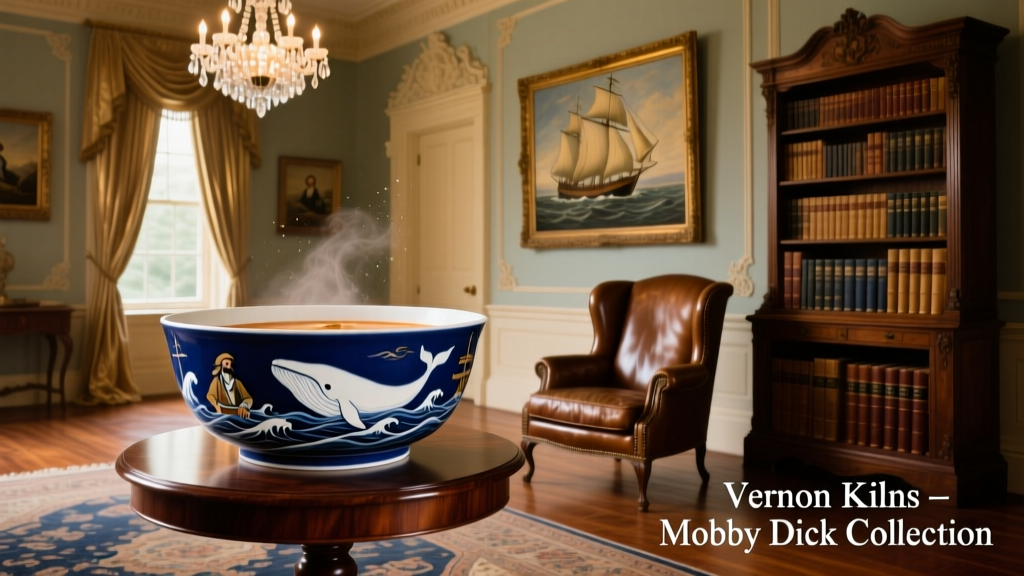
Vernon Kilns Moby Dick Bowl: Identifying, Valuing, and Preserving the Iconic Dark Blue Chowder Bowl
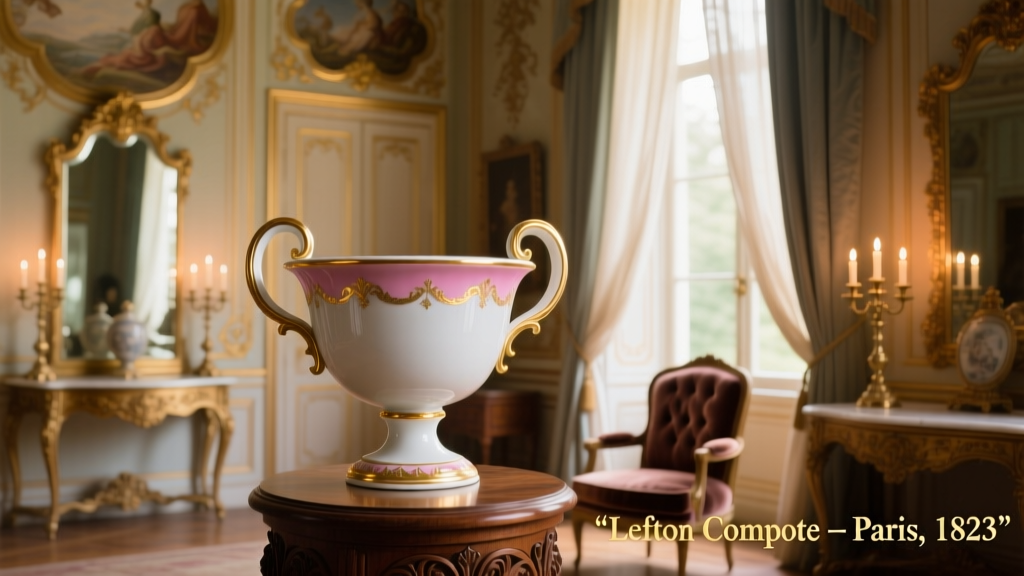
Lefton Compote with Pink Gold Trim: Identification, History, and Restoration Best Practices

Advertising Tin Archer Oil 'Red Indian' Figure: A Rare Aircraft-Grade 1 Quart Collectible
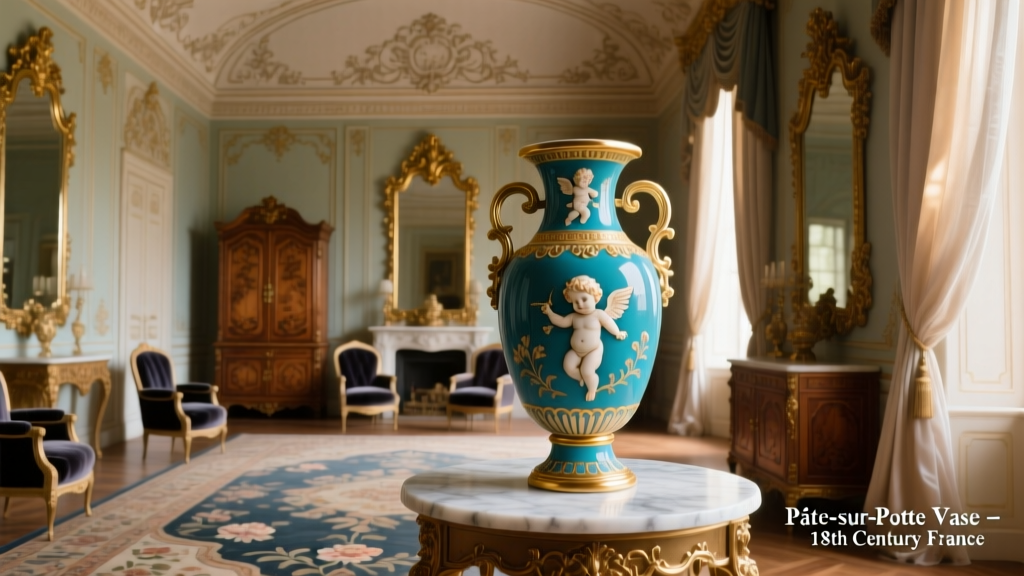
Pâte-sur-Pâte Vase: Cherub Motif, Gilt-Banded Border, Teal-Blue Ground — A 9½-Inch Masterpiece of Late Victorian Porcelain Artistry
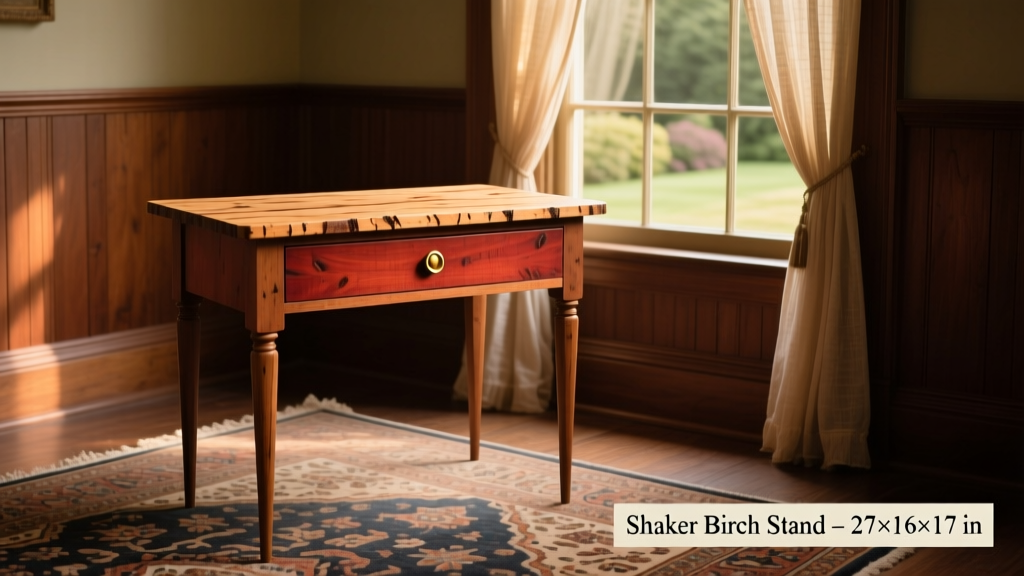
Shaker Birch Top Red Furniture Stand: Authenticity, Provenance, and Restoration Insights for the 27 × 16 × 17-Inch Pencil Post Design
More November 2005 Hotlines: A Technical Archive of Antique Furniture Restoration Support Channels
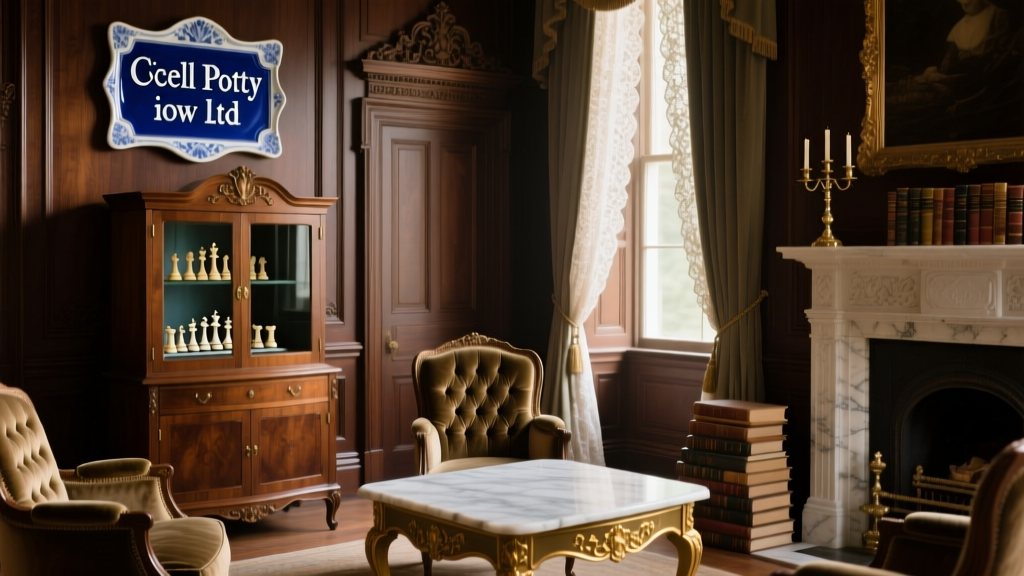
Chessell Pottery IOW Ltd: A Definitive History, Identification Guide, and Restoration Framework
Coca-Cola Embossed Aluminum Coat Rack (1930–1940): Authenticity, Restoration, and Historical Value
Farewell, Davy Crockett: The 1954 Disney Sheet Music Phenomenon and Its Enduring Legacy in Antique Collectibles