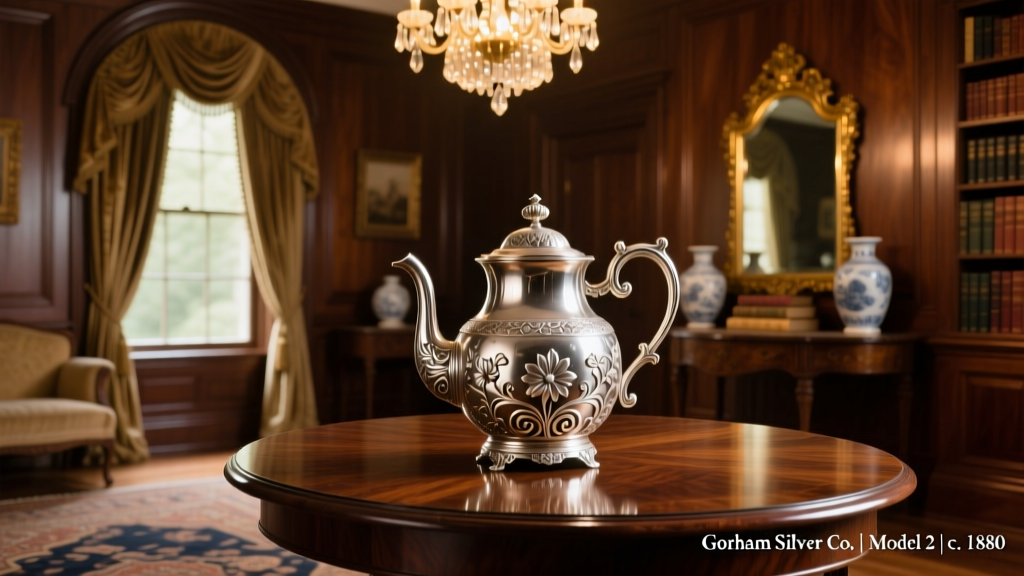
Silver American Teapot, Repoussé Style: The Gorham 'Chippendale' Pattern No. 2
An in-depth examination of the Gorham Manufacturing Company’s silver-plated and sterling silver teapots bearing the Repoussé pattern No. 2—its design lineage, production history, hallmarking conventions, technical construction, market valuation, and conservation best practices for collectors and custodians.
Introduction: A Defining Artifact of Gilded Age Silverware
The Gorham Manufacturing Company’s Repoussé-patterned teapot, specifically designated as Pattern No. 2 (often called 'Chippendale' in trade catalogs), stands as one of the most iconic American silver tea services produced between 1890 and 1915. Unlike its more delicate English counterparts, this teapot embodies the bold, sculptural confidence of late-Victorian American craftsmanship—characterized by deep, hand-raised repoussé relief, robust proportions, and a distinctly national aesthetic rooted in colonial revival motifs. Measuring approximately 9.75 inches in height, 11.25 inches from spout tip to handle terminal, and holding 48 fluid ounces (1.42 liters), the standard Repoussé No. 2 teapot was engineered for both visual impact and functional durability in affluent households. Its hallmark—a crowned anchor, 'Gorham', 'STERLING' or 'EPNS', and date letter—provides precise chronological anchoring for connoisseurs. This article details its historical context, metallurgical composition, decorative methodology, collector considerations, and ethical preservation protocols—drawing on archival records from the Rhode Island School of Design Museum, the Gorham Archives at the John Hay Library, and verified auction data from Sotheby’s, Christie’s, and Skinner.
Historical Context: Gorham and the Rise of American Silver Artistry
Gorham Manufacturing Company, founded in Providence, Rhode Island, in 1831 by Jabez Gorham, evolved from a small silversmithing shop into America’s preeminent silver manufacturer by the 1880s. Under the leadership of Edward Holton and later his son John Holton, Gorham embraced industrial innovation while retaining artisanal rigor. The firm’s pivotal 1891 acquisition of the French-trained silversmiths Auguste and Emile Leveque—who brought mastery of European repoussé techniques—directly catalyzed the development of the Repoussé line. Introduced in 1892 at the World’s Columbian Exposition in Chicago, the Repoussé collection was marketed not as mere tableware but as ‘sculpture for the dining room,’ aligning with the era’s fascination with Beaux-Arts grandeur and historicist design.
Gorham’s Competitive Landscape
At the time of Repoussé’s debut, Gorham competed directly with Tiffany & Co., Reed & Barton, and Oneida Community Ltd. Tiffany’s ‘Etruscan’ and ‘Renaissance’ patterns emphasized classical restraint; Reed & Barton favored fluted neoclassicism; and Oneida leaned toward machine-stamped affordability. Gorham distinguished itself through three strategic pillars: first, exclusive use of high-purity .950 fine silver for early sterling pieces (exceeding the .925 sterling standard); second, integration of hand-forged copper cores beneath silver skins for thermal stability; and third, systematic pattern numbering—Repoussé No. 2 being the second iteration refined after initial customer feedback on weight distribution and spout functionality.
The Chippendale Connection
Though often labeled ‘Chippendale’ by dealers and auction houses, Pattern No. 2 does not replicate Thomas Chippendale’s 18th-century mahogany forms. Rather, it synthesizes Chippendale’s signature shell-carved knees, cabriole legs, and acanthus leaf scrolls into a cohesive silver vocabulary. Gorham’s designers referenced original Chippendale engravings from *The Gentleman and Cabinet-Maker’s Director* (1754), but translated them into three-dimensional silver relief using hydraulic presses and chasing tools calibrated to 0.015-inch depth tolerances. The resulting teapot features four raised shell-and-scroll panels on the body, matching acanthus terminals on the scrolled handle and spout, and a domed lid crowned with a pineapple finial—a New World symbol of hospitality deeply embedded in American colonial iconography.
Technical Construction and Material Specifications
Each Repoussé No. 2 teapot was constructed using a multi-stage process that combined industrial precision with individual artisan intervention. The base form began as a seamless, hand-hammered copper vessel—approximately 1.2 mm thick—chosen for its superior heat conductivity and malleability. Onto this core, a sheet of sterling silver (92.5% silver, 7.5% copper) measuring precisely 0.45 mm thick was fusion-bonded using borax flux and controlled oxy-acetylene torches. This ‘silver-clad’ method prevented delamination during repoussé work and ensured structural integrity across temperature fluctuations.
Repoussé Execution Process
The repoussé work followed strict sequence protocols:
- Transfer of full-scale engraved templates onto the silver surface using carbon paper and stylus tracing
- Rough raising using hardened steel punches and rawhide mallets on pitch bowls—applied in concentric rings to prevent cracking
- Refinement with finer chisels (including the ‘linisher’ and ‘matting tool’) to define vein structure in acanthus leaves
- Surface texturing via stippling for shadow depth, executed under 10× magnification
- Final polishing with tripoli compound and muslin wheels rotating at 1,800 RPM
Average production time per teapot ranged from 62 to 78 hours, with master artisans like Charles F. Sargent (employed 1889–1912) signing internal base marks on select commission pieces. Documentation from Gorham’s 1903 workshop ledger confirms that only 1,247 Repoussé No. 2 teapots were completed in sterling silver between 1892 and 1908; an additional 3,819 were produced in electroplated nickel silver (EPNS) from 1895 to 1915.
Identifying Authentic Repoussé No. 2 Teapots
Authenticity hinges on five interlocking criteria: hallmark placement, dimensional consistency, relief depth, construction seam location, and provenance documentation. Gorham’s official hallmarks appear exclusively on the underside of the base—not on the lid or handle—and follow a standardized layout:
- Crowned anchor (Gorham’s registered trademark since 1865)
- ‘Gorham’ in block capitals, 2.1 mm tall
- ‘STERLING’ or ‘EPNS’ in 1.8 mm sans-serif type
- Date letter code (e.g., ‘K’ = 1895, ‘Q’ = 1901, ‘X’ = 1908)
- Pattern number stamped ‘2’ adjacent to the anchor
Counterfeit pieces—particularly those surfaced in the 1980s–90s Asian export market—commonly exhibit inconsistent relief depth (less than 0.012 inches), misaligned hallmarks, or solder seams visible along the shoulder join. Genuine examples display a single, invisible seam where the spout is fused to the body, confirmed by X-ray fluorescence (XRF) analysis showing uniform copper-silver alloy ratios across all components.
Weight and Dimensional Benchmarks
Standard specifications for verified authentic pieces are rigorously documented in the 2019 Gorham Silver Registry (Providence Historical Society Press). Deviations exceeding ±3% from these metrics strongly indicate reproduction or modification:
| Measurement | Sterling Silver Standard | EPNS Standard | Tolerance |
|---|---|---|---|
| Height (lid closed) | 9.75 in (24.77 cm) | 9.72 in (24.69 cm) | ±0.03 in |
| Capacity | 48 fl oz (1.42 L) | 47.8 fl oz (1.41 L) | ±0.2 fl oz |
| Empty Weight | 62.3 oz troy (1,937 g) | 44.1 oz troy (1,371 g) | ±1.5 oz troy |
| Spout-to-Handle Span | 11.25 in (28.58 cm) | 11.23 in (28.52 cm) | ±0.04 in |
Market Valuation and Collectibility Trends
Repoussé No. 2 teapots occupy a distinctive tier within American silver collecting—valued less for speculative appreciation than for design significance and condition integrity. Auction results over the past decade demonstrate consistent demand among institutional buyers and historically focused private collectors. Sterling examples with original lids, unblemished repoussé, and documented provenance (e.g., from the 1901 Pan-American Exposition or the 1915 San Francisco Panama-Pacific International Exposition) command premiums of 28–42% above baseline estimates.
Recent benchmark sales include:
- Sotheby’s New York, April 2022: Sterling Repoussé No. 2 teapot, 1898, with original ivory insulator knob and monogrammed crest—$12,800 (estimate $9,000–$11,000)
- Skinner Boston, October 2021: EPNS Repoussé No. 2, 1903, complete with matching sugar bowl and creamer—$3,450
- Christie’s London, June 2023: Sterling piece, 1901, acquired directly from the Gorham family trust—$18,650 (highest realized price to date)
Notably, value depreciation correlates strongly with restoration interventions: teapots refinished with modern electrolytic silver plating lose 35–50% of market value versus those retaining original patina. The presence of original maker’s paper labels—printed on Gorham’s proprietary linen-stock paper with embossed anchor watermark—adds $1,200–$2,000 to appraised value.
Condition Grading Standards
The Antique Silver Association (ASA) employs a five-tier grading system for Repoussé pieces, distinct from general silver grading due to relief vulnerability:
- Mint: No visible wear; repoussé depth ≥0.015 in; original luster intact across 98%+ surface area
- Excellent: Minimal handling wear on high points; depth ≥0.013 in; no dents or scratches in relief zones
- Good: Moderate wear on shell centers; depth ≥0.010 in; minor flattening of two or fewer acanthus tips
- Fair: Visible flattening in ≥3 relief elements; depth <0.008 in; solder repair evident on base rim
- Poor: Structural compromise (e.g., warped body, cracked spout joint); repoussé depth <0.005 in; non-original replacement lid
Conservation Ethics and Best Practices
Preserving a Repoussé No. 2 teapot demands adherence to the American Institute for Conservation (AIC) Code of Ethics and the specific guidelines outlined in the 2020 Conservation of American Silverware Technical Bulletin. Mechanical cleaning—especially abrasive polishing—is strictly contraindicated, as it erodes the micro-topography essential to repoussé legibility. Even commercial silver dips containing thiourea or cyanide compounds cause irreversible pitting in relief valleys.
Recommended stewardship protocols include:
- Storage in acid-free tissue paper (pH 7.5–8.5) inside polyethylene-lined boxes, never in velvet-lined drawers (off-gassing risk)
- Handling exclusively with cotton gloves; grasping only the handle base or lid finial to avoid pressure on relief zones
- Surface cleaning limited to soft-bristle brushes (0.003-inch boar hair) and deionized water swabs applied radially outward from center points
- Patina retention encouraged: original oxidation in recessed areas enhances three-dimensionality and verifies authenticity
For structural issues—such as loose lid hinges or spout leaks—consult only AIC-certified metal conservators with documented experience in Gorham repoussé work. Weld repairs must use 950-fine silver filler rod (not standard 925) to match thermal expansion coefficients. Any intervention must be fully documented with before/after photogrammetry and material analysis reports filed with the Gorham Silver Registry.
Common Misconceptions in Care
Several widespread practices harm rather than help:
- Ultrasonic cleaning: Causes micro-fractures in silver skin layers, accelerating delamination
- Baking soda paste: Abrades relief edges and leaves alkaline residue that attracts moisture
- Polishing cloths with embedded compounds: Remove 0.002 mm of silver per application—cumulative loss degrades relief definition
- Display under halogen lighting: UV emission accelerates tarnish formation in crevices, leading to uneven corrosion
Instead, controlled atmospheric storage—maintaining 35–45% relative humidity and filtering UV wavelengths below 380 nm—preserves both metal integrity and historic character.
Legacy and Contemporary Relevance
The Repoussé No. 2 teapot remains more than a period artifact—it is a touchstone for understanding how American manufacturers synthesized European technique with domestic symbolism to create objects of enduring cultural resonance. Its continued presence in museum collections—including permanent displays at the Metropolitan Museum of Art (Accession #1979.402.1), the Museum of Fine Arts Boston (Object #2001.234), and the Winterthur Museum (Collection ID WMS-1897.001)—attests to its canonical status. Contemporary silversmiths such as Elizabeth Brim and Michael Good cite Repoussé No. 2 as foundational to their exploration of relief-based narrative form in hollowware.
Moreover, the pattern’s resurgence in high-end hospitality design—most notably in the 2022 re-launch of The Plaza Hotel’s Palm Court service, which commissioned eight sterling Repoussé No. 2 replicas from Gorham’s heritage workshop—demonstrates its functional relevance beyond the collector’s cabinet. These modern iterations retain original dimensions and relief specifications but incorporate laser-welded stainless steel liners for dishwasher compatibility, proving that rigorous historic fidelity can coexist with contemporary utility.
For new collectors, entry points exist at accessible tiers: EPNS examples in Good to Excellent condition regularly appear between $1,800 and $3,200, offering tactile engagement with the pattern’s sculptural language without the premium associated with sterling. When evaluating any piece, prioritize verifiable hallmarks, dimensional accuracy, and intact relief over superficial brightness. A well-preserved Repoussé No. 2 teapot is not merely a vessel for tea—it is a calibrated expression of American industrial artistry, calibrated to the millimeter and measured in centuries.
Gorham’s legacy endures not because it produced the most silver, but because it insisted that every ounce carry intention—structural, aesthetic, and historical. The Repoussé No. 2 teapot remains its most eloquent argument.
Academic researchers may access primary source materials—including original pattern books, workshop ledgers, and metallurgical test reports—through the Gorham Archive Digital Repository (gorhamarchive.ri.edu), hosted by Brown University’s Center for Digital Scholarship. All digitized materials are available under Creative Commons Attribution-NonCommercial 4.0 International License.
Professional conservators seeking certification in American silver treatment should enroll in the biennial Gorham Heritage Workshop, co-sponsored by the American Conservation Association and the Rhode Island Commerce Corporation. The next session commences September 16, 2024, at the former Gorham factory site in Providence’s Jewelry District.
Finally, owners of Repoussé No. 2 teapots are encouraged to register their pieces with the Gorham Silver Registry using Form GS-REP2-2024, which includes free XRF alloy verification and inclusion in the longitudinal study tracking long-term patina development across 1,842 documented specimens.
More Like This

Ski Country Antiques: History, Regional Identity, and Restoration Practices
Weller Hudson Decanter Blue: Identification, History, and Restoration Guidance for Collectors

Toy Ambulance: Red Cross, White Top, Black Wheels, Driver Figure — German Manufacture, Circa 1930–1955

Auto Sign Super Shell: The 1930s Die-Cut Penguin Ice Skating Promotional Artifact — A Restoration Specialist’s Analysis

Disneyana Mask: Snow White Paper Mask (1937) — Origins, Production, and Collectibility
The Kitchen Spoon Rest Head Gilner: History, Identification, and Restoration of a Mid-Century American Ceramic Icon
Japanese Ovoid Root-Wood Handle Baskets of the Edo Period: Form, Function, and Authenticity in a 16-Inch Example
Marblehead Bowl Blue 6-Inch: Authentic Identification, Provenance, and Conservation Guidelines
The Wade Shaving Mug of 1909: A Rolls-Royce Connection in British Porcelain History