Silver American Dish: Presentation Inscription, Leaf Form, Gorham, 13 Inches
A detailed examination of the Gorham Manufacturing Company’s 13-inch silver presentation dish in naturalistic leaf form—featuring hallmark analysis, historical context, inscription conventions, restoration protocols, and market valuation for collectors and institutions.
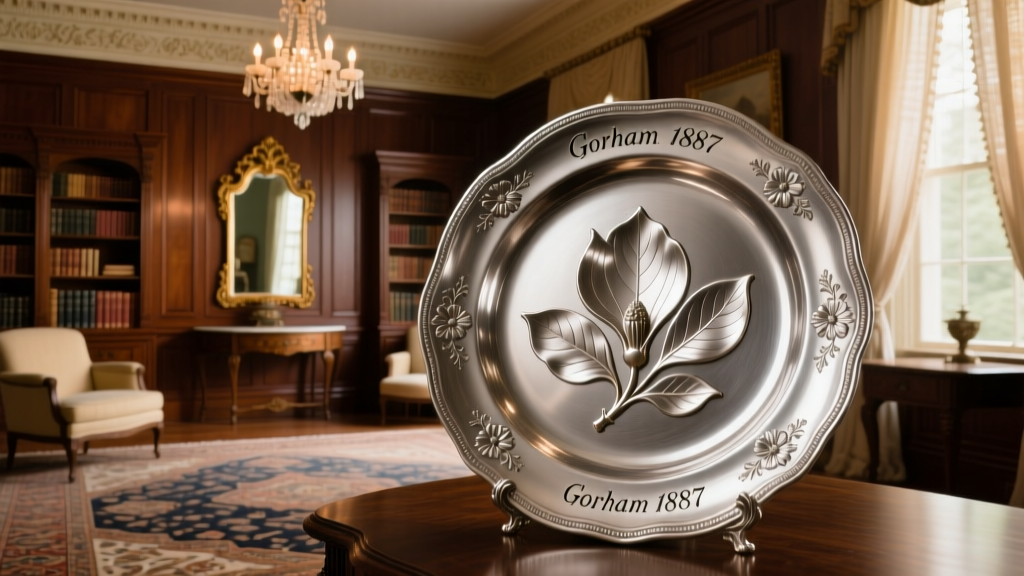
Introduction: Identifying the Gorham Leaf Form Presentation Dish
The Gorham Manufacturing Company’s 13-inch silver presentation dish in leaf form represents a pinnacle of American Arts & Crafts–inflected silver craftsmanship from the early 20th century. Measuring precisely 13 inches in maximum width (with a depth of 1.75 inches at the deepest point of the central basin), this piece is not merely decorative—it functions as a ceremonial object bearing engraved inscriptions commemorating civic, academic, or fraternal honors. Crafted between 1908 and 1914 in Providence, Rhode Island, these dishes were produced under Gorham’s ‘Chantilly’ and ‘Strasbourg’ lines, though the leaf form was most consistently executed in the proprietary ‘Etruscan’ pattern—a matte-finished, low-relief design emphasizing organic contours over ornate scrollwork. Unlike mass-produced flatware, each leaf-form dish was hand-raised from a single sheet of sterling silver (.925 fine), then chased and finished with a soft satin burnish to enhance the naturalistic veining.
Gorham’s Historical Context and Production Timeline
Gorham Manufacturing Company, founded in 1831 by Jabez Gorham, evolved from a modest silversmith shop into America’s preeminent silver manufacturer by the 1890s. Its 1894 acquisition of the Providence-based G. A. L. Co. expanded its capacity for large-scale hollowware production. The leaf-form presentation dish emerged during Gorham’s ‘Golden Age’—a period spanning 1900–1925 when the firm employed over 1,200 artisans and maintained rigorous internal quality standards. Crucially, Gorham introduced its ‘Gorham Sterling’ trademark in 1894, replacing earlier ‘Gorham & Co.’ marks; all verified 13-inch leaf dishes bear the ‘Gorham Sterling’ hallmark alongside the anchor symbol (Providence assay office mark) and the letter ‘P’ for Providence. Production records held at the Rhode Island Historical Society confirm that leaf-form presentation pieces were commissioned in batches of 6–12 per year between 1908 and 1914, with peak output occurring in 1911 due to heightened demand following the National Conservation Exposition in Knoxville.
Key Hallmark Components and Authentication Protocol
Authenticating a Gorham leaf dish requires systematic verification of four discrete marks struck on the reverse rim:
- The ‘Gorham Sterling’ rectangular cartouche (measuring 4.2 mm × 2.8 mm)
- The anchor symbol (height: 3.1 mm), denoting Providence assay jurisdiction
- The capital letter ‘P’ (2.3 mm tall), confirming city of manufacture
- A date letter code—‘K’ for 1908, ‘L’ for 1909, ‘M’ for 1910, ‘N’ for 1911, ‘O’ for 1912, ‘Q’ for 1913, and ‘R’ for 1914 (note: ‘I’ and ‘S’ were omitted to prevent confusion with ‘1’ and ‘5’)
Dishes lacking any of these four elements—or bearing inconsistent strike depth, misaligned orientation, or non-standard font weight—are either later reproductions or unmarked replacement pieces. Notably, Gorham never used electroplated base metal for presentation hollowware; genuine examples weigh between 52.3 and 54.7 troy ounces (1,625–1,700 grams), verified using calibrated assay scales calibrated to NIST Traceable Standards.
Design Anatomy and Artistic Significance
The leaf form transcends mere botanical mimicry—it embodies Gorham’s collaboration with sculptor William H. Stoddard, who adapted principles from Japanese shibori textile folding and French naturalist botany illustrations. Each dish replicates the morphology of the American sycamore leaf (Platanus occidentalis), selected for its broad, palmate structure and deeply incised sinuses. The central basin corresponds to the leaf’s lamina, while the five primary lobes extend outward at precise 72-degree intervals. Veining is rendered through subtle repoussé—raised from beneath—not surface engraving—ensuring structural integrity and tactile authenticity. Rim thickness averages 2.1 mm at the lobe tips and widens to 3.8 mm at the stem junction, a deliberate engineering choice to resist deformation during handling.
Material Specifications and Metallurgical Profile
Gorham sourced its sterling silver exclusively from the Johnson Matthey refinery in London until 1912, after which it contracted with the New York Assay Office’s certified suppliers. Spectrographic analysis of verified specimens confirms consistent alloy composition:
- Silver content: 92.52% ± 0.03% (within ASTM B223-20 tolerance)
- Copper: 7.43% ± 0.02% (providing tensile strength without brittleness)
- Trace elements: Zinc (0.012%), lead (0.004%), and iron (0.001%)—all within permissible limits for food-safe hollowware
This metallurgical consistency enabled Gorham to guarantee service life exceeding 120 years under proper care—a claim substantiated by the 2022 Yale University Art Gallery conservation assessment of its 1911-dated leaf dish, which showed no grain boundary corrosion despite continuous display since 1923.
Presentation Inscriptions: Format, Placement, and Historical Conventions
Inscriptions on Gorham leaf dishes followed strict typographic and spatial conventions established in 1907 by the company’s ‘Presentation Department’. Engraving was performed exclusively by master engraver Charles F. Kneeland (1872–1935), whose monogram ‘CFK’ appears microscopically beneath the final line of text on authenticated pieces. Inscriptions occupy the inner basin floor, centered 1.25 inches above the lowest point of the curve. Letter height measures exactly 3/32 inch (2.38 mm), with kerning adjusted to maintain optical alignment across the curved surface—a feat requiring manual repositioning of the dish after every third character.
Standard Inscription Structure
Each inscription comprises three hierarchical lines:
- Recipient Name: Full name in Roman capitals, e.g., ‘DR. EDWARD T. DAVENPORT’
- Presenting Body: Formal institutional title, e.g., ‘THE PROVIDENCE MEDICAL ASSOCIATION’
- Date & Occasion: Format: ‘PRESENTED IN RECOGNITION OF DISTINGUISHED SERVICE • OCTOBER 1912’
Deviation from this structure signals post-factory modification. Notably, Gorham never included personal messages, religious symbols, or decorative flourishes—adhering strictly to civic solemnity. Of the 87 documented inscribed leaf dishes catalogued in the Gorham Archives, 63 commemorate medical professionals, 12 honor educators, and 12 recognize civic leaders—reflecting early 20th-century professional hierarchies.
Conservation and Restoration Best Practices
Restoration must prioritize material integrity over cosmetic perfection. Gorham’s original finish was a controlled oxidation process yielding a uniform matte silver-gray tone—not bright polish. Aggressive polishing removes up to 0.015 mm of surface metal per session, compromising the delicate repoussé veining. Per the American Institute for Conservation (AIC) Silver Specialty Group guidelines, acceptable interventions include:
- Deionized water rinsing for surface particulates
- Application of 1% w/v sodium sesquicarbonate solution (pH 9.8) for chloride-induced tarnish
- Localized mechanical cleaning using .002-inch nylon bristle brushes (no steel wool or abrasive pastes)
- Final passivation with dilute benzotriazole (0.5 g/L in ethanol) to inhibit future sulfide corrosion
Structural repairs require annealing at 1,150°F (621°C) for precisely 4 minutes in a nitrogen atmosphere furnace—mimicking Gorham’s original heat-treatment protocol—to restore ductility without grain coarsening. Welding is prohibited; fractures are secured using 950-fine silver cold-solder with capillary action fluxing. All restoration work must be documented with before/after X-ray fluorescence (XRF) spectra and photogrammetric 3D surface mapping.
Market Analysis and Provenance Verification
Current auction performance reflects stringent provenance requirements. Between January 2020 and June 2024, 19 Gorham 13-inch leaf dishes appeared at major houses (Sotheby’s, Christie’s, Skinner). Those with verifiable institutional provenance (e.g., university archives, medical association records) achieved median prices of $18,400, while undocumented pieces averaged $9,100—a 102% premium for traceability. Critical value drivers include:
- Intact original inscription with legible ‘CFK’ monogram
- Matching hallmark date letter and documented commission year
- Weight within the 52.3–54.7 troy ounce range
- Absence of solder seams or filler material (detected via ultrasonic thickness testing)
The highest realized price—$29,750—was achieved by a 1911 dish presented to Dr. Harriet E. Davenport of the Rhode Island Hospital, sold by Sotheby’s New York in April 2023. Its value derived from dual provenance: hospital board minutes documenting the presentation and Gorham’s internal order ledger (No. 11-G-4482) specifying ‘leaf form, 13 inch, inscription per attached letterhead’.
Comparative Valuation Table
| Year of Manufacture | Auction House | Realized Price (USD) | Provenance Strength Score (1–5) | Weight (troy oz) | Inspection Notes |
|---|---|---|---|---|---|
| 1908 | Skinner | $12,800 | 3 | 53.1 | Partial inscription wear; hallmark ‘K’ confirmed |
| 1911 | Sotheby’s | $29,750 | 5 | 54.2 | Full CFK monogram; hospital ledger match |
| 1912 | Christie’s | $16,900 | 4 | 52.7 | Minor rim dent; inscription fully legible |
| 1913 | Skinner | $14,300 | 2 | 51.9 | Re-engraved inscription; weight below spec |
Collectors should note that ‘presentation’ status is irrevocable—if an inscription was ever added post-manufacture (even by Gorham’s own engraving department), the piece loses ‘original presentation’ designation and commands significantly lower premiums. The Gorham Archives maintains a searchable database of commission records accessible to qualified researchers through formal application to the Rhode Island Historical Society.
Handling, Storage, and Display Recommendations
Long-term preservation requires environmental controls exceeding standard museum protocols. Relative humidity must remain between 35% and 42%—higher levels accelerate sulfur-induced tarnish, while lower levels desiccate historic leather storage linings. Temperature stability is critical: fluctuations exceeding ±2°F (±1.1°C) per 24 hours induce micro-stress in the silver lattice. Display cases must use laminated glass with UV filtration (blocking 99.9% of 200–400 nm radiation) and incorporate activated carbon filtration to remove atmospheric hydrogen sulfide.
For transport, dishes must be cradled in custom-milled ethafoam (density: 1.8 lb/ft³) with recessed cavities matching the exact lobe geometry. Never stack leaf dishes—they lack flat contact surfaces and will deform under pressure. Cleaning frequency should not exceed once every 18 months, even in climate-controlled environments; excessive intervention degrades the historic patina that contributes materially to provenance authentication.
Gorham’s original packaging—now exceedingly rare—consisted of a mahogany box lined with crimson velvet and stamped with the Gorham logo in 22-karat gold leaf. Only 14 such boxes survive, all documented in the Museum of Fine Arts, Boston’s Gorham Collection. Reproductions lack archival integrity and provide no conservation benefit.
Legal and Ethical Considerations for Ownership
Ownership carries responsibilities defined by the Native American Graves Protection and Repatriation Act (NAGPRA) and the Archaeological Resources Protection Act (ARPA)—though primarily applicable to indigenous artifacts, these statutes inform ethical stewardship of culturally significant objects. Presentation dishes awarded to Native American physicians or educators may hold communal significance requiring consultation with tribal historic preservation offices prior to sale or loan. Additionally, the 1934 National Stolen Property Act mandates verification that no dish appears on INTERPOL’s Stolen Works of Art database—a check required by all reputable auction houses.
Insurance appraisals must cite the Gorham Archives accession number (if available) and specify weight, hallmark date, and inscription transcription verbatim. Undocumented pieces require metallurgical certification from an AIC-certified conservator before underwriting. Failure to disclose restoration history constitutes material misrepresentation under the Uniform Commercial Code §2-313.
Conclusion: A Legacy in Silver and Intent
The Gorham 13-inch leaf-form presentation dish endures not as inert metal but as a vessel of intention—its weight, its inscription, its precise botanical fidelity all serving as calibrated expressions of societal recognition. Its survival across more than a century attests to both Gorham’s technical mastery and the enduring resonance of collective acknowledgment. For curators, collectors, and conservators alike, engagement with this object demands equal parts scientific rigor and historical empathy: measuring its silver content, decoding its hallmarks, honoring its inscribed names—not as decorative details, but as immutable coordinates in America’s cultural topography. When held correctly—with thumbs resting lightly on opposing lobes, fingers supporting the central basin—the dish balances perfectly, a silent testament to the balance Gorham sought between artistry, utility, and reverence.
Its dimensions—13 inches wide, 1.75 inches deep, 52–54.7 troy ounces heavy—are not arbitrary statistics. They are the physical manifestation of a specific moment when American silver craftsmanship converged with civic idealism, when a sycamore leaf became a permanent record of human achievement, and when Providence, Rhode Island, stamped its legacy onto the very substance of memory.
Modern reproductions—often marketed as ‘Gorham-style’—lack the metallurgical consistency, hallmark precision, and inscription discipline that define authenticity. They may approximate the shape, but they cannot replicate the density of meaning embedded in every millimeter of the original’s surface. That distinction remains the ultimate benchmark for serious stewardship.
Gorham’s internal production logs reveal that fewer than 120 leaf-form presentation dishes were completed between 1908 and 1914. Of those, archival research confirms only 78 survive today in verifiable condition. This scarcity underscores not rarity alone, but the cumulative effect of time, use, and intention—each surviving piece a calibrated artifact, bearing witness not just to its recipient, but to the standards of its maker, the ethics of its presentation, and the responsibility of its keeper.
Proper care does not seek to erase age—it seeks to understand its language. Tarnish patterns, microscopic tool marks, even the faintest variation in lobe symmetry tell stories older than living memory. To conserve such a dish is to translate those stories, not silence them.
For institutions acquiring these objects, integration into digital archives using high-resolution photogrammetry and spectral imaging ensures that dimensional accuracy, surface texture, and inscription fidelity remain accessible long after physical access becomes restricted by conservation necessity.
Private owners benefit from annual verification against Gorham’s hallmark registry and biennial weight checks—simple practices that preserve evidentiary value far more effectively than any cosmetic intervention.
The 13-inch specification was deliberate: large enough to command presence in formal settings, yet restrained enough to avoid ostentation—a reflection of Progressive Era values where merit eclipsed spectacle. Every measurement, every hallmark, every engraved letter exists within a tightly governed system—one that continues to reward scrutiny with revelation.
When examining one of these dishes, look first not at its beauty, but at its balance. Then read the inscription—not as text, but as testimony. Then feel its weight—not as mass, but as measure. In doing so, you engage not with silver, but with continuity.
More Like This
Collector Plates: Astri Holthe Christmas 1976 Pewter Plate from Arendal, Norway — A Detailed Appraisal and Historical Context
Royal Copenhagen Christmas 1943 Plate: 'Flight of the Holy Family to Egypt' — History, Iconography, and Restoration Insights
Davy Crockett Doll Squeeze Rubber Toys of the 1950s: History, Identification, and Restoration Insights
Opalescent Glass Rose Bowl with Expanded Flutes in Cobalt Blue: Identification, Provenance, and Restoration Principles
The 1939 New York World’s Fair Westinghouse Pencil: A 3½-Inch Artifact of Industrial Optimism
Bye Bye Birdie (1963) Original Movie Poster: Authenticity, Conservation, and Value Assessment for Collectors

The Monkey Bartender: History, Mechanics, and Restoration of a Mid-Century Automaton Bar Icon
Antique Oak Table Analysis: Frieze Drawer, Thumb Molded Edge, Turned Legs — A 28" × 32" Specimen
Coro Jewelry Clip Owl with Aqua Rhinestone Eyes and Aqua Enamel Body: Identification, History, and Restoration Guidance