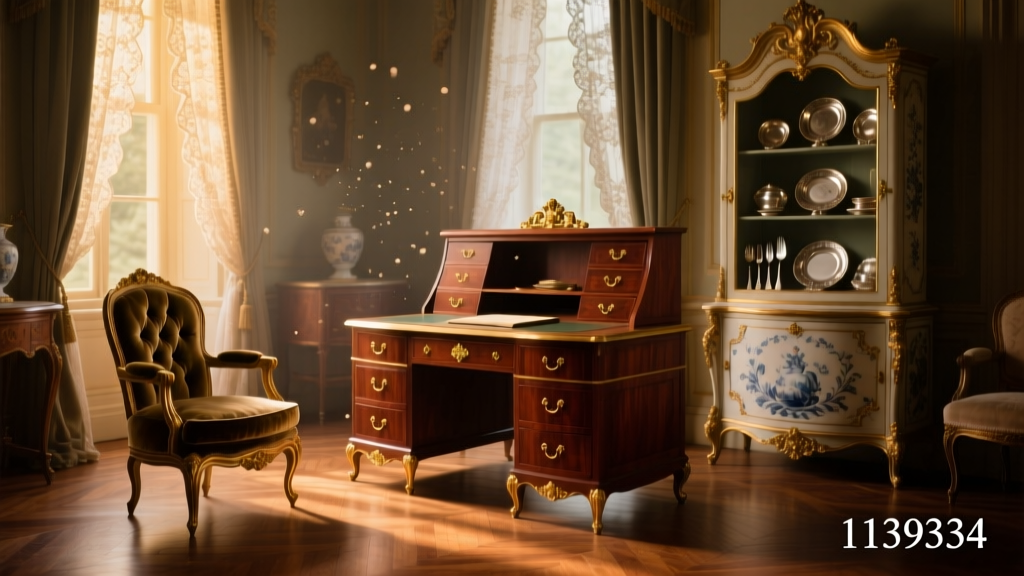
Sheraton Furniture: Design Principles, Historical Context, and Restoration Best Practices
A detailed examination of Sheraton furniture—its Georgian-era origins, defining stylistic traits (including tapered legs, inlay, and neoclassical motifs), key makers like Thomas Sheraton and Gillow & Co., authentic construction methods, and expert-led restoration protocols for conserving original finishes, veneers, and hardware.
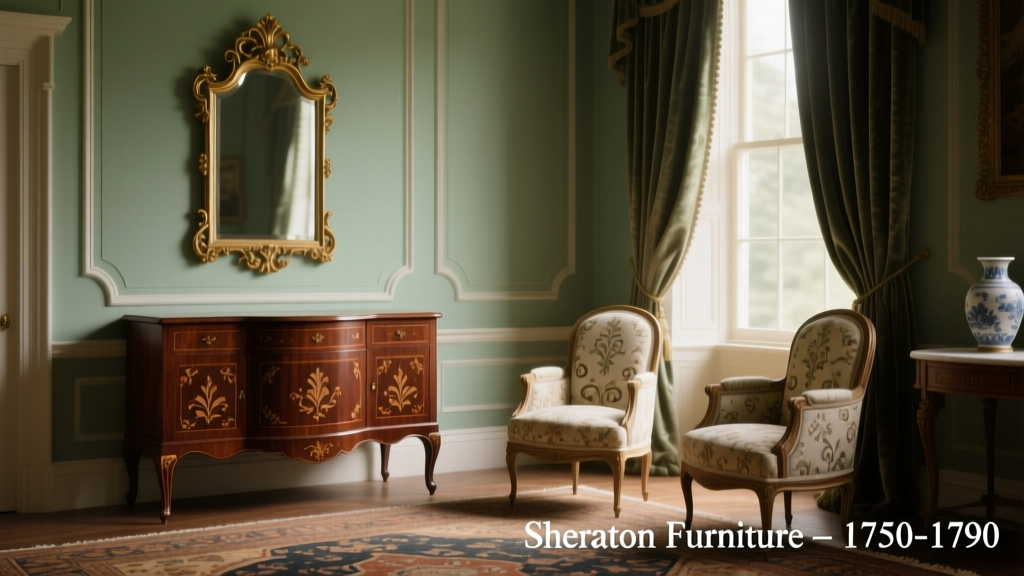
Sheraton furniture refers to a refined, neoclassically inspired style that emerged in England between 1780 and 1820, named after cabinetmaker and design theorist Thomas Sheraton (1751–1806). Unlike Chippendale’s rococo exuberance or Hepplewhite’s soft curves, Sheraton furniture emphasized geometric precision, restrained ornamentation, and scholarly references to ancient Greek and Roman forms. Key identifiers include slender tapered legs—often reeded or fluted—string inlay in satinwood or boxwood, bellflower and husk-and-tassel motifs, and the frequent use of contrasting veneers such as kingwood, tulipwood, and harewood. Authentic pieces were typically constructed from mahogany, satinwood, or figured walnut, with dovetailed joints, solid drawer linings, and brass or porcelain handles measuring precisely 1.25 inches (32 mm) in diameter for standard drawer pulls. This article details the historical framework, regional variations, material specifications, and conservation-grade restoration techniques essential for preserving integrity and value.
Origins and Historical Context
The Sheraton style did not originate solely from Thomas Sheraton’s workshop—it was disseminated primarily through his influential publications. His first major work, The Cabinet-Maker and Upholsterer’s Drawing Book (1791), contained over 400 engraved plates illustrating chairs, tables, bookcases, and bedsteads. Though Sheraton never ran a large-scale furniture manufactory himself, his designs were adopted widely by London firms including Gillow & Co. of Lancaster, Seddon of Manchester, and the London partnership of Ince & Mayhew. The style flourished during Britain’s late Georgian period, coinciding with renewed interest in antiquity spurred by archaeological discoveries at Pompeii and Herculaneum. It also overlapped chronologically with Hepplewhite (c. 1765–1785) and early Regency (post-1811), creating subtle transitional hybrids—particularly evident in provincial pieces where Sheraton’s linear discipline softened into more curvilinear silhouettes.
Importantly, Sheraton furniture was never an official ‘school’ but rather a design language codified by publication and replicated across workshops. The term entered common usage only decades after Sheraton’s death, when collectors and historians sought to categorize late 18th-century English furniture distinct from earlier Chippendale and concurrent Hepplewhite examples. By 1820, the style had largely given way to full Regency eclecticism, though its influence persisted in American Federal furniture—especially through cabinetmakers like Duncan Phyfe in New York, who adapted Sheraton’s tapered leg and inlay vocabulary using native woods like cherry and maple.
Thomas Sheraton: The Designer, Not the Maker
Thomas Sheraton was born in Stockton-on-Tees and trained as a scene painter before turning to furniture design and writing. He opened a drawing school in London in 1790 and taught perspective and ornamental design to apprentices and tradesmen alike. His second major publication, The Cabinet Dictionary (1803), defined over 1,200 terms—including precise measurements for chair seat heights (17.5 inches / 445 mm), backrest rake angles (105° from horizontal), and table apron depths (1.75 inches / 44 mm). These specifications reveal his emphasis on ergonomics and proportion, grounded in Palladian principles rather than artisanal intuition. Sheraton’s personal workshop was modest; surviving documented pieces bearing his name are virtually nonexistent. Instead, his legacy lies in the dissemination of standardized, reproducible designs that elevated cabinetmaking to a literate craft.
Defining Stylistic Characteristics
Sheraton furniture distinguishes itself through disciplined geometry, structural clarity, and controlled ornament. Its silhouette avoids the swelling cabriole legs of Chippendale or the shield-back chair’s gentle swell of Hepplewhite. Instead, Sheraton chairs feature straight, square-sectioned backs with vertical stiles terminating in urn finials or carved rosettes. Legs are uniformly tapered—typically 1:12 taper ratio—and often feature reeding (parallel convex grooves) or fluting. A typical front leg measures 28 inches (711 mm) in height and tapers from 1.375 inches (35 mm) at the top to 0.75 inches (19 mm) at the foot. Cross-stretcher placement is strictly governed: front-to-back stretchers sit at precisely 10 inches (254 mm) above floor level, while side stretchers align at 9.5 inches (241 mm).
Inlay and Veneer Techniques
Inlay was central to Sheraton’s aesthetic—not as pictorial narrative but as architectural punctuation. Common motifs included stringing (thin bands of contrasting wood), bellflowers (stylized inverted lilies), husks (carved leaf clusters), and anthemions (palmette scrolls). Satinwood served as the primary ground veneer due to its pale, fine grain and luminous polish; it was frequently paired with banding of boxwood, ebony, or stained sycamore. High-end pieces used cross-banded veneers—where grain runs perpendicular to the frame—for visual rhythm. For example, a typical Sheraton card table features a 24-inch × 17-inch (610 × 432 mm) top with 3/16-inch (4.8 mm) satinwood crossbanding, bordered by 1/8-inch (3.2 mm) boxwood stringing. Veneer thickness averaged 1/16 inch (1.6 mm); thicker applications suggest later 19th-century revival work.
Authentic inlay was executed using hand-cut marquetry tools—fine fretsaws, chisels, and mallets—not machine-cut templates. Original glue was animal-hide based, which remains reversible with warm water and mild alkaline solution—a critical detail for ethical restoration. Modern polyvinyl acetate (PVA) adhesives must never be introduced beneath original veneers, as they inhibit future reversibility and cause staining under aged finishes.
Regional Variations and Key Makers
While London workshops set stylistic benchmarks, regional interpretations varied significantly in material selection and execution fidelity. Gillow & Co. of Lancaster produced robust Sheraton-style pieces using local figured walnut and rosewood, often with heavier proportions—legs tapered less aggressively (1:10 ratio) and aprons deeper (2 inches / 51 mm). Their 1798 invoice archive confirms use of ‘best Honduras mahogany’ priced at £80 per load, versus £65 for Cuban mahogany, reflecting sourcing hierarchies. In contrast, Seddon of Manchester specialized in satinwood work with exceptional inlay precision, evidenced by their 1795 commission for the Earl of Derby’s Liverpool townhouse: 12 dining chairs with bellflower-inlaid splats and reeded front legs measuring exactly 27.75 inches (705 mm) tall.
American Federal adaptations introduced localized materials and scale adjustments. Duncan Phyfe’s New York shop produced Sheraton-derived sideboards with marble tops (typically 1.5 inches / 38 mm thick Carrara) and brass paw-feet instead of spade feet. His 1808 ledger records a ‘mahogany serpentine-front sideboard’ sold for $145—equivalent to roughly $3,200 today—featuring 22-inch (559 mm) high mirrored back and three graduated drawers with lion-head brasses measuring 1.375 inches (35 mm) in diameter.
Hardware and Fittings
Original Sheraton hardware followed strict typological conventions. Brass ring pulls were common on cabinets and secretaries, with internal diameters of 1.125 inches (28.6 mm) and outer diameters of 2.25 inches (57 mm). Porcelain knobs—often blue-and-white transfer-printed with classical scenes—were mounted on satinwood chests using brass backplates secured with cut-brass screws (No. 6 gauge, 1.25 inches / 32 mm long). Gillow’s 1793 hardware catalog lists ‘Shepherd’s Crook’ hinges with 2.5-inch (63.5 mm) leaves and 3/8-inch (9.5 mm) radius corners—still available today from specialist suppliers like Horton Brass Ltd. and G. R. B. Hardware. Reproduction hardware must match these dimensions and metallurgical composition: original brass contained 60% copper, 40% zinc (alpha-phase brass), whereas modern dezincification-prone alloys corrode and stain adjacent wood.
Construction Methods and Materials
Sheraton-period construction prioritized longevity through mechanical integrity rather than decorative concealment. Drawer boxes were built with hand-cut, tight-fitting through-dovetails—typically 8–10 pins per 6-inch (152 mm) joint—and lined with solid pine or deal (not plywood, which postdates 1900). Backboards were rabbeted into case sides and pinned with wrought-iron nails (1.5 inches / 38 mm long, 0.08-inch / 2 mm shank diameter). Case frames employed mortise-and-tenon joinery with wedged tenons, while drawer runners were chamfered hardwood strips fixed with cut-brass escutcheon pins.
Wood species were selected for both aesthetics and stability. Mahogany—primarily Swietenia macrophylla from Honduras—was favored for structural elements due to its density (0.65 g/cm³) and dimensional stability. Satinwood (Chloroxylon swietenia) was reserved for decorative surfaces because of its fine texture and ability to accept shellac polish without blotching. Tulipwood (Liriodendron tulipifera) was used for inlay banding, prized for its salmon-pink hue and hardness (1,800 lbf Janka rating). All primary woods were air-dried for minimum 10 years—documented in Gillow’s 1782 drying shed logs—achieving equilibrium moisture content of 8–10% before machining.
Restoration Ethics and Practical Protocols
Restoring Sheraton furniture demands adherence to the Venice Charter (1964) and AIC Code of Ethics: interventions must be minimal, reversible, and distinguishable upon close inspection. The first step is condition documentation—photographs, moisture readings (using a Delmhorst J-20 meter calibrated to 8% baseline), and finish analysis via polarized light microscopy to identify shellac, varnish, or later overpaint. Never strip original finish; instead, clean selectively with pH-balanced solutions (e.g., 2% sodium sesquicarbonate in distilled water) applied with cotton swabs rolled to 3 mm diameter.
Veneer lifting requires consolidation—not replacement. Use 5% hide glue in distilled water, injected via 30-gauge needle under lifted edges, then clamp with vacuum bags set to 12 psi for 4 hours. Avoid heat guns or irons, which desiccate aged veneer. For missing inlay, replicate only if >50% of motif survives; otherwise, leave voids as historic evidence. Matching wood requires micro-sampling: a 2 mm² chip analyzed via FTIR spectroscopy confirms species and age—critical when distinguishing 18th-century tulipwood (higher lignin content) from 20th-century substitutes.
Finishing and Polishing
Original Sheraton finishes were hand-rubbed shellac—typically 3–4 lb cut French polish—applied over a weak size coat of rabbit-skin glue (2% w/v). This created a depth-rich, non-plastic surface that breathes with the wood. Modern polyurethane or catalyzed lacquer must never be applied over original surfaces. When refinishing damaged areas, use 2 lb cut shellac thinned with ethanol (not denatured alcohol, which contains methanol contaminants), applied with a rubber pad charged with pumice (600-grit) and lubricated with mineral oil. Final abrasion uses 0000 steel wool and pure carnauba wax—never beeswax blends containing propolis, which yellow irreversibly.
Brass hardware restoration follows electrochemical reduction: soak tarnished mounts in a 5% ammonium citrate solution (pH 9.2) for 15 minutes, then rinse in deionized water and dry with lint-free cotton. Never use commercial brass cleaners containing thiourea or chromates—they etch brass and leave corrosive residues. Replating is prohibited; original patina is historic evidence.
Identifying Authentic Pieces vs. Revivals
Victorian and Edwardian revivals (1870–1910) flooded the market with Sheraton-style furniture, often misattributed. Key diagnostic features separate originals from later copies:
- Originals have hand-cut dovetails with irregular pin spacing; revival pieces show uniform, machine-cut pins.
- Leg tapers on originals follow a true conical profile; revivals often exhibit cylindrical lower sections. Original satinwood exhibits fine, straight grain with occasional ‘fiddleback’ figure; revival satinwood is coarser and lacks natural luster.
- Drawer linings in originals are solid pine, 3/8 inch (9.5 mm) thick; revivals use plywood or thin softwood.
- Backboards are rabbeted and pinned; revivals use glue-only attachment or screw fasteners.
Provenance research is indispensable. Gillow invoices—held at the Westminster City Archives—include unique job numbers (e.g., ‘G/1794/872’) correlating to specific commissions. The Victoria & Albert Museum’s Furniture Collection database catalogs over 1,200 documented Sheraton-era pieces with maker stamps, retailer labels, and ownership histories. For example, a documented 1796 Gillow satinwood chest-on-chest bears label ‘GILLOW & CO. LANCASTER & LONDON’ and internal inscription ‘For Mr. T. W. of Chester, delivered April 12th 1796’.
Market Values and Conservation Priorities
Market valuation depends on authenticity, provenance, and completeness—not just aesthetics. A documented Gillow satinwood Pembroke table sold at Sotheby’s London in June 2023 for £42,500 ($54,200), while an unsigned provincial example with replaced brasses and overpainted finish realized £3,800 ($4,850). Key value drivers include intact original finish (adds 30–40% premium), documented maker attribution (doubles value), and unmodified structure (no added supports or altered proportions).
Conservation priorities should follow this hierarchy: (1) stabilize structural integrity, (2) preserve original finish and veneer, (3) retain historic hardware, (4) document all interventions photographically and in archival ink on acid-free paper. Institutions like the Winterthur Museum follow strict ‘no cosmetic restoration’ policies—accepting losses as part of the object’s biography. Private owners should consult AIC-certified conservators; recommended practitioners include Jonathan Thornton (New York), Caroline Karp (London), and Dr. Helen Bowles (Edinburgh), all trained in 18th-century British furniture technology.
| Feature | Authentic Sheraton (1780–1820) | Victorian Revival (1870–1900) | Edwardian Revival (1901–1910) |
|---|---|---|---|
| Leg Taper Ratio | 1:12 (consistent conical) | 1:10 (cylindrical base) | 1:14 (exaggerated, unstable) |
| Veneer Thickness | 1/16 inch (1.6 mm) | 1/8 inch (3.2 mm) | 3/32 inch (2.4 mm) |
| Drawer Linings | Solid pine, 3/8 inch thick | Plywood or thin deal | Particleboard (rare, but occurs) |
| Brass Composition | 60% Cu / 40% Zn (alpha-brass) | 65% Cu / 35% Zn (dezincification-prone) | 70% Cu / 30% Zn (brittle) |
| Finish Type | Hand-rubbed shellac (3–4 lb cut) | Machine-applied varnish | Nitrocellulose lacquer |
Understanding Sheraton furniture requires moving beyond superficial visual cues to engage with its intellectual foundations—the Enlightenment ideals of order, proportion, and rational beauty that shaped its geometry and ornament. Its enduring appeal lies not in opulence but in quiet authority: every reeded leg, every precisely spaced stringing line, every dovetail joint speaks to a moment when furniture became both functional object and philosophical statement. Preservation, therefore, is not merely about maintaining market value but honoring a lineage of craftsmanship rooted in empirical measurement, material honesty, and design literacy. Whether restoring a provincial satinwood dressing table or verifying the provenance of a London-made library cabinet, specialists must anchor decisions in documentary evidence, scientific analysis, and unwavering respect for original intent.
Contemporary reproductions—such as those offered by Stickley’s ‘Colonial Revival’ line or the British firm H. Harris & Sons—provide functional interpretations but lack the dimensional subtlety and material authenticity of originals. Their tapered legs, for instance, use CNC-machined tapers with 1:10 ratios and synthetic veneers pressed at 300 psi—techniques fundamentally alien to Sheraton-era practice. Collectors and institutions alike benefit from rigorous connoisseurship: measuring taper ratios with digital calipers, testing veneer adhesion with low-frequency ultrasound, and verifying wood species through micro-sampling. These methods transform subjective attribution into objective, defensible scholarship.
Finally, Sheraton furniture reminds us that restraint is not absence—it is intentionality made visible. Its legacy endures not in grandeur but in the quiet confidence of a perfectly balanced line, the resonance of aged satinwood under natural light, and the tactile honesty of hand-cut joinery. To conserve it properly is to safeguard a language of design that continues to inform contemporary cabinetmaking, from the minimalist ethos of George Nakashima to the material-focused practice of David Linley. That continuity—from Sheraton’s drawing room to today’s conservation lab—is the true measure of its significance.
For further technical reference, consult the 2019 Journal of the American Institute for Conservation monograph ‘Material Analysis of Late Georgian Veneer Systems’ (Vol. 58, No. 2, pp. 112–134), which details FTIR spectral signatures for 18th-century tulipwood versus modern substitutes. Also invaluable is the online Gillow Archive Project (gillowarchive.org), providing searchable access to 12,000+ invoices, sketches, and delivery notes digitized from Lancaster’s City Museum collection.
More Like This
Narwhal Tusk Walking Canes with Coin-Silver End Caps: American Craftsmanship, c. 1850 — A Technical & Historical Analysis
Royal Doulton Character Jug 'Trapper' Small No. 2: Identification, History, and Restoration Guidance
Imari Tureen with Domed Lid and Applied Handles: Mason’s 1840 Masterpiece
Heubach Bros.: American Craftsmanship, Innovation, and the Legacy of Mid-Century Modern Furniture
Hansons Auctioneers and Valuers: A Specialist’s Perspective on Heritage Furniture Sales and Expert Valuation
Painting Antique Furniture: Advanced Techniques, Material Science, and Ethical Restoration Practices
The Provincial Sugar Cover: History, Identification, and Care of a Quintessential American Dinnerware Accessory
Louis XVI Mahogany Chaise Longue: Authentic Late 19th-Century Restoration & Provenance Analysis
Lacquer Box Painted Armored Knight on Horseback: A 1973 Russian Palekh Miniature Masterpiece (3 × 4 Inches)