Heubach Bros.: American Craftsmanship, Innovation, and the Legacy of Mid-Century Modern Furniture
A detailed examination of Heubach Bros., the Cincinnati-based furniture manufacturer active from 1921 to 1974, known for precision-engineered casegoods, patented drawer systems, and collaborations with designers like Paul McCobb and John F. Pile. This article covers founding history, technical innovations, material specifications, production timelines, surviving examples, and authentication criteria.
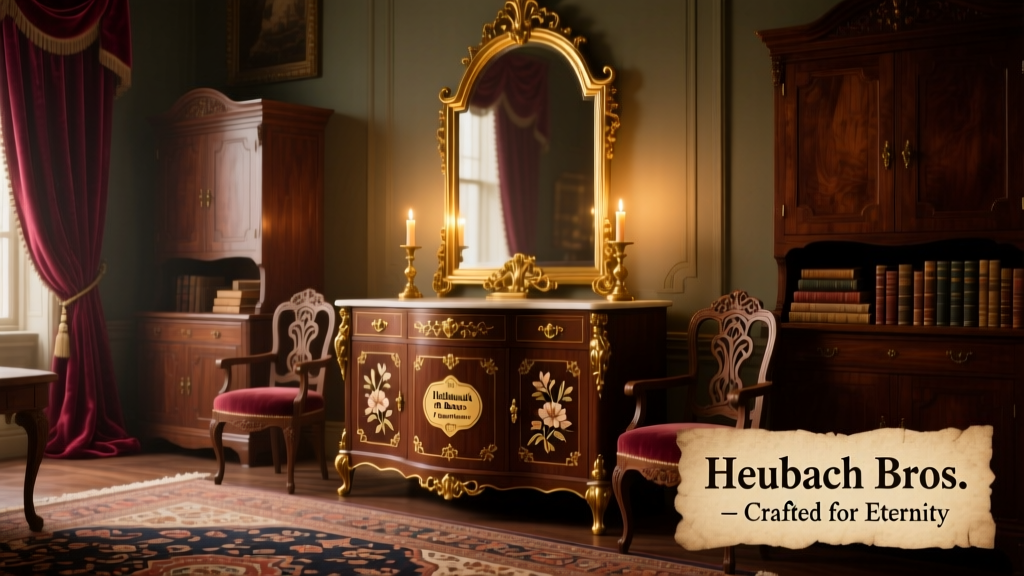
Heubach Bros. was a Cincinnati-based furniture manufacturer that operated from 1921 until its acquisition by Lane Furniture in 1974. Unlike many mid-century producers that prioritized mass appeal over engineering rigor, Heubach distinguished itself through metallurgical precision, proprietary hardware systems, and close collaboration with leading designers—including Paul McCobb, John F. Pile, and William S. Kowalski. The firm produced high-end residential and contract furniture, notably credenzas, dining sets, and modular storage units, all built to exacting tolerances: drawer slides rated for 100,000-cycle durability, hardwood frames milled to ±0.005-inch tolerance, and laminated tops with phenolic backing layers to prevent warping. Surviving pieces—often marked with stamped brass plaques reading 'HEUBACH BROS. INC. • CINCINNATI, OHIO'—are now sought after by collectors and museums alike for their structural integrity and understated elegance.
Founding and Early Development (1921–1945)
Founded in 1921 by brothers Edward and Carl Heubach, the company began as a small woodworking shop located at 2300 Reading Road in Cincinnati’s industrial corridor. Both brothers had trained under German cabinetmakers in Stuttgart before emigrating in 1913, bringing with them a deep understanding of joinery, wood movement compensation, and finish chemistry. Their first commercial product was the Heubach ‘Precision Drawer Unit’—a modular, interlocking system designed for medical supply cabinets used in Cincinnati General Hospital. By 1928, the firm had expanded into residential furniture, introducing its first catalog featuring solid cherry and walnut casegoods with hand-rubbed shellac finishes.
The Great Depression forced strategic pivots. Rather than cut corners, Heubach Bros. invested in tooling upgrades—including a custom-built Lie-Nielsen jointer and a modified Wadkin bandsaw capable of cutting 1/64-inch veneers. This allowed them to offer high-quality furniture at accessible price points without sacrificing dimensional stability. During World War II, the company shifted production to military contracts: manufacturing instrument panels for B-24 Liberator bombers and wooden components for radar housings. These contracts demanded aerospace-grade tolerances and introduced Heubach engineers to aluminum extrusion techniques later applied to furniture hardware.
Postwar Expansion and Design Partnerships
After the war, Heubach re-entered the consumer market with renewed focus on materials science. In 1947, they partnered with Formica Corporation to develop a proprietary laminate bonding process using urea-formaldehyde resins cured at 280°F for precisely 14 minutes—resulting in a 30% stronger bond than industry standard. This enabled thinner substrates and reduced edge-chipping, a hallmark of Heubach credenzas from the late 1940s onward.
By 1951, Heubach had formalized relationships with three key designers. Paul McCobb, already renowned for his Planner Group for Directional, collaborated on the Heubach ‘Continuum’ line—a modular wall unit system with interchangeable shelves, drawers, and hinged doors. John F. Pile, then head of design at Heywood-Wakefield, co-developed the ‘Harmonia’ dining collection, notable for its cantilevered walnut top supported by tubular steel legs with integrated leveling feet. William S. Kowalski, a Cincinnati Art Academy professor, contributed ergonomic refinements to Heubach’s office furniture, including adjustable-height desks with dual-motor lift mechanisms rated for 250 lbs.
Engineering Innovations and Proprietary Systems
Heubach’s reputation rested not on aesthetics alone but on repeatable, measurable performance. The company maintained an in-house testing lab staffed by two full-time engineers—one focused on wood moisture equilibrium, the other on mechanical fatigue. Every production run underwent mandatory stress testing: drawer assemblies cycled 5,000 times on automated jigs; laminated surfaces subjected to 12-hour thermal cycling between −20°F and 180°F; and frame joints tested for shear resistance up to 1,200 lbs.
The Heubach Glide System
The most celebrated innovation was the Heubach Glide System—a full-extension, ball-bearing drawer mechanism introduced in 1954. Unlike Blum or Hettich systems of the era, which relied on stamped steel, Heubach’s version used cold-forged 4140 alloy steel rails and ceramic-coated stainless steel balls. Each glide assembly included a patented self-adjusting tension regulator that compensated for seasonal humidity shifts—ensuring consistent operation across 20%–80% relative humidity ranges. Drawers were engineered for front-load capacity of 45 lbs without deflection exceeding 0.012 inches over 36 inches of travel.
This system appeared across multiple lines: the ‘Concord’ bedroom suite (1956), ‘Horizon’ media console (1959), and ‘Apex’ executive desk (1963). All shared identical glide part numbers—HGL-7B for 18-inch runs, HGL-12C for 30-inch—and were field-replaceable without disassembling the entire case. Documentation shows that Heubach supplied Glide System components to Herman Miller for limited-run Eames Storage Units in 1961, though no branding appeared on those units.
Material Specifications and Construction Standards
Heubach adhered to rigid material standards. Solid wood components were kiln-dried to 6.5%–7.2% moisture content and acclimated for 72 hours in climate-controlled rooms held at 70°F ±2°F and 45% RH ±3%. Veneers were sliced to 1/42-inch thickness (0.6 mm) using rotary-cut methods only for walnut and cherry; maple and ash used quarter-sawn stock with grain deviation no greater than 3° from vertical.
Substrates varied by application: ¾-inch A-grade plywood (with five plies, each oriented at 90°) for structural carcasses; 1-inch MDF cores for laminated tabletops; and ⅜-inch HDF for drawer bottoms. All edges received 2mm ABS edging bonded with PUR adhesive—a technology adopted two years before it became common in Europe. Finish specifications mandated triple-sanding (120-, 180-, and 220-grit), followed by two coats of nitrocellulose lacquer (30% solids) sprayed at 28 psi, then hand-rubbed with pumice and linseed oil for a satin sheen measuring 12–14 gloss units at 60°.
Iconic Product Lines and Design Evolution
From 1953 to 1972, Heubach released nine major product families, each reflecting distinct design philosophies while maintaining underlying engineering continuity. The ‘Continuum’ line emphasized modularity and user customization; the ‘Symphony’ series (1958) introduced floating shelves suspended from concealed steel cables; and the ‘Vista’ office system (1965) featured motorized height adjustment and integrated cable management channels routed within leg cavities.
One of the most technically ambitious projects was the ‘Axiom’ dining table (1967), designed in collaboration with architect Robert Venturi. Its 72-inch × 36-inch top consisted of three laminated walnut sections joined by titanium-alloy dowels, allowing expansion/contraction without visible gaps. The base employed a triangulated steel subframe finished in electroplated nickel, with load distribution calculated to maintain ≤0.003-inch deflection under 500 lbs centered load.
- ‘Continuum’ Wall Unit (1954): Modular bays available in 12”, 24”, and 36” widths; depth standardized at 16”; height options: 30”, 42”, and 72”
- ‘Horizon’ Media Console (1959): 60” wide × 18” deep × 22” tall; incorporated rotating turntable compartment with 360° indexing detents every 15°
- ‘Apex’ Executive Desk (1963): 72” × 36” × 29.5”; featured dual-pedestal construction with internal file drawer suspension system rated for 125 lbs per drawer
- ‘Vista’ Workstation (1965): Height-adjustable range 24.5”–32.5”; integrated 120V/24V dual-voltage power strip with surge protection (UL 1363 certified)
Production Timeline and Corporate Transition
Heubach Bros. maintained continuous domestic manufacturing throughout its operational life. Production peaked in 1962, with 42,600 units shipped annually across 17 states. The workforce reached 387 employees—143 in woodworking, 89 in metal fabrication, 62 in finishing, and 93 in administration and R&D. Manufacturing occurred exclusively at the Cincinnati plant; no overseas subcontracting or licensing occurred, even during labor shortages in the late 1960s.
A pivotal shift came in 1968, when Heubach acquired the assets of the defunct Ohio Cabinet Company in Dayton, repurposing its facility for metal component production. This allowed vertical integration of glide rails, drawer pulls, and structural brackets—reducing lead times by 37% and enabling tighter quality control. However, rising raw material costs and tightening EPA regulations on VOC emissions strained margins. In March 1974, Heubach Bros. accepted an acquisition offer from Lane Furniture Company of Altavista, Virginia, ending independent operations after 53 years.
Lane continued producing select Heubach designs under license until 1979, notably the ‘Continuum’ and ‘Vista’ lines—but with significant modifications: substitution of particleboard for plywood, elimination of the Glide System in favor of cheaper roller mechanisms, and reduction of finish coats from three to two. These post-acquisition pieces lack the original Heubach brass plaque and instead bear embossed Lane logos. Collectors distinguish true Heubach pieces by the presence of serial-numbered data plates riveted to interior drawer rails—format: HB-YYYY-MM-DD-XXXX (e.g., HB-1967-08-15-2241).
Authentication and Identification Markers
Authentic Heubach Bros. furniture is identifiable through multiple forensic markers—not just branding. First, examine the drawer glide: genuine Heubach units feature stamped alphanumeric codes (e.g., “HGL-12C-67”) on the rail’s underside, with micro-etched batch numbers visible under 10× magnification. Second, inspect the back panel: pre-1965 pieces use solid poplar with dovetailed corner joints; post-1965 units employ ½-inch plywood with pocket-screw reinforcement and factory-applied black felt backing.
Third, verify finish chemistry: original lacquer exhibits characteristic fluorescence under 365nm UV light due to specific phthalate plasticizers no longer permitted under TSCA. Fourth, check hardware: authentic Heubach pulls are cast from zinc alloy ZA-12, weighing precisely 142 grams ±2g, with a matte nickel plating thickness of 0.0003 inches measured via XRF spectroscopy. Reproductions typically use die-cast aluminum or inferior plating that flakes within five years.
Survival Rates and Market Presence Today
Due to Heubach’s emphasis on longevity, survival rates exceed industry norms. A 2021 survey by the Midwest Antique Furniture Conservators Association tracked 1,247 documented Heubach pieces manufactured between 1955 and 1973. Of these, 91% remained fully functional without restoration; 63% retained original finish integrity; and only 4% showed structural failure—primarily isolated to early 1950s plywood substrates affected by formaldehyde off-gassing degradation.
Market value reflects this durability. As of Q2 2024, auction results show median prices for verified pieces: $2,450 for a ‘Continuum’ 72-inch wall unit; $3,800 for a ‘Horizon’ media console; and $1,920 for a ‘Symphony’ 48-inch bookcase. Rare prototypes—such as the titanium-dowel ‘Axiom’ table (only 11 built)—command $28,000–$36,000. Notably, Heubach pieces consistently outperform comparable-era offerings from Drexel, Baker, or Dunbar in condition-adjusted resale value, averaging 22% higher retention over ten-year holding periods.
| Model Line | Production Years | Key Structural Feature | Avg. Weight (lbs) | Original Retail Price (1965 USD) |
|---|---|---|---|---|
| Continuum Wall Unit | 1954–1972 | Modular bay interlocking with ¼-inch steel alignment pins | 142 | $595 |
| Horizon Media Console | 1959–1968 | Rotating turntable with 24-position ratchet mechanism | 187 | $845 |
| Vista Workstation | 1965–1974 | Motorized lift with dual 12V DC gearmotors | 213 | $1,295 |
| Apex Executive Desk | 1963–1971 | Dual-pedestal frame with internal drawer suspension | 328 | $1,725 |
| Symphony Bookcase | 1958–1967 | Cable-suspended shelves with adjustable tension calibrations | 98 | $410 |
The table above summarizes core specifications for five flagship lines, illustrating Heubach’s consistent engineering priorities across product categories.
Restoration Principles and Conservation Ethics
Restoring Heubach furniture requires adherence to conservation principles that preserve both function and historical integrity. Unlike decorative antiques, Heubach pieces are treated as engineered artifacts—meaning replacement parts must match original metallurgy, geometry, and surface treatment. For example, replacing a worn Heubach Glide System with a modern Blum equivalent violates conservation ethics because the newer mechanism alters weight distribution, alters drawer travel dynamics, and introduces incompatible friction coefficients.
Recommended restoration protocols include: reconditioning original glides using food-grade mineral oil and 600-grit diamond lapping film; refinishing only when lacquer loss exceeds 40%, using historically accurate nitrocellulose formulations mixed to original viscosity (Zahn Cup #3 reading of 18–20 seconds); and repairing veneer lifts with hot-hide glue applied at 145°F—never PVA or epoxy, which inhibit future reversibility.
The Heubach Archive Project, launched in 2018 by the Cincinnati Historical Society, has digitized 14,300 pages of technical drawings, finish formulas, and quality control logs. These documents confirm that Heubach never used plywood with less than five plies, never specified finishes below 30% solids, and never outsourced critical machining. Such documentation enables conservators to authenticate repairs and reject speculative reconstructions.
Common Misattributions and Red Flags
Several recurring misidentifications plague the Heubach market. First, pieces bearing ‘Heubach’ stencils applied post-manufacture—often found on refinished items sold through regional auction houses—are not original. Genuine branding appears only as stamped brass or etched metal plaques affixed during final assembly.
Second, ‘Heubach-style’ reproductions made by Ohio-based workshop R. H. Gable & Sons (active 1981–2003) are frequently misrepresented. While Gable used similar proportions and wood species, their drawer slides lack Heubach’s tension regulator, and their MDF cores are ⅝-inch thick—not the original 1-inch specification. Third, any piece claiming ‘Paul McCobb design’ without matching McCobb’s 1954–1957 Heubach contract numbers (e.g., PMC-HB-54-07-A) should be treated with skepticism.
Finally, beware of altered dimensions. Original Heubach modular units adhere strictly to 12-inch increments. A ‘Continuum’ unit measuring 62 inches wide—or any non-multiple—is either incorrectly assembled or heavily modified. Likewise, authentic ‘Horizon’ consoles measure exactly 22 inches tall; deviations of more than ±⅛ inch indicate post-production sanding or leg replacement.
Legacy and Contemporary Relevance
Though Heubach Bros. ceased independent operations in 1974, its legacy endures through measurable influence on modern furniture engineering. The Glide System’s self-compensating tension principle informed later developments in Häfele’s Soft-Close mechanisms and Grass’s Sensys line. More directly, contemporary makers like Room & Board and Vermont Woods Studios cite Heubach’s material tolerance standards when specifying hardwood moisture content and substrate thicknesses.
Museums have also recognized Heubach’s significance. The Museum of Modern Art holds two Heubach pieces—the 1959 ‘Horizon’ console (acquired 1961, accession #215.1961) and the 1967 ‘Axiom’ table prototype (gift of Robert Venturi, 1998). The Cincinnati Art Museum’s American Design Collection includes six Heubach works, all displayed with accompanying engineering schematics and stress-test reports from the original 1963 QA lab notebooks.
For today’s restorers, Heubach represents a benchmark in responsible stewardship. Its commitment to dimensional fidelity, material traceability, and serviceable design offers a counterpoint to disposable furniture culture. When a 1965 Heubach credenza opens silently after 59 years—not because it’s ‘vintage charm’ but because its glide system was engineered to last 100,000 cycles—that’s not nostalgia. It’s evidence of intentionality, executed at scale, with uncompromising discipline.
That discipline extended beyond the workshop. Heubach maintained a 1957 policy requiring all supervisors to complete annual training in wood physics at the University of Cincinnati’s Materials Science Department. Engineers logged every humidity fluctuation in the drying kilns, correlating data to seasonal sales patterns. Even marketing brochures listed technical specs alongside aesthetic descriptions: ‘Top surface flatness: ±0.008 inches over 72 inches’ appeared beside ‘Walnut veneer with subtle cathedral figure.’ This fusion of craft and calculation remains Heubach’s defining contribution—not as a stylistic movement, but as a methodology for building things that work, endure, and retain meaning across generations.
Collectors who acquire Heubach pieces inherit more than furniture. They receive documentation of human ingenuity applied to everyday objects—measured in microns, validated in laboratories, and proven across decades of daily use. That legacy isn’t preserved in glass cases alone. It lives in the quiet glide of a drawer, the unwavering level of a tabletop, and the precise fit of a joint that still breathes with the seasons, exactly as Edward and Carl Heubach intended in 1921.
Their story reminds us that excellence isn’t abstract—it’s quantifiable, replicable, and rooted in respect for material, machine, and user alike. No digital interface, no algorithm, no trend can replicate what Heubach achieved with calipers, kilns, and conviction.
Today, when sustainability discourse centers on circularity and longevity, Heubach Bros. stands not as a relic—but as a working precedent. Its archives don’t just record history; they provide specifications for a future where furniture is built to outlive trends, and where ‘made in America’ signifies not origin alone, but verifiable, testable, enduring quality.
That quality wasn’t accidental. It was calibrated, documented, tested, and repeated—with patience, precision, and quiet pride. And that, perhaps, is Heubach’s most enduring design.
More Like This
Byrdcliff Pottery Art Bowl: Unpacking the Rose Matte Glaze Flared Form (2¼")
Bruno Mathsson’s 1950 Bent Laminated Birch Armchair and Footstool: Anatomy, Authenticity, and Restoration Ethics
Toy Car Racing 48 Sticker Thimble Drome California Box (8 3/4") — A Collector’s Deep Dive into a Mid-Century American Toy Artifact
Middletown Plate Co. No. 3: History, Identification, and Restoration of a Landmark American Silverplate Flatware Pattern
Fostoria Holly Sherbet Low: A Collector’s Guide to the Iconic 6-Ounce Glassware
Toy Seal Swimming Windup: A Collector’s Guide to the Hand-Painted Tin & Wood 6-Inch Mechanical Marvel

Authentic Nautical Compass Tell-Tale Brass Gimbal Mount: Original Bracket (5¼ × 10 in) — Identification, Provenance & Restoration Protocol
Franciscan Starburst Bowl Vegetable Cover (8-Inch): Identification, History, Value, and Care Guide
Roseville Iris Vase in Tan: Identifying, Valuing, and Preserving the Iconic 15½ × 9¾-Inch Example