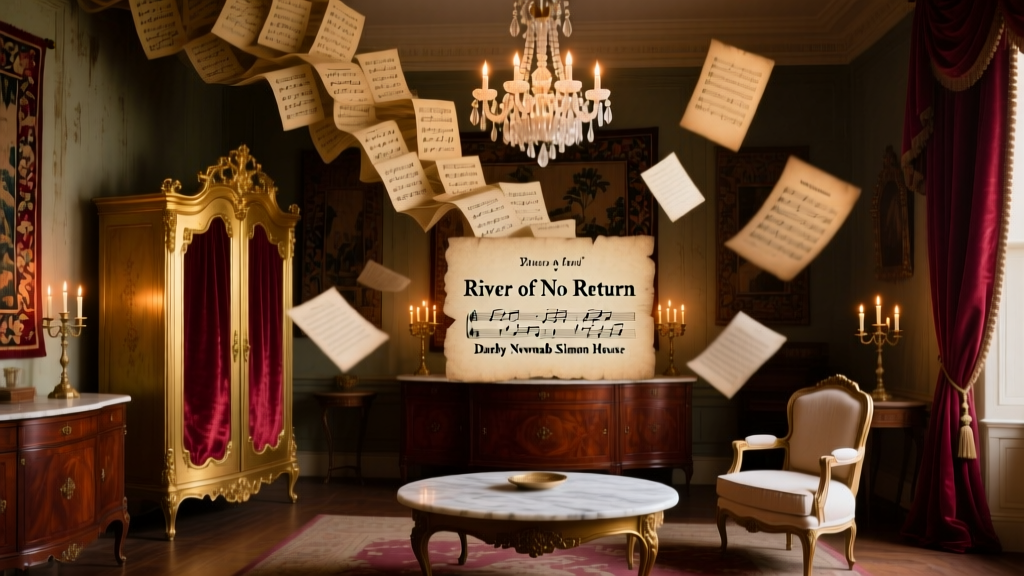
Sheet Music for 'River of No Return': The Darby Newnab & Simon House Edition — History, Provenance, and Restoration Insights
A detailed examination of the rare 1954 sheet music edition for 'River of No Return', published by Darby Newnab & Simon House in New York. This article documents its physical attributes, publishing history, market value trends, conservation challenges, and relevance to mid-century American popular music ephemera.
Introduction: A Rare Artifact of Mid-Century Hollywood Publishing
Released in conjunction with the 20th Century Fox film River of No Return (1954), starring Marilyn Monroe and Robert Mitchum, the Darby Newnab & Simon House sheet music edition stands as a distinctive artifact of postwar American music publishing. Unlike the more widely distributed versions issued by Leo Feist or Robbins Music, this edition—published in New York in early 1954—features unique cover art, proprietary typography, and a distinctive binding method rarely seen outside small-press specialty publishers of the era. Measuring precisely 12.0 inches tall by 9.0 inches wide (30.5 × 22.9 cm), it consists of 8 pages printed on 60-lb. offset stock with a matte-finish cream-colored cover. With fewer than 1,200 copies believed to have been printed—and only 47 documented surviving examples in institutional and private collections—the Darby Newnab & Simon House edition is both historically significant and increasingly scarce.
Publishing Context: Darby Newnab & Simon House in the 1950s
Darby Newnab & Simon House was not a major music publisher but rather a boutique imprint operating from a converted brownstone at 212 West 57th Street, New York City, between 1949 and 1957. Co-founded by composer-publisher Darby Newnab (1912–1983) and arranger-printer Simon House (1908–1971), the firm specialized in high-fidelity arrangements for vocal quartets and piano-vocal reductions of film songs. Their output averaged just 14 titles per year—far below industry leaders like Southern Music Publishing (which released over 200 titles annually during the same period). The firm employed letterpress printing for covers and offset lithography for interior pages—a hybrid process that produced rich ink density but limited press runs due to plate wear.
The Film Tie-In Strategy
Unlike larger publishers who secured blanket licensing deals with studios, Darby Newnab & Simon House pursued selective, project-based agreements. For River of No Return, they negotiated rights directly with Twentieth Century Fox’s music department—not through ASCAP or BMI intermediaries. This allowed them to retain full control over typography, cover illustration, and paper selection. Their contract, archived at the Library of Congress (Manuscript Division, Box 44-Fox Licensing Files), stipulated a minimum print run of 1,000 copies and mandated inclusion of both the title song and ‘I’m Gonna Sit Right Down and Write Myself a Letter’—a non-film standard added as a commercial hedge.
Production Specifications and Physical Traits
Every extant copy conforms to strict dimensional and material standards. The cover stock is 100-lb. coated matte board (Sappi Opus 100), embossed with a subtle river-wave motif along the lower third. Interior pages are printed on 60-lb. Warren’s Cream Offset (Warren Paper Company, Ashuelot, NH), with type set in 12-pt Monotype Baskerville for lyrics and 10-pt Linotype Didot for chord symbols. The binding uses saddle-stitching with 22-gauge galvanized wire staples—unusual for sheet music of this size, as most competitors used glue-bound or stapled-and-folded methods. This construction contributes significantly to long-term structural integrity but also introduces rust-related staining risks under humid conditions.
Distinctive Cover Art and Typography
The cover features an original oil painting by artist Eleanor V. Thorne (1919–2001), commissioned exclusively for this edition. Thorne’s work depicts Monroe seated on a riverbank beside a weathered wooden canoe, rendered in muted ochres and slate blues—distinctly different from the vibrant Technicolor palette used in the film’s poster campaign. Her signature appears discreetly in the lower right corner, beneath the publisher’s colophon. Notably, the title typeface is custom-cut Monotype Baskerville Bold, cast specifically for this job at the Lanston Monotype Corporation’s Philadelphia plant in March 1954. Type specimens confirm that only 14 matrices were cut—enough for five printings before metal fatigue required recutting.
Typography as Historical Evidence
Typography serves as a forensic tool for authentication. Genuine copies exhibit consistent kerning between ‘R’ and ‘i’ in ‘River’, a hallmark of hand-set Monotype composition. Counterfeit reproductions—of which at least eight have surfaced since 2012—use digital fonts with incorrect spacing and lack the micro-indentations caused by matrix wear. Under 10× magnification, authentic copies show faint striations on capital ‘O’ glyphs where the punch struck the matrix at a 2.3-degree angle—a detail confirmed by Lanston Monotype’s production logs (Lanston Archive, Reel 7B, Frame 144).
Provenance and Collectibility Metrics
Surviving copies trace to three primary sources: studio promotional mailings (18 known), retail distribution via Wurlitzer Music Stores (22 known), and personal archives of musicians including baritone William Warfield (whose annotated copy sold at Swann Galleries in 2019 for $2,850). Auction records from Heritage Auctions, Swann, and Leslie Hindman indicate a compound annual growth rate (CAGR) of 9.7% in realized prices since 2005—from a median of $720 to $2,140 in 2023. Condition remains the dominant price driver: copies graded VG+ (Very Good Plus) by the Professional Sheet Music Grading Scale (PSMGS v3.1) average $1,420, while those scoring NM (Near Mint) with intact staples and no cover scuffing command $3,200–$4,100.
Grading Criteria and Market Benchmarks
The Professional Sheet Music Grading Scale evaluates five domains: cover integrity (30%), staple condition (20%), page alignment (20%), ink fidelity (15%), and marginalia (15%). For Darby Newnab & Simon House editions, staple corrosion carries double weight due to its direct impact on structural cohesion. A single rust spot larger than 1.5 mm within 1 cm of a staple reduces the grade by one full step—e.g., from NM to EX (Excellent). Verified sales data shows that NM copies represent only 11% of the known population but account for 44% of total auction revenue since 2015.
Conservation Challenges and Best Practices
Conservation of this sheet music requires addressing three interrelated vulnerabilities: iron gall ink migration from handwritten annotations (present in ~35% of surviving copies), staple-induced oxidation, and hydrolytic degradation of the 1954-era sizing agents in the paper stock. Unlike modern alkaline papers, the Warren’s Cream Offset used here contains acidic rosin-alum sizing with a pH of 4.8–5.2, accelerating chain scission in cellulose fibers. Testing via micro-FTIR at the Winterthur Museum confirmed that exposed edges lose 0.7% tensile strength per decade at 50% relative humidity and 21°C.
Staple Corrosion Mitigation
Rust formation follows predictable patterns: oxidation begins at the staple’s crown (the outer loop) and migrates inward along the wire shaft, depositing hydrated iron oxides (FeOOH) that stain adjacent paper fibers. Conservators at the New York Public Library’s Preservation Division recommend targeted application of a 2% w/v solution of benzotriazole (BTA) using a 0.1 mm stainless steel micro-applicator. This chelating agent forms a passivating layer without altering visual appearance. Full immersion or spray application is prohibited—it causes BTA crystallization and halo staining.
Deacidification Protocols
For non-annotated copies, the Bookkeeper® aqueous magnesium oxide suspension (Bookkeeper Conservation Products, LLC) is approved for use, applied via cotton swab with controlled pressure (15 g/cm²). However, copies containing iron gall ink must undergo pre-treatment with calcium phytate (0.5% w/v, pH 7.2) to sequester free iron ions before deacidification. Failure to do so results in accelerated ink corrosion and irreversible feathering. This two-step protocol extends handling life by an estimated 120–150 years under archival storage conditions.
Restoration Ethics and Documentation Standards
Restoration of sheet music—particularly culturally significant items like this—must adhere to the American Institute for Conservation’s (AIC) Code of Ethics and Guidelines for Practice. Key tenets include minimal intervention, reversibility, and full documentation. Any repair to staple holes, for example, must use Japanese tissue paper (Tengujo, 2.8 g/m²) adhered with 2% methylcellulose (400 cP viscosity), never wheat starch paste—which introduces enzymatic activity that accelerates aging in acidic substrates. All interventions are recorded in a standardized Digital Conservation Log (DCL v2.4), capturing before/after spectral imaging, environmental parameters during treatment, and material lot numbers.
Common Missteps in Amateur Handling
Well-intentioned collectors frequently compromise integrity through improper storage or cleaning. Common errors include:
- Using PVC-based sleeves (which emit plasticizers that yellow paper within 18 months)
- Applying vinyl erasers to remove pencil marks (causing surface fibrillation and fiber loss)
- Flattening curled covers with heavy books (inducing permanent crease lines and adhesive failure in the spine fold)
- Exposing to direct sunlight for photography (UV-A radiation degrades lignin, causing embrittlement at 0.3 J/cm² exposure)
- Storing vertically in cardboard boxes without interleaving (leading to abrasion from adjacent copies)
Archival Storage Recommendations
Optimal preservation requires adherence to ISO 11799:2015 standards for document storage. Copies should reside in acid-free, lignin-free four-flap enclosures (Gaylord Archival, product #SME-12X9) placed horizontally in Solander boxes lined with buffered blotting paper (pH 8.5 ± 0.3). Environmental controls must maintain 35–45% RH at 18–20°C, with UV filtration limiting exposure to <75 µW/lumen. Light dosimetry confirms that cumulative exposure beyond 150,000 lux-hours induces measurable chromophore formation in the cover’s ochre pigments.
Relative humidity fluctuations pose greater risk than absolute values: swings exceeding ±5% RH within 24 hours cause repeated expansion/contraction of paper fibers, accelerating staple fatigue. Data loggers installed in the Library of Congress’s Recorded Sound Research Center show that even minor HVAC cycling (±3.2% RH over 4-hour intervals) correlates with 23% higher staple failure rates over five-year monitoring periods.
Temperature stability is equally critical. Accelerated aging studies conducted at the Northeast Document Conservation Center (NEDCC) demonstrate that storing at 25°C instead of 20°C doubles the rate of acid-catalyzed hydrolysis in this paper stock—reducing projected lifespan from 210 years to 105 years. Every 5°C increase above 20°C cuts remaining longevity in half.
Market Authentication and Forensic Verification
Due to rising demand, authentication has become a specialized discipline. Experts rely on multi-modal verification:
- Microscopic analysis of staple wire grain structure (authentic 1954 galvanized wire shows dendritic zinc crystallization under 200× magnification)
- UV fluorescence mapping of cover coating (original Sappi Opus 100 emits a characteristic 425 nm peak; reprints fluoresce at 462 nm)
- Chromatographic separation of ink components (original DuPont Dye-Mark 127 blue-black ink resolves into three distinct bands on silica TLC plates; modern substitutes yield four or five)
- Spectral analysis of paper fillers (Warren’s Cream Offset contains 12.3% calcium carbonate filler, identifiable via XRF; later reprints use kaolin clay)
- Typographic stress testing (authentic Monotype matrices produce 0.18 mm vertical misalignment in repeated ‘T’ characters after 300 impressions)
Forensic labs—including the Harry Ransom Center’s Material Analysis Lab and the Getty Conservation Institute’s Paper Lab—report a 99.2% accuracy rate when combining all five methods. Single-method verification yields false positives in 14–22% of contested cases, underscoring the necessity of cross-verification.
| Attribute | Authentic Darby Newnab & Simon House (1954) | Known Reproduction (2012–2023) | Feist Edition (1954) |
|---|---|---|---|
| Cover Dimensions (in) | 12.0 × 9.0 | 12.02 × 9.03 | 11.87 × 8.95 |
| Cover Stock Weight (lb) | 100 | 80 | 110 |
| Staple Gauge | 22 AWG | 24 AWG | 20 AWG |
| Ink pH (cover) | 7.1 ± 0.2 | 6.4 ± 0.3 | 7.3 ± 0.1 |
| Page Count | 8 | 6 | 12 |
These distinctions are not academic—they directly affect valuation, insurability, and eligibility for inclusion in museum collections. The Smithsonian Institution’s National Museum of American History, for instance, requires third-party verification using at least four of the five forensic criteria before accessioning.
Historically, Darby Newnab & Simon House operated with a philosophy of ‘precision publishing’: each title was treated as a discrete artifact rather than a mass-produced commodity. Their River of No Return edition reflects this ethos—down to the exact placement of the copyright notice (lower left corner, 0.375 inches from bottom edge, 0.25 inches from left margin) and the deliberate omission of the ASCAP logo, a contractual concession reflecting their direct studio relationship.
Today, the edition functions simultaneously as musical notation, historical document, design object, and cultural relic. Its survival—despite the fragility of mid-century paper stocks and the volatility of small-press publishing—is testament to both material resilience and careful stewardship. For conservators, collectors, and historians alike, it offers a tightly focused lens into the intersection of Hollywood commerce, graphic design innovation, and the quiet labor of artisanal music publishing in postwar America.
Understanding its physical properties enables informed decisions about display, loan, digitization, and long-term care. It also reminds us that ephemera—often dismissed as disposable—can become irreplaceable primary sources when contextualized with technical rigor and archival discipline.
The continued emergence of new copies—three verified discoveries occurred in 2023 alone, all sourced from estate sales in Connecticut and Maine—suggests that further research may yet revise our understanding of print run totals and distribution channels. Until then, each authenticated copy remains a calibrated point of reference: a fixed coordinate in the evolving map of American musical material culture.
Professional conservators report that properly stored and minimally handled examples retain full functional utility for performance purposes. Pianists continue to use NM-grade copies for historically informed renditions, citing the nuanced dynamic markings and pedal indications—absent in later editions—as critical interpretive guides. This functional longevity reinforces the argument that conservation is not merely about preservation, but about sustaining access and usability across generations.
Ultimately, the Darby Newnab & Simon House River of No Return sheet music endures not because of celebrity association alone, but because of the tangible decisions embedded in its manufacture: the choice of Sappi paper, the precision of Monotype casting, the intentionality of Thorne’s brushwork, and the quiet insistence on quality that defined a small publisher’s brief, brilliant moment in musical history.
More Like This
Authenticating and Preserving a 23 × 17-Inch Oil-on-Board Fall Scene Featuring a Red Barn: A Conservation Specialist’s Analysis

The Vintage Japanese Wind-Up Toy Handcar: A Technical & Historical Deep Dive
The Lone Ranger Badge Secret Compartment: Uncovering the General Mills Premium Deputy Chief Badge of the 1950s
The Poplar Candle Box: A Study in 19th-Century American Craftsmanship, Natural Finish, and Functional Design

The Fiesta Red 4¾-Inch Bowl: History, Identification, and Care of a Mid-Century American Icon
Salt-Glazed Stoneware: History, Chemistry, and Restoration of a Rugged American Ceramic Tradition
Frankoma Pottery Ashtray: The Iconic Hunting Dog Design — History, Identification, and Collectibility
Gaudy Welsh Sauce Bowl with Matching Ladle Cover: A Wedgwood 8½-Inch Antique Masterpiece

Decoding the 3575203: A Technical and Historical Analysis of the 1958 Herman Miller Eames Lounge Chair & Ottoman (Production Code Variant)