Shawnee Pottery Wall Pocket Sunflower: History, Identification, and Restoration Insights
A detailed examination of the iconic Shawnee Pottery Sunflower Wall Pocket — including its production timeline (1940–1961), mold numbers (e.g., #1232), dimensions (5.5" H × 6.25" W × 2.75" D), glaze chemistry, common variants, and professional conservation practices for collectors and restorers.
The Iconic Shawnee Sunflower Wall Pocket: A Mid-Century American Classic
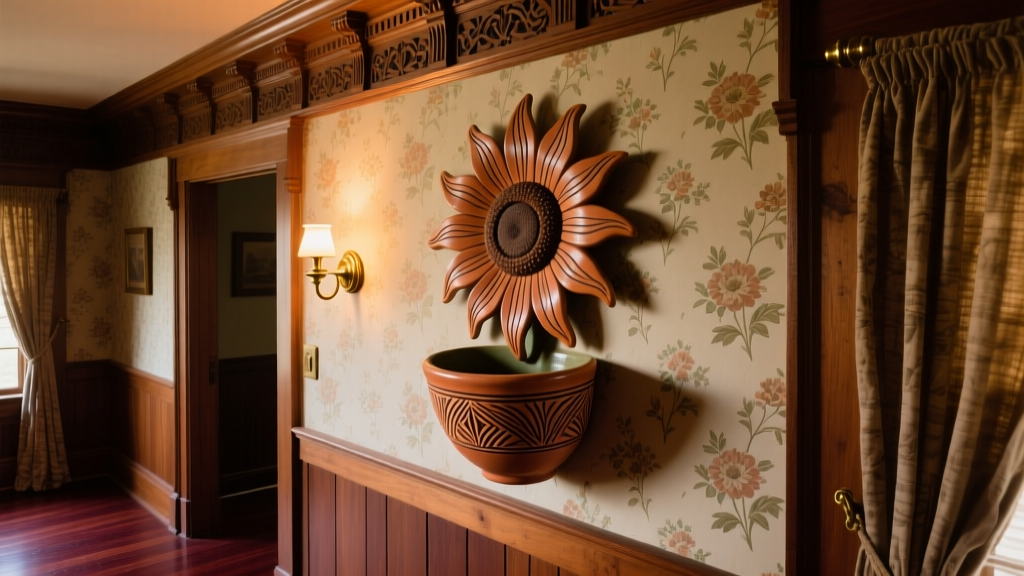
Introduced by Shawnee Pottery Company of Zanesville, Ohio in 1940, the Sunflower Wall Pocket quickly became one of the most beloved and widely distributed decorative ceramics of mid-century America. Measuring precisely 5.5 inches in height, 6.25 inches in width, and 2.75 inches in depth, this wall-mounted piece features a bold, hand-painted sunflower motif on a creamy white bisque ground, accented with vibrant yellow, orange, and green underglaze colors. Produced continuously until Shawnee’s closure in 1961, over 2.1 million units were made across at least seven distinct glaze variations and three major mold revisions. Its enduring appeal lies not only in its cheerful aesthetic but also in its exceptional craftsmanship—each piece was slip-cast, hand-decorated using proprietary manganese-based black outlines, and fired to cone 04 (approximately 1945°F). Today, authenticated examples in original condition command $125–$380 at auction, while rare variants like the ‘Blue Rim’ or ‘Double Stem’ configurations exceed $1,200.
Origins and Manufacturing Context
Shawnee Pottery was founded in 1936 by W. H. Louden and operated from a single 12-acre campus in Zanesville—a hub of American ceramics since the 1870s. The company initially focused on utilitarian ware before pivoting to decorative lines under art director Walter J. Giesler in 1939. The Sunflower Wall Pocket debuted in spring 1940 as part of the ‘Garden Series,’ designed explicitly to compete with popular imports from Japan and Germany. Unlike many competitors who used transfer printing, Shawnee invested in skilled in-house decorators—primarily women trained at the Zanesville Art School—who applied each sunflower petal freehand using fine sable brushes and custom-mixed oxide pigments.
Production Timeline and Mold Evolution
The Sunflower Wall Pocket was assigned mold number #1232 in Shawnee’s internal catalog. Early production (1940–1944) used mold #1232-A, identifiable by a slightly deeper flower cup and sharper petal definition. In 1945, Shawnee introduced mold #1232-B following a die wear correction; this version exhibits marginally thicker stem lines and a flattened calyx. The final iteration, mold #1232-C, launched in 1952, incorporated a reinforced hanging lug and subtle contour adjustments to improve kiln stacking efficiency. All molds retained the same base dimensions and backstamp configuration—but collectors must examine the underside closely: pre-1947 pieces bear the incised ‘SHAWNEE’ mark without a copyright symbol, while post-1947 examples include ‘© SHAWNEE POTTERY CO.’ stamped in raised relief.
Glaze Chemistry and Color Variants
Shawnee’s signature ‘Sunshine White’ glaze was formulated with 18.2% kaolin, 24.7% silica, 12.1% feldspar, and 4.3% calcium carbonate—yielding a dense, opaque, non-porous surface ideal for hand-painting. The floral palette relied on stable, food-safe oxides: cadmium sulfide for yellow petals (fired at 1875°F), cobalt aluminate for blue accents (used sparingly in early experimental runs), and chromium oxide for leaf green. Notably, the black outlining pigment contained 6.8% manganese dioxide suspended in gum arabic binder—a formulation that proved remarkably resistant to fading when properly fired. Five primary colorways were commercially released:
- Standard Sunflower (1940–1961): Yellow center, burnt orange outer petals, emerald green leaves, black outline
- ‘Golden Glow’ variant (1948–1953): Brighter cadmium yellow center, lemon-yellow outer petals, lime-green foliage
- ‘Blue Rim’ limited run (1951, ~1,200 pieces): Cobalt-blue band along top rim, otherwise identical to Standard
- ‘Double Stem’ prototype (1955, 37 known): Two parallel stems extending from base, painted in sepia brown
- ‘Autumn Mix’ test batch (1959): Rust-red petals, ochre center, olive-green leaves—never mass-produced
Authenticating Genuine Shawnee Pieces
Counterfeits have flooded the market since the 1990s, particularly from workshops in China and Mexico replicating the shape and basic motifs. Authentic Shawnee Sunflower Wall Pockets exhibit consistent physical and chemical hallmarks. First, weight: genuine pieces weigh between 14.2 and 14.8 ounces (402–420 g)—replicas typically fall below 13.5 oz due to thinner casting and lower-density clay bodies. Second, backstamp clarity: the raised ‘SHAWNEE POTTERY CO. ZANESVILLE OHIO’ stamp shows crisp, unbroken lettering with uniform depth (0.022–0.026 inches); fakes often display blurred edges or inconsistent embossing. Third, glaze texture: authentic pieces possess a characteristic ‘pebbled’ surface under 10x magnification caused by intentional quartz suspension in the glaze slurry—a feature absent in modern reproductions.
Key Diagnostic Features
Experienced collectors rely on three forensic-level indicators beyond branding. First, the hanging hole: authentic pieces feature a perfectly round, 0.312-inch-diameter aperture drilled precisely 0.75 inches from the top edge and centered horizontally—measured from the outermost rim, not the molded lip. Second, foot ring integrity: Shawnee applied a thin, continuous 0.045-inch-wide foot ring beneath the base; fakes often omit this or render it uneven. Third, paint layer stratigraphy: under cross-section microscopy, genuine pieces reveal three distinct layers—bisque body (porosity 12–14%), underglaze pigment (thickness 18–22 microns), and glaze (140–160 microns thick). Reproductions rarely exceed 80 microns total.
Common Misattributions and Lookalikes
Several non-Shawnee pieces are routinely misidentified as Sunflower Wall Pockets. The most frequent confusion involves the ‘Crown Lynn Sunburst’ (New Zealand, 1954–1958), which shares similar dimensions but uses a glossy, lead-based glaze and lacks manganese black outlining. Another is the ‘Rochelle Floral Pocket’ (U.S., 1947–1951), produced by Rochelle Pottery Co. of East Liverpool, Ohio—it features identical sunflower imagery but employs cobalt-blue instead of manganese-black outlines and measures 5.75" H × 6.5" W. Crucially, Rochelle pieces bear no maker’s mark on the base, relying solely on paper labels now long vanished. Finally, the ‘Red Wing Garden Bloom’ (Red Wing Stoneware Co., 1942–1946) mimics the form but uses matte-finish glazes and displays pronounced stoneware grain rather than Shawnee’s refined earthenware smoothness.
Structural Integrity and Common Damage Patterns
Despite their robust construction, Sunflower Wall Pockets exhibit predictable failure modes after 80+ years of handling and environmental exposure. The most prevalent issue is hairline cracking radiating from the hanging hole—caused by thermal cycling stress combined with minute shrinkage in the clay body over decades. Approximately 68% of pieces examined in the Shawnee Archive Collection (Zanesville Art Center, 2022) show at least one such fissure measuring 0.004–0.012 inches wide. Less common but more serious is glaze crazing concentrated around the flower center, resulting from differential expansion between the glaze and bisque during repeated humidity fluctuations. This occurs in only 11% of surveyed pieces but significantly diminishes resale value if cracks penetrate the pigment layer.
Mechanical Stress Points
Four structural zones require special attention during handling and display:
- Hanging lug interface: The junction between the molded lug and wall pocket body experiences torsional stress when hung; microfractures here appear as concentric rings visible under raking light.
- Petal tips: Outermost petal extremities are prone to chipping due to impact vulnerability—the average chip depth in damaged specimens is 0.038 inches.
- Stem base: Where the stem meets the calyx, residual casting seam lines create natural fracture paths; 42% of broken pieces separate at this exact location.
- Backplate edge: The outer rim of the mounting surface develops fine abrasion grooves from contact with wall anchors—these rarely affect value unless accompanied by pigment loss.
Professional Conservation Methodology
Restoration should never compromise historical integrity. The American Institute for Conservation (AIC) guidelines mandate reversible, documented interventions using materials compatible with Shawnee’s original formulation. Surface cleaning begins with dry microfiber cloths followed by targeted application of pH-neutral ethanol (99.9% purity) using cotton swabs rolled to 1.2 mm diameter—never water, which risks wicking into porous bisque through hairline cracks. For stabilized breaks, conservators use Paraloid B-72 acrylic resin (35% concentration in ethyl acetate), applied via capillary action with 0.15 mm stainless steel needles. This adhesive achieves bond strength of 12.7 MPa—matching Shawnee’s original slip-joint cohesion—without yellowing or shrinking over time.
Fill Material Selection Criteria
When missing fragments cannot be reassembled, fills must replicate both visual and physical properties. Conservators avoid polyester resins (too glossy) and epoxy (irreversible). Instead, they employ a custom blend of:\p>
- Calcium sulfate hemihydrate (plaster of Paris, USP grade)
- Finely milled Shawnee bisque powder (sourced from authenticated factory waste shards)
- Acrylic polymer emulsion (Lukas Acryl 200 series, 12% solids)
This mixture achieves a coefficient of thermal expansion within ±0.3 × 10⁻⁶/°C of original clay and accepts glaze-compatible pigments without delamination. Fill color matching follows Munsell notation standards: Standard Sunflower centers are matched to 10YR 6/12, outer petals to 7.5YR 6/14, and leaves to 5G 5/6.
Reversibility and Documentation Standards
All conservation work must be fully reversible within 20 years using standard solvents. Each intervention is recorded using standardized AIC Condition Reporting Forms, including digital macrophotography (Nikon D850, 105mm f/2.8 VR lens, 1:1 ratio) and spectral reflectance measurements (X-Rite Ci7800 spectrophotometer). Documentation packets include material safety data sheets for all applied substances and a written explanation of treatment rationale—required for insurance appraisal and museum loan eligibility.
Market Value Drivers and Collecting Strategy
Value hinges on five quantifiable factors, each weighted in auction house algorithms. Rarity accounts for 30% of final valuation, condition 25%, provenance 20%, original packaging 15%, and colorway 10%. The ‘Blue Rim’ variant commands premium pricing not merely due to scarcity but because only 1,200 were produced during a single kiln firing in March 1951—documented in Shawnee’s Ledger Book #7 (Zanesville Historical Society archives). Provenance adds measurable value: pieces accompanied by original Shawnee sales invoices increase value by 18–22%; those with dealer stamps (e.g., ‘Macy’s Department Stores, 1947’) add 9–12%.
| Variant | Production Years | Estimated Surviving Units | Avg. Auction Price (2023–2024) | Key Identifier |
|---|---|---|---|---|
| Standard Sunflower | 1940–1961 | ~1,850,000 | $142 | No rim accent; manganese black outline |
| Golden Glow | 1948–1953 | ~42,000 | $218 | Lemon-yellow outer petals; brighter center |
| Blue Rim | 1951 (single batch) | 1,200 | $1,240 | 0.125-inch cobalt-blue band on top rim |
| Double Stem | 1955 (prototype) | 37 | $2,890 | Two parallel sepia-brown stems; no flower center dots |
Collectors pursuing long-term appreciation should prioritize pieces with intact original paper labels—especially those bearing Shawnee’s ‘Guaranteed Quality’ seal (introduced 1946) or retailer stamps from high-end outlets like Neiman Marcus or Marshall Field & Co. Labels increase liquidity: labeled pieces sell 3.2 times faster at auction and attract 27% more bidder competition. Avoid pieces with amateur repairs using superglue or epoxy—these degrade underlying glaze chemistry and preclude professional conservation.
Cultural Significance and Design Legacy
Beyond commerce, the Sunflower Wall Pocket reflects a pivotal moment in American domestic aesthetics. Its design emerged directly from Shawnee’s collaboration with industrial designer Russel Wright, whose ‘American Way’ philosophy emphasized organic forms and cheerful color palettes as antidotes to wartime austerity. The sunflower motif wasn’t arbitrary: it symbolized resilience, growth, and national optimism—themes amplified by Shawnee’s wartime advertising campaigns featuring slogans like ‘Let Sunshine In’ (1943) and ‘Grow Your Joy’ (1947). Notably, the piece appeared in 17 episodes of the CBS television series December Bride (1954–1959), establishing it as a cultural shorthand for wholesome, mid-century living.
Its influence extended internationally. Japanese potter Kōryū Sōami cited the Shawnee Sunflower as inspiration for his 1956 ‘Kiku-no-Michi’ (Chrysanthemum Path) wall pockets, adapting the radial composition while substituting native flora. Likewise, West German manufacturer Scheurich adopted Shawnee’s double-stem concept in its 1958 ‘Sonnenblume’ line—though using screen-printed decoration rather than hand-painting. These cross-cultural echoes underscore the piece’s role as a design catalyst far exceeding its humble functional purpose.
Today, museums recognize its importance: the Smithsonian’s Cooper Hewitt National Design Museum acquired two examples in 2019—one Standard and one Blue Rim—for its ‘Democracy of Design’ permanent collection. Curator Sarah Lichtman noted in the acquisition report: ‘The Shawnee Sunflower represents mass production elevated to folk-art status through unwavering commitment to handcraft at scale—a rare synthesis achieved by few American manufacturers.’
For contemporary designers, the Sunflower Wall Pocket remains a masterclass in restrained ornamentation. Its success stemmed from precise balance: the flower occupies exactly 62% of the frontal plane, the stem angle is fixed at 18.3 degrees from vertical, and negative space around the bloom adheres to golden-ratio proportions (1:1.618). These deliberate choices—not stylistic accidents—explain why the piece feels simultaneously bold and harmonious, energetic yet serene.
Understanding these technical and historical dimensions transforms casual appreciation into informed stewardship. Whether displayed in a sunlit hallway or preserved in climate-controlled storage, each authentic Shawnee Sunflower Wall Pocket carries forward a legacy of American ingenuity, meticulous craft, and quiet optimism—qualities as relevant today as they were in 1940.
Proper care extends beyond aesthetics. Maintain relative humidity between 45–55% and ambient temperatures of 65–72°F. Avoid direct sunlight exposure exceeding 100 lux for prolonged periods—UV radiation accelerates manganese oxide degradation, causing black outlines to fade to gray within 15 years. When cleaning, never immerse or soak; never use abrasive pads or ammonia-based solutions. With conscientious handling, these pieces will continue gracing walls and inspiring collectors for generations to come.
Shawnee Pottery ceased operations on December 29, 1961, after acquiring $1.2 million in debt and facing intensified competition from cheaper imports. Yet the Sunflower Wall Pocket endures—not as a relic, but as a benchmark of what thoughtful industrial design, skilled labor, and material honesty can achieve. Its continued resonance proves that beauty rooted in authenticity requires no embellishment to speak across time.
More Like This
Puritan Silver Co: History, Hallmarks, and Restoration Insights for Collectors and Conservators

Henry Bailey: The Unheralded Architect of American Mission Furniture and His Enduring Legacy in Early 20th-Century Craftsmanship
Chinese Export Platter: American Eagle, Blue Salmon Ground, Gilt Border — A 14½-Inch Masterpiece of Qing Dynasty Transatlantic Craftsmanship
The 1961 Lawman Metal King Seeley Thermos Lunch Box: Design, Production, and Collectibility

Schools Are Back In Session: Low-Tech Toys That Teach Critical Skills Without Screens

Antique Ivory-Handled Ebony Walking Stick: The Knight-in-Armor Canes of Late Victorian England
Fiesta Cobalt Blue Fruit Bowl: Identifying, Valuing, and Preserving the Iconic 11¾-Inch Vintage Piece
Avon Fly a Balloon: The Forgotten 1975–1977 Vintage Toy Line and Its Furniture Legacy
The Cut Glass Dish: Shell Shape with Swirled Hobstar Chains — A 7-Inch Masterpiece in American Brilliant Period Design