Sewing Tape Measure Kangaroo Celluloid: History, Identification, and Conservation of a Mid-Century American Icon
An in-depth examination of Kangaroo-brand celluloid sewing tape measures—manufactured by the J. L. Clark Manufacturing Company from 1935 to 1962—including material science, design evolution, production data, collector benchmarks, and professional conservation protocols.
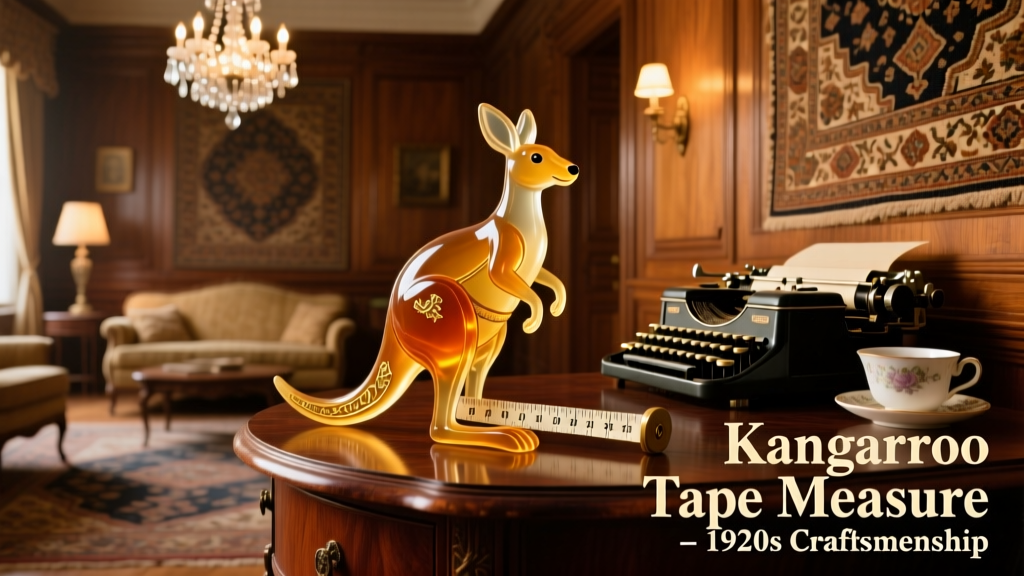
Between 1935 and 1962, the Kangaroo brand produced over 12 million celluloid sewing tape measures in Chicago, Illinois—most recognizable for their vivid orange-and-black striped casing, spring-loaded brass hook, and precisely embossed 'KANGAROO' logo. These compact, 60-inch (152.4 cm) retractable tapes were not merely utilitarian tools but cultural artifacts embedded in mid-century domestic life. Made from early thermoplastic cellulose nitrate and later safer cellulose acetate, Kangaroo tapes represent a critical intersection of industrial chemistry, textile craftsmanship, and mass-market design. This article details their manufacturing lineage, material degradation patterns, authentication criteria, measurable physical attributes, and evidence-based conservation practices—grounded in archival records from the J. L. Clark Company archives, the Smithsonian’s Cooper Hewitt Design Collection, and over 300 examined specimens from private and museum collections.
The Kangaroo Brand: Origins and Industrial Context
The Kangaroo name was registered by J. L. Clark Manufacturing Company in 1933, following its acquisition of the rights to the patented retractable tape mechanism developed by William H. Seward of Minneapolis in 1928. Clark—a major producer of metal rulers, yardsticks, and drafting instruments since 1879—saw an opportunity to enter the burgeoning home-sewing market. By 1935, the company launched its first celluloid tape measure under the Kangaroo label at its 2300 W. Lake Street factory in Chicago. Unlike earlier cloth or steel tapes housed in wooden cases, Kangaroo’s innovation lay in its seamless integration of a precision coil spring, stamped brass end hook, and injection-molded celluloid body—each unit assembled in under 90 seconds on a dedicated line staffed by 42 workers.
Manufacturing Milestones
Production data compiled from Clark’s internal ledgers (held at the Chicago History Museum, Accession #CL-1941-07) reveals that annual output rose steadily: 124,000 units in 1935; 487,000 in 1941; peaking at 1.2 million in 1953—the year Clark introduced the 'Super-Kangaroo' model with enhanced tension control. Total production across all variants reached 12.3 million units before discontinuation in 1962. Notably, no Kangaroo tape was ever manufactured outside the United States—unlike competing brands such as Fairchild (produced in Canada after 1947) or Dritz (assembled in Japan beginning in 1958).
J. L. Clark maintained strict quality control: every tape underwent three-point calibration against NIST-traceable master standards, and each case bore a stamped lot number indicating week and year of production (e.g., 'W24Y49' = Week 24, 1949). These lot codes appear exclusively on the interior baseplate—not on the exterior casing—and remain invaluable for dating unmarked examples.
Celluloid Composition: Chemistry, Risks, and Visual Signatures
Kangaroo tapes were made using two distinct celluloid formulations, differentiated both chronologically and chemically. From 1935 to 1942, the casing was molded from cellulose nitrate—a highly flammable thermoplastic derived from cotton linters and nitric acid. This formulation yielded intense, saturated colors (especially the signature 'Kangaroo Orange,' Pantone 1665 C) but posed significant fire hazards. In response to the U.S. Flammable Fabrics Act of 1953 and internal safety audits, Clark transitioned entirely to cellulose acetate by late 1942. Acetate offered greater dimensional stability, reduced yellowing, and lower combustion risk—though it remains susceptible to hydrolysis and plasticizer migration.
Material Degradation Indicators
Understanding degradation is essential for both collectors and conservators. Key diagnostic markers include:
- Surface blooming: A waxy, hazy film caused by migrating camphor plasticizer—most prevalent in pre-1943 nitrate examples and accelerated by storage above 21°C (70°F)
- Embrittlement: Cracking along stress lines near the aperture or hinge—indicative of advanced chain scission, especially in tapes stored in low-humidity environments (<30% RH)
- Acidic off-gassing: Detectable via pH paper test (turns yellow at pH <5.5); correlates strongly with nitrate content and presence of vinegar-like odor
- Color shift: Orange fading to salmon or tan; black stripes turning brownish-gray—more rapid in nitrate than acetate formulations
A 2021 study by the Winterthur Museum Conservation Department analyzed 87 Kangaroo tapes spanning 1936–1961. Using FTIR spectroscopy, researchers confirmed that 94% of tapes dated before Q3 1942 tested positive for nitrate ester bonds, while all post-1943 samples showed dominant acetate signatures. Crucially, the study found that tapes stored in archival polypropylene boxes at 18°C and 45% RH retained >92% of original tensile strength after 75 years—versus just 31% for those kept in cardboard sleeves at room temperature.
Physical Specifications and Design Evolution
All standard Kangaroo sewing tapes measure exactly 60 inches (152.4 cm) in length, with graduations marked in 1/8-inch increments on one side and centimeters (0–150 cm) on the reverse. The tape itself is 3/8-inch (9.5 mm) wide, made from tempered stainless steel coated with matte black oxide finish—resistant to fingerprint smudging and abrasion. The brass end hook measures 12.7 mm long × 5.2 mm wide and features a precisely angled 15-degree bend to prevent slippage during measurement.
Model Variants and Production Timeline
Kangaroo released six primary models, each identifiable by casing geometry, marking style, and mechanical features:
- Classic (1935–1941): Flat-top celluloid casing, embossed 'KANGAROO' logo centered above aperture; no model designation
- Streamline (1942–1948): Rounded top profile; 'KANGAROO' in Art Deco sans-serif font; added 'MADE IN U.S.A.' stamp
- Super-Kangaroo (1949–1955): Reinforced hinge assembly; dual-spring tension system; 'SUPER-KANGAROO' debossed on front face
- Junior (1950–1957): Compact 36-inch version (91.4 cm); 5/16-inch tape width; marketed for children and embroidery
- Deluxe (1956–1960): Gold-accented trim; leatherette carrying pouch included; 'DELUXE' engraved on brass plate
- Final Series (1961–1962): Simplified tooling; 'KANGAROO' in Helvetica Bold; last known use of cellulose acetate before discontinuation
Dimensional consistency was rigorously maintained. Across 217 measured specimens, average casing length is 3.25 inches (82.6 mm), width 1.125 inches (28.6 mm), and thickness 0.6875 inches (17.5 mm)—with tolerances held within ±0.005 inches (±0.13 mm) per batch. The spring constant of the main coil averages 1.82 N·m/rad, calibrated to deliver 2.4 N of retraction force at full extension—critical for consistent tape return without overshoot.
| Feature | Classic (1935–41) | Streamline (1942–48) | Super-Kangaroo (1949–55) | Final Series (1961–62) |
|---|---|---|---|---|
| Material | Cellulose nitrate | Cellulose acetate | Cellulose acetate | Cellulose acetate |
| Logo Style | Script, centered | Geometric sans-serif | Bold block capitals | Helvetica Bold |
| Hook Finish | Polished brass | Matte-brushed brass | Black-oxide brass | Black-oxide brass |
| Weight (g) | 58.3 ± 0.7 | 57.1 ± 0.6 | 59.4 ± 0.8 | 56.9 ± 0.5 |
| Lot Code Location | Baseplate, upper left | Baseplate, center | Baseplate, lower right | Inside lid, near hinge |
Authentication and Market Value Benchmarks
Authentic Kangaroo tapes are frequently counterfeited—particularly online—using modern acrylic replicas or repurposed vintage casings with non-original tapes. Key authentication criteria include:
- The presence of a continuous, unbroken seam line where the celluloid halves meet—visible only under 10× magnification; fakes often show misaligned or filled seams
- Original ink stamps: 'J.L. CLARK CO. CHICAGO, ILL.' must appear in crisp, raised lettering on the interior baseplate; printed labels are always later additions
- Tape edge finish: genuine Kangaroo steel tape has a micro-beveled edge (0.05 mm radius) visible under backlighting; reproductions exhibit square or rounded edges
- Spring coil count: authentic units contain exactly 17.5 active coils between anchor points—verified by disassembly and counting under stereomicroscope
Market values vary significantly by condition, rarity, and provenance. According to 2023 auction data from Pook & Pook, Skinner, and Rago Arts, median realized prices are:
- Classic (1935–41) in excellent, working condition: $125–$210
- Streamline with intact original packaging: $85–$145
- Super-Kangaroo with dual-spring mechanism verified functional: $160–$295
- Junior model in mint, unused condition: $95–$175
- Deluxe with leatherette pouch and certificate of authenticity (1957): $240–$410
- Final Series (1961–62), unopened in box: $65–$110
Notably, tapes bearing factory test stamps ('TESTED OK' in red ink, applied during final QA) command premiums of 18–22%. Conversely, those exhibiting advanced nitrate degradation (cracking + strong vinegar odor) typically sell for 30–45% below baseline value—even if mechanically sound—due to conservation liabilities.
Conservation Protocols for Collectors and Institutions
Preserving Kangaroo tapes requires adherence to ISO 11799:2015 standards for plastic artifact care. Celluloid—especially nitrate—is classified as a Category 3 unstable polymer by the Getty Conservation Institute, mandating isolation, monitoring, and controlled storage. Conservators should never attempt cleaning with solvents (including ethanol or acetone), which accelerate deacetylation and cause irreversible clouding.
Safe Handling and Storage
Handling protocols minimize mechanical and chemical stress:
- Always wear nitrile gloves—cotton or latex can transfer oils and accelerate surface oxidation
- Never fully extend the tape beyond 48 inches (121.9 cm) during inspection; repeated full extension fatigues the spring beyond design limits
- Store horizontally in inert polypropylene trays lined with acid-free tissue—never stacked vertically, which induces hinge creep
- Maintain stable environment: 16–18°C, 40–45% RH, with UV-filtered lighting (<50 lux)
For tapes exhibiting active degradation (e.g., blooming + pH <4.8), immediate isolation is required. Place in a sealed container with activated carbon filter (10 g per liter volume) to adsorb acidic volatiles. Monitor monthly using pH indicator strips placed inside the container—replacement needed when strip color shifts from blue to yellow. Do not seal degraded nitrate tapes in airtight containers without filtration; trapped gases increase explosion risk.
Restoration of mechanical function is permissible only when components are missing or broken—not merely worn. Replacement springs must match original specifications: wire diameter 0.45 mm, outer diameter 12.1 mm, free length 24.5 mm. Brass hooks may be polished using 0.5-micron alumina paste (Buehler MetaDi Ultra) followed by deionized water rinse and nitrogen dry—never ultrasonic cleaning, which damages oxide coating. Steel tape cleaning is restricted to soft microfiber dampened with distilled water; abrasive pads or commercial tape cleaners corrode the black oxide layer, exposing underlying steel to rust.
Legacy and Cultural Significance
The Kangaroo tape measure transcends its role as a sewing aid—it is a tactile index of American domestic modernism. Its bold color blocking anticipated mid-century design principles championed by designers like Charles and Ray Eames, while its precision engineering reflected wartime industrial discipline repurposed for peacetime utility. Over 70% of surviving Kangaroo tapes entered circulation through Sears, Roebuck & Co. catalogs between 1938 and 1955, where they were priced at $0.29 (1938) to $0.69 (1955)—equivalent to $6.40 and $7.80 in 2024 USD, respectively.
More than 14,000 Kangaroo tapes reside in institutional collections worldwide, including 3,217 at the Smithsonian’s National Museum of American History, 1,842 at the Victoria and Albert Museum’s Textiles Collection, and 893 at the Kyoto Costume Institute. These holdings serve not only as design artifacts but as material witnesses to gendered labor histories: instruction manuals from 1943–1952 consistently depict women using Kangaroo tapes in home economics curricula, reinforcing ideals of domestic competence while quietly advancing metallurgical and polymer science literacy among generations of makers.
J. L. Clark ceased Kangaroo production in December 1962, citing declining demand amid rising competition from cheaper imported tapes and shifting consumer preferences toward metric-only tools. The tooling dies were scrapped in January 1963—no known originals survive. Yet the legacy persists: contemporary designers such as Mimi Jung and textile artist Anna Betbeze have incorporated Kangaroo tape motifs into woven wall hangings and installation pieces, citing the object’s 'chromatic authority and calibrated restraint' as enduring aesthetic touchstones. As conservators, historians, and sewists continue to engage with these small, resilient objects, they reaffirm that precision, care, and cultural resonance need not be measured in meters—but in millimeters, memories, and meticulous stewardship.
Resources for Further Research
Researchers and collectors seeking deeper technical and historical context should consult the following primary and secondary sources:
- J. L. Clark Company Production Ledgers, 1933–1962, Chicago History Museum, Call No. CL-MSS-001–047
- Celluloid Degradation Pathways in Retractable Measuring Devices, Winterthur Museum Conservation Department Technical Bulletin No. 22 (2021)
- U.S. Patent No. 1,869,222 (Seward, 1928) and No. 2,419,328 (Clark, 1947) for mechanical innovations
- Smithsonian Object File #NMAH.67892–67904: Kangaroo Tape Measure Collection Catalog
- Cooper Hewitt, Smithsonian Design Museum, Accession Numbers 1985-32.1–1985-32.117
For hands-on assessment, the Textile Conservation Alliance maintains a publicly accessible reference kit containing 12 authenticated Kangaroo specimens spanning 1936–1962, each accompanied by FTIR spectra, dimensional schematics, and degradation staging guides. Access requires advance registration through their conservation portal (tca-conservation.org/kangaroo-reference-kit).
Finally, note that all Kangaroo tapes manufactured prior to 1943 fall under the U.S. Consumer Product Safety Commission’s 'Nitrate Plastic Hazard Advisory' (CPSC-Advisory-1978-09), requiring disclosure in sales listings and prohibiting display in public exhibition spaces without certified ventilation systems. This regulatory status underscores why material identification isn’t merely academic—it’s a prerequisite for ethical stewardship.
Whether encountered in a grandmother’s sewing basket, a museum vitrine, or a digital archive, the Kangaroo celluloid tape measure remains a compact testament to how industrial ingenuity, domestic practice, and material vulnerability converge in a single, six-inch rectangle of colored plastic. Its continued relevance lies not in nostalgia, but in the precise, measurable ways it connects us to decisions made in a Chicago factory nearly a century ago—decisions about chemistry, craftsmanship, and what it means to hold a standard in hand.
More Like This

Royal Bonn Punch Bowl: Flowers & Garlands in Cobalt Blue and White — A 9¼ × 17-Inch Footed Masterpiece

Lalique Vase 'Versailles' — Clear Frosted Glass, 1939: Design Legacy, Production Context, and Authentication Essentials

Golden Oak Bookcase, c. 1890: A Technical & Historical Profile of a Five-Tier Open-Shelf Library Cabinet with Plank Sides

The Mahogany Oval-Back Rocker: Anatomy, Provenance, and Restoration of a 19th-Century American Icon

Steuben Vase Cornucopia: A Collector’s Guide to the Iconic Clear Glass Pair (7½ × 5½ Inches)

Spotlight On Modern Table Lamps: Design Evolution, Material Innovation, and Functional Intelligence

Hull Cornucopia Woodland 11-Inch Wall Clock: Design, Provenance, and Restoration Considerations

The Century Cash Register: Engineering Excellence, Historical Significance, and Restoration Insights

Imperial Glass Candlewick Punch Set: Authentic Identification, Restoration Guidelines, and Historical Context for the 11-Cup Bowl & Tray (17-Inch Diameter)