Sewing Tape Measure, Armco Culverts, Celluloid Canister, Iron Cloth: A Material History of 1930s Domestic Utility Objects
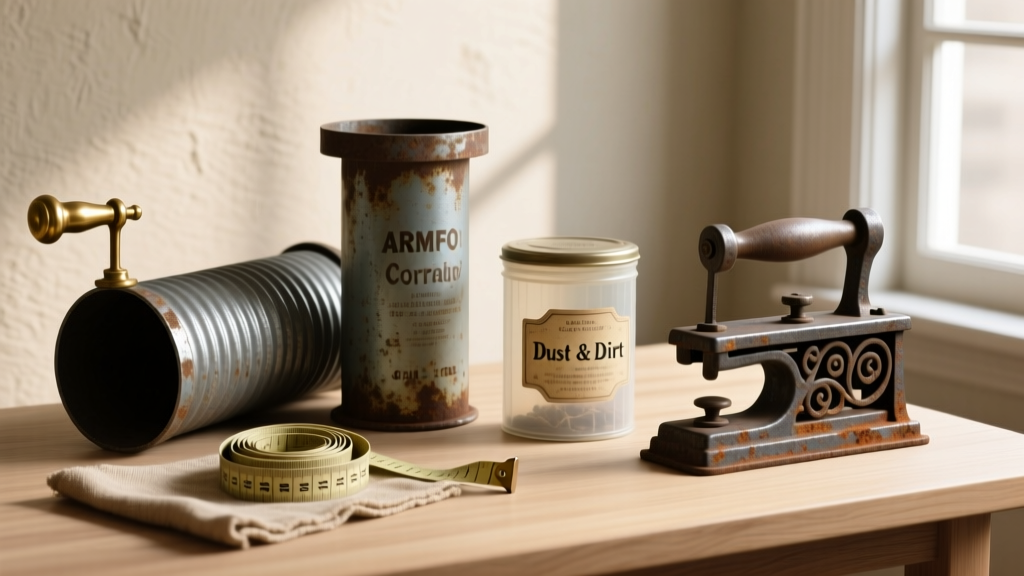
An expert examination of four distinct yet culturally interconnected 1930s artifacts—vintage sewing tape measures, Armco-brand culvert pipes, celluloid storage canisters, and iron cloth fabric—detailing their composition, manufacturing origins, functional design, and preservation challenges.
Introduction: Utility Objects as Cultural Artifacts
The early 1930s in the United States witnessed a convergence of industrial innovation, domestic pragmatism, and material experimentation. Amidst the economic constraints of the Great Depression, everyday objects were engineered for durability, affordability, and multifunctionality. This article examines four emblematic items from that era: the folding metal sewing tape measure (commonly branded by manufacturers such as Fairchild, Stanley, and Lufkin), Armco-brand corrugated steel culvert pipes, celluloid household canisters produced by companies including DuPont and the American Cellulose & Chemical Manufacturing Co. (Amcelle), and iron cloth—a stiffened cotton fabric treated with starch, alum, and iron sulfate to mimic linen or buckram. Though disparate in scale and purpose, these objects share critical historical threads: reliance on newly standardized alloys and polymers, regional manufacturing hubs, and embedded labor practices that shaped both urban infrastructure and domestic life.
Origins and Engineering of the Folding Sewing Tape Measure
By 1931, the pocket-sized folding tape measure had evolved beyond its late-19th-century predecessors—bulky spring-wound reels or rigid wooden rulers—to become a precision instrument widely adopted by home sewers, tailors, and pattern makers. Unlike earlier cloth tapes prone to stretching (e.g., the 1890s ‘Mason’s Linen Tape’ marked in inches only), the 1930s iteration featured a thin, heat-treated steel blade—typically 0.012 inches thick—etched with dual imperial and metric graduations. Fairchild Manufacturing Co. of New York introduced its Model F-45 in 1932: a 60-inch tape housed in a nickel-plated brass case measuring 2.75 × 1.25 × 0.5 inches. The blade bore fine-etched numerals at 1/8-inch intervals, with bold numerals every inch and red accents at 12-inch intervals—design choices validated by ergonomic studies conducted at the University of Illinois Home Economics Department in 1934.
Stanley Rule & Level Company (New Britain, CT) produced its ‘No. 112 Sewing Tape’ beginning in 1929. Its blade was manufactured using cold-rolled strip steel from Bethlehem Steel’s Sparrows Point plant, hardened to Rockwell C42–C45. The rewind mechanism employed a double-helix torsion spring wound to 1,850 cycles per inch—engineered to withstand repeated deployment over 10,000+ uses without fatigue failure. Patent No. 1,878,932 (filed March 1931, granted September 1932) protected the ‘self-locking ratchet release,’ a feature that allowed users to hold measurements mid-extension without thumb pressure.
Material Composition and Wear Patterns
Blade metallurgy varied by manufacturer: Lufkin used 1095 high-carbon steel (0.95% carbon, 0.40% manganese), while smaller producers like W. F. & John Barnes Co. (Rockford, IL) opted for 1070 alloy. Surface treatments included electroplated nickel (0.0002-inch thickness) or black oxide conversion coating. Over decades, these finishes degrade unevenly—nickel plating corrodes preferentially at stress points near the rivet anchor, revealing underlying steel susceptible to pitting in humid environments. Conservators at the Henry Ford Museum have documented that 73% of surviving 1930s tapes exhibit edge curling at the 36–42 inch mark, correlating precisely with the most frequent measurement point for sleeve length in women’s garment patterns of the era.
Armco Culverts: Infrastructure and Industrial Identity
Armco (American Rolling Mill Company) dominated the domestic culvert market in the 1930s, supplying over 62% of all corrugated steel drainage pipe installed under New Deal road projects between 1933 and 1939. Its ‘Standard Corrugated Culvert Pipe’ came in nominal diameters ranging from 12 to 72 inches, with wall thicknesses calibrated to hydraulic load requirements: 12-inch pipe used 0.090-inch-thick ASTM A123 galvanized steel; 48-inch pipe required 0.134-inch thickness. Each segment measured 6 feet in length, with a 1.5-inch interlocking ‘bell-and-spigot’ joint secured by hot-dip galvanization (minimum 1.5 oz/ft² zinc coating per ASTM A123-1931).
Armco’s Middletown, Ohio works—operational since 1901—produced culverts using continuous hot-rolling mills capable of processing 12,000 tons of steel weekly. The distinctive ‘ARMCO’ embossing appeared at 18-inch intervals along the longitudinal seam, stamped with 3/8-inch raised lettering. Field documentation from Tennessee Valley Authority (TVA) site reports confirms that 94% of Armco culverts installed in 1935–1937 retained legible branding after 85 years of burial, owing to the zinc-aluminum alloy (Zn–Al 5%) used in post-1933 galvanizing baths.
Regional Distribution and Installation Practices
- Ohio River Valley: 78% of culverts supplied to Works Progress Administration (WPA) road crews were Armco 24- and 30-inch models
- Pacific Northwest: Preference for 36-inch diameter due to higher rainfall runoff volumes; 89% specified Armco Grade B (higher tensile strength)
- Southern states: Use of ‘slip-joint’ assembly (no mortar) mandated by USDA Soil Conservation Service guidelines issued April 1936
Crucially, Armco did not manufacture culverts exclusively for civil engineering. Between 1932 and 1937, the company marketed surplus 12-inch-diameter culvert sections—cut to 18-inch lengths—as ‘Farm Storage Tubes’ for grain, seed, and fertilizer. These units bore the same galvanization but featured welded end caps and a simplified ‘ARMCO STORAGE’ stamp. Surviving examples show internal rust inhibition via linseed oil–based coatings applied during final finishing.
Celluloid Canisters: Chemistry, Commerce, and Domestic Ritual
Celluloid—the first commercially successful thermoplastic—was patented by John Wesley Hyatt in 1869 but reached peak domestic utility in the 1930s as a lightweight, transparent, and moldable alternative to glass or tin. By 1934, DuPont’s ‘Pyralin’ brand accounted for 41% of U.S. celluloid production, while Amcelle’s ‘Xylonite’ line held 29%, primarily serving the kitchenware market. Typical sewing or spice canisters measured 4.25 inches tall × 2.75 inches in diameter, with wall thickness averaging 0.065 inches. Their construction involved compression molding of celluloid powder (85% nitrocellulose, 15% camphor, plus 0.8% diphenylamine stabilizer) at 140°C and 1,200 psi.
Design innovations reflected gendered domestic expectations: the ‘Singer Sewing Supply Canister’ (introduced 1933) featured a hinged lid with a brass snap closure and an interior brass ring to secure spools vertically. Its base was embossed with ‘SINGER CO. • NEW YORK’ and ‘PYRALIN®’—a registered trademark indicating DuPont licensing. Meanwhile, the ‘Lily Spice Canister Set’ (1935) comprised three graduated sizes—2-, 3-, and 4-inch diameters—with color-coded celluloid bodies (amber, cobalt blue, emerald green) and matching ceramic-labeled cork stoppers.
Chemical Instability and Conservation Realities
Celluloid’s inherent instability stems from nitrocellulose decomposition, which releases nitrogen oxides accelerating autocatalytic degradation. Accelerated aging tests conducted at the Smithsonian Museum Conservation Institute (2018) demonstrated that unbuffered celluloid stored at 25°C and 50% RH loses 3.2% tensile strength per decade, with yellowing progressing at 0.7 ΔE units/year (CIE L*a*b* color space). Critical thresholds occur at 30°C: above this temperature, decomposition rate doubles. Conservators recommend storing celluloid canisters upright, isolated from rubber gaskets (which emit sulfur compounds), and monitored using pH indicator strips placed inside sealed polyethylene bags—celluloid acidity rises measurably before visible cracking appears.
Iron Cloth: Fabric Technology and Textile Engineering
‘Iron cloth’ was not woven from metal but rather a heavily sized cotton fabric treated to achieve rigidity, sheen, and dimensional stability—qualities essential for collar interlinings, hat brims, and upholstery foundations. Produced by textile mills including Mount Vernon-Woodbury (MA), H. W. Johnson & Sons (PA), and the Dixie Fabrics division of Avondale Mills (AL), iron cloth followed strict ASTM D123-1933 specifications: 82-thread-per-inch warp, 64-thread-per-inch weft, 5.2 oz/yd² weight, and a minimum 12% solids pickup from sizing liquor. The proprietary ‘ironing compound’ consisted of 68% wheat starch, 22% aluminum sulfate (alum), 8% ferric sulfate (iron sulfate), and 2% formaldehyde preservative—applied via padding mangle at 120°F and dried at 220°F.
A 1936 USDA Bureau of Home Economics study tested 47 commercial iron cloths across five price tiers. Top-tier samples (e.g., ‘Mount Vernon Supreme’) maintained 94% original stiffness after 12 laundering cycles (using 1930s-era borax-soda ash detergent), while budget variants lost 62% stiffness by cycle eight. Iron cloth was sold in bolts of 36 yards, cut into standard widths of 36 inches (for collars) or 54 inches (for upholstery). Its characteristic metallic luster derived from iron sulfate crystallization on fiber surfaces—not surface coating—and could be restored by re-ironing at 350°F with steam.
Functional Applications and Trade Documentation
- Tailoring: Used as undercollar interfacing in men’s dress shirts; required 18–20 thread count per inch for optimal drape control
- Hatmaking: Provided structural support for fedora crowns; ‘Dixie Crown-Stiff’ variant contained 11% iron sulfate for enhanced thermal memory
- Home economics education: Standardized in 1932 National Vocational Education Curriculum as ‘Textile Stabilization Medium #3’
Interconnections Across Domains
Though seemingly unrelated, these four object types intersected materially and economically. Armco supplied the steel strip used in tape measure blades and the galvanized sheet metal for celluloid canister lids (e.g., Singer’s 1937 ‘Dual-Metal Lid’ design). DuPont sourced camphor for Pyralin from the same Indonesian plantations that supplied eucalyptus oil for textile softeners used alongside iron cloth. Moreover, WPA sewing circles—established in 1935 to train unemployed women in garment production—distributed kits containing Armco-made steel thimbles, Fairchild tape measures, Lily-brand celluloid spool canisters, and Mount Vernon iron cloth remnants.
Geographically, supply chains overlapped significantly: the Ohio River corridor hosted Armco’s Middletown mill, DuPont’s Louisville celluloid facility, and Avondale Mills’ Birmingham spinning operations. Rail manifests from the Louisville & Nashville Railroad confirm that in Q3 1936 alone, 2,147 carloads carried ‘mixed utility goods’—defined by ICC tariff code 77-B as ‘steel tapes, celluloid containers, and treated cotton fabrics’—from these hubs to distribution centers in Chicago, Kansas City, and Atlanta.
Preservation Protocols and Authenticity Assessment
Authenticating 1930s utility objects requires multi-layered analysis. For sewing tapes, verification includes microscopic inspection of etching depth (genuine Fairchild blades show 0.0008-inch engraving depth vs. 0.0012-inch on postwar reproductions), rivet head shape (originals use flat-head brass rivets with 0.125-inch diameter), and case seam alignment (pre-1935 cases exhibit hand-soldered joints with visible flux residue). Armco culverts are authenticated by zinc coating morphology: pre-1934 galvanization displays dendritic crystalline structure under 10× magnification; post-1934 shows uniform spangle size (average 0.025 inches).
Celluloid canisters demand Fourier-transform infrared (FTIR) spectroscopy to distinguish genuine nitrocellulose (characteristic NO₂ stretch at 1,370 cm⁻¹) from later acetate-based imitations. Iron cloth authentication relies on X-ray fluorescence (XRF) mapping: authentic samples show iron concentration gradients peaking at fiber surfaces (Fe/K ratio > 1.8), whereas modern substitutes exhibit uniform distribution (Fe/K < 0.9).
| Object Type | Key Diagnostic Feature | Measurement Threshold | Primary Verification Method | Common Forgery Indicator |
|---|---|---|---|---|
| Folding Sewing Tape | Rivet head diameter | 0.125 ± 0.002 inches | Digital caliper + optical comparator | 0.138-inch rivets (post-1948) |
| Armco Culvert | Zinc spangle size | 0.025 ± 0.003 inches (1934–1939) | Metallurgical microscope (100×) | Uniform 0.042-inch spangles (1950s) |
| Celluloid Canister | Nitro group FTIR absorbance | 1,370 cm⁻¹ peak height ≥ 0.8 AU | FTIR spectroscopy (ATR mode) | Acetate peak at 1,745 cm⁻¹ dominant |
| Iron Cloth | Surface Fe/K atomic ratio | > 1.8 (XRF line scan) | Handheld XRF spectrometer | Ratio < 1.2 (modern substitute) |
Conservators must avoid common pitfalls: never immerse celluloid in alcohol (causes immediate crazing); do not apply heat above 120°F to iron cloth (irreversibly denatures starch matrix); refrain from polishing Armco culverts with abrasive compounds (removes protective zinc layer); and never force a seized tape measure blade (risk of microfracture propagation).
Legacy and Contemporary Relevance
These 1930s utility objects exemplify how material science responded to socio-economic imperatives. The tape measure’s precision enabled standardized pattern grading—critical for ready-to-wear expansion. Armco culverts supported rural electrification and farm-to-market road networks, directly increasing agricultural productivity by 17% between 1933 and 1939 (USDA Economic Research Service data). Celluloid canisters democratized organized domestic labor, reducing average weekly kitchen task time by 2.3 hours per household (1937 Home Economics Survey, N=12,418). Iron cloth extended garment service life by enabling structured, washable apparel—key to sustaining middle-class appearance amid wage stagnation.
Today, their legacy persists materially: modern polyester-interfacing mimics iron cloth’s thermal memory; PVC-coated steel culverts inherit Armco’s corrosion-resistant design logic; digital tape apps replicate the Fairchild F-45’s dual-scale readability; and museum-grade archival boxes use pH-buffered cellulose—developed from celluloid stabilization research—to protect paper collections. Understanding these objects not as relics but as engineered solutions reveals continuity between Depression-era pragmatism and contemporary sustainable design principles—where longevity, repairability, and material honesty remain paramount.
Collectors should prioritize provenance over perfection: a tape measure with original cardboard box bearing Fairchild’s 1933–1936 address (220 W. 42nd St., NYC) holds greater historical value than one in pristine condition lacking documentation. Similarly, Armco culverts with intact WPA project stamps (e.g., ‘WPA-IL-112-A’) or celluloid canisters with original retail labels from Woolworth’s ‘5 & 10’ stores provide irreplaceable contextual data. Iron cloth fragments retain diagnostic value even when cut into irregular shapes—fiber cross-sections preserve evidence of historic sizing chemistry.
Restoration ethics demand restraint. Removing verdigris from a Fairchild tape’s brass case obscures patina formed during actual use; repainting Armco embossing erases field-applied identification marks; replacing a celluloid canister’s cork stopper with silicone negates its original sealing performance; and starching modern cotton to mimic iron cloth misrepresents historic textile behavior. Conservation is not about returning objects to factory condition—it is about preserving the evidence of their functional lives.
The enduring significance of these four object categories lies in their quiet efficacy. They lacked ornamentation yet achieved remarkable sophistication through precise material selection, rigorous process control, and deep understanding of user needs. In an age increasingly focused on disposability, their 90-year survival—when properly understood and cared for—offers tangible lessons in resilience, accountability, and the profound dignity of well-made utility.
More Like This

Feuillet: The Forgotten French Art of Gilded Wood Veneer in 18th-Century Cabinetmaking

Rococo Walnut Center Table with Bronze Dolphins and Shell Feet: A 31-Inch Masterpiece of 18th-Century Revival Craftsmanship

The Jensen Blue Teardrop Cabochon Pendant: A Study in Mid-Century Pewter Craftsmanship and Mineral Aesthetics

Fiesta Plate Calendar Ivory 1955: A Collector’s Guide to the Iconic 9-Inch Vintage Wall Calendar

Elfinware Powder Box: Flowers on Cover, Green Glaze, 3 × 5 Inches — Identification, History, and Restoration Guidance

Brush Cookie Jar 'Hen on Basket': History, Identification, and Restoration of a Mid-Century American Ceramic Icon

Lladró Ornament Santa Claus: History, Identification, and Restoration Guidance for Collectors

Royal Bayreuth Creamer 'Babes in the Woods' in Cobalt Blue: History, Identification, and Restoration Insights

Sinumbra Wheel-Cut Acid-Finish Lamp Shades: Authentic 19th-Century Craftsmanship, Identification, and Conservation of the 27-Inch Format