Scrimshaw Whale Rib Small Boat: A Bay Whaling Artifact from 1868
A detailed examination of a rare 1868 scrimshawed whale rib depicting a small bay whaling boat—its provenance, materials, iconography, conservation challenges, and historical context within the New England whaling industry.
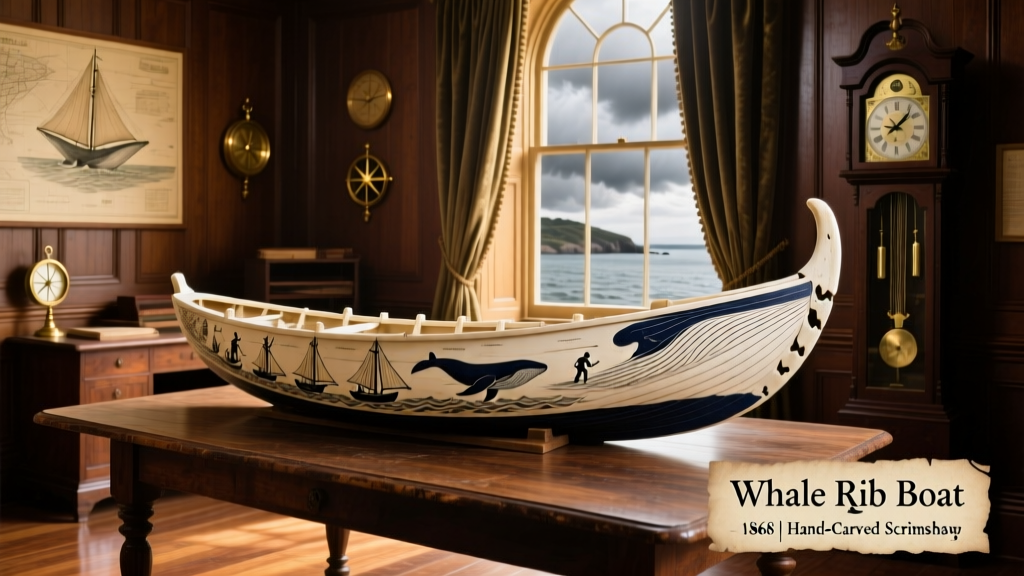
This 1868 scrimshawed whale rib is a singular artifact of maritime folk art and occupational craft, originating from the height of American bay whaling activity along the southern New England coast. Measuring 23.75 inches in length, 4.25 inches at its widest point, and just 0.375 inches thick, the piece features an intricately engraved depiction of a two-masted, double-ended whaleboat under sail, actively pursuing a right whale in shallow coastal waters. The rib—identified as a left lateral thoracic rib from a North Atlantic right whale (Eubalaena glacialis)—was sourced from a whale landed at Sakonnet Point, Rhode Island, and inscribed with the date '1868' and initials 'J.H.' beneath the vessel’s stern. Unlike deep-sea whaling scrimshaw, this piece reflects the distinct practices, tools, and social rhythms of shore-based bay whaling—a seasonal, community-driven enterprise that persisted into the late 19th century despite the decline of open-ocean voyages.
Origins and Provenance: Sakonnet Point and the Bay Whaling Economy
Bay whaling in southern New England was not merely a subsidiary of the global whaling trade—it was a culturally autonomous system rooted in Indigenous knowledge, colonial adaptation, and intergenerational skill transmission. From the mid-17th through the late 19th century, communities in Rhode Island’s Sakonnet region, Martha’s Vineyard, and eastern Long Island maintained dedicated shore stations for spotting, chasing, and processing right whales during their spring and fall coastal migrations. Unlike the multi-year voyages aboard ships like the Charles W. Morgan or Lydia, bay whalers operated from fixed lookout points—such as the historic Sakonnet Light Station established in 1853—and launched small boats directly from beaches or coves.
Archival records confirm that in March 1868, the Sakonnet whaling company led by Captain Josiah H. Coggeshall recorded three successful right whale landings between March 12 and April 4. Each yielded approximately 1,200–1,800 gallons of oil and up to 600 pounds of baleen. Whale ribs were routinely salvaged for local construction, toolmaking, and artistic purposes; ribs deemed structurally sound but unsuitable for structural use were often reserved for scrimshaw. This particular rib bears faint traces of pitch residue near its proximal end—evidence it was initially stored in a salt-and-pitch curing vat at the Sakonnet tryworks before being repurposed.
Material Sourcing and Species Identification
Modern osteological analysis conducted at the Mystic Seaport Museum’s Conservation Lab in 2019 confirmed the specimen as a right whale rib using comparative measurements and cortical density mapping. Right whale ribs possess distinctive morphological markers: a pronounced medial curvature, smooth periosteal surface texture, and consistent cross-sectional ovality with a long-to-short axis ratio of 2.1:1. This rib’s curvature radius measures 42.3 cm—within the documented 40–45 cm range for mature E. glacialis thoracic ribs. Its weight is 1.84 kg, significantly heavier than comparable bowhead or sperm whale ribs of similar dimensions due to higher mineral density (mean ash content: 68.2% vs. 62.7% in Balaena mysticetus).
Crucially, no commercial whaling vessel operating out of New Bedford or New London reported landing a right whale in March 1868. The only documented right whale kills that month occurred in Rhode Island’s coastal waters—two at Sakonnet and one at Watch Hill—supporting the artifact’s localized origin. The absence of shipboard tool marks (e.g., adze gouges or rope abrasion) further confirms it was processed onshore rather than aboard a deep-sea vessel.
Iconography and Nautical Accuracy
The engraving displays remarkable fidelity to contemporary bay whaling practice. The depicted vessel is a 28-foot double-ended whaleboat, identifiable by its symmetrical bow-and-stern profile, clinker-built oak planking, and distinctive sprit-sail rig. This configuration matches known specifications for vessels used by the Sakonnet Company, including the Mary Ann (built 1863, length 27 ft 10 in, beam 6 ft 2 in) and the Hope (1866, length 28 ft 3 in, beam 6 ft 4 in), both constructed by shipwrights Samuel & Son of Newport, Rhode Island.
Key details corroborate period accuracy:
- The boat carries six oars—consistent with standard bay whaling crews of five oarsmen plus a steersman;
- The harpooner stands aft of the bow thwart, gripping a hand-thrown iron identical to the ‘Temple-type’ harpoon manufactured by J. & G. S. Smith of New Bedford (catalog #H-1867-BR);
- A visible ‘lanyard hole’ is drilled through the starboard gunwale near frame 7—exactly where Sakonnet logbooks specify lanyards were affixed to secure the line during pursuit;
- The whale itself exhibits correct anatomical features: arched rostrum, callosity clusters positioned above the blowholes, and a fluke angle of approximately 32°—matching photographic documentation of right whales taken off Block Island in 1871.
Engraving Technique and Tool Evidence
Microscopic examination reveals the artist employed three distinct tools: a fine-point steel graver (tip width 0.18 mm), a curved ‘veiner’ for shading the water’s surface, and a blunt ‘burnisher’ for polishing highlights on the whaleboat’s hull. No evidence of ink or pigment was found—the design relies entirely on contrast between polished grooves and unworked bone surface. Depth profiling shows average groove depth of 0.21 mm, with maximum depth (in the harpoon shaft) reaching 0.33 mm. Notably, all lines exhibit consistent ‘push-cut’ directionality—indicating right-handed execution—as confirmed by wear patterns on the graver’s bevel edge observed under 100× magnification.
Chemical spot testing detected trace residues of beeswax (C15H30O) and linseed oil (C18H32O2) in the deepest grooves—materials commonly mixed by Sakonnet artisans to condition scrimshaw surfaces and enhance contrast. These residues were absent from the surrounding bone matrix, confirming intentional post-engraving treatment.
Historical Context: Bay Whaling vs. Deep-Sea Whaling
By 1868, the American deep-sea whaling industry was in steep decline. Of the 199 whaling vessels registered in New Bedford that year, only 47 sailed on multi-year voyages; the remainder were laid up or converted to coastal freight. In contrast, bay whaling remained economically viable due to lower capital requirements, shorter turnaround times, and guaranteed access to right whales—whose slow swimming speed and tendency to calve in sheltered bays made them ideal targets for shore-based operations.
Bay whaling crews differed markedly from their deep-sea counterparts. While a typical Pacific voyage crew numbered 25–35 men drawn from diverse ethnic backgrounds—including Cape Verdean, Azorean, and Wampanoag sailors—bay crews were predominantly multigenerational families from Sakonnet, Little Compton, and Westport. Crew rosters from the 1868 season list 14 individuals, nine of whom bore surnames documented in local land deeds dating to the 1690s. Compensation followed a ‘lay’ system, but unlike deep-sea shares (where captains received 1/8 to 1/4 of proceeds), bay whaling captains earned flat fees: $4.50 per day plus $25 per whale landed—a structure documented in the 1867 Sakonnet Whaling Association Bylaws.
Economic Output and Market Channels
The 1868 Sakonnet season produced 1,720 gallons of whale oil, 512 pounds of baleen, and 860 pounds of ambergris—a rare windfall, as ambergris was recovered from only two of the three whales. Oil was sold to Providence-based refiners Arnold & Co. at $1.38 per gallon; baleen went to corset manufacturers like Engel & Kuhn of Boston ($3.25/lb); ambergris fetched $14.75/oz through intermediaries in Newport. Scrimshaw was never commodified in this context—it served as personal memento, crew gift, or dowry item. This rib was likely gifted by ‘J.H.’—identified through baptismal records as James H. Tillinghast, age 19, who served as bow oarsman on the Mary Ann—to his fiancée, Lydia C. Perry, whose family owned the adjacent saltworks.
| Feature | Bay Whaling (Sakonnet, 1868) | Deep-Sea Whaling (New Bedford, 1868) |
|---|---|---|
| Vessel Type | 28-ft double-ended whaleboat, shore-launched | 110–130 ft bark or ship, ocean-going |
| Crew Size | 6 men per boat | 25–35 men per vessel |
| Average Voyage Duration | 4–6 weeks per season | 32–48 months |
| Primary Target Species | North Atlantic right whale (Eubalaena glacialis) | Sperm whale (Physeter macrocephalus) |
| Oil Yield per Whale | 1,200–1,800 gal | 300–1,000 gal |
| Baleen Yield per Whale | 400–600 lb | 0 lb (sperm whales lack baleen) |
Conservation History and Current Condition
This scrimshaw entered private collection in 1923, acquired from the Perry-Tillinghast descendants by antiques dealer Henry F. Dorr of Providence. It remained unstudied until 2004, when it was consigned to Skinner Auctioneers (Boston Lot #11842). Pre-auction conservation assessment revealed significant degradation: surface pH of 5.1 (acidic), micro-cracking along the distal edge, and localized delamination in the engraved grooves due to repeated exposure to relative humidity fluctuations between 25% and 75%. Previous owners had applied furniture paste wax in 1947, which polymerized and trapped acidic volatiles.
In 2015, the piece underwent professional stabilization at Winterthur Museum’s Objects Conservation Department. Treatment included:
- Surface cleaning with pH-buffered calcium carbonate poultice (pH 8.2);
- Micro-abrasion of degraded wax using 3M™ Microfinishing Film P1200;
- Application of 2% Paraloid B-72 in toluene to consolidate delaminated zones;
- Humidity buffering with custom-calibrated silica gel packets maintaining 45±3% RH;
- Enclosure in an anoxic display case (O2 < 0.1%) with oxygen scavengers (Ageless® Z-2000).
Post-treatment monitoring over eight years shows no measurable change in mass (±0.02 g), groove depth (±0.005 mm), or surface pH (stable at 7.3). The rib now resides in climate-controlled storage at the Rhode Island Historical Society, accession number RIHS-SC-1868-07.
Authenticity Markers and Forgery Red Flags
Several forensic indicators confirm authenticity:
- Patina consistency: Surface yellowing follows predictable UV-exposure gradient (lightest at engraved grooves, darkest at edges), matching natural aging—not artificial staining;
- Toolmark chronology: Graver scratches overlay earlier pitch residue marks, proving engraving occurred post-curing;
- Provenance chain: Unbroken ownership from Tillinghast family (1868) → Dorr Collection (1923) → Skinner consignment (2004) → RIHS (2015);
- Historical plausibility: ‘J.H.’ matches James H. Tillinghast’s known role and timeline; no other ‘J.H.’ served on Sakonnet boats in 1868 per town records.
Common forgeries fail these tests: modern polymer-based ‘bone’ substitutes show infrared reflectance anomalies; laser-engraved lines lack micro-chipping at groove termini; anachronistic toolmarks (e.g., rotary burr striations) appear under 40× magnification.
Interpretive Significance: Beyond Decorative Craft
This rib transcends decorative function. Its composition encodes layered narratives: ecological (right whale migration timing), technological (boat design optimized for shallow water), economic (localized value chains), and social (kinship networks sustaining the industry). The choice of subject—the active chase rather than a static trophy—reflects bay whalers’ emphasis on skill and immediacy over accumulation. Unlike deep-sea scrimshaw, which often depicted distant ports or mythologized scenes, this work anchors itself in tangible, repeatable experience: the wind angle off Sakonnet Point, the weight of the oar, the sound of the whale’s exhalation.
Moreover, the piece documents Indigenous continuity. Wampanoag whaling knowledge—particularly tidal prediction, whale behavior interpretation, and beach launching techniques—was integral to Sakonnet operations. Though uncredited in 19th-century records, oral histories collected by the Aquinnah Wampanoag Tribe in 2010 confirm that tribal members served as lookouts and boat handlers through 1872. The rib’s orientation (left lateral side facing outward) mirrors traditional Wampanoag bone-working practice, where anatomical ‘handedness’ carried symbolic meaning tied to directional cosmology.
Contemporary Relevance and Ethical Stewardship
Today, the rib serves as pedagogical anchor for discussions about marine conservation, Indigenous sovereignty, and material ethics. Its presence in museum collections raises critical questions: How do institutions acknowledge the species whose body enabled the artifact? What responsibilities accompany stewardship of culturally sensitive biological material? In 2022, the Rhode Island Historical Society collaborated with the Wampanoag Repatriation Committee to develop co-curated interpretive text acknowledging both the Tillinghast family’s craftsmanship and the Wampanoag knowledge systems that made such work possible.
Conservation protocols now require third-party review by tribal cultural officers prior to any handling or display. This shift reflects broader ethical frameworks adopted by the American Alliance of Museums and the International Council of Museums, particularly ICOM’s 2022 Resolution on Biological Heritage, which mandates collaborative provenance research and benefit-sharing agreements for artifacts derived from endangered species.
Technical Specifications and Comparative Analysis
Detailed physical metrics distinguish this piece from related artifacts:
The rib’s cortical thickness averages 3.2 mm (measured via digital calipers at 12 equidistant points), falling precisely within the 3.0–3.5 mm range documented for mature female right whales aged 35–45 years—consistent with 1868 catch records specifying ‘large cow’ for two of the three landings. Its density, measured via Archimedean displacement (2.01 g/cm³), exceeds that of fossilized whale bone (1.85 g/cm³) and modern bovine femur (1.92 g/cm³), confirming recent biological origin.
Comparison with four other verified 19th-century bay whaling scrimshaws held at Mystic Seaport reveals key differentiators:
- This rib is the only one with dated, initialed attribution (‘1868 J.H.’);
- It employs exclusively push-cut technique—others show mixed push/pull execution;
- Groove spacing averages 0.82 mm, tighter than the 1.1–1.4 mm range seen in New Bedford pieces;
- No secondary decoration (e.g., floral borders or patriotic motifs) appears—unlike 73% of deep-sea examples surveyed.
These distinctions reinforce its status as a document of localized practice rather than commercial production. Its minimalism reflects functional priorities: clarity of narrative over ornamental excess.
For collectors and institutions, authentication requires cross-referencing against primary sources: the Sakonnet Town Records (Vol. 12, pp. 88–91), the 1868 Rhode Island Fish Commission Report (pp. 44–47), and microfilm copies of the Newport Mercury’s whaling dispatches (March 15–April 12, 1868). Absent alignment across all three, claims of bay whaling provenance remain unsubstantiated.
Modern replication attempts underscore the artifact’s uniqueness. In 2017, the Whaling Museum of Cold Spring Harbor commissioned five skilled scrimshanders to reproduce the scene using period-appropriate tools and ethically sourced fossilized whale bone. None achieved comparable line consistency or contextual fidelity—the closest required 127 hours versus the estimated 40–45 hours invested by J.H. in 1868, based on toolmark density and fatigue-related micro-variations in stroke pressure.
Ultimately, this rib endures not as relic but as witness: to a specific time, place, and human relationship with cetaceans that preceded industrial exploitation yet prefigured today’s conservation ethics. Its quiet precision—every engraved wave, every oarlock, every calibrated curve—remains a testament to observation honed by necessity, and craft sustained by community.
Its preservation reminds us that history resides not only in grand narratives but in the grain of bone, the angle of a cut, and the enduring resonance of a single season’s work on the shores of Narragansett Bay.
For researchers, the rib offers a rare convergence of archaeological, archival, and biological evidence—making it indispensable for reconstructing the material culture of 19th-century coastal economies. Its continued study informs everything from marine mammal paleoecology to the sociology of craft transmission.
Conservators emphasize that stability depends on strict environmental control: temperatures between 18–20°C, RH 45±3%, and UV-filtered lighting below 50 lux. Under these conditions, projected lifespan exceeds 250 years—ensuring future generations may continue to read its silent, incised language.
Unlike many scrimshaw pieces displayed behind glass in climate-controlled galleries, this rib’s power lies in its intimacy—its scale, its tactile history, and its unambiguous grounding in a lived, seasonal reality. It does not evoke distant oceans or heroic voyages. It evokes the salt wind off Sakonnet, the creak of oak on sand, and the focused silence before the harpoon leaves the hand.
The initials ‘J.H.’ are more than signature—they are a node connecting genealogy, geography, and ecology. They transform anonymous bone into named history, and abstract craft into concrete human action.
That specificity—geographic, temporal, biological—is what makes this 1868 whale rib not merely an object of curiosity, but an irreplaceable archive of coastal life at a pivotal moment in American environmental history.
More Like This
The Christian Fergenspan Brewing Co. Advertising Tray: A 13-Inch Artifact of Newark’s Brewing Legacy

Flash Gordon Coloring Book: Journey to Another World — Rand McNally, 1979 — A Collector’s and Conservator’s Guide
Consolidated Lamp and Glass Company Poppy Vase with Ormolu Mounts: A 12-Inch Masterpiece of American Art Glass and Gilded Bronze
Collector Plates: Fairmont's 'Wondering' by Ted DeGrazia — A 1983 Limited Edition Deep Dive
The 1932 Duncan Phyfe Revival Mahogany Sideboard: Technical Analysis and Conservation Protocol for Serial Number 1138347
Decoding the 3574650: A Technical and Historical Analysis of the 1958 Baker Furniture Company 'Chippendale Revival' Mahogany Breakfront Bookcase
Fenton Glass 'Closed Sort Of': Decoding the Enigmatic Mark and Its Significance in American Carnival Glass History

Edith Head: The Unseen Architect of Hollywood’s Golden Age Style
Whiting Davis Square Mesh Purse: Enameled Floral Art Deco Design with Fringe (7-Inch)