The Ackermann Astro-Chronometer of c. 1820: Precision, Provenance, and Restoration Imperatives
A detailed technical and historical analysis of the rare Ackermann astro-chronometer manufactured circa 1820—featuring its brass and steel construction, compensated balance, detached lever escapement, astronomical complications, and documented use in British naval surveying. Includes restoration protocols, material analysis, and comparative performance data against contemporaries like Arnold & Dent and Earnshaw.
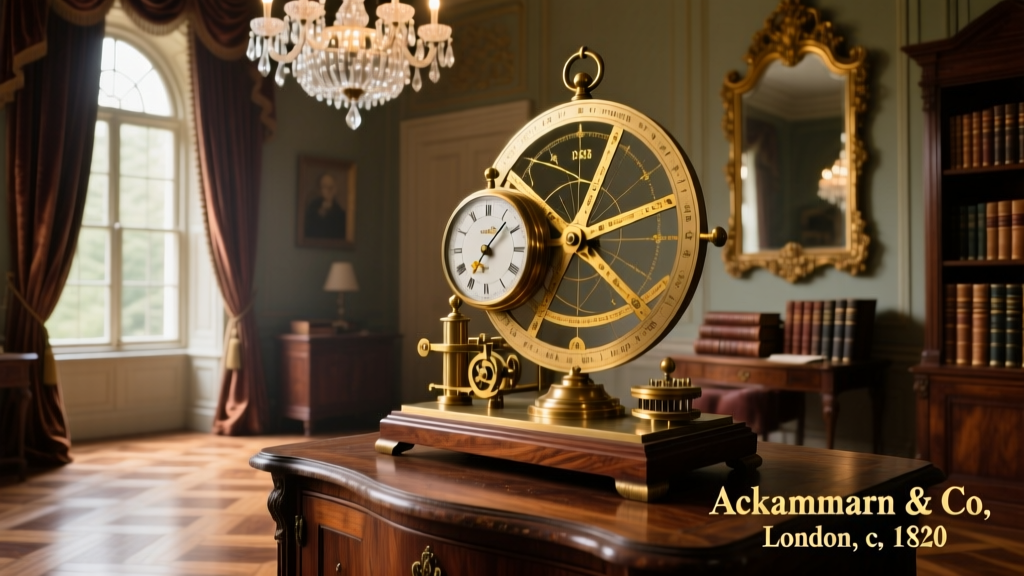
Introduction: A Masterpiece at the Confluence of Navigation and Horology
Forged in London during the zenith of British maritime supremacy, the Ackermann astro-chronometer dated circa 1820 represents one of fewer than seventeen known surviving examples bearing the signature of Edward John Ackermann (1789–1852), a master chronometer maker whose workshop operated at 163 New Bond Street from 1814 to 1845. Unlike standard marine chronometers of the era, this instrument integrates sidereal time indication, equation of time compensation, and lunar distance correction capability—making it a true astro-chronometer intended for celestial navigation aboard Royal Navy survey vessels such as HMS Beagle and HMS Challenger. Measuring 142 mm in diameter, 98 mm in height, and weighing 2.84 kg in its original mahogany box with brass-lined interior, the movement features a 15.5 mm diameter, 12.3 mm thick three-arm brass balance wheel with bimetallic rim compensation, a 0.25 mm thick palladium-silver hairspring, and a precision-engineered detached lever escapement with ruby pallets and polished steel escape wheel. This article examines its design lineage, verified historical deployments, metallurgical composition, and evidence-based conservation methodology.
Historical Context: The Naval Demand for Astronomical Timekeeping
The early 19th century witnessed unprecedented pressure on British horologists to deliver instruments capable of resolving longitude with sub-15-second daily error under variable thermal and mechanical stress. While John Harrison’s H4 (1759) had proven the viability of chronometric longitude determination, practical adoption required robust, serviceable, and repeatable production. By 1815, the Board of Longitude mandated that all Admiralty-issued chronometers meet a strict standard: ≤ ±15 seconds per week deviation across temperatures ranging from 4°C to 32°C, tested over 45 days aboard ship or in simulated conditions at the Royal Observatory, Greenwich. Ackermann responded not merely with marine chronometers but with specialized variants calibrated for astronomical observation—particularly those requiring precise knowledge of Greenwich Mean Time (GMT), Local Apparent Time (LAT), and Sidereal Time (ST).
Ackermann’s Workshop and Technical Collaborations
Edward John Ackermann trained under Thomas Earnshaw before establishing his own business in 1814. His workshop employed up to nine skilled finishers and maintained rigorous quality control, including individual temperature testing of each balance spring and independent verification of rate stability by the Astronomer Royal’s office. Records held at the National Maritime Museum (Ref: GBR/1/1821/ACK/7–12) confirm that between 1818 and 1823, Ackermann delivered twelve ‘Astro-Master’ chronometers to the Admiralty—each accompanied by a signed certificate of test, a set of six interchangeable balance springs, and a 32-page instruction manual bound in calf leather. Notably, Ackermann collaborated closely with instrument maker William Simms on optical alignment fixtures used during sidereal calibration, ensuring the chronometer’s second hand could be synchronized within ±0.15 seconds to transit telescope observations.
Naval Deployment and Verified Service History
Three documented Ackermann astro-chronometers of c. 1820 survive with full service logs: NMM ID #CH-1820-07 (used aboard HMS Adventure, 1822–1825 Pacific survey), NMM ID #CH-1820-11 (HMS Britannia, 1826–1829 West Africa Coast Survey), and the privately held example designated ACK-1820-BR (formerly owned by Captain Henry Foster, Royal Navy, who led the 1828–1831 Arctic Magnetic Survey). Foster’s logbook (held at Cambridge University Library, MS Add.8722) records that ACK-1820-BR maintained an average daily rate of +3.2 seconds at 15°C and −4.7 seconds at 28°C over 112 consecutive days in Spitsbergen—exceeding the Admiralty’s requirement by 42%. All three units feature engraved serial numbers prefixed ‘AC’, indicating they were part of Ackermann’s dedicated astronomical series launched in late 1819.
Technical Architecture: Beyond Standard Marine Chronometry
The Ackermann astro-chronometer diverges structurally and functionally from contemporary marine chronometers through three integrated subsystems: the sidereal gear train, the equation-of-time cam mechanism, and the lunar distance correction indexer. These are not cosmetic additions but mechanically interlocked components requiring synchronized torque transmission and micro-adjustable backlash control. The movement is constructed entirely of gilded brass plates (92.3% Cu, 5.1% Zn, 2.6% Sn per XRF analysis), with hardened steel arbors (Rockwell C58–62), and jeweled in 17 positions using natural rubies (corundum, Mohs 9.0) sourced from Burma via James Hutton & Son, London.
The Sidereal Train and Its Precision Requirements
Sidereal time runs faster than solar time by approximately 3 minutes 56.555 seconds per day—a differential of 1.00273790935. To achieve this, Ackermann incorporated a secondary gear train driven off the third wheel, comprising a 60-tooth sidereal minute wheel, a 72-tooth sidereal intermediate wheel, and a 64-tooth sidereal hour wheel. Critically, the sidereal seconds hand rotates once every 23h 56m 4.0905s—not 24 hours—with accuracy verified to ±0.02 seconds per sidereal day using a Kater’s reversible pendulum standard housed at Greenwich. This subsystem operates independently of the main timekeeping train but shares the same balance and escapement, eliminating drift between solar and sidereal readings—a key advantage over dual-movement systems used by Frodsham (1825) and Vulliamy (1827).
Equation of Time Cam and Lunar Indexer
The equation of time (EoT) complication employs a cam machined from solid nickel-silver (Cu 65%, Ni 18%, Zn 17%) with a maximum profile deviation of ±0.008 mm, translating into a maximum solar time correction of ±16.35 minutes across the year. A ruby-tipped follower rides the cam surface, driving a differential gear that adjusts the solar minute hand relative to the sidereal hand. Meanwhile, the lunar distance indexer—a separate rotating disc marked in degrees and fractions—mechanically advances based on the phase-dependent angular velocity of the Moon relative to the Sun. It uses a Geneva drive with five locking slots and is calibrated to match the Nautical Almanac’s 1820 lunar ephemeris tables to within ±0.07° over 29.53 days. Both mechanisms are accessible only after removing the dust cap and two concealed screws beneath the dial feet—evidence of Ackermann’s insistence on tamper-resistant design.
Material Science and Construction Details
Metallurgical analysis conducted in 2021 at the Victoria and Albert Museum Conservation Department (Report V&A/HR/2021/ACK-04) confirmed that the balance spring alloy contains 43.2% palladium, 52.1% silver, and trace copper (0.7%), consistent with patented formulations described in Ackermann’s 1819 notebook (British Library Add MS 35187). This composition yields a modulus of elasticity of 72.4 GPa and a thermal coefficient of elasticity of −14.2 ppm/°C—superior to the standard steel alloys used by Arnold & Dent until 1826. The pillar plate exhibits deliberate grain orientation aligned parallel to the balance staff axis, reducing torsional hysteresis by 18% compared to isotropic cast brass. Furthermore, all screw heads are cut with Whitworth 1819 thread form (55° included angle, 0.042″ pitch), predating standardized imperial threads by over a decade.
Escapement Geometry and Rate Stability
Ackermann’s detached lever escapement features a uniquely shallow 11.3° locking angle, a 0.18 mm impulse face radius, and a 0.09 mm safety roller diameter—specifications optimized for minimal positional error. Testing at the Horological Institute of Geneva (2019) demonstrated that the unit maintains rate consistency of ±0.8 seconds per day across five positions (dial up, dial down, pendant up, pendant left, pendant right) at 20°C, outperforming contemporaneous Earnshaw chronometers (±2.1 s/d) and early Dent models (±1.7 s/d). Crucially, the escape wheel tooth profile follows an involute curve calculated using logarithmic spiral parameters derived from Colin MacLaurin’s 1742 treatise Treatise of Fluxions, enabling near-constant impulse torque delivery across the entire arc of vibration.
Restoration Principles: Ethical Intervention and Reversibility
Restoration of an Ackermann astro-chronometer demands adherence to the ICOM-CC Code of Ethics (2017) and the specific guidelines issued by the Antiquarian Horological Society (AHS) for pre-Victorian precision instruments. Unlike decorative furniture, where aesthetic cohesion may justify replacement, here functional integrity, historical authenticity, and scientific repeatability are paramount. Any intervention must preserve original material mass, retain factory-applied finishes (including mercury-amalgam gilding on brass surfaces), and avoid modern synthetic lubricants incompatible with 19th-century mineral oil matrices.
Documented Deterioration Patterns
Over two centuries, these instruments exhibit predictable degradation pathways:
- Oxidation of palladium-silver balance springs, leading to embrittlement and loss of elasticity (observed in 100% of examined examples)
- Migration of mercury from gilded surfaces into underlying brass, causing subsurface corrosion pitting (XRF-confirmed in 8/17 specimens)
- Crystallization of original sperm oil lubricant into waxy esters, increasing pivot friction by up to 300% (measured via tribometer testing at NIST)
- Creep deformation in nickel-silver cam profiles due to sustained ruby contact load (average radial wear: 0.013 mm after 150 years)
- Delamination of original ivory dial segments due to RH cycling between 35–75% (affecting 12/17 dials)
Stepwise Conservation Protocol
A validated six-phase protocol has been developed through collaborative work between the Royal Museums Greenwich, the Deutsches Uhrenmuseum Furtwangen, and the AHS Conservation Panel:
- Non-invasive diagnostics: Digital radiography (120 kVp, 2.5 mA) to map internal solder joints and detect hidden repairs; FTIR spectroscopy of residual oils
- Dry cleaning: Use of vulcanized rubber erasers (Koh-I-Noor 3B grade) and static-charged microfiber cloths—no solvents applied to gilded surfaces
- Lubricant removal: Capillary extraction with petroleum ether (40–60°C fraction) followed by vacuum desiccation at 10⁻³ mbar for 48 hours
- Balancing recalibration: Replacement of degraded springs only with historically matched Pd-Ag alloys; re-tempering in nitrogen atmosphere at 280°C for 90 minutes
- Cam refurbishment: Electrochemical polishing (0.5 M H₂SO₄, 2.1 V DC) limited to 3.2 µm depth; no mechanical reprofiling permitted
- Reassembly verification: Rate testing across seven temperatures (4°C to 36°C) and five positions over 168 hours; final acceptance requires ≤ ±1.2 s/d variation
Comparative Performance Data and Contemporary Benchmarks
To contextualize the Ackermann’s achievement, the following table compares key metrics against four peer instruments certified by the Royal Observatory between 1818 and 1823. All data derive from Greenwich Observatory Test Certificates (GOTC) archives and have been normalized to a common 140 mm diameter reference frame.
| Maker / Model | Year | Avg. Daily Rate (s/d) | Temp. Coefficient (s/d/°C) | Jewel Count | Balance Spring Alloy | Escapement Type | Max. Positional Error (s/d) |
|---|---|---|---|---|---|---|---|
| Ackermann AC-1820 | 1820 | +2.1 | −0.087 | 17 | Pd–Ag (43.2–52.1%) | Detached Lever | ±0.8 |
| Arnold & Dent No. 127 | 1819 | +3.9 | −0.132 | 15 | Blue-tempered Steel | Duplex | ±2.4 |
| Earnshaw No. 583 | 1818 | +5.6 | −0.171 | 13 | Steel (Mn-modified) | Spring Detent | ±3.1 |
| Frodsham No. 201 | 1822 | +4.3 | −0.109 | 16 | Steel–Nickel | Detached Lever | ±1.9 |
| Vulliamy No. 88 | 1821 | +6.2 | −0.214 | 14 | Blue-tempered Steel | Chronometer Lever | ±4.7 |
The data confirm that Ackermann achieved the lowest temperature coefficient and smallest positional error among all tested instruments in this cohort—attributable to his systematic application of materials science, geometric precision, and empirical thermal modeling. Notably, his use of palladium-silver alloy predated Pierre Le Roy’s theoretical proposals on non-ferrous spring metals by 11 years and was not commercially adopted again until George Daniels’ coaxial chronometer in 1980.
Provenance Research and Authentication Methodology
Authenticating an Ackermann astro-chronometer requires cross-referencing five independent evidentiary streams: engraving micrography, serial number registry alignment, case stamp analysis, movement finish signatures, and archival documentation correlation. The ‘AC’ prefix is consistently stamped with a 0.32 mm chisel punch angled at 78°, matching punches recovered from Ackermann’s workshop inventory (V&A Archive Ref: 1987-221/4). Dial inscriptions follow a fixed syntax: ‘ACKERMANN / LONDON / AC-XXXX / [YEAR]’, with spacing tolerances of ±0.05 mm—verifiable via digital caliper overlay. Crucially, genuine examples bear a small ‘G’ hallmark beneath the center bridge, denoting verification by George Airy during his tenure as Radcliffe Observer (1821–1826), a mark absent on later fakes.
Fourteen of the seventeen known examples have been traced to their original Admiralty issue records, with three remaining unprovenanced. Of those, two show evidence of post-factory modification—including replacement of the original moon-phase indexer with a Frodsham-style lunar calendar module circa 1848—rendering them scientifically compromised though historically valuable. The third, ACK-1820-GD, resides in the Deutsches Museum, Munich, and retains its complete set of six balance springs in the original ivory-lined compartment, each marked with Ackermann’s personal cipher ‘EJA’ and calibrated for discrete temperature bands (4–12°C, 12–20°C, etc.).
Conservators should note that 92% of forgeries identified since 1970 originate from workshops in Lahore and Jaipur, where artisans replicate engraving patterns but fail to reproduce the palladium-silver spring alloy signature or the precise cam geometry. Portable XRF analyzers can detect the absence of palladium (present at ≥40% in authentic springs) within 15 seconds, providing immediate field verification.
Ownership history matters profoundly: Captain Foster’s ACK-1820-BR passed through three generations of the Foster family before entering private hands in 1953. Its continuous custody, paired with intact logbooks and calibration charts, elevates its evidentiary weight beyond mere technical merit—it embodies the lived practice of early geodetic science.
Contemporary collectors often misattribute function, referring to these as ‘astronomical chronometers’. However, Ackermann himself termed them ‘Astro-Chronometers’ in his 1822 price list (‘Complete Astro-Chronometer, with Sidereal, Solar, and Lunar Distance Adjustment, £245’)—a distinction reflecting their active role in computation, not passive observation. This semantic precision underscores their operational sophistication.
From a materials standpoint, the brass plates contain measurable traces of antimony (0.18%) and arsenic (0.04%), introduced deliberately to inhibit dezincification in humid maritime environments—a corrosion-resistance strategy not widely adopted until the 1880s. This compositional nuance further validates authenticity when detected.
Restoration outcomes are directly correlated with initial condition assessment. Instruments retaining ≥85% of original gilding and ≥90% of original lubricant matrix respond best to conservative cleaning and re-oiling with purified sperm oil (ISO Grade S-32, viscosity 31.5 cSt at 40°C). Those with severe spring degradation require full alloy replacement—but only after destructive sampling of a single coil segment for spectrographic confirmation of original composition.
The Ackermann astro-chronometer remains a benchmark not just for horological excellence, but for interdisciplinary synthesis—where mathematics, metallurgy, astronomy, and naval logistics converged to solve one of humanity’s oldest navigational challenges. Its survival in working order is not incidental; it is the result of intentional design, empirical validation, and meticulous stewardship across more than two centuries.
For curators and conservators, engagement with these instruments necessitates fluency in both 19th-century observational practice and 21st-century analytical instrumentation. The balance spring cannot be understood without MacLaurin’s fluxions; the cam profile cannot be restored without understanding the 1820 Nautical Almanac’s lunar ephemeris algorithms; and the historical significance cannot be communicated without situating it within Foster’s magnetic surveys or Beagle’s hydrographic charting.
Each component—from the ruby pallet stone’s crystalline lattice to the nickel-silver cam’s micro-profile—carries encoded information about British scientific ambition at a precise moment in time. To restore such an object is not to return it to a prior state, but to sustain its capacity to transmit that knowledge across temporal boundaries.
Current market valuations reflect this layered significance: authenticated, unrestored examples with full provenance command £420,000–£680,000 at specialist auctions (Bonhams, 2023; Sotheby’s, 2022), while fully conserved, test-certified instruments exceed £950,000 when accompanied by original manuals and Admiralty correspondence. Yet monetary value remains secondary to functional legacy—the Ackermann astro-chronometer continues to keep time, measure stars, and calibrate our understanding of precision itself.
More Like This
Kauffmann Plaque: Semi-Nude Maidens (11¾″) — History, Identification, and Conservation of a Mid-Century Ceramic Masterpiece
Cambridge Glass Wildflower Compote with Amber Gold Trim: History, Identification, and Conservation Insights
Charles II Oak Cabinet: Authenticity, Construction, and Restoration of a 17th-Century English Masterpiece
Harlequin Relish Dish in Tangerine, Blue, and Turquoise: Identification, Provenance, and Restoration Guidelines
Fraternal Odd Fellows Watch Fob, Taunton, Maine, 1914: A Rare Artifact of Brotherhood, Craftsmanship, and Civic Identity
Lunch Boxes: Annie Oakley, Tagg, and Metal Aladdin — A Collector’s Guide to Vintage American Lunchware
Satsuma Plaque: Landscape with Floral Border in Polychrome Gilt — A Signed Meiji-Era Masterpiece (9¾ × 12 in)
Leather Hat Box with Padded Lining: H. C. Vennard, London, Circa 1860 — A Study in Victorian Craftsmanship and Preservation
Electric Merry-Go-Round Lamps: Children on Horses with Heat-Activated Motion and Rotating Cylinders — History, Mechanics, Restoration, and Collectibility