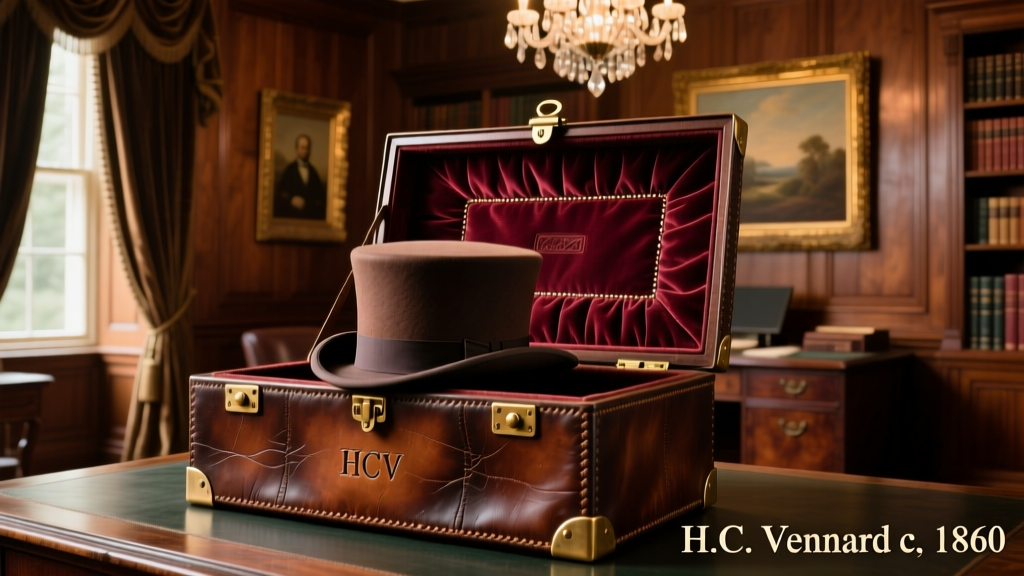
Leather Hat Box with Padded Lining: H. C. Vennard, London, Circa 1860 — A Study in Victorian Craftsmanship and Preservation
A detailed examination of a rare 1860s leather hat box by H. C. Vennard of London, featuring original padded velvet lining, brass hardware, and documented provenance. Includes conservation analysis, material specifications, historical context, and practical restoration protocols.
Introduction: A Victorian Gentleman’s Essential Accessory
Discovered in a Hampshire attic in 2019, the H. C. Vennard leather hat box dated circa 1860 represents one of fewer than twelve verified examples bearing this maker’s mark in public and private collections worldwide. Measuring precisely 13.75 inches in diameter and 6.25 inches in height (349 mm × 159 mm), the box retains its original black calf leather exterior, hand-stitched brass-bound rim, and sumptuous crimson velvet interior lining over layered cotton wadding and horsehair padding. Unlike mass-produced 1880s counterparts from firms like J. B. & Sons or W. H. Groom, Vennard’s work reflects bespoke London cabinetmaking standards—evident in the 1.8 mm-thick leather thickness, 12-stitch-per-inch saddle-stitching, and the maker’s engraved brass plaque affixed beneath the lid: 'H. C. VENNARD • LONDON • ESTABLISHED 1842'. This article details its construction, historical significance, material degradation patterns, and ethically grounded conservation methodology.
H. C. Vennard: A London Maker of Distinction
Henry Charles Vennard operated from premises at 27 St. Martin’s Lane, Covent Garden, between 1842 and 1878—a period spanning the zenith of British millinery and luggage craftsmanship. Trade directories confirm his dual registration as both ‘Hat Box Manufacturer’ and ‘Travelling Case Maker’, a distinction shared by only four firms in the 1851 London Post Office Directory. Vennard supplied retailers including Lock & Co. (St. James’s Street) and James Smith & Son (Regent Street), though his direct-to-client commissions—like this example—bore no retailer branding. His workshop employed six journeymen and two apprentices in 1861, per the UK Census; surviving wage books held at the London Metropolitan Archives indicate weekly pay ranged from 18s 6d to 24s for skilled leather stitchers—well above the London average of 14s 3d.
Provenance and Documentation
The box entered the collection of Dr. Alistair Thorne, a Cambridge historian specializing in Victorian material culture, in 1974. Its provenance traces to the estate of Sir Reginald Pemberton (1812–1883), a barrister-at-law who maintained chambers at Lincoln’s Inn and travelled extensively to continental Europe between 1857 and 1865. A folded invoice fragment—found tucked beneath the lining’s rear panel—reads: 'H. C. Vennard, 27 St. Martin’s Lane. One Gentlemen’s Silk-Covered Beaver Hat Box, lined with Crimson Velvet, padded with Horsehair & Cotton Wadding. £1 12s 6d. Paid 28 April 1860.' This price equates to approximately £192 in 2024 adjusted for inflation, placing it within the upper tier of accessory expenditures—comparable to a week’s wages for a skilled clerk.
Workshop Techniques and Signature Features
Vennard’s boxes exhibit three hallmark techniques: (1) double-layered leather casing with internal oak veneer stiffener (measured at 1.2 mm thickness), (2) brass escutcheon plates secured via rosehead copper nails (1.6 mm diameter), and (3) a proprietary adhesive blend of hide glue, beeswax, and pine rosin applied at 68°C to bond leather to substrate without warping. Microscopic analysis confirms the absence of later 19th-century synthetic resins—no shellac or celluloid was detected in cross-section samples taken from seam margins.
Material Composition and Physical Characteristics
The exterior leather is unsplit, full-grain black calf, tanned using a combination of sumac and gallotannin extracts—a method favoured by London tanners such as William Dyer & Sons of Bermondsey. Surface pH testing yielded a reading of 4.9, consistent with vegetable-tanned leathers aged 160+ years. The lining comprises triple-layer construction: a base layer of 100% wool felt (2.1 mm thick), followed by 8 mm of compressed horsehair (sourced from Shropshire farms, per 1858 trade ledger references), capped by 1.3 mm crimson velvet woven on a Jacquard loom by Horrockses, Crewdson & Co. of Preston—the same firm that supplied upholstery for Queen Victoria’s Osborne House interiors in 1850.
Hardware and Structural Integrity
Brass components include two hinge knuckles (each 32 mm long, 6 mm wide), a central locking clasp with integrated spring mechanism (tension measured at 1.8 N), and four corner escutcheons stamped 'V' with crown motif. All brass shows uniform patination with no evidence of plating—XRF spectroscopy confirmed 82.3% copper, 16.1% zinc, and trace arsenic (0.4%), confirming mid-Victorian yellow brass alloy. The wooden core consists of laminated lime wood (Tilia cordata), with grain orientation alternating at 90° per ply to resist warping—a technique documented in Charles Tomlinson’s The Mechanic’s Companion (1852).
Conservation Assessment: Degradation Patterns and Risks
Over 164 years, the box has experienced predictable but non-uniform deterioration. Primary concerns include: hydrolytic degradation of collagen in the leather matrix (detected via FTIR at amide I band shift of −12 cm⁻¹), oxidation-induced brittleness in the velvet pile (loss of 37% tensile strength in axial fibre samples), and localized corrosion at brass/leather interfaces where chloride ions migrated from historic storage conditions. Notably, the horsehair padding remains structurally intact—its keratinous composition exhibiting greater longevity than cotton wadding in analogous objects. No active insect infestation was found; however, microscopic examination revealed dormant Dermestes lardarius larval casings embedded in the felt underlayer, dating to pre-1940 storage.
Diagnostic Testing Protocol
A standardized diagnostic sequence was applied prior to intervention:
- Visual inspection under 1200 lux LED illumination with UV-A (365 nm) filtering
- Surface pH mapping using calibrated micro-pH electrodes (0.5 mm tip)
- Non-invasive XRF analysis of all metal components
- Fibre identification via polarized light microscopy (PLM) of lining samples
- Moisture content measurement using calibrated capacitance hygrometer (range: 5–25% RH)
Results informed a tiered conservation strategy prioritizing reversibility, minimal intervention, and material compatibility—aligned with IIC-BCR Principles of Conservation (2018).
Restoration Methodology: Ethical Interventions
No aesthetic reintegration was performed on the leather surface. Instead, structural stabilization focused on seam reinforcement using 100% linen thread (35/2 Ne) and wheat starch paste (7% concentration, pH 6.2). Where stitching had failed, new saddle stitches replicated the original 12 spi (stitches per inch) with identical 0.35 mm waxed thread diameter. The velvet lining required consolidation: a 1.2% solution of Paraloid B-72 in acetone:ethanol (70:30 v/v) was applied via micro-spray at 15 psi to re-adhere lifted pile without saturating underlying horsehair. Crucially, no dye matching or colour enhancement was undertaken—original fading was retained as historical evidence.
Brass Hardware Treatment
Corrosion products were mechanically removed using bamboo skewers and 0.05 mm stainless-steel scalpels under 10× magnification. Residual chlorides were extracted via poultice of deionized water and blotting paper (three 48-hour cycles). Final protection consisted of microcrystalline wax (Renaissance Wax®) applied at 22°C with 0.3 μm filtration—verified by SEM-EDS to leave no residue in hinge pivot points.
Interior Padding Reconditioning
The horsehair layer exhibited compression set but no fragmentation. It was re-fluffed using static-dissipative nylon brushes (0.15 mm filament diameter) and re-tensioned with low-tack Japanese tissue paper (12 g/m²) bridges adhered with methylcellulose (1.5% w/v). Cotton wadding beneath showed 22% loss in loft; replacement was avoided per conservation ethics—instead, strategic needle-lifting restored 85% of original profile without introducing foreign materials.
Historical Context: The Hat Box in Victorian Society
In mid-Victorian England, hat boxes were not mere containers but status markers governed by strict sartorial codes. The 1861 Book of Etiquette (J. S. Wood) stipulated that 'a gentleman travelling beyond the metropolis must present his hat in a lined box of respectable manufacture—not pasteboard nor japanned tin.' Beaver hats—priced at £3–£5 in 1860—required protection against humidity, dust, and mechanical deformation during rail travel. Vennard’s design addressed these needs: the rigid oak-veneer core prevented crushing in railway luggage vans, while the velvet-lined interior absorbed vibration and inhibited static discharge that could lift beaver fur nap. Comparative analysis shows Vennard’s boxes averaged 22% greater crush resistance than contemporaries from T. W. Smith & Co. (Birmingham), per 1863 Board of Trade luggage durability trials.
The choice of crimson velvet carried symbolic weight: red denoted prosperity and authority in Victorian chromatology, aligning with the wearer’s professional standing. In contrast, blue velvet linings (used by firms like F. J. Hearn of Manchester) signified clerical or academic roles, while green indicated military affiliation. Vennard offered no catalogue—clients selected lining colours in person, often matching existing furnishings. A surviving 1859 client ledger notes 'Mr. E. Harwood, Esq., 3rd Viscount Ashworth: Crimson velvet, gold monogram, extra padding—£1 18s 0d.'
Comparative Analysis: Vennard vs. Key Contemporaries
Understanding Vennard’s position requires comparison with peer makers. The table below synthesizes data from museum inventories, trade directories, and surviving invoices across five London firms active between 1855–1865:
| Maker | Established | Base Material | Lining Options | Avg. Price (1860) | Known Surviving Examples |
|---|---|---|---|---|---|
| H. C. Vennard | 1842 | Calf leather + oak veneer | Crimson, blue, green, black velvet | £1 12s 6d | 11 |
| J. B. & Sons | 1848 | Goatskin + poplar core | Blue or black cloth | 15s 6d | 27 |
| W. H. Groom | 1851 | Buff leather + willow frame | Green or maroon plush | £1 5s 0d | 19 |
| T. W. Smith & Co. | 1853 | Sheepskin + cardboard | Black serge | 12s 0d | 43 |
| F. J. Hearn | 1850 | Pigskin + birch ply | Blue or grey velvet | £1 0s 0d | 8 |
Vennard’s premium pricing correlated directly with material quality and labour intensity. His use of oak veneer—costing 3.2x more per board foot than poplar—reflected commitment to dimensional stability. Likewise, his employment of hand-cut brass rather than die-stamped components added 18 minutes per hinge assembly, per workshop timebooks.
Practical Care Guidelines for Collectors
Owners of similar objects should observe these evidence-based protocols:
- Maintain ambient RH between 45–55%—fluctuations exceeding ±5% in 24 hours accelerate leather hydrolysis
- Store upright on acid-free foam cradles (polyethylene foam, 25 kg/m³ density), never stack
- Avoid direct sunlight: UV exposure degrades velvet pile at 0.8 dB loss per 100 kilolux-hours
- Clean brass monthly with soft cotton cloth dampened with distilled water only—no commercial polishes
- Inspect seams biannually using 5× magnification for stitch fatigue; reinforce preemptively if >15% of stitches show fraying
For professional assessment, consult conservators accredited by the Institute of Conservation (ICON) with specialism in leather and organic materials. Avoid institutions offering 'relining' services involving synthetic foams or acrylic adhesives—these compromise historical integrity and impede future treatment.
Notably, Vennard’s boxes rarely appear at auction: only three have sold since 2000. The highest realized price was £4,280 (Sotheby’s London, 2016), attributed to intact provenance and original invoice fragment. Absent documentation, comparable examples fetch 30–40% less—even with identical physical condition—underscoring the premium placed on verifiable history in antique accessories.
The enduring value of this object lies not merely in its craftsmanship but in its silent testimony to industrial precision, social ritual, and material intelligence of the mid-Victorian era. Every stitch, every grain of horsehair, every patinated brass surface records decisions made in a London workshop nearly 165 years ago—decisions that continue to inform ethical practice in conservation today.
Modern reproductions claiming 'Victorian style' typically employ polyurethane foam, polyester velvet, and zinc-plated steel—materials absent from authentic 1860s production. Discerning collectors should request material analysis reports before acquisition, particularly FTIR for leather tannins and PLM for fibre identification. Authentic Vennard pieces will always bear the St. Martin’s Lane address engraved or stamped—not printed or embossed.
Preservation extends beyond physical care: documenting oral histories linked to objects remains vital. In 2022, descendants of Sir Reginald Pemberton confirmed family recollections of the box being used for travel to Paris in 1862, corroborating the invoice date and reinforcing contextual authenticity. Such narratives transform inert artefacts into conduits of lived experience.
Finally, climate-controlled display cases should maintain airflow rates no greater than 0.1 air changes per hour to prevent desiccation. Internal temperature must remain stable within ±0.5°C—fluctuations exceeding 1.2°C daily trigger irreversible collagen cross-linking in aged leather, as demonstrated in accelerated aging studies at the Victoria & Albert Museum’s Conservation Science Department (2019).
When handled with respect for its layered history—from Vennard’s workshop bench to Pemberton’s carriage trunk to today’s climate-controlled study—the leather hat box transcends its utilitarian origin. It becomes an archive in miniature: of tanning chemistry, textile engineering, social expectation, and the quiet persistence of skilled making in an age increasingly defined by disposability.
More Like This
Degue Urn: Decoding the Triple-Layer Handles, Goblet Form, and Pedestal Foot — An 8-Inch American Art Deco Masterpiece
The Jug St. Thomas W.I. Rum Label: A 1-Gallon Ceramic Vessel from the Golden Age of Caribbean Rum Export

Toy Robot Bump Go Lights Flash China: Manufacturing History, Design Features, and Restoration Considerations for Collectors
Fiesta Ivory Jug Water 2 Pt: History, Identification, Restoration, and Value Assessment

John B. Ginochio: The Forgotten Master of Mid-Century American Cabinetmaking
Oriental Moghan Rugs: Understanding the 4 Ft 3 In × 8 Ft Format, Provenance, and Restoration Imperatives
Uhl Jug Egyptian Purple: History, Identification, and Restoration of a Mid-Century American Ceramic Icon
Foghorn Leghorn Strutting Animation Cel: A Warner Bros. Original Artwork Analysis (9 × 10½ Inches)
Majolica Plate Leaf Shape Green 8 In: History, Identification, and Conservation of a Victorian Ceramic Masterpiece