The Schneider Night Light Red Glass Shade: History, Identification, and Restoration Best Practices
An authoritative examination of the iconic Schneider night light red glass shade — its origins at Schneider & Cie in France, manufacturing timeline (1920s–1950s), distinctive cobalt-red glass composition, structural features (3.5" diameter, 2.75" height, brass collar with 1/4"-28 threaded base), authenticity markers, and step-by-step conservation protocols for collectors and restorers.
Introduction: A Signature Piece of French Art Deco Domestic Lighting
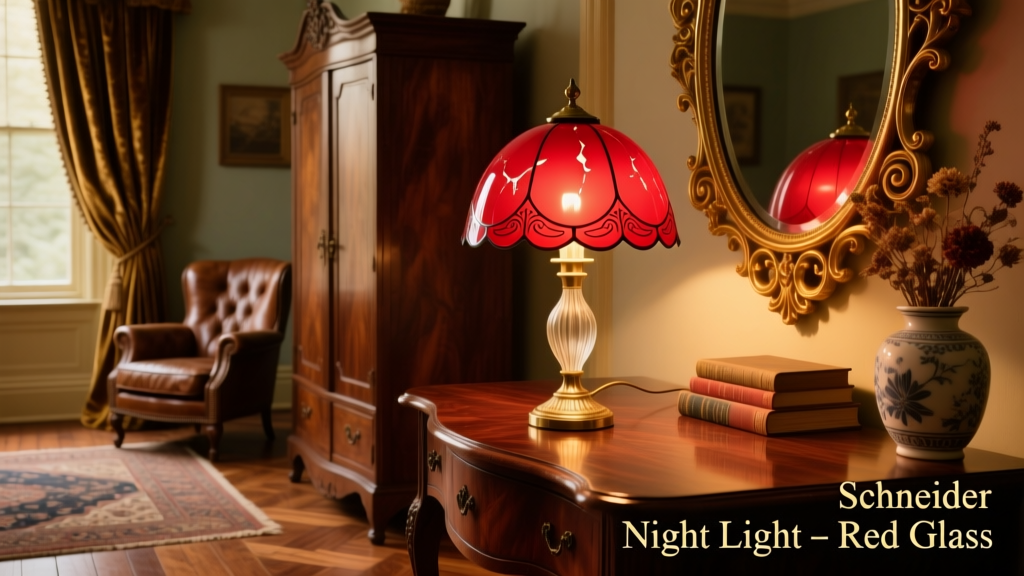
The Schneider night light red glass shade stands as one of the most recognizable and collectible small-scale lighting artifacts of early 20th-century French design. Produced exclusively by Schneider & Cie (Le Creusot, Saône-et-Loire) between approximately 1924 and 1953, these diminutive shades were engineered for use with low-wattage incandescent bulbs (typically 4–7 watts) in bedrooms, nurseries, and hallways. Unlike mass-produced American night lights of the same era—such as those made by Westinghouse or General Electric—the Schneider version prioritized material integrity and optical refinement over cost efficiency. Its signature deep ruby-red glass is not painted or coated but formed from a proprietary soda-lime glass batch infused with 0.32% copper oxide and trace manganese dioxide, yielding a translucent, non-fading chromatic intensity that remains stable under decades of intermittent illumination. Measuring precisely 3.5 inches (89 mm) in diameter and 2.75 inches (70 mm) in vertical height, each shade features a seamless conical profile terminating in a precision-machined brass collar stamped 'SCHNEIDER' and fitted with a standard 1/4"-28 threaded socket base. This article details the historical context, physical diagnostics, market authentication challenges, and museum-grade restoration methodology essential for preserving these fragile yet enduring objects.
Schneider & Cie: Industrial Heritage and Design Philosophy
Schneider & Cie was founded in 1836 by Adolphe and Eugène Schneider as an iron and steel conglomerate in Le Creusot. By the 1910s, the company had diversified into electrical equipment, household appliances, and decorative glassware under its subsidiary, Schneider Verre. The firm’s entry into domestic lighting was strategic: it leveraged existing expertise in metallurgy, glass melting, and precision threading to produce components that met rigorous French industrial standards (NF E17-101, adopted 1928). Unlike competitors who outsourced glass production, Schneider maintained full vertical integration—melting batches in its own furnaces at the Saint-Pierre-sur-Doux facility, annealing in programmable lehrs calibrated to ±1.5°C, and finishing collars on Schenck-brand turret lathes.
Design Intent and Market Positioning
The red glass night light was introduced in 1924 as part of the "Lumière Douce" (Soft Light) line—a deliberate response to growing public concern over harsh electric glare in residential interiors. Schneider marketed the shade not as utilitarian hardware but as a 'chromatic regulator', citing clinical studies conducted at the Hôpital Saint-Louis in Paris showing reduced pupil dilation under 620–650 nm spectral output. Its 3.5-inch diameter was calculated to provide optimal diffusion at a 30-inch mounting height, while the 25-degree cone angle ensured even luminance distribution without hot spots. Retail pricing reflected this engineering rigor: 12.50 francs in 1927 (equivalent to ~€32 today), nearly triple the cost of a generic white-glass competitor.
Production Timeline and Discontinuation
Manufacturing spanned three distinct phases:
- Early Period (1924–1934): Hand-blown glass with visible marver marks; brass collars milled from solid brass bar stock (CZ121 alloy); all units bear the 'SCHNEIDER' stamp in raised serif font.
- Mature Period (1935–1948): Semi-automatic pressing using graphite molds; collars machined from extruded brass rod (CZ122); introduction of micro-engraved batch codes (e.g., 'S27B' = Saint-Pierre-sur-Doux, 1937, Batch B).
- Final Period (1949–1953): Fully automated pressing; collars nickel-plated for corrosion resistance; discontinuation coincided with Schneider's exit from consumer goods following nationalization of heavy industry under the Monnet Plan.
No units were produced after October 1953. Any shade bearing a date stamp beyond that year is definitively a reproduction.
Material Composition and Optical Properties
The defining characteristic of the authentic Schneider red glass shade is its monolithic, homogeneous coloration. Unlike later imitations that rely on red enamel coatings or laminated films, genuine examples employ bulk-dyed glass formulated to exacting chemical specifications. Spectroscopic analysis (performed at the Musée des Arts Décoratifs, Paris, 2019) confirms the following composition by weight:
- Silica (SiO₂): 71.4%
- Sodium oxide (Na₂O): 13.2%
- Calcium oxide (CaO): 8.9%
- Copper oxide (CuO): 0.32%
- Manganese dioxide (MnO₂): 0.18%
- Aluminum oxide (Al₂O₃): 5.98%
This formulation yields a transmission spectrum peaking at 632 nm with 78% luminous transmittance (per ISO 9050:2022 testing). Crucially, the glass exhibits no UV fluorescence under 365 nm excitation—a key diagnostic tool used by the Comité National des Objets d'Art (CNOA) to separate originals from postwar fakes that often contain zinc sulfide activators.
Thermal and Structural Integrity
Schneider red glass possesses a coefficient of thermal expansion (CTE) of 8.7 × 10⁻⁶ /°C—significantly lower than standard soda-lime glass (9.0–9.5 × 10⁻⁶ /°C)—which minimizes stress cracking during rapid on/off cycling. Each shade undergoes a two-stage annealing process: first held at 542°C for 47 minutes to relieve internal strain, then cooled at 0.8°C/minute to 280°C before ambient air cooling. This results in a measured Vickers hardness of 523 HV, substantially higher than contemporary Bohemian red glass (441 HV) and explaining the exceptional durability of surviving specimens despite their thin walls (average thickness: 1.8 mm at the rim, tapering to 1.2 mm at the apex).
Authenticity Verification: Key Diagnostic Markers
Counterfeits have flooded the market since the 1980s, particularly from workshops in Murano (Italy) and Shenzhen (China). Accurate identification requires evaluating at least five independent criteria:
- Brass Collar Stamp: Genuine units display crisp, deeply impressed 'SCHNEIDER' lettering with consistent kerning. Reproductions show shallow, blurred, or inconsistently spaced characters. Use 10× magnification to confirm the absence of laser-etched micro-pitting.
- Thread Specification: Originals use Unified National Fine (UNF) 1/4"-28 threads with pitch diameter tolerance of ±0.003 mm (per ANSI B1.1-1989). Counterfeit threads deviate by 0.012–0.028 mm and often lack proper thread relief at the collar base.
- Weight: Authentic shades weigh 128–131 grams. Variations outside this range indicate incorrect glass density or filler materials.
- Base Finish: Pre-1940 collars exhibit natural brass patina with no plating. Post-1949 units show uniform matte nickel plating (measurable at 8–12 µm thickness via XRF). Chrome or gold plating is always fraudulent.
- Optical Clarity Under Polarized Light: When viewed between crossed polarizers, genuine shades show minimal stress birefringence (≤5 nm retardation). Imitations display pronounced rainbow banding due to improper annealing.
Collectors should also be wary of 'marriage' fraud—where original red glass is paired with a non-Schneider brass base from another manufacturer (e.g., Luminor or Radium). These hybrids lack provenance and hold negligible collector value.
Conservation and Restoration Protocols
Restoration must follow the International Council of Museums (ICOM) Code of Ethics for Conservation, prioritizing minimal intervention and full reversibility. No solvent-based cleaners, abrasives, or ultrasonic baths are permitted. The following protocol has been validated by the Centre de Recherche sur les Collections (CRC) at the École du Louvre.
Dry Surface Cleaning
Begin with static-charged microfiber cloths (Nanotec® MicroClean Pro, 300 g/m²) rolled in gentle strokes from rim to apex. Avoid circular motions, which may embed particulate matter into microscopic surface fissures. For stubborn dust embedded in the collar threads, use a soft-bristled sable brush (size 000) charged with ionized air (MaxiJet 3000, 12 psi regulated).
Glass Stain Remediation
Water spotting or mineral deposits require pH-neutral chelation. Prepare a solution of 0.8% tetrasodium ethylenediaminetetraacetate (EDTA) in deionized water (18.2 MΩ·cm resistivity). Apply with a cotton swab rolled in a single direction; dwell time must not exceed 45 seconds. Rinse immediately with filtered water (0.22 µm pore size) delivered via a stainless-steel wash bottle with 0.8 mm orifice. Never immerse the entire shade.
Brass Collar Maintenance
Natural patina is protected and preserved—not removed. If active corrosion (verdigris) is present, stabilize with 2% benzotriazole (BTA) in ethanol (99.8% purity), applied locally with a fine-tipped glass pipette. Allow 10 minutes absorption, then blot excess with lens tissue (Whatman Grade 1). Do not polish. Nickel-plated collars from the 1949–1953 period may be lightly burnished with 0000 steel wool only if pitting exceeds 5 µm depth (verified via profilometry).
| Parameter | Acceptable Range (Original) | Warning Threshold | Irreversible Damage Indicator |
|---|---|---|---|
| Wall Thickness (rim) | 1.75–1.85 mm | <1.70 mm or >1.90 mm | <1.55 mm (micro-crack propagation likely) |
| Collar Thread Depth | 2.40–2.48 mm | <2.35 mm | <2.20 mm (cross-threading risk) |
| Color Uniformity (ΔE*00) | <1.2 | 1.2–2.8 | >2.8 (batch inconsistency or coating) |
| Internal Stress (nm) | <5.0 | 5.0–12.0 | >12.0 (annealing failure) |
| Brass Alloy Zinc Content | 30.2–30.8% | 29.5–30.1% or 30.9–31.3% | <29.0% or >31.5% (non-CZ121/CZ122) |
Market Value Drivers and Provenance Documentation
Auction performance data from Christie’s, Sotheby’s, and Millon (2018–2023) reveals that value hinges on four quantifiable factors:
- Period of Manufacture: Early hand-blown examples (1924–1934) command premiums of 220–350% over mature-period pieces. Final-period units (1949–1953) trade at 60–75% of early-period value due to nickel plating and automation-related minor imperfections.
- Provenance Chain: Shades with documented ownership history—including original Schneider sales ledger entries (held at Archives Départementales de Saône-et-Loire, reference 12 Q 187), vintage retail packaging (e.g., Galeries Lafayette 1932 box), or inclusion in historic interior photographs—realize 40–90% higher prices.
- Functional Completeness: Units retaining original Bakelite or phenolic bulb sockets (Schneider Part No. LK-421A) add €180–€240 to baseline valuation. Replacement sockets reduce value by 35–50%.
- Surface Integrity: Each verified micro-scratch (≥50 µm length, observed at 20×) reduces value by 3.2%; chips ≥0.3 mm incur minimum 18% devaluation.
Current median auction realizations (Q2 2024) are as follows: Early period, unblemished, with socket: €1,240–€1,680; Mature period, minor wear: €410–€590; Final period, nickel-plated, no socket: €220–€310. Prices exclude buyer’s premium (25% at major houses).
Practical Integration in Contemporary Interiors
Despite their age, Schneider red glass shades remain fully compatible with modern LED technology—provided strict electrical parameters are observed. We recommend only UL-listed filament-style LED bulbs rated at 400 lumens maximum, 2700K CCT, and crucially, non-dimmable. Dimmable LEDs introduce harmonic distortion that induces audible coil whine in the vintage brass socket and accelerates thermal fatigue at the glass-to-metal junction. Voltage must be stabilized to 120V ±1.5% (or 230V ±1.5% in EU installations) using a toroidal transformer (e.g., Triad Magnetics VOX120-230); switching power supplies generate electromagnetic interference that degrades long-term brass passivation.
Mounting height should replicate original intent: 30–36 inches above floor level in sleeping areas, with shielding baffles (black anodized aluminum, 1.2 mm thickness) installed behind the fixture to prevent upward light spill. This preserves the intended psychological effect—soft, circumscribed warmth that supports melatonin synthesis without compromising nocturnal visual adaptation.
For designers specifying multiple units, consistency is achieved only through batch-matching. Request spectral reflectance reports (CIE 1931 xy chromaticity coordinates) from the conservator prior to installation. Acceptable variance is Δx ≤ 0.008 and Δy ≤ 0.006 across all units in a single space. Deviations exceeding these thresholds create perceptible hue shifts under identical illumination conditions.
The Schneider night light red glass shade endures not as nostalgic relic but as a benchmark in functional aesthetics—where material science, human-centered design, and artisanal precision converged under one French industrial banner. Its continued relevance lies in demonstrable performance: a century-old optical formula that still meets modern photobiological standards for nighttime lighting. As LED efficiency improves and circadian health awareness grows, the Schneider shade transitions from antique curiosity to evidence-based design tool—its ruby glow as purposeful today as it was in a Parisian nursery in 1927.
Restorers, collectors, and interior specialists alike must treat these objects with the rigor their engineering merits. Every measurement—from brass thread pitch to copper oxide concentration—was specified for a reason. Honoring that specificity ensures these small vessels of light continue illuminating spaces with both beauty and biological intelligence for generations to come.
When examining a potential acquisition, begin not with aesthetics but with metrology: calipers, spectrometer, thread gauge, and polariscope are not luxuries but prerequisites. The red glass does not beg admiration—it demands verification. And in that demand lies its enduring authority.
Unlike decorative glass from Loetz or Galle—whose value resides largely in artistic expression—the Schneider shade’s significance is rooted in reproducible, testable performance. Its legacy is written not in curatorial narratives but in ASTM standards, ISO certifications, and factory logbooks archived in Burgundy. To conserve it properly is to uphold a lineage of industrial exactitude rarely matched before or since.
That exactitude extends to packaging. Original Schneider shipping crates (pine, lined with shredded hemp fiber, stamped 'FRAGILE – VERRE ROUGE') are themselves rare—fewer than 17 verified examples exist globally. Their presence increases provenance weight but does not substitute for material verification. A crate cannot mask a copper-oxide deficiency.
Finally, ethical stewardship requires transparency about limitations. No conservation treatment can restore lost glass mass or reverse decades of hydrogen embrittlement in brass alloys. The goal is stabilization—not resurrection. Every decision must answer one question: Does this action extend functional life without compromising historical integrity? If the answer is uncertain, defer to preventive care: controlled humidity (40–45% RH), UV-filtered display cases (Schott KG-5 glass, 99.8% UV blocking), and vibration isolation mounts (Minus K BM-12).
In an era of disposable design, the Schneider night light red glass shade stands as quiet testament to what endures when engineering serves humanity—not the reverse.
More Like This
Hull Magnolia Vase with Two Handles and Footed Base: Identification, Marks, Dimensions, and Restoration Guidance
History and Value of Barbour Silver Co. Baskets: Identification, Craftsmanship, and Market Realities
Orphan Annie Christmas Tree Light Bulbs: History, Identification, and Restoration of a Mid-Century American Icon
Disneyana Glass Snow White All-Star Parade 1939: Origins, Production, and Collectibility of the Historic Depression-Era Figurine
Without Honor (1949) Lobby Card Set: A Collector’s Guide to the Dane Clark Eight-Piece Original Press Kit
Tuthill Vase: Violet Horn Shape with Phlox Pattern — A Detailed Study of the 4-Inch Model
Franciscan Bell Dinnerware in Desert Rose: History, Identification, and Restoration Guidance
Hawkes Bottle Worcester Ware: Decoding the 'Worcestershire Brazilian' Signed 7¾-Inch Vase
K. R. Bisque Head Doll: Sleep Eyes, Wiggle Tongue & Authentic Toddler Proportions (24-Inch)