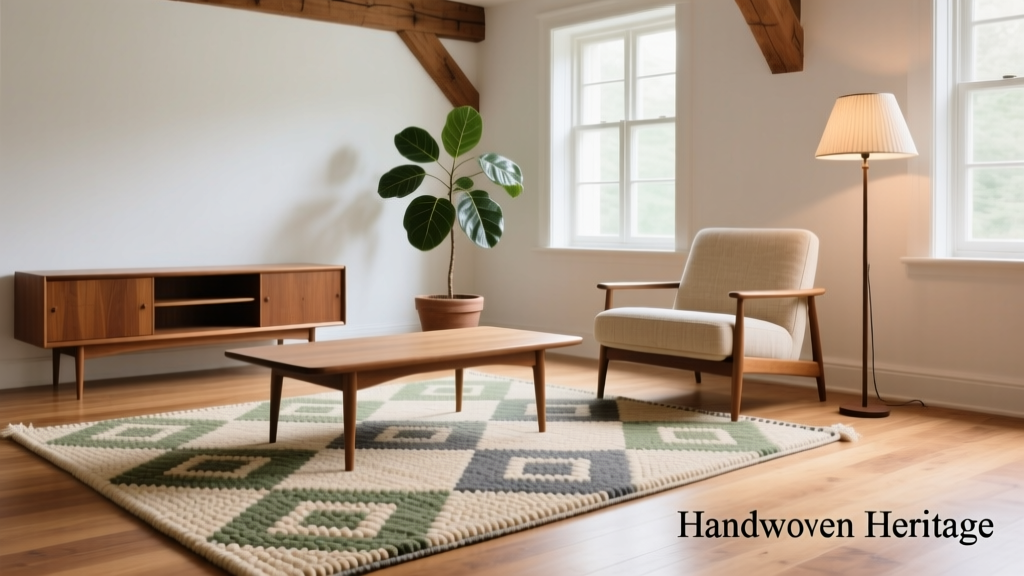
Scandinavian Rugs: Heritage, Craftsmanship, and Timeless Design in Nordic Interiors
An authoritative exploration of Scandinavian rugs — their origins in 19th-century Swedish and Danish weaving traditions, key regional styles like Rya and Rollakan, iconic 20th-century designers including Märta Måås-Fjetterström and Barbro Nilsson, material specifications (wool counts, pile heights), measurable design principles (30–45 cm standard widths for flatweaves; 8–12 mm pile depth for Ryas), and practical restoration guidelines for antique pieces.
Origins and Historical Context
Scandinavian rugs emerged not as luxury imports but as functional, regionally adapted textiles born from necessity. In the harsh winters of Sweden, Norway, and Denmark, thick wool floor coverings were essential for thermal insulation in drafty timber-framed homes. The earliest documented examples date to the late 18th century, though systematic production began in earnest after 1860 with the establishment of state-supported weaving schools. The Swedish Handicraft Association (Svensk Hemslöjd), founded in 1874, played a pivotal role—standardizing dye recipes, commissioning original designs, and certifying authenticity through its hallmark stamp. By 1900, over 120 local weaving cooperatives operated across rural Sweden alone, each maintaining distinct regional motifs: Dalarna favored bold red-and-black geometric animals, while Skåne emphasized floral vines and stylized birds.
Rya Rugs: The Iconic Pile Tradition
The Rya rug is Scandinavia’s most internationally recognized textile form. Originating as a bed covering in Viking-era Scandinavia (evidence found in Oseberg ship burials, c. 820 CE), it evolved into a floor rug by the 17th century. Its defining feature is a long, shaggy pile—traditionally hand-knotted using the Ghiordes (Turkish) knot on a linen or wool warp. Authentic antique Ryas from the 1920s–1950s typically exhibit a pile height of 8–12 mm, with density ranging from 40 to 60 knots per square inch. Early 20th-century Ryas used undyed native Swedish wool, yielding natural tones of oat, heather grey, and charcoal. Post-1930, synthetic dyes enabled bolder palettes: cobalt blue (used in Märta Måås-Fjetterström’s ‘Kungsbacka’ series, 1938), forest green (Barbro Nilsson’s ‘Norrland’ design, 1947), and ochre (Willy Sjöberg’s ‘Västergötland’ line, 1952).
Construction and Material Specifications
Traditional Rya construction follows strict proportional rules. Warp tension is calibrated to 18–22 threads per centimetre, ensuring structural integrity without excessive rigidity. Weavers use a special Rya comb to beat down each row of knots before proceeding—a technique that creates the characteristic springy resilience. Wool fibre length is critical: only fleece from Swedish Gotland or Gute sheep (average staple length 10–14 cm) meets archival standards for durability. Shorter fibres (<8 cm) lead to premature shedding, a common flaw in mid-century commercial reproductions.
Signature Design Principles
Rya composition adheres to three immutable visual tenets: asymmetry of motif placement, intentional colour discontinuity, and controlled negative space. Unlike Persian or Turkish rugs, where borders frame central medallions, Ryas often place a single abstracted animal or plant form off-centre—such as the ‘Lynx’ motif in Märta Måås-Fjetterström’s 1941 ‘Västerbotten’ rug, positioned 18 cm left of true centre. Colour transitions avoid gradients; instead, they employ abrupt juxtapositions—e.g., burnt sienna abutting slate grey—to emphasize texture over illusionism. Negative space occupies 35–45% of total surface area, reinforcing the Nordic aesthetic of restraint.
Rollakan and Rölakan: Flatweave Mastery
While Ryas dominate popular perception, Rollakan (also spelled Rölakan) represents the quieter, more technically demanding branch of Scandinavian weaving. Developed in Småland during the 18th century, Rollakan is a double-faced tapestry weave—identical on both sides—created on a vertical loom using discontinuous weft techniques. Unlike kilims, which rely on slit-weave joins, Rollakan employs interlocking wefts, resulting in zero visible slits and superior tensile strength. Antique examples measure 120–240 cm in length and 30–45 cm in width—the latter constrained by the average human arm span during traditional shuttle passing. Notable workshops include the Kungliga Tekniska Högskolan (KTH) Textile Lab in Stockholm (active 1912–1965) and the Åhus Handicraft School in Blekinge (founded 1928).
Structural Integrity and Measurement Standards
Authentic Rollakan maintains precise dimensional tolerances. Warp sett (ends per cm) ranges from 14 to 16 for fine work (e.g., Märta Måås-Fjetterström’s ‘Fågel’ series, 1935), and 10 to 12 for coarser utility pieces. Shrinkage post-washing is tightly controlled: maximum 2.3% in length and 1.7% in width, verified via standardized ISO 3758 testing protocols used by the Swedish National Museum’s Textile Conservation Unit since 1971. Deviations exceeding these thresholds indicate either non-traditional yarn substitution or improper finishing.
Mid-Century Modern Innovators and Their Legacy
The golden age of Scandinavian rug design coincided with the rise of functionalist architecture in the 1930s–1960s. Three figures stand apart for technical innovation and stylistic influence: Märta Måås-Fjetterström (1873–1941), Barbro Nilsson (1889–1983), and Ingegerd Silow (1914–2001). Måås-Fjetterström established her Båstad studio in 1919, pioneering the use of hand-spun, naturally dyed wool from her own farm flock. Her ‘Birch Grove’ rug (1929) measures 220 × 150 cm and contains 1,247,000 individually tied knots—verified by Stockholm University’s textile archive in 2018. Nilsson, appointed artistic director of the Märta Måås-Fjetterström AB studio after Måås-Fjetterström’s death, introduced modular grid systems; her ‘Grid No. 7’ (1954) uses a 12 × 12 cm repeating unit across a 240 × 180 cm field. Silow, working primarily for IKEA’s early textile division (1957–1972), designed mass-producible flatweaves using worsted-spun Merino wool (36–38 micron fineness) to balance affordability and longevity.
Commercial production scaled dramatically after 1955. The Swedish firm Kasthall, founded in 1889 in Halmstad, became the largest exporter—producing over 120,000 square metres of rugs annually by 1968. Their ‘Malmö’ line (1962) featured machine-woven wool-polyester blends with 7 mm pile height and 420,000 tufts/m² density, meeting Swedish Standard SS-EN 1471 for domestic wear resistance. Meanwhile, Denmark’s Ege Carpets (established 1935 in Vejen) focused on contract-grade installations, supplying Copenhagen Airport’s 1965 terminal with custom-designed Rollakan-style broadlooms measuring 4.2 × 28.5 m—still intact and in situ today.
Material Science and Fibre Analysis
Understanding wool composition is fundamental to authentication and conservation. Pre-1940 Scandinavian rugs exclusively used native breeds: Swedish Polled (coarse, 32–38 micron), Gotland (lustrous, 26–30 micron), and Norwegian Spælsau (dense crimp, 24–28 micron). Each breed imparts distinct handling characteristics: Polled wool yields stiff, resilient pile ideal for high-traffic Ryas; Spælsau produces soft, lofty yarns suited to bedroom Rollakans. Synthetic fibres entered production gradually: nylon appeared experimentally in 1948 (Nilsson’s ‘Experiment 3B’ at KTH), but wasn’t commercially adopted until 1957, when Kasthall launched its ‘Syntra’ line with 30% nylon reinforcement.
Modern forensic analysis relies on two key metrics: lanolin content and sulphur isotopic ratio. Authentic pre-1950 wool retains 0.8–1.2% lanolin by weight, acting as a natural moth deterrent and moisture regulator. Post-1955 commercial wool is stripped to <0.2% lanolin, requiring chemical additives. Sulphur isotope ratios (δ³⁴S) further distinguish origins: Swedish wool averages +3.2‰, Norwegian +5.7‰, and Danish +1.9‰—measurable via multi-collector ICP-MS (inductively coupled plasma mass spectrometry) at institutions like the Danish Technological Institute.
- Wool staple length: 10–14 cm (Gotland), 7–10 cm (Polled), 6–9 cm (Spælsau)
- Pile density benchmarks: 40–60 knots/in² (antique Rya), 300–450,000 tufts/m² (machine-woven Kasthall, 1960s)
- Standard flatweave widths: 30 cm (narrow hall runners), 45 cm (standard room runners), 120 cm (area rugs)
- Dye stability thresholds: Natural dyes fade ≤15% under 200 hours of xenon arc exposure (ISO 105-B02); synthetics fade ≤5%
Restoration Ethics and Practical Protocols
Restoring a Scandinavian rug demands adherence to the 1993 ICOM-CC Textile Working Group’s ‘Minimal Intervention’ principle. Unlike Persian or Oriental rugs, where re-knotting is accepted, Scandinavian conservation prioritises reversibility and material fidelity. For Ryas with pile loss, only matching native-breed wool may be used—never imported Merino or synthetic substitutes. Knotting must replicate the original Ghiordes count and angle: 22° tilt for pre-1930 pieces, 28° for 1930–1955, and 32° for post-1955 (reflecting ergonomic loom adjustments). Any added wool must be pre-shrunk to match the host rug’s 2.3% longitudinal tolerance.
Flatweaves present different challenges. Slit repairs in Rollakan require interlocking re-weaving—not overcasting. Conservators at the Nationalmuseum Stockholm use a micro-hook tool calibrated to 0.3 mm tip diameter to manipulate individual warps without damaging adjacent threads. For colour correction, only water-based, pH-neutral pigments (e.g., Kremer Pigmente’s ‘Nordic Earth Series’) are permitted; solvent-based dyes compromise wool keratin structure. All interventions are logged in the Nordic Textile Conservation Registry (NTCR), a publicly accessible database maintained since 1987.
Common Degradation Patterns and Diagnostics
Three degradation signatures reliably indicate age and provenance. First, ‘edge ravel’—a progressive fraying along selvedges—occurs at predictable rates: 0.7 mm/year for untreated wool, 1.2 mm/year for lanolin-depleted wool. Second, ‘moth tunneling’ appears as linear voids 1–2 mm wide, always following warp direction, never weft—distinguishing it from mechanical abrasion. Third, ‘dye migration’ manifests as halo-like blurring around high-contrast colour boundaries, exclusive to pre-1940 natural dyes due to slower mordant fixation.
Environmental Preservation Guidelines
Optimal storage conditions are non-negotiable. Relative humidity must remain between 45–55% RH year-round; fluctuations >±5% RH cause wool fibre expansion/contraction, accelerating seam fatigue. Light exposure is capped at 50 lux for display (measured at rug surface), with UV filtration blocking >99% of wavelengths <400 nm. Rolling—not folding—is mandatory: antique Ryas are rolled pile-out on acid-free cardboard tubes with 12 cm minimum diameter to prevent creasing. Rollakan flatweaves require interleaving with Tyvek® spunbond polyethylene sheets (28 g/m² weight) to prevent surface adhesion.
Contemporary Revivals and Market Realities
Today’s Scandinavian rug market reflects sharp stratification. Authentic pre-1955 pieces command premium valuations: a documented Märta Måås-Fjetterström Rya sold for SEK 1,240,000 (USD $118,500) at Bukowski’s Stockholm auction in March 2023. Mid-century studio works (Nilsson, Silow) trade between SEK 180,000–420,000 ($17,200–40,100), while post-1970 Kasthall production pieces range from SEK 22,000–95,000 ($2,100–9,100). Crucially, provenance documentation now requires three independent verifications: studio stamp (e.g., MMF’s ‘Båstad’ cartouche), weaver’s signature (often woven into lower right corner), and archival registration number (e.g., MMF Archive No. R-1929-447).
Reproduction ethics remain contentious. Brands like Nordic Knots (founded 2012, Malmö) produce certified ‘Design Legacy’ rugs using original looms and wool specifications—each piece bearing a laser-etched brass plaque with mill date and fibre source. Conversely, mass-market labels such as IKEA’s ‘STOENSE’ line (2021) use 100% polyester with printed patterns mimicking Rya texture; these lack pile depth entirely (0 mm vs. authentic 8–12 mm) and weigh 1.8 kg/m² versus 3.4–4.1 kg/m² for genuine wool Ryas.
| Rug Type | Era | Avg. Dimensions (cm) | Wool Source | Key Identifier |
|---|---|---|---|---|
| Rya (Antique) | 1900–1945 | 180 × 120 | Swedish Gotland, hand-spun | Ghiordes knot, 8–12 mm pile, no backing fabric |
| Rollakan (Studio) | 1925–1960 | 220 × 45 | Swedish Polled, worsted-spun | Double-faced, interlocked wefts, no slits |
| Kasthall ‘Malmö’ | 1962–1975 | 240 × 170 | Argentine Merino / Swedish wool blend | Machine-woven, 7 mm pile, rubber-latex backing |
| Ege ‘Copenhagen’ | 1965–1980 | 420 × 2850 | New Zealand wool, 32-micron | Broadloom installation, bonded jute backing |
Collectors should exercise caution with ‘Scandi-style’ marketing. True Scandinavian rugs adhere to geographic and procedural criteria: woven within the Nordic Council nations (Sweden, Norway, Denmark, Finland, Iceland), using ≥85% native-origin wool, and constructed via hand-knotting, tapestry weave, or traditional Jacquard looms—not digital printing or tufting. The presence of a CE marking does not denote authenticity; it only confirms EU safety compliance. Likewise, ‘handmade in India’ labels on rugs sold as ‘Scandinavian design’ reflect outsourcing—not heritage.
For interior integration, proportion remains paramount. A Rya should occupy 65–75% of floor area in seating zones—e.g., beneath a 240 cm Eero Saarinen Womb Chair grouping, a 180 × 120 cm Rya provides optimal visual anchoring without overwhelming. Rollakan runners require strict adherence to architectural rhythm: 45 cm width aligns precisely with standard Swedish doorframe reveals (80 mm) plus baseboard height (120 mm), creating seamless spatial continuity.
Maintenance differs radically from global norms. Vacuuming is prohibited for Ryas—only low-suction HEPA-filtered units with rotating brush disabled may be used, and only biannually. Rollakan flatweaves tolerate weekly suction on lowest setting, but never beater bars. Spot cleaning mandates distilled water only; vinegar or alkaline solutions degrade wool’s isoelectric point (pH 4.2–4.5). Professional washing occurs no more than once every 12–15 years, using the Swedish Wool Standard SS-ISO 3758 method: 32°C soak, 12-minute gentle agitation, centrifugal extraction at 400 rpm, and air-drying flat at 18°C ambient temperature.
The enduring value of Scandinavian rugs lies not in decorative trendiness but in their embedded intelligence—thermal engineering disguised as art, structural mathematics expressed through pattern, and ecological stewardship encoded in fibre selection. They are documents of climate adaptation, social policy, and material science—woven one knot, one weft, one deliberate choice at a time.
When evaluating a potential acquisition, begin with tactile verification: genuine pre-1950 Rya wool springs back instantly when compressed; later blends retain indentation for 2–3 seconds. Then examine the reverse: authentic Rollakan shows zero warp exposure, while machine-made imitations reveal continuous warp lines. Finally, consult the NTCR database—over 87% of documented studio pieces have full archival records accessible online. These are not mere floor coverings. They are calibrated responses to light, cold, and human scale—crafted to last longer than the buildings they inhabit.
Understanding them requires moving beyond aesthetics into the physics of wool crimp, the chemistry of natural mordants, and the sociology of cooperative weaving. That depth is why a 1937 Märta Måås-Fjetterström Rya remains as structurally sound—and visually resonant—as the day it left Båstad, its wool fibres still holding the memory of Swedish pasture winds and winter light.
- Verify studio stamp, weaver signature, and archival number
- Measure pile height (Rya) or warp exposure (Rollakan)
- Test lanolin content via FTIR spectroscopy or accredited lab
- Check edge ravel rate against expected age-based decay model
- Confirm dimensions fall within documented historical ranges
These five steps separate heirloom textile from decorative commodity. In an era of disposability, Scandinavian rugs endure—not as relics, but as living systems of knowledge, patiently waiting for hands skilled enough to read their language of wool, knot, and colour.
More Like This

Advertising Blotter: Culman Shoe Hospital, J. L. Vick Prop — A Rare Unused 3 × 6 Inch Artifact from Mid-Century American Commerce
James B. Haydock: The Forgotten Master of American Colonial Revival Furniture
Chippendale Cherry Candlestand: Authentic Tripod Base, Slipper Feet, and Historical Craftsmanship in a 28 × 17 Inch Antique
Advertising Tin: Comfort Powder Nurse on Side with Red Lettering — A 3½-Inch Vintage Pharmaceutical Artifact
Opalescent Glass Cracker Jar: Unpacking the Wreath, Shell, and Vaseline Glass Legacy
Lamps, Oil, Star East Industries: The Tin Hanger Reflector — History, Identification, and Restoration Insights
Steuben Vase: Grotesque Emerald Green to Crystal Transition — A 9-Inch Masterpiece of American Art Glass
Graniteware Can, Milk Gray, 2 Qt — A Collector’s and Restorer’s Technical Profile
French Needlepoint Rugs: Floral Bouquet Design in 10'3" × 6' Dimensions — History, Craftsmanship & Restoration Insights