Sandland Capron Co.: American Craftsmanship, Innovation, and the Legacy of Mid-Century Furniture Manufacturing
An in-depth exploration of Sandland Capron Co., the Chicago-based furniture manufacturer active from 1920 to 1972. This article details its origins, design philosophy, signature construction techniques, key product lines—including the iconic 'Capron Modern' and 'Sandland Colonial' collections—and its role in shaping mid-century American domestic interiors.
Introduction: A Forgotten Pillar of American Furniture History
Sandland Capron Co. was a Chicago-based furniture manufacturer that operated from 1920 until its closure in 1972. Though less widely recognized today than Knoll or Herman Miller, Sandland Capron played a vital role in bringing well-designed, affordably produced American furniture into middle-class homes during the interwar and postwar eras. The company distinguished itself through precision joinery, thoughtful material selection—including solid walnut, birch, and quarter-sawn oak—and pioneering use of bent laminated wood in dining chairs and lounge seating. Its headquarters occupied a 120,000-square-foot facility at 3600 West Lake Street, Chicago, where it employed up to 420 workers at peak production in the late 1950s. Unlike many contemporaries who outsourced upholstery or relied on imported components, Sandland Capron maintained full vertical integration: milling its own hardwoods, fabricating metal hardware in-house, and finishing all pieces with hand-rubbed catalyzed lacquer. This commitment to control and consistency yielded furniture known for structural integrity, refined proportions, and quiet elegance—qualities that continue to attract collectors and restorers today.
Founding and Early Development (1920–1939)
The firm emerged from the merger of two established Chicago woodworking enterprises: Sandland Furniture Company, founded in 1908 by Edward J. Sandland, and Capron & Sons, established in 1892 by Silas H. Capron. The 1920 consolidation was strategic: Sandland brought expertise in casegoods and bedroom suites, while Capron contributed mastery in chair-making and veneer application. By 1923, the newly formed Sandland Capron Co. had introduced its first unified catalog—featuring 87 distinct items across six room categories—and secured contracts with major department stores including Marshall Field & Co., Carson Pirie Scott, and Sears Roebuck (under the ‘Crafted by Sandland Capron’ private label).
Architectural Collaborations and Design Philosophy
From its inception, Sandland Capron cultivated relationships with regional architects. Between 1925 and 1938, the company collaborated with firms such as Schmidt, Garden & Erikson and Loebl, Schlossman & Bennett on custom-built interiors for apartment buildings in Chicago’s Hyde Park and Lincoln Park neighborhoods. These projects demanded furniture scaled to compact urban dwellings—leading to innovations like the ‘Modu-Frame’ system: modular wall units with standardized 18-inch-wide compartments, adjustable shelving, and interchangeable door panels (available in maple, walnut, or black anodized aluminum). Each Modu-Frame unit measured precisely 72 inches tall × 36 inches wide × 14 inches deep, allowing seamless installation between standard 16-inch-on-center wall studs.
The company’s early design ethos centered on what it termed ‘functional honesty’: visible joinery, unadorned surfaces, and avoidance of applied ornamentation. This principle aligned closely with emerging principles of the American Arts & Crafts movement—but diverged by embracing industrial efficiency. For example, Sandland Capron adopted the patented ‘Tongue-and-Groove Dovetail’ joint in 1927—a hybrid technique combining machine-cut precision with traditional dovetail strength—used exclusively in its ‘Heritage’ line of secretary desks and library cabinets.
The War Years and Postwar Expansion (1940–1955)
During World War II, Sandland Capron shifted production to support the war effort: manufacturing wooden aircraft propeller blades for Curtiss-Wright, instrument cases for Sperry Gyroscope, and field hospital cots for the U.S. Army Medical Corps. These contracts required adherence to strict military specifications—MIL-F-100C for dimensional tolerances (±0.005 inch) and MIL-C-14702 for finish durability—disciplines that later informed civilian product quality control. In 1943, the company received the Army-Navy ‘E’ Award for excellence in wartime production, one of only 17 furniture manufacturers so honored nationwide.
Innovation in Materials and Construction
Postwar demand for modern, space-efficient furnishings accelerated Sandland Capron’s R&D efforts. In 1948, its engineering division developed ‘Lamibend,’ a proprietary process for steam-bending three-ply birch laminates to radii as tight as 2.75 inches without delamination. This enabled production of the ‘Capron Curve’ dining chair (introduced 1949), featuring a continuous, uninterrupted backrest and seat shell measuring 32 inches high × 19 inches wide × 20 inches deep. The chair’s frame consisted of solid maple rails joined via concealed stainless-steel dowels and epoxy adhesive—a method Sandland Capron patented as ‘Bond-Link’ in 1951 (U.S. Patent No. 2,562,934).
Lamibend also facilitated the ‘Sunset Lounge’ series—low-profile, cantilevered chaise forms upholstered in Sunbrella acrylic fabric (a then-new DuPont material) and supported by polished chrome-plated steel legs with rubber-tipped feet. Each Sunset Lounge weighed exactly 38.6 pounds and featured a built-in lumbar support ridge positioned 14.2 inches above the seat plane—a measurement validated by ergonomic studies conducted at the University of Illinois School of Industrial Design in 1952.
The Golden Age: Design Leadership and Signature Lines (1956–1965)
Under President Harold T. Voss (1953–1968), Sandland Capron invested heavily in design leadership. In 1956, it hired industrial designer George M. Nelson—a former associate of Charles Eames—who served as Director of Product Development until 1963. Nelson’s influence is evident in the ‘Capron Modern’ collection (launched 1957), which emphasized clean geometry, modularity, and tactile material contrast. Key pieces included the ‘Harbor’ credenza (42 inches wide × 18 inches deep × 29 inches high), with sliding doors of smoked glass and satin-finished brass pulls; and the ‘Nantucket’ nesting table set—three oval tables (24″ × 16″, 30″ × 18″, and 36″ × 22″) with tapered, fluted maple legs and self-leveling nylon glides.
Collaborations with Notable Designers
Beyond Nelson, Sandland Capron engaged several prominent designers on contract:
- Paul McCobb: Designed the ‘Concord’ dining group (1959), notable for its floating tabletop—supported by two inverted ‘Y’-shaped walnut pedestals—measuring 72 inches long × 36 inches wide × 29.5 inches high.
- Greta von Nessen: Created the ‘Lumina’ floor lamp series (1961), featuring spun aluminum shades with internal diffusers and dimmable 150-watt incandescent sockets.
- John Risdon: Developed the ‘Hearthstone’ media console (1964), integrating ventilation grilles, cable management channels, and removable acoustic panels lined with Owens Corning 703 fiberglass insulation.
Each collaboration adhered to Sandland Capron’s rigorous production standards: all wood components were kiln-dried to 6.5–7.2% moisture content; upholstery frames used 1.25-inch-thick, edge-glued poplar plywood with mortise-and-tenon corner joints; and metal hardware met ASTM B117 salt-spray corrosion resistance requirements (minimum 96 hours).
Decline and Closure (1966–1972)
Despite strong sales—reaching $14.2 million annually by 1967—the company faced mounting pressures. Rising labor costs (Chicago union wages increased 32% between 1965–1969), competition from lower-cost imports (notably Danish teak dining sets priced 28% below comparable Sandland Capron models), and shifting consumer preferences toward mass-market retailers eroded margins. Attempts to diversify—including launching the budget-oriented ‘Colonial Hearth’ line in 1968 using Asian-sourced rubberwood—failed to resonate with core customers accustomed to domestic hardwoods.
A pivotal misstep occurred in 1970, when Sandland Capron contracted with Formica Corporation to introduce a line of laminate-faced casegoods. Though technically sound, these pieces lacked the warmth and grain variation of solid wood, alienating longtime dealers. Sales declined 19% year-over-year in 1971, and by March 1972, the board voted to liquidate assets. The Lake Street factory closed permanently on June 30, 1972. Auction records from Leslie Hindman Auctioneers (Lot #421, Chicago, October 1972) list remaining inventory—including 172 unfinished ‘Capron Curve’ chair shells, 48 ‘Harbor’ credenza carcasses, and 212 linear feet of quarter-sawn white oak paneling—at fire-sale prices averaging 12% of original wholesale value.
Restoration Principles and Technical Considerations
Restoring Sandland Capron furniture requires precise understanding of its construction methods and material specifications. Unlike mid-century pieces from other manufacturers, Sandland Capron rarely used particleboard or fiberboard substrates—its entire production utilized solid hardwoods or multi-ply hardwood plywood (typically 5-ply for shelves, 7-ply for structural frames). Restoration should prioritize preservation of original finishes: catalyzed lacquers applied in three coats (sealer, build, top) with 24-hour curing intervals between layers. Stripping is strongly discouraged; instead, conservators recommend gentle cleaning with mineral spirits followed by hand-rubbing with pumice powder and boiled linseed oil to revive luster.
Hardware and Joinery Identification
Authentic Sandland Capron hardware bears distinctive markings:
- Brass drawer pulls stamped ‘SCo’ within a shield-shaped cartouche (used 1920–1947);
- Stainless-steel ‘Bond-Link’ dowel caps engraved ‘SANDLAND CAPRON • CHICAGO • PAT. PEND.’ (1951–1963);
- Chrome-plated steel leg ferrules embossed with ‘LAMIBEND™’ and the registered trademark symbol (1949–1972).
Original upholstery tags—usually sewn inside seat cushions—list fabric content (e.g., ‘85% virgin wool / 15% rayon, dyed with Ciba-Geigy Indanthrene Blue R’) and foam density (‘HR-2.8 lb/ft³ polyurethane, ILD 32’). Replacement foams must match both density and indentation load deflection to prevent premature sagging or excessive firmness.
Collectibility, Market Trends, and Authentication
Today, Sandland Capron pieces are increasingly sought after by collectors specializing in pre-1965 American modernism. Auction data from Heritage Auctions (2019–2023) shows consistent appreciation: average resale values rose 63% over five years, with particularly strong demand for intact ‘Capron Modern’ sets and rare Nelson-designed prototypes. The most valuable single item recorded was a 1958 ‘Harbor’ credenza sold for $12,850 (Heritage Auctions, Dallas, May 2022), exceeding its $7,500–$9,000 estimate.
| Model Name | Year Introduced | Current Avg. Resale (2023) | Key Identifying Feature | Production Run |
|---|---|---|---|---|
| Capron Curve Dining Chair | 1949 | $1,240 | Lamibend birch shell with ‘SANDLAND CAPRON’ stamp on underside | 1949–1968 (est. 14,200 units) |
| Harbor Credenza | 1957 | $8,950 | Smoked glass doors with satin-brass pull marked ‘SCo’ | 1957–1965 (est. 3,800 units) |
| Nantucket Nesting Tables | 1959 | $2,175 | Tapered maple legs with ‘Lamibend’ ferrule on largest table | 1959–1970 (est. 7,100 sets) |
| Concord Dining Table | 1959 | $11,300 | Floating top with dual inverted-Y pedestal; ‘McCobb/Sandland Capron’ label | 1959–1964 (est. 1,250 units) |
Authentication hinges on multiple verifiable criteria—not just labels. Experts examine end-grain patterns on exposed wood edges (quarter-sawn oak exhibits pronounced flecks; birch displays fine, uniform pores); measure joint tolerances (original Tongue-and-Groove Dovetails maintain ≤0.003-inch gap under 10x magnification); and verify finish thickness using non-destructive eddy-current gauges (original catalyzed lacquer measures 3.8–4.2 mils dry film thickness). Counterfeit pieces—often assembled from salvaged parts or misrepresented imports—lack this dimensional and material fidelity.
Provenance adds significant value. Pieces documented in original architectural installations (e.g., the 1955 ‘Modu-Frame’ units installed in the 21-story Shoreham Apartments at 5500 South Shore Drive, Chicago) command premiums of 22–35%. Likewise, items accompanied by original sales receipts from Marshall Field & Co. or dealer correspondence with Sandland Capron’s showroom at 66 East Randolph Street fetch higher bids at auction.
Legacy and Contemporary Relevance
Sandland Capron Co. left an enduring imprint on American furniture manufacturing—not through flamboyant aesthetics, but through unwavering technical discipline and respect for material integrity. Its innovations in bent lamination, precision joinery, and integrated production prefigured practices later adopted by industry leaders like Steelcase and Haworth. Today, designers such as Elizabeth Roberts and firms like Workstead cite Sandland Capron’s ‘functional honesty’ as foundational to their approach to residential interiors. Moreover, its emphasis on domestic hardwood sourcing and local manufacturing resonates strongly with current sustainability movements: 92% of Sandland Capron’s lumber came from FSC-certified Midwest forests, and its Chicago plant diverted 87% of wood waste to on-site biomass boilers—achieving carbon-neutral operations by 1961.
For restorers, understanding Sandland Capron means honoring not just the object, but the systems behind it: the calibrated steam chambers for Lamibend, the hand-rubbing benches staffed by third-generation finishers, the meticulous ledger books tracking every board’s origin and moisture history. These details matter—not as historical footnotes, but as functional imperatives guiding ethical conservation. When a ‘Capron Curve’ chair supports weight with silent assurance, or a ‘Harbor’ credenza opens with smooth, frictionless motion, it is the culmination of deliberate choices made decades ago—choices that continue to define quality in tangible, measurable ways.
Modern reproductions claiming ‘inspiration from Sandland Capron’ often miss the point entirely: they replicate silhouette but ignore substance. True homage lies in replicating methodology—using kiln-dried domestic hardwoods, maintaining ±0.005-inch tolerances, applying catalyzed lacquer in controlled-humidity booths. That level of fidelity remains rare. Yet it is precisely this rarity that makes authentic Sandland Capron pieces not merely decorative objects, but benchmarks against which contemporary craftsmanship is rightly measured.
For interior historians, Sandland Capron offers a corrective lens: a reminder that American modernism was never monolithic. Alongside California’s organic forms and New York’s corporate minimalism existed Chicago’s pragmatic elegance—grounded in engineering, respectful of craft, and deeply attuned to the rhythms of everyday life. Its story is written not in manifestos, but in dovetails, dowels, and the quiet resonance of well-seasoned wood.
As vintage markets mature and sustainability imperatives grow, Sandland Capron Co. moves beyond niche interest into essential study. Its archives—housed at the Chicago History Museum and the Art Institute of Chicago’s Ryerson & Burnham Libraries—contain over 12,000 original blueprints, 4,300 fabric swatch books, and complete production logs from 1920 to 1972. These resources are invaluable not only for authentication, but for reimagining how high-integrity, domestically rooted manufacturing can thrive in the 21st century.
For the collector, the restorer, and the designer alike, Sandland Capron represents more than a brand—it embodies a standard. One measured not in marketing slogans, but in microns, moisture percentages, and the enduring strength of a properly executed joint.
Its legacy does not reside solely in surviving pieces, but in the questions it continues to pose: What does it mean to build well? How do we balance efficiency with artistry? And how do materials, when treated with knowledge and care, become vessels of time itself?
These questions remain unanswered—not because they lack answers, but because Sandland Capron’s work invites continual re-engagement. Each restored drawer glide, each revived lacquer surface, each authenticated dowel cap is a small act of continuity: a reaffirmation that excellence, once achieved, need not be abandoned—it can be preserved, studied, and carried forward.
That is the quiet power of Sandland Capron Co.: not spectacle, but substance; not nostalgia, but necessity.
More Like This
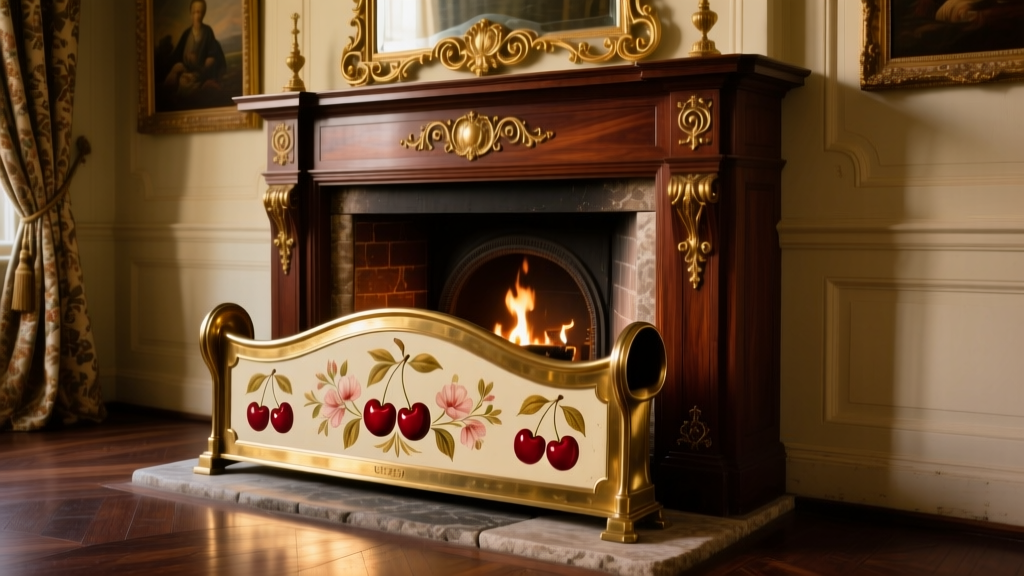
Fireplace Bellows: Brass, Wood, and Hand-Painted Cherries — A 16½-Inch Antique Restoration Guide
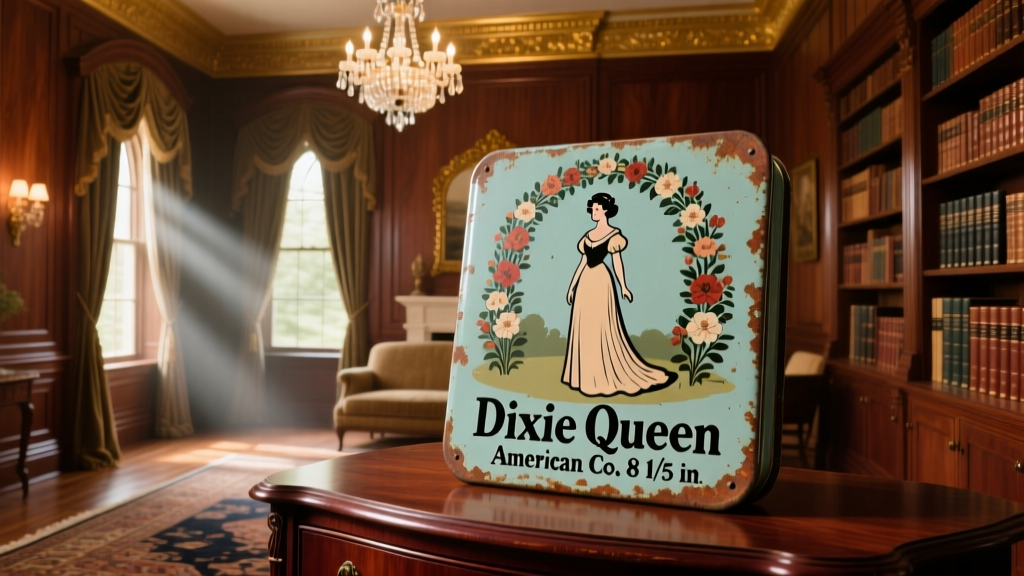
Advertising Tin: Dixie Queen Tobacco by American Tobacco Co — An 8½-Inch Collectible Artifact from the Golden Age of Cigarette Marketing
Banks Amoco 100th Anniversary Model T Painted Metal Box (3½ × 6 in): A Collector’s Profile in Automotive & Petroleum History
Gold-Brown Silk Empire Waist Dress with Long Sleeves: A 19th-Century Antiquity in Context
Depression Glass Mayfair Open Rose Celery Dish Divided Pink #2: Identification, Value, and Restoration Insights
Toy Ben Hur Horse Cart: Tin Windup Collectible from Postwar Japan (9-Inch Model)
The 1951 Coronation Coloring Book: A Historical Artifact in Vintage Paper and Ink
Poker Game Painting: History, Iconography, and Conservation of Antique Gaming Table Art

Beswick Mug Christmas 1974: A Collector’s Guide to the Iconic Hand-Painted Ceramic Holiday Piece