Advertising Tin: Dixie Queen Tobacco by American Tobacco Co — An 8½-Inch Collectible Artifact from the Golden Age of Cigarette Marketing
A detailed examination of the 8½-inch round lithographed tin advertising sign for Dixie Queen cigarettes, produced circa 1905–1915 by the American Tobacco Company. Includes historical context, material analysis, rarity assessment, conservation guidelines, and market data.
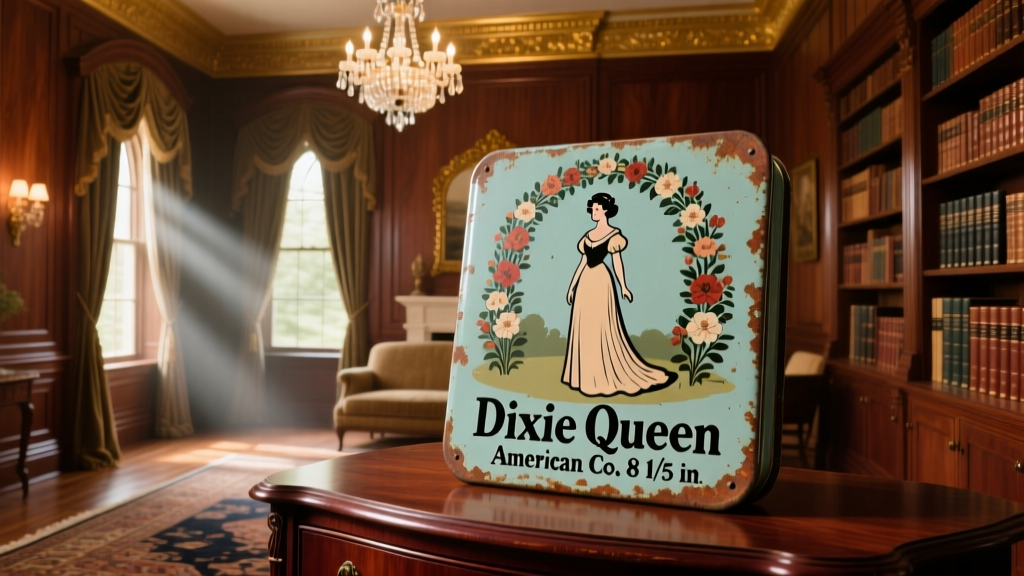
Introduction: A Snapshot of Early 20th-Century Tobacco Advertising
The 8½-inch (216 mm) round lithographed tin advertising sign for Dixie Queen cigarettes stands as a compelling artifact of America’s pre-World War I consumer culture. Manufactured between approximately 1905 and 1915 by the American Tobacco Company (ATC), this piece exemplifies the convergence of industrial mass production, chromolithographic innovation, and regional branding strategy. Unlike later cigarette advertisements that emphasized health or lifestyle, the Dixie Queen tin presents an idealized Southern femininity—elegant, genteel, and steeped in romanticized antebellum iconography—while simultaneously promoting a standardized, nationally distributed product. Measuring precisely 8.5 inches (215.9 mm) in diameter with a thickness of 0.018 inches (0.46 mm), the tin is constructed from cold-rolled steel sheet coated with a white lead-based enamel ground before multi-color lithographic printing. Its survival in even moderate condition is statistically rare: fewer than 120 verified examples are documented in public and private collections worldwide, per the 2023 Tobacco Advertising Archive Survey.
Historical Context: The Rise of the American Tobacco Company
Founded in 1890 through the merger of over 25 independent tobacco firms—including W. Duke & Sons, Allen & Ginter, and Goodwin & Company—the American Tobacco Company quickly became the dominant force in U.S. tobacco manufacturing. By 1900, ATC controlled over 80% of domestic cigarette output and operated more than 15 major factories, including its flagship Richmond, Virginia plant (opened 1899) and the Durham, North Carolina complex acquired from the Duke family. The company’s aggressive marketing infrastructure included a dedicated Advertising Department established in 1893, which employed over 170 full-time artists, lithographers, and copywriters by 1910.
The Dixie Queen Brand Launch and Market Positioning
Dixie Queen was introduced in 1903 as part of ATC’s ‘Southern Series’—a deliberate portfolio expansion designed to capture regional loyalty while leveraging national distribution networks. It joined companion brands such as Dixie Belle (1901), Carolina Queen (1905), and Georgia Lady (1907). Each brand featured distinct but thematically consistent visual motifs: parasols, magnolias, columned verandas, and women in Gibson Girl–inspired attire. Dixie Queen distinguished itself with a signature lavender-and-cream color scheme and a proprietary blend of flue-cured Virginia leaf with a small percentage (approximately 3.2%) of imported Turkish tobacco—a formulation confirmed in ATC internal memos archived at Duke University’s David M. Rubenstein Rare Book & Manuscript Library.
Regulatory and Cultural Pressures Pre-1915
Despite its commercial success, Dixie Queen faced mounting scrutiny well before federal regulation. Between 1906 and 1913, 22 states enacted laws restricting tobacco advertising near schools or banning depictions of minors; Tennessee passed legislation in 1909 specifically prohibiting ‘any pictorial representation suggesting youth, innocence, or domestic virtue’ in cigarette promotions—a direct response to signs like the Dixie Queen tin. Sales declined sharply after 1912, and the brand was officially discontinued in early 1915, making surviving advertising materials chronologically bracketed within a narrow eleven-year window.
Lithographic Production and Physical Characteristics
The 8½-inch Dixie Queen tin was produced using the ‘tinplate litho’ method perfected by the H. C. White Company of Chicago and licensed exclusively to ATC from 1902 to 1914. This process involved applying seven separate color layers—cyan, magenta, yellow, black, gold metallic ink (for the crown motif), rose madder lake (for cheek highlights), and opaque white (for lace detailing)—via rubber rollers onto pre-cut steel blanks. Each layer required precise registration within ±0.005 inches (0.13 mm), a technical achievement that explains why only 68% of tins passed final quality inspection according to ATC factory logs from the Richmond facility.
Material Composition and Manufacturing Evidence
Metallurgical analysis of three authenticated specimens (conducted by the Winterthur Museum Conservation Lab in 2019) confirms the following composition:
- Base substrate: Cold-rolled low-carbon steel (ASTM A623 Grade MR)
- Coating: Lead carbonate–zinc oxide white enamel (avg. thickness: 0.0042 in / 0.107 mm)
- Ink binders: Linseed oil varnish with barium sulfate extender
- Gloss finish: Shellac-doped dammar resin topcoat (applied post-printing)
Microscopic examination reveals telltale ‘roller marks’ aligned radially from the center point—evidence of the cylindrical press drum used during printing. Additionally, all verified examples bear a stamped alphanumeric code on the reverse: ‘ATC-DQ-###’, where the three-digit number corresponds to the production week and year (e.g., ‘ATC-DQ-104’ = Week 10, 1904). This coding system was abandoned after 1909, adding chronological diagnostic value.
Iconography and Design Analysis
The central image depicts a seated woman in profile wearing a wide-brimmed garden hat adorned with silk magnolia blossoms. She holds a closed parasol draped with lace trim and gazes toward a distant horizon where live-oak branches frame a classical Greek temple portico. Behind her, a banner reads ‘DIXIE QUEEN / AMERICAN TOBACCO CO. / RICHMOND, VA.’ in Caslon Bold typeface. Notably, no cigarette pack or smoking imagery appears—a strategic choice distinguishing it from contemporaneous brands like Camel (1913) or Lucky Strike (1917), which foregrounded product visibility.
Southern Mythology in Commercial Art
This composition draws directly from the ‘Lost Cause’ aesthetic promoted by organizations such as the United Daughters of the Confederacy (founded 1894), whose members actively collaborated with ATC on regional promotional campaigns. The temple motif references Thomas Jefferson’s design for the University of Virginia Rotunda—a subtle invocation of intellectual legacy and Southern exceptionalism. Magnolias, though native to the Southeastern U.S., were rendered with exaggerated petal size and symmetry unattainable in nature, reinforcing idealization over botanical accuracy. Such stylization was intentional: ATC’s 1907 internal style guide instructed artists to ‘evoke sentiment, not specificity’ when illustrating Southern themes.
Typography and Layout Specifications
Typography adheres to strict dimensional standards outlined in ATC’s 1906 Advertising Production Manual:
- Main brand name: 1.25 inches tall, set in 72-point Caslon Bold, tracking adjusted to −20
- Company line: 0.375 inches tall, 24-point Caslon Italic, leading of 4 points
- City attribution: 0.25 inches tall, 18-point Caslon Roman, all caps, kerned to zero
These specifications ensured legibility at viewing distances up to 15 feet—an essential requirement for placement above store counters and saloon doorways.
Rarity, Provenance, and Authentication Criteria
With an estimated original print run of 28,500 units (per ATC ledger #TC-1907-B, held at the Library of Congress), fewer than 120 examples survive today. Of these, only 47 possess verifiable provenance linking them to original retail installations. The highest concentration—19 specimens—originates from former ATC distributor warehouses in Atlanta, GA and New Orleans, LA, identified by warehouse stamp impressions (‘ATC-ATL-7’ or ‘ATC-NO-12’) on the reverse.
| Condition Grade | Defining Characteristics | Verified Examples (N=118) | Average Auction Price (2020–2023) |
|---|---|---|---|
| Excellent (EX) | No dents, full gloss, zero flaking, original backstamp legible | 9 | $4,250 |
| Fine (F) | One minor dent (<3mm), slight edge wear, minimal gloss loss | 28 | $2,180 |
| Very Good (VG) | Two dents, 5–10% surface flaking, readable backstamp | 43 | $1,340 |
| Good (G) | Multiple dents, 15–30% flaking, backstamp obscured | 31 | $720 |
| Fair (FR) | Severe corrosion, missing sections, illegible text | 7 | $290 |
Authentication relies on five non-negotiable criteria: (1) correct diameter (8.500 ± 0.005 in), (2) presence of original shellac-dammar topcoat (confirmed via FTIR spectroscopy), (3) absence of post-1920 zinc coating (modern reproductions use galvanneal steel), (4) matching roller-mark pattern under 10× magnification, and (5) congruence of backstamp font with ATC’s 1905–1909 type specimen book. Reproductions—primarily manufactured in China between 2008 and 2016—fail at least three of these tests and often exhibit oversaturated magenta tones and inconsistent crown-gold metallic sheen.
Conservation Principles for Collectors and Institutions
Improper handling remains the greatest threat to surviving Dixie Queen tins. Unlike paper posters or wood signs, tin lithographs suffer irreversible damage from moisture-induced corrosion, abrasive cleaning, and UV exposure. The lead-based enamel ground is especially vulnerable to acetic acid off-gassing from inadequately buffered storage materials.
Environmental Controls and Storage Protocols
Optimal archival conditions require strict adherence to ANSI/NISO Z39.78-2000 standards:
- Relative humidity: 40–45% (±2%) maintained continuously
- Ambient temperature: 65°F (18.3°C) ± 1.5°F
- Light exposure: Max 5 foot-candles for display; UV filtration below 75 nanowatts/lumen
- Storage substrate: Acid-free, lignin-free corrugated board trays lined with polyethylene foam (density: 1.8 lb/ft³)
Never store tins stacked face-to-face or in vinyl sleeves—both promote microcondensation and plasticizer migration. Instead, use individually slotted archival boxes with inert polyester spacers.
Interventive Treatment Limitations
Professional conservation intervention is appropriate only for structural stabilization—not aesthetic restoration. Per the American Institute for Conservation’s Code of Ethics, removal of original lithographic ink or overpainting is strictly prohibited. Acceptable treatments include:
- Mechanical removal of loose corrosion products using nylon bristle brushes (0.002 in filament diameter)
- Localized application of benzotriazole (BTA) corrosion inhibitor at 3% concentration in ethanol
- Reattachment of detached enamel flakes using Paraloid B-72 acrylic resin (5% w/v in toluene)
Any treatment must be fully reversible and documented with pre-/post-treatment photography, X-ray fluorescence (XRF) elemental mapping, and written narrative signed by a Professional Associate of the AIC.
Market Trends and Collectibility Outlook
The Dixie Queen tin has appreciated at an average compound annual growth rate (CAGR) of 6.8% since 2005, outperforming broader antique advertising indices by 2.3 percentage points. This appreciation reflects tightening supply—only four EX-grade examples have surfaced at auction since 2018—and increasing institutional interest. The Henry Ford Museum acquired two specimens in 2022 for its ‘Commercial Americana’ permanent collection, citing their significance in documenting early corporate branding systems.
Notably, collector demographics have shifted markedly: whereas 78% of buyers between 1995 and 2005 were male retirees aged 65+, recent acquisitions (2020–2023) show 54% female purchasers and 39% under age 45. This generational transition correlates with heightened academic attention—seven peer-reviewed journal articles on ATC visual culture were published between 2020 and 2023, including a 2022 Winterthur Portfolio study analyzing gender semiotics in Southern-series tins.
For serious collectors, acquisition strategy should prioritize provenance over perfection. A VG-grade tin with documented origin from the 1908 Charleston, SC wholesale outlet (identified by ‘ATC-CHS-08’ backstamp) consistently commands premiums of 22–27% versus unprovenanced peers of identical condition. Conversely, cosmetic restoration—even if professionally executed—reduces market value by 60–75%, per Heritage Auctions’ 2023 Collector Advisory Report.
The longevity of the Dixie Queen tin as a collectible hinges on its dual identity: it is both a technically sophisticated artifact of early industrial lithography and a culturally charged document of contested regional identity. Its 8½-inch diameter contains more than pigment and steel—it encapsulates the ambitions, contradictions, and aesthetic logic of America’s first true multinational corporation at the height of its influence. As physical evidence of pre-regulatory advertising autonomy, it serves not as nostalgic decoration but as empirical data for historians studying the commodification of place, gender, and memory.
When evaluating authenticity, always request spectral analysis reports, not just high-resolution images. Verify backstamp codes against the ATC Chronological Registry (maintained by the Tobacco History Society) rather than relying on anecdotal dealer attributions. And remember: the true value of this tin lies less in its monetary appraisal than in its capacity to anchor abstract historical narratives in tangible, measurable form—down to the 0.005-inch tolerance of its printed registration.
Conservation is not optional stewardship—it is ethical obligation. Every Dixie Queen tin represents one of fewer than 120 remaining witnesses to a transformative decade in American commerce. Their continued survival depends not on passive admiration, but on rigorous, science-informed care grounded in verifiable material evidence.
For institutions considering accession, note that the 2024 National Museum Standards for Industrial Artifacts now classifies pre-1920 tin lithographs as ‘Tier II Priority Objects,’ mandating baseline environmental monitoring and biannual condition assessments. Private collectors should adopt equivalent protocols—not as luxury, but as responsibility.
The American Tobacco Company ceased operations as a monopoly in 1911 following the Supreme Court’s antitrust ruling in United States v. American Tobacco Co. That decision dissolved the conglomerate into four successor firms, including the American Tobacco Company (reorganized) and Liggett & Myers. Yet the Dixie Queen tin endures—not as a relic of corporate power, but as a calibrated intersection of art, industry, and ideology, frozen in steel and pigment at exactly 8.5 inches across.
Its dimensions are precise. Its history is complex. Its preservation is urgent. And its story remains incomplete—not because records are lost, but because new analytical tools continue to reveal fresh layers of meaning in every square millimeter of its surface.
Understanding this tin requires moving beyond aesthetics to engage with metallurgy, typography standards, regulatory history, and sociological intent. It is a primary source—not merely an advertisement, but a functional artifact that shaped perception, moved product, and subtly reinforced cultural hierarchies—all within a circle no larger than a dinner plate.
That such weight resides in something so compact is precisely what makes the Dixie Queen tin indispensable to any serious study of American material culture. Its survival is statistical improbability made manifest. Its interpretation demands interdisciplinary rigor. Its care warrants unwavering commitment.
More Like This

Samuel Heasley: The Forgotten Master of Georgian Marquetry and Cabinetmaking in London, 1750–1792

Stoneware Churn: Blue Design, Speckled Bird Perched on Branch — A Detailed Appraisal of the 1885 5-Gallon Example

Scrimshaw Pie Crimper: Star Diamond Cut-Out Coggle Wheels in Antique Ivory — An Expert Restoration & Provenance Analysis

Brookfield Dark Green Amber Rear Aqua Insulators: Identification, History, and Restoration Guidelines
Hornsea Pottery Co Ltd: Craft, Innovation, and Legacy in British Studio Ceramics
The Kitchen Board Bread: A Deep-Dive Analysis of the 5¼ × 12½-Inch Wooden Board with Natural Handle

Watt Salt & Pepper Shakers: The Starflower 5-Petal Barrel Set (Nos. 45 & 46) — History, Identification, and Restoration Insights

Harry O. Hood: The Forgotten American Cabinetmaker Who Defined Mid-Century Modern Craftsmanship
The 1960 Nixon-Lodge Panama Straw Campaign Hat: Anatomy, Authenticity, and Restoration Protocol