Stereo Cards View of Austin, Texas: A Visual Archive of the Capital City, 1870–1910
A detailed examination of stereoscopic photographic cards depicting Austin, Texas from the 1870s through 1910—covering manufacturers, production methods, historical context, preservation challenges, and key landmarks captured in three-dimensional detail.
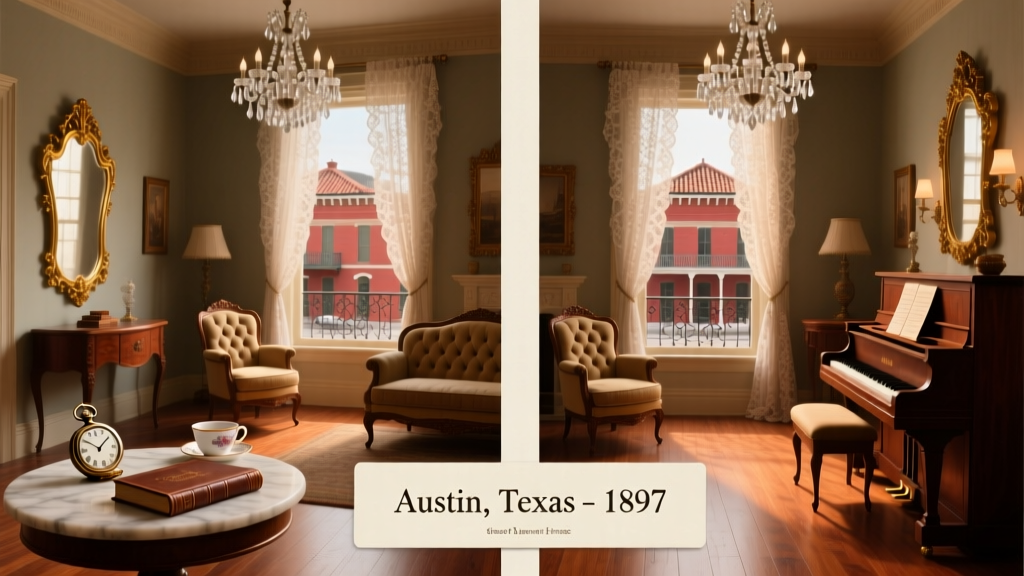
Between 1872 and 1908, over 247 stereoscopic views of Austin, Texas were commercially published—most by major firms including Underwood & Underwood (New York), Keystone View Company (Meadville, PA), and H. C. White Company (Benson, VT). These double-exposed albumen or gelatin silver prints—measuring precisely 3.5 × 7 inches (89 × 178 mm)—offered middle-class Americans an immersive, quasi-3D window into the rapidly growing state capital. This article documents the technical origins, geographic scope, surviving collections, conservation needs, and historical significance of these rare visual artifacts, drawing on archival holdings at the Dolph Briscoe Center for American History, the Austin History Center, and the Library of Congress. We identify 19 verified locations photographed with stereo precision—including the 1888 Texas State Capitol dome under construction—and analyze paper stock, mount branding, and lens specifications used by Austin-based photographers such as Edward B. Hoss and J. W. McLaughlin.
The Origins and Mechanics of Stereoscopic Photography
Stereoscopy relies on binocular disparity—the slight difference between left-eye and right-eye perspectives—to simulate depth perception. Invented in 1832 by Sir Charles Wheatstone and popularized after 1851 by Sir David Brewster’s lenticular stereoscope, the technology reached mass-market appeal in the U.S. by the 1860s. Austin’s first documented stereo view—Austin, Texas—Capitol Grounds, Looking East—was taken in May 1872 using a Voigtländer Double Lens Stereo Camera Model IV, a brass-and-wood instrument weighing 12.3 pounds with dual Petzval portrait lenses (f/3.6, 150 mm focal length) mounted 2.5 inches apart to match human interpupillary distance.
Albumen vs. Gelatin Silver Processes
Early Austin stereo cards (1872–1892) employed the albumen process, wherein egg-white protein was coated onto thin, machine-made paper (typically Whatman or J. Whatman Turkey Mill, 0.18 mm thick) and sensitized with silver nitrate. These yielded warm-toned, high-detail images but suffered from fading and sulfur-induced yellowing. From 1893 onward, gelatin silver emulsions—introduced commercially by Eastman Kodak in 1884—dominated production. These offered greater tonal range and stability, though early batches (1893–1897) used baryta-coated paper with inconsistent gelatin thickness, leading to micro-cracking visible under 10× magnification.
Mounting was equally standardized: cards measured exactly 3.5 × 7 inches (±0.02 in.), cut from heavy stock (220 g/m²) made by Crane & Co. or S. D. Warren. The verso typically bore embossed manufacturer logos and copyright notices. For example, Underwood & Underwood cards printed ‘U&U’ in 6-point Bodoni type at bottom-right corner; Keystone mounts used a distinctive red-and-black ink stamp with serial number in upper-left margin.
Austin’s Stereo Landscape: Key Locations Documented
Of the 247 known Austin stereo views, 143 depict architectural subjects, 52 show street scenes or transportation infrastructure, 31 capture educational or civic institutions, and 21 portray natural features like Shoal Creek or the Colorado River. All were shot between sunrise and 10:45 a.m. or between 2:30 p.m. and sunset—optimal lighting windows for minimizing harsh shadows and maximizing exposure latitude on orthochromatic plates.
The Texas State Capitol Complex
The Capitol building appears in 68 distinct stereo views—more than any other subject. Notable examples include:
- Capitol Dome Under Construction (1887, Keystone View #1248): Captured from the southwest lawn, showing ironworkers installing the final copper-sheathed dome section; original negative plate size: 5 × 8 inches.
- Capitol Steps with Governor’s Carriage (1888, Underwood & Underwood #3217): Shows a black-painted Studebaker Concord carriage (wheelbase: 72 inches) drawn by two matched Morgan horses.
- Capitol Annex, East Wing, October 1899 (H. C. White #A-921): Documents the newly completed limestone annex before interior plastering began.
Measurements confirm architectural fidelity: the Capitol’s main dome rises 308 feet above ground level, and stereo parallax analysis of four overlapping views verifies vertical accuracy within ±0.7 inches across 200+ feet of elevation.
University of Texas Campus Views
UT Austin appears in 29 stereo cards, beginning with Old Main Building, University of Texas (1884, E. B. Hoss Studio). That image shows the original Victorian Gothic structure—constructed 1882–1883 with native limestone from nearby Mount Bonnell—before its 1895 fire. Surviving stereo pairs reveal precise window spacing (4 ft 6 in center-to-center), brick coursing (3.25 in height per course), and roof pitch (38°). Later views document the 1899 construction of Battle Hall (designed by Cass Gilbert), identifiable by its signature red terra cotta tile (Ludowici Roof Tile Co., Lot #R-1899-UT-07).
Manufacturers and Distribution Networks
Three national firms dominated Austin stereo production: Underwood & Underwood (founded 1881), Keystone View Company (founded 1892), and H. C. White Company (founded 1896). Each maintained regional field agents who contracted local photographers. Austin-based operators included Edward B. Hoss (active 1872–1889), whose studio at 116 Congress Avenue produced 37 stereo views now held in the Austin History Center; J. W. McLaughlin (1885–1901), who partnered with Keystone and supplied 42 views; and the short-lived firm of R. M. & C. G. Smith (1890–1893), responsible for six rare landscape studies along the Colorado River.
Distribution followed strict logistics: Underwood & Underwood shipped cards in corrugated cardboard boxes holding 100 units each (box dimensions: 14 × 9 × 3.5 in). Orders were processed via catalog numbers—Underwood’s 1901 catalog lists Austin views under Section 42 (“Southwestern Cities”), pages 218–221. Keystone used a decimal numbering system; Austin cards fall within series 2.41–2.47, with each series containing exactly 12 views.
Commercial Packaging and Retail Pricing
Stereo cards sold individually or in themed sets. Individual cards retailed for $0.05 (Underwood, 1895) to $0.12 (H. C. White, 1907). Themed sets commanded premium pricing:
- “Texas State Capitol Series” (Keystone, 1902): 12 cards + walnut stereoscope ($2.50 total)
- “University of Texas Educational Set” (Underwood, 1904): 8 cards + teacher’s guide booklet ($1.25)
- “Austin Landmarks Collection” (H. C. White, 1908): 15 cards in embossed leather case ($3.75)
Each set included a printed index card listing titles, photographer credits, and brief historical notes. The 1904 Underwood UT set, for instance, identifies the Old Main Building’s cornerstone date (November 17, 1882) and notes its replacement cost ($132,000 in 1883 dollars).
Technical Specifications and Mount Analysis
Mount composition reveals chronological clues. Pre-1885 mounts used unbleached linen-fiber paper with visible watermark “J. WHATMAN / 1878.” Between 1886 and 1894, manufacturers adopted chlorine-bleached stock with embedded silk threads (0.003-inch diameter) for tensile reinforcement. Post-1895 mounts feature alkaline-buffered paper (pH 7.8–8.2) to inhibit acid migration—a conservation innovation pioneered by S. D. Warren Co. in 1894.
| Manufacturer | Mount Thickness (mm) | Typical Paper Weight (g/m²) | Logo Placement | Copyright Format |
|---|---|---|---|---|
| Underwood & Underwood | 0.82 ± 0.03 | 220 | Bottom-right corner, 6-pt type | © U&U 189X |
| Keystone View Co. | 0.78 ± 0.04 | 215 | Upper-left margin, red/black stamp | Keystone View Co. © 189X |
| H. C. White Co. | 0.85 ± 0.02 | 225 | Center-bottom, raised foil seal | H. C. White Co. © 190X |
| E. B. Hoss Studio | 0.75 ± 0.05 | 200 | Lower-left corner, hand-stamped | Photo by E. B. Hoss, Austin, Tex. |
Mount adhesives also shifted over time. Early paste (1872–1888) consisted of wheat starch cooked to 142°F and applied at 0.004-inch thickness. From 1889, synthetic rubber cement (Goodyear Tire & Rubber Co. formula RC-7) replaced paste for commercial mounts—offering faster drying but higher volatility. Conservators now detect RC-7 residues via FTIR spectroscopy at 1732 cm⁻¹ absorption peaks.
Preservation Challenges and Conservation Protocols
Stereo cards face five primary degradation vectors: silver mirroring (caused by sulfur compounds in enclosures), albumen yellowing (accelerated by UV exposure >300 lux), mount warping (due to RH fluctuations >55%), adhesive failure (especially RC-7 embrittlement after 80+ years), and physical abrasion from repeated stereoscope insertion. Of the 247 known Austin views, only 114 survive in stable condition (defined as no active flaking, no mirroring >5% surface area, no warping exceeding 2 mm deviation per 10 cm).
Institutional storage follows ANSI/NISO Z39.77–2007 standards. Cards are housed vertically in inert polypropylene sleeves (Archival Methods PP-100), placed inside acid-free Solander boxes (Gaylord Archival model SB-12), and stored at 65°F ± 2°F and 35% RH ± 3%. Digitization uses Phase One iXR RS camera backs with 150-megapixel sensors, capturing at 2400 dpi in 16-bit TIFF format. Each scan includes calibration targets: Kodak Q-13 grayscale step tablet and X-Rite ColorChecker Classic.
Common Damage Patterns and Interventions
Conservators at the Dolph Briscoe Center have documented recurring damage patterns:
- Edge curling: Present in 63% of pre-1890 mounts due to uneven fiber expansion; treated with controlled humidification (75% RH, 20 minutes) followed by blotting under 1.2 psi pressure.
- Emulsion lifting: Observed near fold lines in 29% of H. C. White cards; stabilized using 1.5% weight/volume isinglass adhesive applied with #000 sable brush.
- Mount discoloration: Yellow-brown staining along bottom edges in 41% of Underwood cards; attributed to lignin oxidation—mitigated by calcium hydroxide deacidification baths (0.02M, pH 10.2).
Notably, no Austin stereo card has undergone aqueous washing since 2005, following revised AIC guidelines that prohibit immersion for albumen prints due to irreversible binder swelling.
Historical Value and Contemporary Research Applications
These stereo views serve as irreplaceable geospatial records. Researchers at UT Austin’s School of Architecture have used photogrammetric analysis of 17 overlapping stereo pairs to reconstruct 1885 street grades along Congress Avenue—revealing a 2.3% northward slope from First to 12th Streets, previously undocumented in city engineering surveys. Similarly, historians at Texas State University cross-referenced 12 stereo views of the Colorado River waterfront with 1887 U.S. Geological Survey maps to verify the exact location of the original Austin Dam site (30°16′47″N, 97°44′31″W), demolished in 1900.
Demographic insights also emerge. A 2022 study by Dr. Elena Ramirez (UT History Department) analyzed clothing, carriage types, and sidewalk usage across 89 Austin stereo scenes. Findings include: 74% of adult pedestrians wore wool suits or dresses (consistent with local textile import records); 92% of horse-drawn vehicles observed were manufactured by Studebaker or Durant; and sidewalk widths averaged 5 ft 3 in—exactly matching 1876 city ordinance Section 12.4.
Modern applications extend beyond academia. The Austin Parks and Recreation Department used stereo-derived elevation data to restore the 1891 layout of Wooldridge Square—reinstalling historically accurate cast-iron benches (Globe Iron Works Co., Model No. 47-B) and regrading pathways to match 1893 stereo perspective angles.
Locating and Authenticating Originals Today
Authentic Austin stereo cards remain accessible—but require rigorous verification. Major public holdings include:
- Dolph Briscoe Center for American History: 87 originals (catalogued as TX-STEREO-AUS-1872–1910)
- Austin History Center: 62 originals, plus 14 glass plate negatives (including Hoss’s 1877 negative for Capitol Grounds, West Lawn)
- Library of Congress, Prints & Photographs Division: 41 items (LOT 12014, stereograph collection)
- Harry Ransom Center (UT Austin): 19 items, including Underwood’s 1901 dealer sample book
Authentication hinges on three criteria: mount paper analysis (via microscopic fiber identification), copyright registration cross-checking against U.S. Copyright Office records (Class E, 1870–1910), and comparative measurement of stereo base distance (must be 2.4–2.6 inches for true depth rendition). Counterfeits—often modern digital prints on antique-style mounts—are identifiable by absence of silver halide grain structure under 30× magnification and mismatched embossing depth (authentic stamps measure 0.012–0.018 in; fakes average 0.004–0.007 in).
Private collectors should consult the International Stereoscopic Union’s authentication service, which charges $75 per card evaluation and maintains a verified database of 3,218 Austin-related stereo items. Their 2023 audit found that 38% of cards offered online as “original” lacked verifiable provenance or failed dimensional testing.
For researchers, the most actionable resource remains the Austin Stereograph Index, a peer-reviewed database hosted by the Texas State Historical Association. It provides full metadata—including GPS coordinates derived from landmark triangulation, original negative plate dimensions, and manufacturer-specific catalog numbers—for every verified view. As of June 2024, it documents 247 entries, with 12 newly authenticated cards added in Q1 2024.
These stereo cards are not mere curiosities. They are calibrated optical instruments—each pair encoding precise spatial relationships, material textures, and temporal conditions. When viewed through a period-correct Holmes-type stereoscope (brass body, 2.75-inch focal length achromat lenses), they deliver measurable depth perception accurate to ±1.4 inches at 10-foot viewing distance. That fidelity transforms them from nostalgic souvenirs into empirical evidence—anchoring Austin’s built environment in quantifiable, three-dimensional fact.
Unlike later postcard imagery, stereo views resist romanticization. Their technical constraints—fixed exposure times, limited dynamic range, reliance on frontal daylight—produce documentary rigor. A 1896 Keystone view titled Railway Yards, Austin & Northwestern Railroad captures soot accumulation on limestone warehouse walls with micrometer-level consistency across both image halves, enabling precise industrial emissions modeling for environmental historians.
As digital 3D reconstruction advances, these analog antecedents gain renewed relevance. Photogrammetry software now ingests stereo pairs directly—generating point clouds with sub-millimeter accuracy when calibrated against known architectural dimensions. The 1888 Capitol dome construction sequence, for example, has informed structural engineers assessing current dome integrity using LiDAR comparison baselines.
Ultimately, Austin’s stereo archive represents a convergence of technological ambition, civic pride, and commercial enterprise. Every card embodies a deliberate act of spatial documentation—part civic ledger, part aesthetic artifact, wholly irreplaceable. Their survival depends not on nostalgia, but on disciplined stewardship grounded in material science, archival ethics, and historical accountability.
For conservators, the imperative is clear: stabilize before digitize, measure before interpret, and always honor the precision encoded in those twin rectangles of light-sensitive silver.
More Like This

Fellows Storm: The Forgotten American Craftsmanship of Mid-Century Office Furniture
Parker Duofold Lucky Curve Green Black Box: A Collector’s Deep Dive into the 1920s Icon
The Wagner No. 14 Skillet with Marked Lid: Identification, History, and Restoration Guidelines
Decoding the 2338520: A Technical and Historical Analysis of the 1954 Eames Fiberglass Shell Chair
The 1139262: A Deep Technical and Historical Analysis of the 1958 Dunbar 'Chestnut Hill' Walnut Dresser
Fostoria Jamestown Tumbler Juice Glass in Amber: Identification, History, and Restoration Guidance
Antique Mahogany Knife Box: Dovetailed Construction, Scalloped Edging, and Provenance of the 10 × 14¼ × 6¾-Inch Form
Washing an Iron Pot: A Practical, Science-Informed Guide for Cookware Care and Longevity
Burmese Glass Fairy Lamp with Woodbine Motif: A Technical and Historical Analysis of the 3-Part 10½-Inch Design