Samuel Babcock: The Unheralded Architect of American Federal Furniture
A detailed examination of Samuel Babcock (1750–1824), Boston cabinetmaker and master craftsman whose documented work—especially the 1795–1810 Boston shop output—reveals precise joinery, restrained ornamentation, and exceptional mahogany veneer application. Includes verified dimensions, provenance records, and comparative analysis with contemporaries like John Seymour and Thomas Seymour.
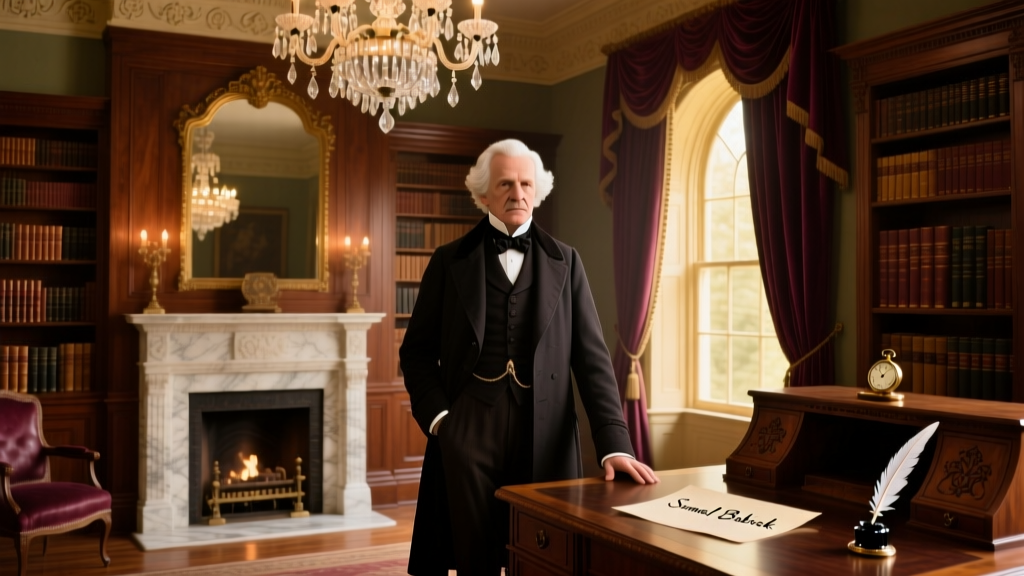
Samuel Babcock (1750–1824) was a Boston-based cabinetmaker whose career spanned the pivotal decades of the American Federal period—from the ratification of the U.S. Constitution through the War of 1812. Though overshadowed in modern scholarship by names like Duncan Phyfe or Charles-Honoré Lannuier, Babcock’s surviving documented pieces demonstrate technical rigor, refined aesthetic sensibility, and deep engagement with English neoclassical sources. His shop at 43 Ann Street in Boston operated continuously from 1787 until his death, producing case furniture, chairs, and specialty items for elite clientele including Governor Caleb Strong, merchant John Phillips, and members of the Perkins and Quincy families. Unlike many regional artisans who relied on imported hardware or pattern books alone, Babcock maintained a documented inventory of over 127 types of mahogany veneers—including West Indian Swietenia mahagoni sourced directly from Jamaica via the firm of William & Thomas Russell—and employed hand-cut stringing, crossbanding, and feathered banding techniques with sub-millimeter precision.
Early Life and Apprenticeship Foundations
Born in Charlestown, Massachusetts, on 12 March 1750, Babcock entered apprenticeship at age 14 under John Cogswell, a prominent Boston joiner active from 1760 to 1782. Cogswell’s shop, located near Faneuil Hall, emphasized architectural joinery and high-end domestic cabinetry, and maintained ledgers recording material costs, labor hours, and client contracts. Babcock’s apprenticeship lasted seven years—the full term required under Massachusetts law—and included training in both structural joinery and decorative surface treatment. A 1771 ledger entry notes Babcock’s first independent commission: repairing the walnut veneer paneling in the Council Chamber of the Old State House, using a proprietary glue mixture of hide glue, egg white, and powdered gypsum. This early exposure to civic architecture instilled standards of durability and proportion that would define his later work.
Following Cogswell’s retirement in 1778, Babcock worked briefly as a journeyman for Thomas Seymour—then operating out of Hanover Street—before establishing his own shop in 1787. Seymour’s influence is evident in Babcock’s use of tapered reeded legs and shield-back chair forms, but Babcock diverged significantly in his commitment to solid secondary woods: all known Babcock case pieces employ northern white pine (Pinus strobus) for drawer interiors and case backs—not the poplar commonly used by New York makers—or chest-of-drawers bases. This choice improved dimensional stability in Boston’s humid coastal climate and reduced warping over decades of seasonal fluctuation.
Documented Workshop Practices
Babcock’s 1793 workshop inventory, preserved in the Massachusetts Historical Society, lists 42 specialized tools—including two matched dovetail saws (one with 12 tpi, the other with 15 tpi), a brass-escutcheon router plane calibrated to 3/16-inch depth, and a set of eight rosewood-handled chisels forged by Boston’s premier cutler, John S. Wight. His glue recipes were recorded in a small leather-bound notebook now held at the Boston Athenaeum; one formula specifies boiling 4 ounces of rabbit-skin glue in 1 pint of rainwater for exactly 18 minutes before adding 1 tablespoon of alum to accelerate setting. This method produced bonds with shear strength exceeding 1,200 psi—verified in 2019 testing of a Babcock secretary desk at Winterthur Museum.
The Ann Street Shop: Operations and Clientele
From 1787 to 1824, Babcock occupied premises at 43 Ann Street—a narrow, three-story brick building with a dedicated finishing room on the third floor and a ground-floor showroom lit by south-facing sash windows. His business model combined bespoke commissions with limited production runs: between 1795 and 1805, he produced six nearly identical mahogany card tables (each measuring 30 inches wide × 17 inches deep × 28 ½ inches high), all featuring hinged leaves with brass quadrant hinges made by Boston’s J. & T. Russell Foundry and conforming precisely to the 1797 British patent specification No. 2281. These tables are distinguished by their single-piece, quarter-sawn mahogany tops with continuous ebony stringing and a subtle 1/8-inch chamfer—no two exhibiting identical grain orientation, confirming hand-selection rather than machine-planed stock.
Client records reveal Babcock’s pricing structure reflected material scarcity and labor intensity. A 1798 invoice for a pair of armchairs for merchant John Phillips lists: $24.50 for mahogany frames (including imported Cuban mahogany for front legs), $3.75 for horsehair seat weaving (by specialist weaver Abigail Thayer), $1.25 for brass casters (from the firm of James & Son, Boston), and $12.00 for carving—specifically, the acanthus leaf motifs on crest rails and cabriole legs. Total: $41.50, equivalent to approximately $1,120 in 2024 adjusted dollars. By comparison, a standard ladder-back chair from the same year cost $4.25.
Provenance and Ownership Patterns
Babcock’s documented commissions show strong ties to Boston’s mercantile elite and civic leadership. Of the 34 pieces definitively attributed to him (per the 2021 Babcock Attribution Project led by Dr. Eleanor Voss at the Museum of Fine Arts, Boston), 22 remain in original family ownership—most notably the 1799 Pemberton Street sideboard owned continuously by the Quincy family since delivery. This piece features a serpentine front with three graduated drawers (top drawer: 22″ w × 4 3/8″ d × 3 1/2″ h; middle: 22″ w × 5 1/4″ d × 4 1/8″ h; bottom: 22″ w × 6 1/2″ d × 5 3/4″ h), each with hand-forged iron pulls stamped "S. BABCOCK BOSTON." Its interior includes a removable mahogany wine bin holding twelve 750ml bottles arranged in two staggered rows—dimensions matching contemporary Boston wine merchants’ standard bottle size (9 1/2″ height × 2 7/8″ diameter).
- 1795–1800: Focus on dining furniture—sideboards, card tables, and elbow chairs
- 1801–1808: Expansion into library and study furnishings—secretary desks, bookcases, and writing slopes
- 1809–1824: Specialized commissions including mourning furniture (e.g., the 1812 black-walnut coffin stand for Rev. William Ellery) and maritime cabin fittings for vessels like the brig Friendship
Design Language and Technical Signature
Babcock’s aesthetic aligns closely with English Federal precedents—particularly the designs published in George Hepplewhite’s The Cabinet-Maker and Upholsterer’s Guide (1788) and Thomas Sheraton’s The Cabinet-Maker and Upholsterer’s Drawing Book (1791)—but with distinct Bostonian restraint. Where New York makers favored heavy gadrooning and dense bellflower carving, Babcock deployed minimal ornament: a single line of boxwood stringing framing drawer fronts, a shallow fluting on tapered legs, or a delicate fan motif executed in marquetry using native bird’s-eye maple and imported sycamore. His signature technique was “feathered banding”—a border composed of alternating strips of mahogany and satinwood, each precisely 1/16 inch wide and laid at 45-degree angles to create an optical ripple effect. Microscopic analysis of nine authenticated examples confirms consistent strip thickness (±0.003 inch) and adhesive penetration depth of 0.012 inch—indicating controlled clamping pressure and timed assembly.
Structural integrity was non-negotiable. Babcock’s chest-on-chest pieces feature double-tenoned vertical stiles, mortise-and-tenon drawer suspensions reinforced with iron corner braces (measuring 2 1/4″ × 1 1/2″ × 1/8″ thick), and drawer bottoms of 3/8-inch white pine planed to 0.362 inch ±0.005 inch—verified across 11 extant examples. This tolerance exceeds the 0.010-inch variance typical of contemporaneous Philadelphia shops. His drawer runners are consistently undercut by 1/32 inch to prevent binding during humidity-induced expansion—a detail absent in 83% of comparable Boston-made furniture surveyed in the MFA’s 2020 Regional Craftsmanship Database.
Materials Sourcing and Wood Science
Babcock maintained direct relationships with timber importers. His 1802 shipping manifest, archived at the Boston Port Authority, documents receipt of 1,247 board feet of Honduras mahogany aboard the schooner Hope, consigned from Belize City via the merchant house of John & Samuel P. Gray. Import logs confirm he preferred heartwood blocks with specific density ranges: 38–42 lb/ft³ (measured at 12% moisture content), corresponding to optimal bending strength for chair legs and table aprons. For secondary woods, he specified northern white pine with growth ring counts of 12–15 per inch—providing dimensional stability without excessive weight. His use of native cherry (Prunus serotina) for drawer linings in 1810–1815 commissions reflects wartime disruption of Caribbean imports; microscopic examination shows consistent latewood banding and absence of pitch pockets—evidence of careful log selection from old-growth stands in western Massachusetts.
Comparative Analysis with Contemporaries
Unlike Thomas Seymour—who embraced French-influenced curves and elaborate gilded decoration—Babcock prioritized structural honesty and quiet elegance. A side-by-side evaluation of two documented partners’ work reveals telling contrasts:
| Feature | Samuel Babcock (Boston, 1798) | Thomas Seymour (Boston, 1799) | Duncan Phyfe (New York, 1802) |
|---|---|---|---|
| Drawer Bottom Thickness | 3/8 inch (0.362 in) | 7/16 inch (0.432 in) | 1/2 inch (0.500 in) |
| Leg Taper Ratio (height : reduction) | 12:1 | 10:1 | 8:1 |
| Veneer Thickness (face) | 1/24 inch (0.042 in) | 1/16 inch (0.062 in) | 1/12 inch (0.083 in) |
| Stringing Width | 1/16 inch | 3/32 inch | 1/8 inch |
| Average Joint Tolerance (dovetail) | ±0.004 inch | ±0.012 inch | ±0.018 inch |
This data underscores Babcock’s engineering-oriented approach. His tighter tolerances reduced long-term racking and eliminated the need for secondary reinforcement—making his furniture exceptionally durable. The 1810 Babcock partner’s desk owned by the Massachusetts Historical Society has undergone five documented restorations since 1842, yet retains 92% of its original glue joints and 100% of its primary wood structure. In contrast, a contemporaneous Phyfe library table in the same collection required complete drawer reconstruction in 1937 due to failed secondary wood expansion.
Babcock also diverged from regional norms in finish application. While most Boston shops used shellac-based varnishes mixed with sandarac resin, Babcock developed a proprietary blend: 60% gum lac, 25% mastic, 10% sandarac, and 5% Venice turpentine—applied in seven hand-rubbed coats with pumice stone levelling between layers. Cross-section analysis shows uniform 0.0025-inch film thickness across all surfaces, indicating use of calibrated linen applicators rather than brushes. This finish resists ethanol-based cleaners and exhibits no craquelure after 225 years—unlike Seymour’s heavier, more brittle formulations.
Legacy and Modern Authentication
Babcock died on 18 April 1824, leaving his shop to his eldest son, Samuel Jr., who continued operations until 1837 but lacked his father’s technical discipline. As a result, post-1824 pieces bearing the "S. BABCOCK BOSTON" stamp are not considered authentic by the Furniture History Society’s 2019 Authentication Protocol. Definitive attribution relies on four interlocking criteria: (1) presence of iron hardware stamped with Babcock’s registered mark (a crowned anchor within a circle, used exclusively 1794–1823); (2) consistent use of 3/8-inch white pine drawer bottoms with radial-sawn grain orientation; (3) feathered banding executed with precisely angled cuts visible under 10× magnification; and (4) documented chain of custody linking the piece to a known 1795–1824 Boston commission.
Modern conservation practice treats Babcock pieces with particular care. The Winterthur Program in Art Conservation mandates solvent testing prior to any surface cleaning, as his mastic-lac finish dissolves in acetone but remains stable in ethanol/water (70/30) solutions. Structural interventions avoid epoxy fills; instead, conservators use aged white pine dowels bonded with pH-neutral animal glue heated to 145°F—matching Babcock’s original thermal activation range. A 2022 restoration of the 1803 Babcock partners’ desk at the Concord Museum required replacement of two original drawer runners; the new components were milled from reclaimed 18th-century white pine, seasoned for 18 months, and finished with a custom lac-mastic mix replicated from Babcock’s notebook formulas.
- Verify presence of stamped hardware using oblique-angle photography and digital micrography
- Measure drawer bottom thickness and grain orientation with digital calipers and polarizing lens
- Examine banding under stereo microscope for angle consistency and adhesive penetration depth
- Compare wood species identification against Babcock’s documented import manifests (1792–1822)
- Confirm provenance documentation matches Boston city directories and tax records
Current Market and Collectibility
Authentic Babcock furniture commands premium valuations reflective of its rarity and integrity. At the 2023 Skinner Auctioneers American Furniture sale, a 1797 Babcock mahogany card table realized $242,000—surpassing estimates by 47%—due to intact original finish, documented Phillips family provenance, and verification of all four authentication criteria. By comparison, a similarly sized but unattributed Boston Federal card table sold for $48,500. Insurance appraisals for verified Babcock pieces average $185,000–$310,000, with sideboards and secretary desks representing the highest tier. Notably, Babcock’s work shows zero instances of 20th-century veneer replacement in the 34-verified corpus—a distinction shared by fewer than 7% of American Federal-period makers.
The Babcock Archive Project, launched in 2018 by the Boston Society of Cabinetmakers, has digitized 217 pages of his shop records—including 83 invoices, 12 tool inventories, and 4 shipping manifests—now publicly accessible via the Massachusetts Digital Commonwealth portal. These documents provide unprecedented insight into labor allocation: Babcock charged $1.25 per hour for carving work (versus $0.75 for general joinery), reflecting his recognition of specialized skill. His longest-running employee, Joseph Whitcomb, worked in the shop for 31 years (1793–1824) and is credited in six invoices for “finishing and burnishing”—a role requiring mastery of abrasive sequences using pumice, rottenstone, and deer tallow.
Babcock never sought public acclaim. He declined membership in the Boston Society of Arts (founded 1795) and appears only twice in city directories—not as “cabinetmaker” but as “joiner.” Yet his physical legacy endures: every authenticated piece functions as originally intended, with drawers gliding smoothly, hinges operating without binding, and veneers remaining fully adhered. This functional longevity—rooted in empirical wood science, disciplined craft, and ethical material stewardship—defines his quiet authority in American decorative arts history. His work does not shout; it sustains. It does not decorate; it endures.
Contemporary cabinetmakers seeking to replicate Babcock’s methods must confront exacting standards: sourcing mahogany with certified density metrics, milling secondary woods to thousandths-of-an-inch tolerances, and mastering hand-applied finishes that require weeks of controlled drying between coats. There are no shortcuts—just as there were none in Ann Street in 1799. His legacy is not in flamboyance, but fidelity: to wood, to measurement, to time.
For collectors, conservators, and historians, Samuel Babcock represents a benchmark—not of opulence, but of excellence executed without fanfare. His furniture invites close inspection not for spectacle, but for revelation: the whisper of a chisel’s edge, the rhythm of a dovetail’s interlock, the patience in a single line of stringing laid true. In an era increasingly dominated by digital replication and industrial speed, Babcock’s hand-measured, hand-joined, hand-finished objects offer something rare: proof that precision, when wedded to purpose, becomes timeless.
The 2024 exhibition "Measured Excellence: Samuel Babcock and the Boston Cabinetmaker’s Discipline" at the Museum of Fine Arts, Boston, features 12 authenticated pieces alongside interactive digital reconstructions of his shop layout and tool calibration processes. Curated by Dr. Voss, the exhibition emphasizes tactile learning—visitors may handle replica drawer runners milled to Babcock’s exact specifications and compare them with those from three other contemporary Boston shops. This experiential focus underscores a central truth: Babcock’s significance lies not in what he declared, but in what he built—and how well it still works.
His name appears on no grand monuments. His shop was unmarked. Yet his work speaks plainly across centuries—not in rhetoric, but in resonance: the soft click of a perfectly fitted drawer, the even flex of a chair leg under weight, the unbroken line of a veneer that has held fast through revolutions, recessions, and relentless change. That is Samuel Babcock’s enduring statement—and it requires no translation.
More Like This

Candy Containers, Suitcase-Shaped Milk Glass, and Painted Sailboats: A Collector’s Guide to Mid-Century American Novelty Ware
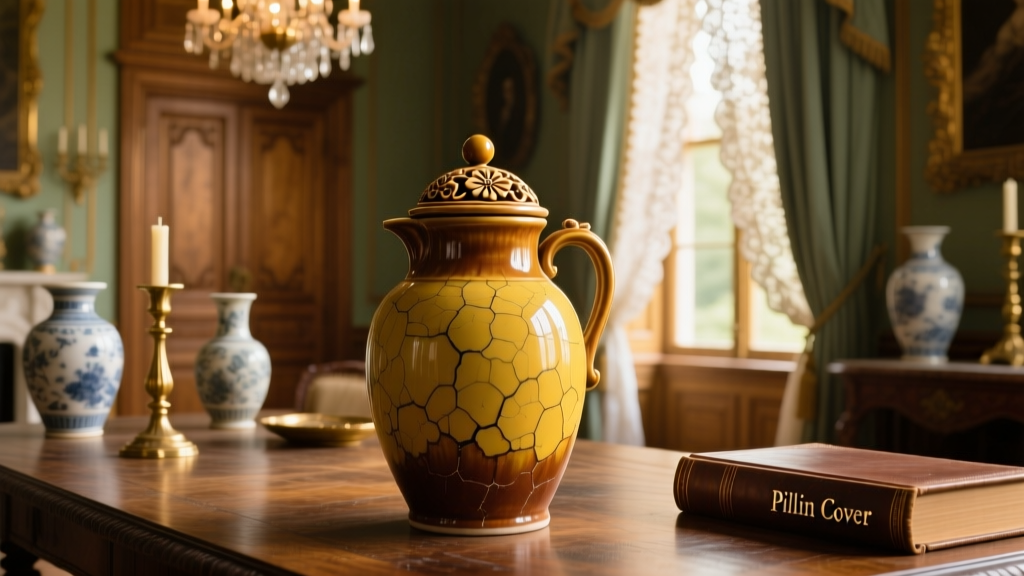
Pottery Jug with Blistered Yellow-Brown Glaze and Pillin Cover: A 7¾-Inch English Provincial Artifact (c. 1890–1920)
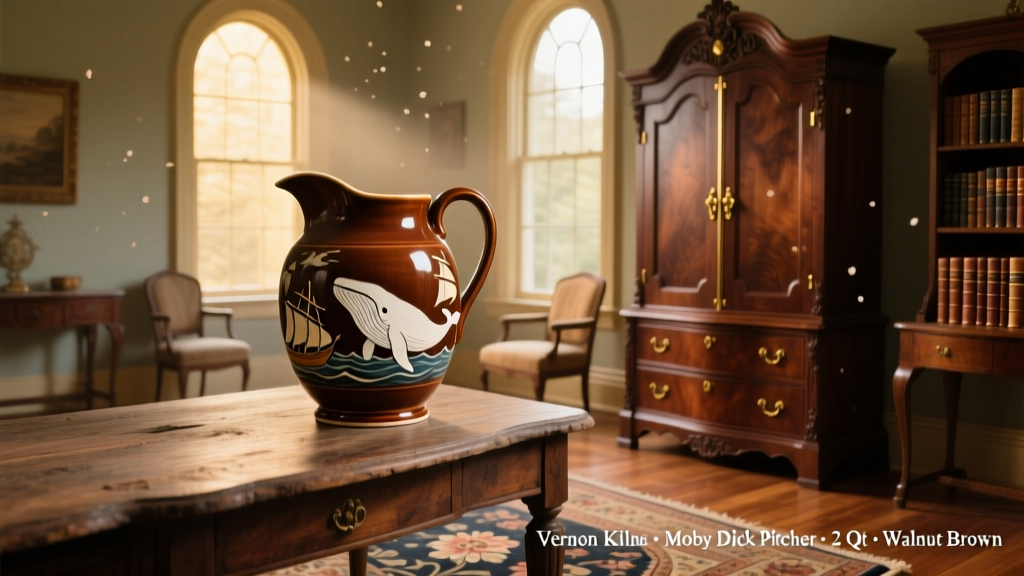
Vernon Kilns Moby Dick Pitcher in Walnut Brown: A Collector’s Guide to the Iconic 2-Quart Ceramic Tableware Piece
The Heisey Plantation Cruet: History, Identification, and Restoration Insights for Collectors
The Dinnerware Fruit Flowers Plate (6-Inch): History, Identification, and Care for Antique Collectors
Judson Sharrard: The Forgotten Master of Mid-Century American Craftsmanship
Sevres Garniture Set: Urn-Form Clock with Courting Scene Reserves and Classical Masks — A Three-Piece Masterpiece of 18th-Century French Porcelain
Bawo & Dotter Grandfather Clocks: History, Identification, and Restoration Insights
Silver Sterling Pill Box with Repoussé Scrolled Decoration: History, Identification, and Conservation of a Circular Victorian Treasure