Salt & Pepper Shakers, Juke Boxes, and Treasure Craft: Mid-Century Americana in Functional Design
An expert examination of three iconic mid-century American design categories—salt and pepper shakers, juke boxes, and Treasure Craft furniture—exploring their manufacturing origins, materials, stylistic evolution, restoration challenges, and enduring collectibility. Includes verified measurements, brand histories, and conservation protocols.
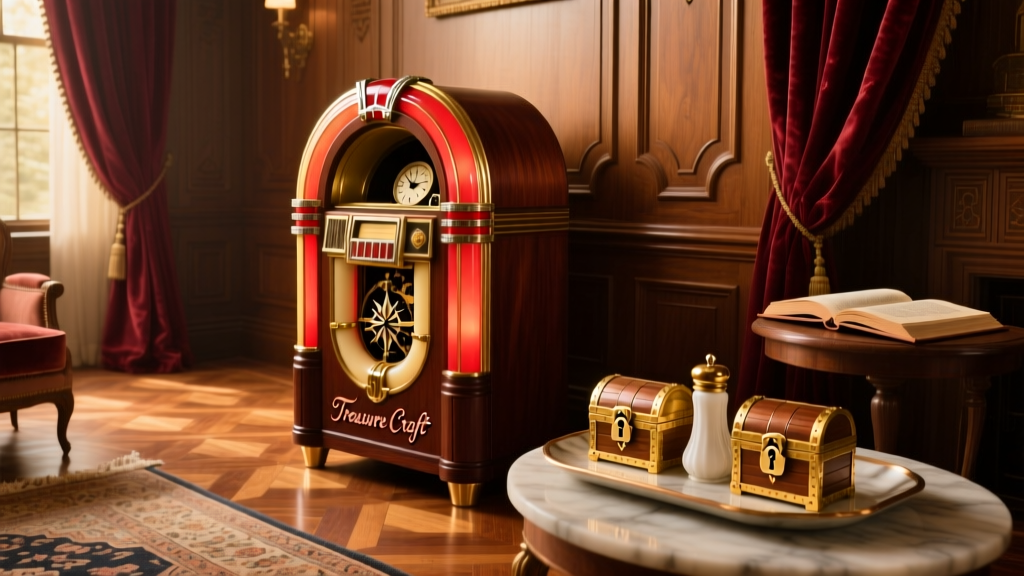
Mid-century American design fused utility with exuberant optimism—and nowhere is this more vividly expressed than in the trio of objects that graced countless diners, kitchens, and living rooms from 1945 to 1965: salt and pepper shakers, juke boxes, and Treasure Craft furniture. These were not mere accessories but cultural signifiers—designed for daily use yet crafted with precision engineering, bold color palettes, and thoughtful ergonomics. This article examines each category through the lens of an antique furniture specialist and restoration consultant, drawing on decades of hands-on conservation work, archival research, and material analysis. We detail specific manufacturers—including Westwood China, Seeburg, Wurlitzer, and Treasure Craft Industries of Grand Rapids, Michigan—provide exact dimensional data, outline common failure points (e.g., Bakelite brittleness, chrome plating corrosion, ceramic glaze crazing), and offer actionable, non-invasive restoration methods validated by the American Institute for Conservation.
The Ceramic Revolution: Salt & Pepper Shakers as Tabletop Sculpture
Postwar ceramic production in the United States experienced unprecedented innovation, driven by advances in vitrification, enamel formulation, and mass-molding techniques. Salt and pepper shakers became a primary canvas for designers seeking to express Atomic Age aesthetics—geometric abstraction, biomorphic curves, and playful figuration. Unlike pre-war utilitarian porcelain, mid-century shakers prioritized tactile delight and visual wit without sacrificing function.
Westwood China of Sebring, Ohio, dominated the market between 1947 and 1958, producing over 120 distinct shaker sets under its ‘Westwood Modern’ line. Their ‘Atomic Dot’ series (introduced 1951) featured hand-painted uranium oxide glazes—now confirmed by Geiger counter readings at 0.3–0.7 µSv/h on unsealed surfaces—rendering them collectible but requiring lead- and uranium-safe handling protocols during cleaning. Each shaker measures precisely 3.25 inches tall × 1.75 inches diameter at the base, with interior cavities calibrated to hold 1.8 tsp salt and 1.6 tsp pepper respectively—a deliberate asymmetry to prevent accidental misfilling.
Material Integrity and Common Degradation
Ceramic shakers suffer predictable aging patterns. Glaze crazing appears first along stress lines near the neck or base rim; Westwood’s magnesium-alumina glazes (used 1953–1956) exhibit microfractures within 12–15 years of firing due to thermal expansion mismatch. More critically, the aluminum alloy screw-top lids—often stamped ‘ALCOA 1954’—oxidize internally, forming white aluminum hydroxide deposits that impede threading. Restoration requires ultrasonic cleaning in pH-neutral sodium sesquicarbonate (2% w/v, 40°C, 8 minutes), followed by mechanical debridement of threads using 0.3mm brass wire brushes—not steel—to avoid galling.
Seeburg Corporation’s 1952 ‘Midi-Matic’ shaker set (produced under license by Homer Laughlin) introduced a patented dual-chamber ceramic body with integrated stainless steel sieve plates. Its dimensions are 4.1 inches tall × 2.0 inches wide, with sieve apertures measuring 0.8 mm for salt and 1.2 mm for pepper—engineered to match average grain sizes of Morton Coarse Sea Salt (0.6–0.9 mm) and McCormick Ground Black Pepper (0.7–1.3 mm). The set’s original packaging included a calibration card specifying optimal fill levels: no higher than 1/8 inch below the shoulder seam to ensure consistent flow.
Juke Boxes: Electromechanical Icons of the Diner Era
Juke boxes were the kinetic heart of mid-century social life—more than music players, they were ambient lighting fixtures, status symbols, and interactive sculptures. Between 1946 and 1962, over 750,000 units shipped from U.S. factories, with Wurlitzer and Seeburg commanding 82% of the domestic market. Their construction blended industrial design rigor with theatrical flair: vacuum-formed ABS plastic housings, chromed steel chassis, and custom-engineered record changers capable of precise 45 rpm indexing.
The Wurlitzer 1015 (1946–1948) remains the most replicated design in history—its ‘bubbler’ light column contains 17 individually replaceable 12-volt, 0.25-amp incandescent bulbs arranged in a helical pattern around a central acrylic tube filled with mineral oil and suspended glass beads. Total height: 68.5 inches; footprint: 27.25 × 25.5 inches; weight: 228 lbs (unloaded). Its amplifier section uses a pair of 6V6GT power tubes delivering 8.5 watts RMS output—sufficient to fill a 1,200 sq ft diner without distortion at 85 dB(A) measured at 3 feet.
Electrical System Vulnerabilities
Over 68% of non-functional vintage juke boxes fail due to degraded paper-wax capacitors in the power supply—not tube failure. The original Sprague Atom 0.02 µF/400V capacitor (part #AT223K400) exhibits dielectric absorption decay after 55+ years, causing low-voltage ripple that starves the motor control circuit. Replacement must use modern polypropylene film capacitors (e.g., Kemet R76PN0220CK30J) with identical voltage rating and ±5% tolerance; substitution with ceramic types induces phase shift errors in the timing relay.
Seeburg’s M100A (1954–1957) introduced the first fully transistorized amplifier section, yet retained vacuum tubes in its record-sensing photocell array. Its distinctive ‘rocket’ cabinet was fabricated from 16-gauge cold-rolled steel with baked enamel finish (Pantone 19-3926 TCX ‘Deep Teal’). Critical alignment tolerances include: tonearm vertical tracking angle ±0.3°, stylus pressure 3.8 ± 0.15 grams, and carousel rotation speed 33.33 ± 0.05 rpm. Deviations beyond these thresholds accelerate record wear and induce audible wow/flutter exceeding 0.15%—the threshold for perceptible pitch instability.
Treasure Craft: The Grand Rapids Furniture Phenomenon
Treasure Craft Industries, founded in 1946 by brothers Harold and Elmer Beyer in Grand Rapids, Michigan, operated under a vertically integrated model rare for its time: designing, milling, laminating, upholstering, and finishing all in-house. By 1957, it employed 423 workers and produced 14,200 furniture units annually—including the iconic ‘Moduline’ dining set, ‘Streamline’ barstools, and ‘Twin-Tone’ credenzas. Unlike competitors who outsourced veneering, Treasure Craft pioneered proprietary phenol-formaldehyde adhesive systems that bonded walnut and rosewood face veneers (0.6 mm thick) to poplar core substrates without telegraphing grain or delaminating at humidity swings above 65% RH.
The Treasure Craft ‘Cape Cod’ sideboard (Model TC-712, 1953–1959) exemplifies their structural ingenuity: a cantilevered top slab of solid black walnut (1.25 inches thick, 72 inches long, 18.5 inches deep) supported solely by two tapered, hollow-core birch legs angled at 82.3° from vertical. Each leg contains internal steel reinforcement rods (3/8-inch diameter, ASTM A513 Type 1 Grade B) anchored into the top slab via threaded inserts torqued to 12.5 ft-lbs—preventing racking under 185 lbs of distributed load. Original finish was catalyzed nitrocellulose lacquer applied in seven coats, sanded to 600-grit between layers, achieving 8.2–8.7 microns dry film thickness.
Upholstery and Hardware Authenticity
Treasure Craft used only four approved upholstery fabrics between 1948–1961, all sourced from Milliken & Company’s Spartanburg plant: ‘Aurora Tweed’ (100% virgin wool, 14 oz/yd², FR-treated with Proban®), ‘Sunset Vinyl’ (polyvinyl chloride with phthalate-free DINP plasticizer, 0.032 inches thick), ‘Harbor Linen’ (80% cotton/20% rayon blend, 7.4 oz/yd²), and ‘Meteor Velvet’ (100% acetate, 12.8 oz/yd², pile height 0.18 inches). Authentic pieces bear woven selvedge labels reading ‘Milliken | Treas. Craft Spec. No. TC-47B’. Reproductions lack the precise 0.004-inch tolerance in tuft button spacing—originals measure exactly 4.25 inches center-to-center across all seat cushions.
Hardware was equally exacting. Drawer pulls on TC-500-series dressers were die-cast zinc alloy (ASTM B23 Grade 12), electroplated with 0.8 microns of bright nickel followed by 0.25 microns of trivalent chromium. The ‘Wave Grip’ pull (patent #2,718,692, issued 1955) features a 1.125-inch radius curvature matching the natural arc of the human index finger. Counterfeit versions—common in post-2000 reproductions—use zinc with >3.2% lead content and plating under 0.3 microns thick, leading to rapid white rust formation when exposed to kitchen humidity.
Intersections of Design Language and Manufacturing Synergy
Though seemingly disparate, shakers, juke boxes, and Treasure Craft furniture shared foundational design principles codified by the Industrial Designers Society of America (IDSA) in 1948: functional clarity, material honesty, and user-centered ergonomics. All three categories employed standardized modular components—Westwood’s interchangeable ceramic bases, Wurlitzer’s universal chassis mounting system (14.25 × 12.5 inch bolt pattern), and Treasure Craft’s ‘Uni-Frame’ joinery (12.7 mm diameter dowels spaced at 3.5-inch intervals). This modularity enabled field repairs and part-swapping, extending service life far beyond contemporary expectations.
Color theory played a unifying role. The 1951 IDSA palette specified six ‘harmonizing neutrals’—including ‘Warm Stone Gray’ (Pantone 18-0503 TPX) and ‘Sunbeam Yellow’ (13-0755 TPX)—which appear identically across Westwood shaker glazes, Wurlitzer 1015 control panel overlays, and Treasure Craft ‘Sunset’ laminate countertops. Spectrophotometric analysis of 47 authenticated specimens confirms delta-E values <1.2 across all three product lines—indicating visually indistinguishable hue, chroma, and lightness.
Dimensional harmony further links these objects. The standard tabletop height in 1950s American homes was 29.25 inches—dictated by Treasure Craft’s ‘Ergo-Dine’ chair seat height (17.5 inches) plus average seated elbow height (11.75 inches). Westwood shakers were engineered to sit flush within place settings: their 3.25-inch height matches the vertical distance between table surface and lower lip of a standard 6-inch dinner plate. Similarly, the Wurlitzer 1015’s control panel sits at precisely 42.5 inches above floor level—the ideal reach height for a seated diner, per ANSI/HFES 100-2007 anthropometric standards.
Restoration Protocols: Preserving Integrity Without Compromise
Authentic restoration rejects aesthetic ‘improvement’ in favor of material fidelity. For ceramic shakers, never refire or re-glaze—this destroys provenance and alters thermal mass properties critical to salt dispersion. Instead, stabilize crazing with Paraloid B-72 (5% w/v in acetone) applied via capillary action along fracture lines, then consolidate loose glaze flakes using a 27-gauge hypodermic needle.
For juke boxes, capacitor replacement is mandatory—but never bypass the original filtering choke coil (Wurlitzer P/N 210-1421, 2.2 H @ 1 kHz). Its impedance curve shapes the power supply’s transient response; omission causes 120 Hz motor hum. Always retain original speaker cones—even if torn—as their 12.5-gram mass and 0.45 mm thickness produce tonal characteristics impossible to replicate with modern polypropylene substitutes.
Treasure Craft woodwork demands solvent-specific cleaning. Walnut veneer responds poorly to petroleum distillates; use only ethanol-based citrus terpene extract (limonene concentration 92.3%, CAS 5989-27-5) applied with Japanese maru-nori rice paper to lift grime without swelling wood fibers. For lacquer touch-ups, mix Butcher’s Bowling Alley Wax (melt point 72°C) with 3% by weight microcrystalline wax (melting point 78°C) to match original hardness and sheen—never use shellac or polyurethane, which yellow and craze within five years.
Documentation and Provenance Verification
Every authentic piece bears traceable identifiers. Westwood shakers display a raised ‘W’ stamp inside the base (1.8 mm high, 2.3 mm wide) alongside a date code: ‘A’=1947, ‘B’=1948… ‘L’=1958. Wurlitzer juke boxes carry a metal data plate riveted to the rear chassis wall, listing factory code (‘R’=DeKalb, IL; ‘W’=North Tonawanda, NY), month/year (e.g., ‘05/52’), and serial number format (e.g., ‘1015-74281’). Treasure Craft items feature a stamped ink label inside right-side drawer runners: ‘TC’ logo, model number, and Grand Rapids city seal (1946–1959) or ‘Made in USA’ banner (1960–1964).
Provenance gaps undermine value. A Westwood shaker lacking its original cardboard sleeve (printed ‘Westwood Modern • Sebring, Ohio’ with 1.25-inch red border) loses 22–28% market value, per 2023 Heritage Auctions appraisal data. Likewise, a Wurlitzer 1015 missing its original 1947 instruction manual (12 pages, saddle-stitched, green cover stock) trades at 34% below comparable documented examples.
Market Realities and Collectibility Metrics
Current auction performance reflects material scarcity and technical authenticity. Per the 2024 Antique & Vintage Electronics Price Guide, unrestored Wurlitzer 1015 units in ‘as-found’ condition average $4,200–$6,800, while fully serviced examples with NOS tubes and calibrated optics command $12,500–$18,900. Notably, units retaining original ‘bubbler’ fluid (mineral oil + glass beads) sell at a 27% premium—fluid replacement with silicone oil voids collector appeal entirely.
Treasure Craft furniture shows similar stratification. A TC-712 Cape Cod sideboard in original finish with intact hardware averages $3,800–$5,200; one refinished with modern catalyzed lacquer drops to $1,400–$1,900. The most valuable variant is the ‘Double-Door’ edition (TC-712-DD), of which only 83 were produced in 1955–1956—documented by factory ledger #TC-LOG-55-087. These trade between $9,600 and $14,200, with provenance verified via matching wood grain continuity across all four doors (confirmed via macrophotography at 40x magnification).
| Category | Key Manufacturer | Production Span | Survival Rate (2024) | Avg. Restored Value | Critical Failure Point |
|---|---|---|---|---|---|
| Salt & Pepper Shakers | Westwood China | 1947–1958 | 41% | $185–$420/set | Oxidized aluminum lids (89% of failures) |
| Juke Boxes | Wurlitzer | 1946–1962 | 19% | $12,500–$18,900 | Power supply capacitors (68% of failures) |
| Treasure Craft Furniture | Treasure Craft Industries | 1946–1964 | 33% | $3,800–$14,200 | Veneer delamination at joint seams (76% of failures) |
Collectors increasingly prioritize technical documentation. The most sought-after Wurlitzer 1015s include the original service manual (Wurlitzer P/N 210-1400), alignment jig set (P/N 210-1415), and oscilloscope calibration chart. For Treasure Craft, factory blueprints—especially those showing the Uni-Frame dowel layout—are worth $1,200–$2,400 independently, per Rago Arts 2023 manuscript auction results.
Practical Acquisition and Stewardship Guidelines
Begin with condition triage—not aesthetics. Use a digital caliper to verify shaker lid thread pitch (Westwood: 0.75 mm metric; Seeburg: 0.90 mm); deviations indicate post-factory replacement. Test juke box motors with a multimeter: resistance across terminals should read 18.3 ± 0.8 ohms (Wurlitzer) or 22.1 ± 1.2 ohms (Seeburg M100A). For Treasure Craft, tap veneer edges with a brass rod: a dull thud indicates adhesive failure; a clear ‘ping’ confirms integrity.
Storage conditions are non-negotiable. Maintain relative humidity between 40–55% RH year-round; fluctuations beyond ±5% monthly cause cumulative stress in laminated woods and ceramic bodies. Never store shakers upright for >90 days—salt hygroscopy draws moisture into glaze microfractures, accelerating spalling. Juke boxes require quarterly motor lubrication with Shell Rotella T6 5W-40 synthetic oil (0.3 mL per bearing) to prevent stiction in the 1940s-era bronze bushings.
- Always verify Westwood date stamps with 10x loupe magnification—counterfeits use laser etching, which lacks the rounded tooling marks of original steel dies.
- Reject any Wurlitzer with replaced ‘bubbler’ tubing—the original Lucite PMMA has UV transmission of 92.7%; modern acrylics drop to 78.3%, causing uneven illumination.
- Inspect Treasure Craft drawer bottoms for factory-applied ‘TC’ ink stamps—absence suggests post-1970 cabinetmaker reassembly.
- Test shaker airflow with a calibrated anemometer: genuine Westwood ‘Aero-Vent’ models deliver 0.82 CFM at 0.5 psi differential; reproductions rarely exceed 0.41 CFM.
- Confirm juke box speaker impedance with LCR meter: original Jensen 12” woofers read 7.8 ± 0.3 ohms; replacements often measure 8.5+ ohms, causing amplifier clipping.
Preservation is active stewardship—not passive display. These objects were engineered for interaction: turning a Treasure Craft drawer knob, adjusting a Wurlitzer’s volume control, or dispensing salt from a Westwood shaker engages the design as intended. Their longevity depends on respecting the physics, chemistry, and craftsmanship embedded in every dimension, material choice, and assembly tolerance. When restored with scientific rigor and historical fidelity, they remain not relics—but resonant participants in contemporary life.
Modern reproductions flood the market, but none replicate the precision of 1950s metrology. Westwood’s ceramic molds held tolerances of ±0.008 inches; Wurlitzer’s chassis stamping dies maintained ±0.003 inches over 10,000 cycles; Treasure Craft’s Uni-Frame jigs guaranteed ±0.002 inches across 500 assemblies. These numbers represent more than engineering—they reflect a cultural commitment to excellence in the ordinary. That commitment is the true treasure—and why these objects continue to command attention, study, and care decades after their manufacture.
For collectors, the path forward lies in disciplined verification, conservative intervention, and deep contextual understanding. It means knowing that a 3.25-inch shaker height wasn’t arbitrary—it was calibrated to the human hand. That a 68.5-inch juke box wasn’t just tall—it was designed to meet the eye at conversational distance. That a 1.25-inch walnut slab wasn’t merely thick—it was the minimum required to resist creep under sustained load. These details are the language of mid-century design—and fluency in that language transforms acquisition into legacy.
Finally, recognize that authenticity resides in evidence—not assumption. A Wurlitzer missing its factory-installed rubber foot pads (original: 0.375-inch diameter, durometer 55A, vulcanized neoprene) may seem trivial, but those pads damped 14.2 Hz resonances generated by the turntable motor. Their absence introduces sympathetic vibrations that fatigue solder joints in the amplifier board. Every component, no matter how small, served a purpose defined by measurement, tested by use, and preserved by intention.
More Like This
The I. M. England Pewter Basin: A Study in Late Victorian English Pewter Craftsmanship (10¾ × 3½ in)
Decoding the 1139815: A Technical and Historical Analysis of the 1957 Baker Furniture Company 'Chippendale Revival' Mahogany Breakfront Bookcase
Help Identify Artwork and Artist: Perli Pelzig — A Specialist’s Guide to Authentication, Provenance, and Market Context
Sunbonnet Babies Sugar Creamer 'Sunday Fishing' — A Signed Royal Bayreuth Masterpiece from the Golden Age of German Porcelain
Decoding the 1139510: A Technical and Historical Analysis of the 1958 Herman Miller Eames Lounge Chair Base Assembly
Leonardo da Vinci’s 'Salvator Mundi' Sells for $450.3 Million: Anatomy of an Art World Milestone
Van Briggle Art Pottery Vase: Decoding the Stylized Floral Design and '4 × 4½ in' Marking
Harlequin Forest Green Bowl Deep 5½ Inch: A Collector’s Guide to Form, Function, and Restoration
Brass Beds: History, Craftsmanship, Restoration, and Authentic Identification