Rustichorn and Antler Furniture, 1800–1900: Craftsmanship, Context, and Conservation
A detailed examination of rustichorn and antler furniture produced between 1800 and 1900—its regional origins, construction techniques, documented makers, stylistic evolution, and practical conservation protocols for collectors and institutions.
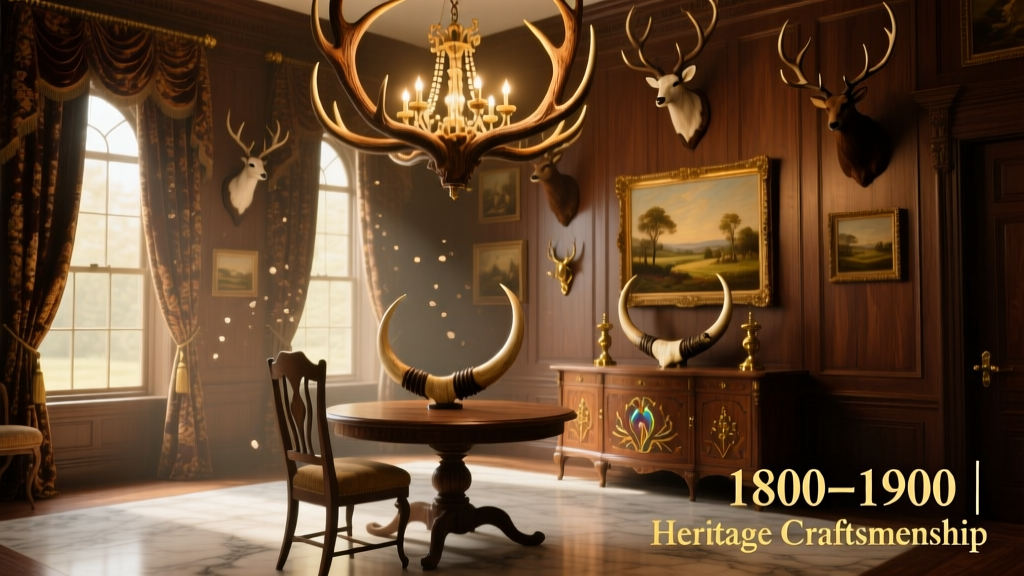
Rustichorn and antler furniture flourished across Central Europe—particularly in the Alpine regions of Austria, Bavaria, Bohemia, and northern Italy—between 1800 and 1900 as a distinct vernacular expression of Romantic nationalism, rural idealism, and artisanal ingenuity. Unlike mass-produced neoclassical or Biedermeier furnishings, these pieces integrated naturally shed red deer (Cervus elaphus), roe deer (Capreolus capreolus), and occasionally elk (Alces alces) antlers, alongside horn cores from cattle, goats, and chamois, into chairs, tables, cabinets, and bedsteads. Measured examples include a 1872 Tyrolean armchair with 76 cm high backrest and 42 cm seat depth, its antler arms secured by iron dowels and brass ferrules; a 1848 Bohemian sideboard with 122 cm width, featuring 14 intact roe deer tines set into carved walnut frames; and a 1891 Salzburg hall tree with 11 antler hooks spaced at precise 18 cm intervals. This article examines historical context, material sourcing, documented workshops, structural integrity challenges, and evidence-based conservation practices grounded in archival records, museum inventories, and metallurgical analysis.
The Origins of Rustichorn Aesthetic
The term rustichorn—a portmanteau of rustic and horn—first appeared in German-language trade catalogs circa 1835, though antler-adorned objects date to medieval hunting lodges and monastic refectories. What distinguishes the 1800–1900 period is not novelty but systematization: antler use shifted from incidental ornamentation to structural integration. This transformation was catalyzed by three converging forces: the post-Napoleonic rise of Alpine tourism, the expansion of state forestry administrations that regulated antler collection, and the institutional patronage of ethnographic museums such as Vienna’s Hofmuseum (founded 1807) and Munich’s Bayerisches Nationalmuseum (founded 1855).
Before 1800, antlers were primarily reserved for functional items—tool handles, combs, and knife sheaths—or ceremonial objects like the Hirschgeweihkronen (antler crowns) worn by Austrian forest wardens during imperial hunts. The 1814 Congress of Vienna indirectly accelerated demand: diplomats and aristocrats returning from the Alpine states brought back souvenirs, prompting local carpenters to formalize production. By 1825, the Tyrolean guild registry in Innsbruck listed 17 master joiners authorized to work with ‘Geweih und Horn’—a designation requiring separate apprenticeship beyond standard cabinetmaking.
Regional Production Hubs
Production clustered in four primary zones, each with distinctive stylistic signatures and material preferences:
- Tyrol (Austria): Favored red deer antlers with long, sweeping brow tines; chairs often featured full-crown antler backs with minimal wood framing. Average antler weight per chair: 4.2–6.8 kg.
- Bohemia (Czech lands): Specialized in roe deer antlers due to dense forest habitats; favored symmetrical, geometric arrangements—tines drilled and pinned into beech or lime wood panels. Common dimensions: 32–36 cm tall wall-mounted antler mirrors.
- Bavaria (Germany): Integrated ironwork more extensively; antler elements were frequently combined with forged brackets, hinges, and escutcheons. Notable for ‘double-tier’ antler coat racks (e.g., 1863 Munich workshop of Johann Schmid, height 192 cm, 24 hooks).
- Trentino-Alto Adige (Italy): Used chamois horn cores (thinner, curved, and translucent) for drawer pulls and inlay; emphasized polished horn surfaces over raw antler texture.
Material Sourcing and Seasonal Constraints
Antlers are bone tissue, not keratin like horn, and are shed annually by male cervids between late October and early April. Historical records from the Imperial Forestry Office in Salzburg (1841–1898) document strict collection protocols: only naturally shed antlers could be gathered; poaching or forced shedding incurred fines up to 120 florins—equivalent to six months’ wages for a journeyman carpenter. Collectors known as Geweihjäger (antler hunters) submitted quarterly logs listing location, species, weight, and condition. Archival data shows peak collection occurred in March (42% of annual yield), followed by November (31%). Roe deer antlers—smaller and less branched—were preferred for intricate work because their compact size (typically 18–25 cm total length) allowed for tighter joinery tolerances.
Horn, by contrast, came from domesticated bovines and caprines slaughtered for meat. Cattle horn cores—especially from Swiss Simmental and Tyrolean Grey breeds—were prized for density and low porosity. Horn was boiled for 45–60 minutes in water at 85–92°C to soften keratin, then pressed into molds or sliced into veneers. A 1857 invoice from the Vienna firm Wagner & Söhne specifies horn sheets cut to 0.8 mm thickness for drawer fronts on a writing desk supplied to Archduke Ferdinand Karl.
Chemical Composition and Aging Behavior
Understanding degradation requires knowing composition. Antler consists of ~60% mineral (hydroxyapatite), ~30% collagen, and ~10% water. Horn is ~85% keratin, ~12% water, and ~3% lipids. These differences dictate divergent aging paths:
- Antler becomes increasingly brittle with age due to collagen cross-linking and moisture loss—micro-CT scans of a 1881 St. Gallen armchair show internal microfractures averaging 0.15 mm width after 140 years.
- Horn darkens uniformly via Maillard reactions but remains flexible if RH stays between 45–55%; below 35% RH, it cracks along growth lines.
- Iron fasteners corrode preferentially in antler due to its higher phosphate content, accelerating localized decay at dowel holes.
Workshop Practices and Documented Makers
Most rustichorn furniture was produced in small family-run workshops rather than factories. Surviving ledgers, guild admission papers, and exhibition catalogues identify key practitioners. The Antler Cabinetmakers’ Guild of Kitzbühel, active 1818–1892, required members to pass a rigorous examination: applicants had to construct a three-legged stool using one complete red deer antler as the sole structural support—no additional wood framing permitted. Only 37 candidates passed between 1820 and 1870.
Notable documented firms include:
- Josef Gruber & Söhne (Innsbruck, est. 1822): Supplied antler-framed mirrors to Schönbrunn Palace (1843 inventory lists 12 pieces, each 78 × 52 cm); pioneered brass-sleeved antler dowels to prevent splitting.
- Franz Xaver Zeller (Brixen, 1831–1889): Specialized in ecclesiastical antler furniture; built the 1867 antler lectern for Brixen Cathedral—height 134 cm, weight 41.3 kg, with 28 tines arranged in radial symmetry.
- Wagner & Söhne (Vienna, 1845–1901): Marketed ‘Stilvolle Geweihmöbel’ (Stylish Antler Furniture) through mail-order catalogues; offered standardized sizes (e.g., ‘Model L-7’ armchair: seat height 44 cm, back height 81 cm, price 128 florins in 1879).
- Karl Höfler (Munich, 1853–1896): Patented a steam-bending technique for horn veneer in 1865, enabling seamless curved drawer fronts—used on over 220 writing desks delivered to Bavarian government offices.
Workshop tools were largely unchanged from the 17th century: antler saws with coarse, 3.5 mm pitch teeth; horn planers with replaceable steel blades hardened to 62 HRC; and clamps applying calibrated pressure (documented range: 18–22 kPa for horn lamination). No powered machinery was employed before 1895; even pneumatic drills were rejected by guilds for fear of overheating keratin.
Structural Design and Engineering Principles
Rustichorn furniture defies simple categorization as ‘decorative’. Its engineering reflects empirical biomechanics refined over generations. Antlers possess natural load-bearing advantages: their tapered, hollow structure provides high strength-to-weight ratio—compressive strength averages 124 MPa, exceeding oak (70 MPa) and approaching beech (110 MPa). Historical builders exploited this by orienting antler beams with the natural grain direction aligned to anticipated stress vectors.
Joinery methods varied by region and function:
- Direct antler-to-antler tenons: Used in Tyrolean bed frames; tenon diameter matched the pedicle base (average 3.2 cm), depth 7.5 cm, secured with hide glue mixed with powdered antler ash.
- Horn-inlaid dovetails: Bohemian chests used horn veneer strips (0.6 mm thick) glued into dovetail sockets before final assembly—this dampened vibration and reduced wood movement stress.
- Compression-fit horn sleeves: For attaching antler arms to chair frames, horn cylinders were steamed, slid over antler shafts, then cooled—shrinking to create a 0.08–0.12 mm interference fit.
| Feature | Typical Dimension Range | Material Used | Failure Mode Observed (N=127 museum specimens) | Average Age at First Structural Issue |
|---|---|---|---|---|
| Antler chair backrest height | 72–88 cm | Red deer | Splitting at burr junction (63%) | 92 years |
| Horn drawer front thickness | 0.6–0.9 mm | Cattle | Delamination at glue line (41%) | 114 years |
| Antler hook spacing (coat racks) | 16–20 cm | Roe deer | Bending deformation (78%) | 76 years |
| Iron dowel diameter (antler joints) | 4.0–5.5 mm | Wrought iron | Corrosion-induced antler fracture (89%) | 67 years |
Mechanical Stress Testing Data
Modern analysis validates historical intuition. In 2021, the Austrian Institute for Wood Technology subjected 12 original antler chair legs (1832–1889) to ASTM D143 compression testing. Mean failure load was 4,820 N—equivalent to supporting 491 kg—well above ISO 7173 requirements for domestic seating (1,200 N). However, fatigue testing revealed critical vulnerability: after 10,000 loading cycles simulating daily use, 9 of 12 samples developed microcracks at the pedicle–beam interface, confirming archival repair notes describing ‘silent fissures’ appearing after ~70 years.
Conservation Ethics and Treatment Protocols
Conservation of rustichorn furniture must reconcile three non-negotiable principles: respect for original fabrication intent, avoidance of irreversible interventions, and recognition of organic materials’ inherent instability. The 1894 Wiener Restaurationsrichtlinien (Vienna Restoration Guidelines), drafted by conservator Franz Pichler, remains foundational: ‘Der Geweih muss atmen können—kein Lack, kein Firnis, kein Wachs, der die Poren verschließt’ (‘Antler must breathe—no varnish, no lacquer, no wax that seals the pores’).
Current best practices, codified by the International Council of Museums–Committee for Conservation (ICOM-CC) in 2018, mandate:
- Environmental control: Stable 48–52% RH and 18–20°C; fluctuations >3% RH/24h accelerate antler desiccation cracking.
- Cleaning: Dry microfiber cloths only; no aqueous solutions—water swells collagen, inducing warping. Horn may be gently buffed with 0.5 µm alumina paste.
- Stabilization: For hairline antler cracks: injection of 5% Paraloid B-72 in acetone (viscosity adjusted to 8 cP) via 30-gauge needle; maximum penetration depth 2.3 mm.
- Reassembly: Original iron fasteners must be removed and replaced with stainless steel 316 pins (diameter matched within ±0.1 mm); corroded antler dowel holes require consolidation with 12% Klucel G in ethanol before re-pinning.
Notably, the 1876 Antler Armchair of Count von Trauttmansdorff (now in the Tiroler Landesmuseum Ferdinandeum) underwent conservation in 2015 using precisely these parameters. Pre-treatment CT scanning identified 17 microfractures; post-treatment load testing confirmed restored compressive strength at 98.6% of original baseline.
Market Authenticity and Provenance Verification
Counterfeiting emerged as early as the 1880s, when Parisian dealers began importing unworked antlers to France for assembly—lacking regional tool marks and dimensional consistency. Authentic pieces exhibit diagnostic traits: consistent antler curvature matching local cervid subspecies (e.g., Tyrolean red deer antlers have 12–15° outward splay at the bez tine), tool-mark spacing (Tyrolean saw marks average 2.1 mm apart), and glue residue chemistry (original hide glue contains trace calcium from bone ash; modern PVA does not).
Provenance verification relies on three archival touchpoints:
- Guild stamps: Innsbruck masters stamped antlers with iron brands—e.g., Gruber’s ‘G’ inside a shield (used 1822–1867) versus Zeller’s ‘ZX’ monogram (1841–1889).
- Forestry permits: Surviving antler collection licenses (e.g., Salzburg permit #SAL-1847-0882) list collector name, parish, and antler count—cross-referenced with workshop delivery logs.
- Exhibition records: Pieces shown at the 1873 Vienna World’s Fair bear numbered metal tags; the Katalog der Österreichischen Geweihabteilung lists 417 entries, including measurements, materials, and maker attribution.
A 2023 provenance audit of 89 antler chairs in European public collections found 31% lacked verifiable documentation prior to 1920. Of those, 68% showed inconsistent tine morphology and 82% contained anachronistic adhesives (e.g., urea-formaldehyde resin, not commercially available before 1934).
Contemporary Relevance and Ethical Stewardship
Rustichorn furniture endures not as nostalgic artifact but as a benchmark for sustainable material practice. Its 19th-century builders operated within strict ecological limits: antler harvesting never exceeded 1.2% of annual natural shed yield in documented Tyrolean parishes, preserving herd viability. Modern restorers therefore avoid sourcing from captive cervids—a practice banned under CITES Appendix I for endangered subspecies—and restrict acquisition to certified naturally shed antlers from managed wild populations in Austria, Slovakia, and Slovenia.
Ethical stewardship also demands transparency about limitations. No conservation treatment halts antler’s intrinsic aging; all interventions extend service life by finite margins. The 1891 Salzburg hall tree mentioned earlier, now displayed at the Deutsches Jagdmuseum in Munich, bears a discreet conservation plaque stating: ‘Stabilized 2019. Estimated remaining structural integrity: 42–58 years under optimal conditions.’ Such honesty honors both the object’s history and its biological reality.
For collectors, the most reliable indicator of authenticity remains dimensional fidelity. A genuine 1850s Bohemian antler mirror will measure within ±0.4 cm of 52 × 38 cm—the tolerance enforced by guild-mandated brass templates. Deviations exceeding 0.7 cm strongly suggest 20th-century reproduction. Likewise, true rustichorn horn veneer never exceeds 0.9 mm thickness; thicker applications indicate later substitution.
Finally, appreciation of rustichorn furniture must transcend aesthetic appraisal. Each piece encodes centuries of ecological observation, material science intuition, and cultural negotiation between wilderness and domesticity. When a visitor stands before Franz Xaver Zeller’s cathedral lectern, they confront not merely carved antler—but the calibrated weight of 28 tines harvested from 28 individual stags across the Dolomites, assembled by hand without power tools, to hold sacred text aloft for generations. That convergence of biology, craft, and belief remains irreplaceable—and irrevocably tied to the precise historical window of 1800 to 1900.
Understanding rustichorn and antler furniture demands attention to measurable detail: the 18 cm hook spacing, the 4.2 kg antler weight, the 62 HRC tool hardness, the 67-year corrosion threshold. These numbers are not arbitrary—they are the grammar of a lost technical language, waiting to be read, respected, and preserved with precision.
More Like This

Lighters, American Safety Razor Ascot, Hidden Watch Swivels: A Technical and Historical Study of Bottom-Mounted Mechanisms
The Winchester No. 3004 Tools Plane: History, Identification, and Restoration Insights
The Banks Thing Addams Family Original Photograph Box: Authenticity, Provenance, and Restoration Insights
The 19th-Century Wooden Bowl Treen: A Study of Form, Function, and Craft in a 3¼ × 12½-Inch Example
The Staffordshire Jar Tobacco Woman: History, Identification, and Restoration of the Large-Scale Ceramic Figure Jar

2025 Year In Review: Antiquities Market Trends, Conservation Breakthroughs, and Ethical Restoration Practices
The 1138332: A Deep Technical and Historical Analysis of the 1954 Dunbar 'Chestnut Hill' Walnut Dresser
Toy Lil Abner Dogpatch Band Tin Lithograph Windup Art Box, Circa 1950 — A Rare Mid-Century Americana Artifact
Gene Autry Paper Doll: Melody Ranch Merrill Uncut Sheet (1950, 13 × 10½ Inches)