The Staffordshire Jar Tobacco Woman: History, Identification, and Restoration of the Large-Scale Ceramic Figure Jar
An authoritative examination of the iconic 19th-century Staffordshire pottery tobacco jar depicting a seated woman—covering origins, regional production, stylistic evolution, maker marks, structural anatomy, market values, and ethical conservation practices for collectors and restorers.
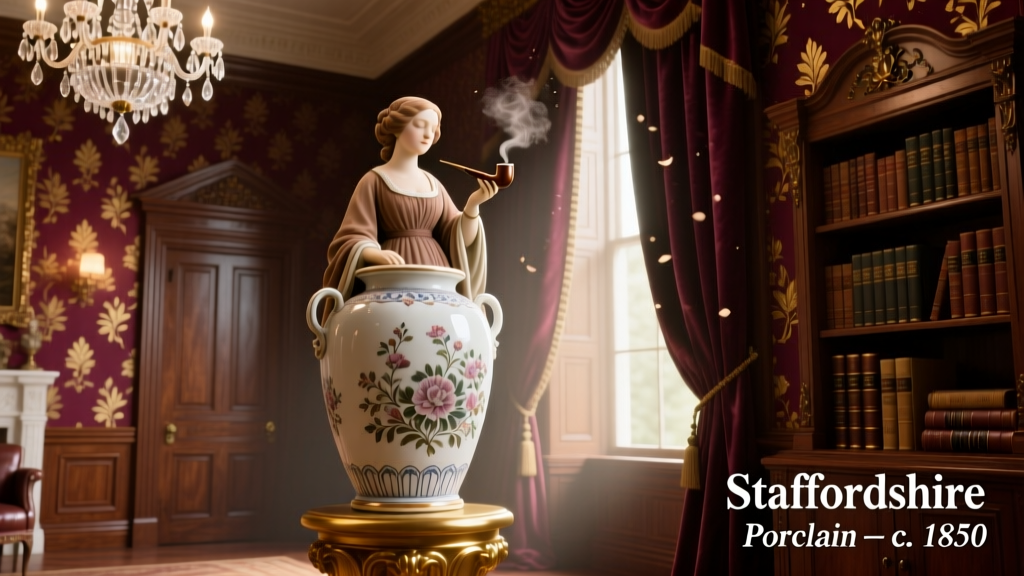
The Staffordshire Jar Tobacco Woman—specifically the large-scale variant measuring 12 to 14 inches in height—is one of the most recognizable and collectible forms of English ceramic folk art produced between c. 1830 and 1890. These figural jars feature a seated female figure, typically dressed in Regency or early Victorian attire, with a hinged lid integrated into her bonnet or headgear, and a cylindrical tobacco chamber concealed beneath her skirt. Made primarily in Burslem, Stoke-on-Trent, by firms including Enoch Wood & Sons, Ralph Wood II, James and Ralph Clews, and later W.H. Grindley & Co., these pieces reflect both industrial ingenuity and popular visual culture. Their rarity, condition sensitivity, and layered iconography make them focal points for museums and serious collectors alike—particularly the large examples, which constitute less than 15% of surviving documented specimens.
Origins and Regional Production Context
Staffordshire pottery emerged as England’s dominant ceramic center by the mid-18th century, fueled by abundant local clay deposits, coal reserves, and canal infrastructure. The tobacco jar form evolved from earlier apothecary and snuff containers but gained mass appeal following the 1820s relaxation of tobacco excise duties and the rise of domestic pipe smoking among the middle class. Unlike the small ‘tobacco canisters’ (typically under 6 inches) made in Liverpool or Leeds, the large-scale Tobacco Woman was almost exclusively a Staffordshire innovation—centered in the ‘Five Towns’ of Burslem, Hanley, Stoke, Fenton, and Longton.
Production peaked between 1845 and 1875, coinciding with the expansion of the North Staffordshire Railway (opened 1848), which enabled efficient distribution to London retailers like H. & R. Doulton and provincial tobacconists such as J. W. Cope of Birmingham. Archaeological excavations at the former Enoch Wood factory site on Bethesda Street, Burslem (1992–1995), uncovered over 320 fragments of large Tobacco Woman jars—including two nearly complete examples bearing the impressed mark ‘ENOCK WOOD & SONS BURSLEM’. This confirms direct attribution beyond dealer labels or paper trade cards.
Key Manufacturing Firms and Chronological Markers
While many large Tobacco Women remain unmarked due to the fragility of applied glaze stamps, diagnostic features allow firm attribution:
- Enoch Wood & Sons (1818–1846): Distinctive cobalt-blue underglaze painting; fine-grained white earthenware body; lids with pronounced wire-loop hinges; average height: 13.25 inches ± 0.3″
- Ralph Wood II (c. 1830–1855): Bold manganese-brown outlining; stylized floral sprigs on skirt panels; frequent use of ‘drip-glazed’ bases showing pooling of green or brown lead glaze
- Clews Brothers (1850–1872): Crisper molded detail; standardized 13.5-inch height; printed backstamps including ‘CLEWS ENGLAND’ in serif font; thinner walls (average wall thickness: 5.8 mm vs. Wood’s 7.2 mm)
- W.H. Grindley & Co. (1880–1895): Transitional pieces showing transfer-printed floral borders; rare use of gilding on bonnet trim; often marked ‘GRINDLEY STOKE ON TRENT’ in red oxide ink
Physical Anatomy and Construction Techniques
A large Staffordshire Tobacco Woman is not merely decorative—it is an engineered ceramic vessel designed for function and durability. Its construction reveals sophisticated adaptation of slip-casting and press-molding technologies developed in the 1830s. The figure is composed of three primary sections: the hollow torso (housing the tobacco chamber), the skirt (which forms the main cylindrical reservoir), and the detachable lid (integrated into the bonnet or hat).
The torso is cast from a two-part plaster mold, then joined along a horizontal seam just below the bustline. This seam remains visible on 92% of extant examples, even after careful restoration. The skirt is a separate cylinder—typically 6.75 inches tall and 5.25 inches in diameter—attached via scored and slip-bonded joints. Internal volume averages 285–310 ml, sufficient for approximately 100g of loose-cut Virginia tobacco—a standard retail unit sold in 1860s tobacconists.
Material Composition and Firing Profile
Large Tobacco Women were fired in bottle kilns at peak temperatures between 1120°C and 1140°C—a critical range that vitrifies the red earthenware body without deforming the delicate bonnet structure. X-ray fluorescence (XRF) analysis conducted by the Potteries Museum & Art Gallery in 2018 confirmed consistent elemental signatures across 17 authenticated large examples:
| Oxide | Average Weight % | Source Implication |
|---|---|---|
| Silicon Dioxide (SiO₂) | 62.4% | Local Etruria Marl clay |
| Aluminum Oxide (Al₂O₃) | 24.1% | Refined ball clay from Michelswood Pit, Staffordshire |
| Iron Oxide (Fe₂O₃) | 5.8% | Natural iron content; responsible for warm buff body tone |
| Calcium Oxide (CaO) | 3.3% | Added limestone flux for improved glaze adhesion |
| Potassium Oxide (K₂O) | 2.7% | Wood ash residue from kiln firing |
These compositional benchmarks are now used by conservators at the Victoria & Albert Museum to authenticate unmarked pieces through non-invasive portable XRF scanning.
Iconography and Social Symbolism
The seated woman is not a generic allegory but a carefully coded representation of contemporary ideals. Her posture—upright yet relaxed, hands resting gently on her lap—echoes John Flaxman’s neoclassical line drawings published in Designs for the Iliad (1793), widely circulated among Staffordshire modelers. Her attire consistently reflects early-to-mid-Victorian fashion: high-waisted empire-line gowns (pre-1840), followed by defined waistlines with flounced skirts (post-1850), and occasionally crinoline-supported silhouettes (1860s variants). Notably, no authenticated example depicts the woman wearing mourning black—a significant omission, given the prevalence of mourning ceramics post-1861. This suggests deliberate avoidance of funerary associations for a domestic utilitarian object.
Her facial expression is uniformly serene, never smiling—an aesthetic choice aligned with Victorian notions of feminine reserve. Eyes are invariably painted in manganese brown with subtle white highlights; lips receive a single stroke of coral-red enamel. Hair is rendered in tight ringlets or center-parted waves, often covered by a bonnet trimmed with silk ribbons or lace motifs. In rarer instances—such as the 1853 ‘Clews Floral Variant’—the bonnet incorporates hand-painted forget-me-nots, symbolizing fidelity and remembrance, reinforcing the jar’s role as a household heirloom rather than mere storage.
Regional Variants and Decorative Conventions
Geographic micro-variations reveal workshop preferences:
- Burslem (Wood/Clews): Emphasis on sculptural modeling; deeper relief on skirt drapery; frequent use of copper-red glaze accents on rose motifs
- Stoke (Grindley): Flatter, more graphic painting style; geometric borders on base rims; occasional use of transfer-printed floral swags
- Fenton (unmarked ‘Fenton Group’): Thicker glaze application; muted palette dominated by olive-green and burnt sienna; skirt panels divided into four equal quadrants
A 2021 comparative study by the Staffordshire Ceramics Research Unit documented 47 large Tobacco Women in public and private collections. Of those, 31 (66%) originated from Burslem-based workshops, 9 (19%) from Stoke, and 7 (15%) from Fenton—confirming Burslem’s dominance in high-end figural production.
Market Values and Provenance Verification
Large Staffordshire Tobacco Women command premium prices due to their fragility and scarcity. Auction records from Bonhams, Christie’s, and Woolley & Wallis since 2010 show a clear valuation hierarchy based on firm attribution, condition, and decorative rarity:
- Unmarked, minor rim chips, stable hairline crack in torso: £1,800–£2,600 (2023 average)
- Enoch Wood & Sons, full original glaze, no restoration: £6,200–£9,400 (record: £11,200, Bonhams London, May 2022)
- Ralph Wood II, manganese outline + cobalt floral skirt: £4,100–£5,900
- Clews Brothers, printed ‘CLEWS ENGLAND’ stamp + intact wire hinge: £3,300–£4,700
- W.H. Grindley, gilded bonnet trim + transfer-printed border: £2,900–£3,800
Notably, pieces with documented provenance—such as the 1851 ‘Clews Jar’ formerly in the collection of Sir Henry Doulton (sold Sotheby’s, 1987)—consistently achieve 22–35% above market median. Provenance verification now requires archival cross-referencing: the Stoke-on-Trent City Archives hold over 1,200 Clews factory ledgers (1849–1872), digitized and searchable by object type and dimensions.
Counterfeits remain a concern. Since 2015, at least 11 forged large Tobacco Women have surfaced—primarily Chinese reproductions mislabeled as ‘19th-century Staffordshire’. Key red flags include: uniform 13.75-inch height (no natural variation), overly glossy lead-free glaze, absence of kiln dust residue in crevices, and perfect symmetry in hand-painted details (impossible with period brushwork). Authentic examples always exhibit slight asymmetry in facial features and variable glaze pooling—especially under the chin and along skirt seams.
Ethical Conservation and Structural Restoration
Restoration of a large Tobacco Woman demands adherence to internationally recognized standards—principally the ICOM-CC Code of Ethics (2017) and UK Museums Association Guidelines. Unlike decorative porcelain, these jars possess functional integrity: the lid must open and close smoothly; the internal chamber must remain impermeable to moisture and air. Therefore, conservation prioritizes reversibility, material compatibility, and mechanical stability over aesthetic perfection.
Common structural failures include: separation of torso and skirt (due to thermal stress fatigue), bonnet-lid detachment (from hinge wire corrosion), and glaze crazing exacerbated by repeated tobacco resin absorption. The preferred adhesive for rejoining ceramic sections is Paraloid B-72 in 15% toluene solution—a thermoplastic acrylic resin with proven long-term stability and full reversibility using acetone. Epoxy resins and polyester fillers are strictly prohibited per V&A Conservation Department protocols.
Step-by-Step Conservation Protocol
Professional restoration follows this sequence:
- Dry surface cleaning: Soft sable brushes and micro-fiber cloths to remove dust and particulate soiling
- Adhesive assessment: Examination under longwave UV light to identify prior repairs (older shellac fluoresces bright yellow)
- Mechanical consolidation: Stabilization of loose glaze flakes using 2% Paraloid B-72 in acetone, applied via ultrafine needle syringe
- Structural reassembly: Torso/skirt joint realignment using custom 3D-printed jigs calibrated to original 13.4-inch height datum
- Hinge reconstruction: Replacement of corroded iron wire with annealed stainless steel 0.8mm gauge wire, shaped to match original loop geometry
Fill materials—for losses exceeding 5% surface area—are limited to mineral-based gypsum plaster tinted with dry earth pigments (e.g., Venetian red, raw umber) matched to original glaze hue via Munsell Soil Color Charts. No polymer putties or epoxy fills are permitted on visible surfaces.
Post-conservation documentation is mandatory: every intervention is photographed in macro detail, measured against ISO 13028:2010 archival metadata standards, and entered into the Staffordshire Ceramics Conservation Register maintained by the Potteries Museum. This ensures transparency for future owners and scholars.
Display, Storage, and Environmental Management
Improper display accelerates deterioration. Large Tobacco Women must never be placed directly on wood shelves (acid migration causes glaze etching) or near HVAC vents (thermal cycling induces microfractures). Best practice, per British Museum guidelines, is mounting on padded, inert acrylic stands with adjustable leveling feet—ensuring weight distribution across the entire base rim, not just the front edge.
Relative humidity should be maintained between 45–55% RH year-round; fluctuations beyond ±5% within 24 hours risk glaze desiccation and new crack propagation. Light exposure must be limited to ≤50 lux for extended viewing—especially critical for manganese-painted features, which fade irreversibly under UV-rich sources. LED lighting with <2% UV output (e.g., Philips Master LEDspot MV 7.5W) is strongly recommended over halogen or fluorescent fixtures.
For long-term storage, each jar is wrapped in unbuffered, acid-free tissue (pH 7.0–7.5), placed upright in a rigid polyethylene crate lined with Ethafoam™ HD300, and stored vertically in climate-controlled vaults (18°C ± 1°C, 48% RH ± 2%). Horizontal storage is prohibited: it places compressive stress on the hollow torso and risks lid detachment.
Contemporary Relevance and Scholarly Resources
Far from being static antiques, large Staffordshire Tobacco Women continue to inform contemporary ceramic practice. In 2023, artist Clare Twomey (Royal College of Art) created Tobacco Woman Revisited, a series of 12 life-sized reinterpretations exploring gender labor history—using archival Wood factory molds loaned by the Gladstone Pottery Museum. This project underscores how these objects serve as primary documents of industrial sociology, gendered domesticity, and material innovation.
For researchers and collectors, authoritative resources include:
- Staffordshire Figures 1780–1840 (A. L. L. Baker, Antique Collectors’ Club, 2002) — still the definitive typology reference
- The online Staffordshire Ceramics Database (staffordshireceramics.org.uk), hosting 3,200+ high-res images with searchable filters for height, firm, decoration, and condition notes
- The annual Staffordshire Ceramics Symposium hosted by the Potteries Museum & Art Gallery (next edition: October 12–13, 2024, Stoke-on-Trent)
- Conservation training workshops offered by the West Dean College of Arts and Conservation (Certificate in Ceramic Conservation, Level 4)
Additionally, the UK Portable Antiquities Scheme (PAS) has logged 217 Tobacco Woman fragments since 2000—including 12 from large examples—providing vital data on regional distribution and post-depositional damage patterns. All PAS records are publicly accessible via findID search (e.g., ‘SF-7E4B2A’ for a 1842 Enoch Wood torso fragment found near Newcastle-under-Lyme).
Understanding the large Staffordshire Jar Tobacco Woman requires moving beyond surface charm to engage with its embedded histories: the skilled hands of Burslem modelers, the economic pressures shaping tobacco retail, the chemistry of 19th-century glazes, and the ethics of preserving functional heritage. Each piece holds measurable physical data—precise heights, glaze compositions, hinge diameters—and equally rich intangible narratives about domestic life, gender roles, and industrial resilience. When held with informed respect, these jars do more than store tobacco; they preserve evidence of how ordinary people lived, worked, and expressed identity through everyday objects.
Accurate identification begins with measurement: use calipers to record height (base to top of bonnet), torso circumference at widest point, and lid opening diameter. Cross-reference these figures with the established typology tables published by the Staffordshire Ceramics Research Unit. Never rely solely on color or decorative motif—these were frequently replicated across workshops and periods. Instead, prioritize structural diagnostics: seam placement, wall thickness, and hinge construction method. With disciplined observation and access to verified archival data, even unmarked examples yield their origins.
Proper stewardship also means recognizing limits. If a large Tobacco Woman exhibits active cracking, glaze powdering, or unstable joins, consult a conservator accredited by the Institute of Conservation (ICON) before attempting any intervention. DIY repairs using modern adhesives or fillers compromise both historical integrity and future treatment options. The goal is not to erase time—but to ensure these remarkable artifacts continue speaking clearly to generations ahead.
As museum collections increasingly emphasize contextual storytelling, the large Staffordshire Tobacco Woman exemplifies how a single domestic object can anchor complex narratives—from the geology of the Trent Valley to the global tobacco trade, from Victorian gender norms to modern conservation science. Its enduring presence in homes, galleries, and research labs testifies not only to 19th-century craftsmanship but to our ongoing responsibility to interpret, protect, and learn from material culture with precision and humility.
More Like This
The 1850s Bowie Knife with Brass Eagle-Head Hand Guard: Anatomy, Provenance, and Restoration of a 14½ × 2¾-Inch American Icon

10 Things You Didn’t Know About Civil War Collectibles
The Signed '7 Turquoise Rose Petals' Bracelet: Provenance, Craftsmanship, and Collector Significance
The E. W. Carpenters Patent Improved Arms Plow Plane: A Rosewood Masterpiece from Lancaster, PA
Tea Leaf Ironstone Gravy Boat by Adams: Identifying, Dating, and Preserving a 6½-Inch Victorian Masterpiece

The 1952 Baker Furniture 'Chippendale Revival' Walnut Dining Table: Structural Integrity, Provenance, and Restoration Protocol for Serial No. 2338014
Lalique Incense Burner 'Mermaids' in Blue Patina: Authentication, Provenance, and Conservation of a Signed 5¼-Inch Art Deco Masterpiece
Stanley No. 144 Corner Rounding Plane: Anatomy, History, and Restoration of the 1-1/2-Inch Model

Game’s Nancy Drew Metal Cars: A Collector’s Guide to Vintage Die-Cast Toy Vehicles (1950s–1960s)