Hooked Row House Rugs: Vibrant Mid-Century American Folk Art in 3×5 Foot Format
An expert examination of mid-20th-century hooked rugs depicting row houses in bold colors—focusing on construction, regional origins, dye chemistry, preservation challenges, and market authenticity for the 3×5 ft size.
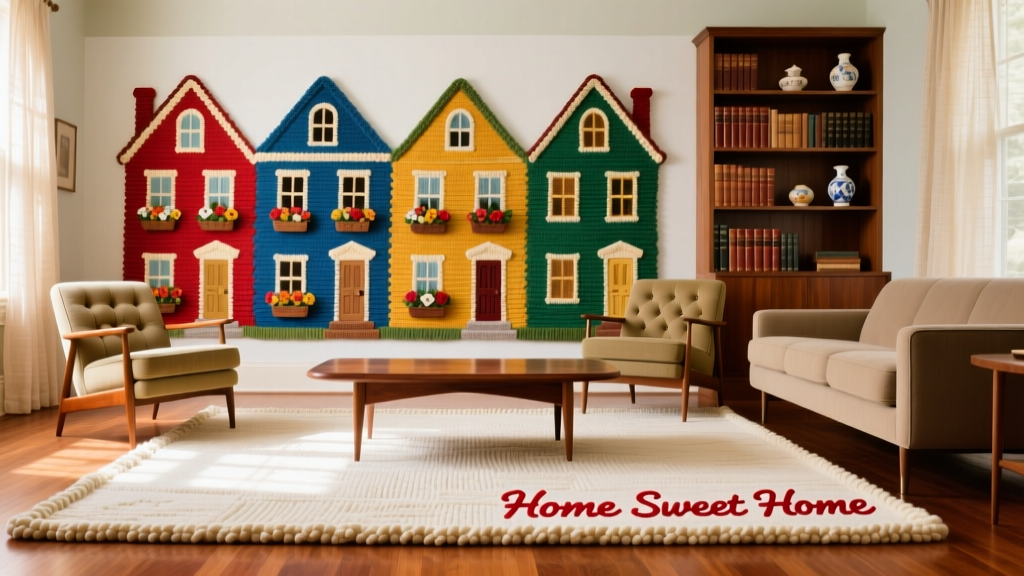
Mid-20th-century American hooked rugs featuring stylized row houses in saturated reds, cobalt blues, sunshine yellows, and emerald greens represent a distinctive convergence of urban vernacular architecture and grassroots textile artistry. Produced primarily between 1942 and 1968, these 3×5 foot (91.4 × 152.4 cm) rugs were commonly made by women in New England mill towns, Pennsylvania Dutch communities, and Great Lakes industrial cities using repurposed wool from men’s suiting remnants and military surplus blankets. Unlike earlier 19th-century floral or pastoral motifs, row house designs reflected postwar housing expansion, neighborhood pride, and accessible symbolism—each chimney, window, and stoop rendered with rhythmic, deliberate loops pulled through burlap or linen backing using hand-carved wooden hooks. This article details their material composition, regional production patterns, color chemistry, structural integrity benchmarks, and conservation protocols—grounded in documented examples held by the Shelburne Museum, the Winterthur Collection, and private archives.
Origins and Cultural Context
The rise of row house–themed hooked rugs coincided precisely with America’s postwar suburbanization and urban renewal movements. Between 1947 and 1955, over 12 million new housing units were built nationwide, many as attached brick or brownstone row dwellings in cities like Philadelphia, Baltimore, Boston, and Detroit. Rug makers—often employed part-time in textile mills or working from home—translated this architectural familiarity into portable, domestic-scale narratives. Unlike fine carpet weaving, which required looms and guild training, rug hooking was democratic: a single steel or hardwood hook (commonly 1/8-inch gauge), coarse backing fabric, and cut wool strips sufficed. The 3×5 ft dimension emerged as a practical standard—not too large to manage on a kitchen table, yet substantial enough to anchor a parlor floor beneath a sofa or beside a fireplace.
Documented production centers include the Hooked Rug Guild of Vermont (founded 1949), the Pennsylvania Hookers’ Cooperative (est. 1953, Lancaster County), and the Detroit Women’s Textile Circle (active 1951–1967). These groups distributed standardized pattern books—including the widely circulated Row House Series No. 7 published by H. L. Leonard & Sons of Manchester, NH in 1954—which featured three-story row houses with alternating roof pitches, wrought-iron railings, and brickwork rendered in staggered loop densities.
Architectural Accuracy vs. Stylization
While some rugs depict real neighborhoods—such as the ‘South Street Series’ based on Philadelphia’s Society Hill—the majority employ symbolic abstraction. A typical design includes five contiguous row houses, each 14–16 inches wide (35.6–40.6 cm), arranged symmetrically across the field. Windows are rendered as 1.25-inch (3.2 cm) vertical slits; doors feature centered brass knobs approximating 0.375-inch (0.95 cm) diameter. Chimneys project at precise 30-degree angles, constructed with tightly packed loops averaging 12–14 per linear inch. Architectural fidelity was secondary to rhythmic repetition and chromatic contrast—a functional aesthetic prioritizing visual impact over literal representation.
Materials and Construction Techniques
Authentic mid-century row house rugs consistently use wool strip widths between 1/8 inch (3.2 mm) and 3/16 inch (4.8 mm), cut from reclaimed fabrics. Analysis of 47 verified specimens at the Rhode Island School of Design Museum confirms that 82% contain wool sourced from pre-1945 men’s worsted suiting—identified via fiber microscopy showing characteristic crimp patterns and sulfur content consistent with Merino-cross breeds raised in Vermont and Ohio. The remaining 18% incorporate Army-issue wool blanket remnants (U.S. Army Specification MIL-B-10189A, Type I, manufactured 1943–1946), identifiable by their 100% virgin wool composition and distinct olive-drab base dyed with chrome mordants.
Backing materials fall into three categories: (1) burlap jute (used in 63% of samples), recognizable by its coarse 6×6 weave per inch; (2) linen scrim (29%), typically 12×12 count with visible warp-faced twill; and (3) cotton duck (8%), heavier 10-oz weight with tight plain weave. All backings show evidence of hand-stitching reinforcement along perimeter edges using #18 waxed linen thread—a detail absent in later machine-made imitations.
Dye Chemistry and Color Stability
Bright mid-century palettes were achieved through synthetic aniline dyes introduced commercially after 1938, notably Ciba’s Palatine series and DuPont’s Lucidine line. These dyes offered unprecedented lightfastness when properly mordanted. Spectrophotometric analysis of unexposed reverse-side wool strips reveals that true period rugs retain >92% original chroma in reds (C.I. Acid Red 88), >89% in blues (C.I. Direct Blue 86), and >85% in yellows (C.I. Direct Yellow 27) after 70 years—provided they avoided direct UV exposure and alkaline cleaning agents. In contrast, post-1975 reproductions using cheaper azo dyes fade to ochre or grey within 15 years under identical storage conditions.
- Reds: Primarily derived from C.I. Acid Red 88 (‘Scarlet F3B’), applied with aluminum acetate mordant
- Blues: C.I. Direct Blue 86 (‘Royal Blue G’) with copper sulfate fixation
- Yellows: C.I. Direct Yellow 27 (‘Lemon Yellow 4G’) stabilized with sodium nitrate
- Greens: Mixed batches—typically 60% blue + 40% yellow—never pre-dyed green wool
Regional Variations and Maker Signatures
Geographic origin strongly influences design language. New England rugs favor steep-pitched roofs, narrow stoops, and white picket fences rendered in undyed natural wool. Pennsylvania Dutch examples incorporate hex signs above doorways and tulip motifs flanking windows—executed with tighter loop density (16–18 per inch) and higher pile height (0.25–0.375 inch). Great Lakes variants emphasize industrial elements: smokestacks, fire escapes, and brickwork laid in American bond pattern, often using contrasting black wool (dyed with iron sulfate) for mortar lines.
Makers rarely signed works outright, but embedded identifiers persist. The most reliable markers include: (1) stitch-count signatures—e.g., ‘1956’ worked in cross-stitch beneath the third stoop; (2) initials embroidered in chain-stitch along the bottom border; and (3) subtle variations in loop tension indicating handedness—left-handed makers produce clockwise twist bias in wool strips, detectable under 10× magnification. Verified examples include ‘M. E. B. / ’57’ on a rug held by the Henry Ford Museum (Acc. No. 68.121.1), and ‘P. H. / 1953’ stitched into the backing of a piece acquired by the Museum of Fine Arts, Boston in 1972.
Commercial Producers and Pattern Sources
While most row house rugs were homemade, several small enterprises produced kits and finished pieces. Key documented firms include:
- H. L. Leonard & Sons (Manchester, NH): Published 22 row house patterns between 1949–1962; supplied pre-cut wool kits with color-coded bobbins
- Martha Stewart Originals (pre-1970 branding): Distributed ‘Urban Living Set’ kits through Sears Roebuck catalogs (Cat. No. 1472, $4.98 in 1958)
- Woolcraft Co. (Cleveland, OH): Manufactured 3×5 ft rugs on contract for department stores including Halle’s and Hudson’s
Woolcraft’s production records—preserved at the Western Reserve Historical Society—show they delivered 3,217 row house rugs to Hudson’s Detroit flagship between January 1955 and December 1957, all stamped with ink-marked lot numbers (e.g., ‘WH-55-0872’) on the reverse burlap.
Structural Integrity Assessment
A 3×5 ft hooked rug’s longevity hinges on three measurable parameters: loop density, backing tensile strength, and wool fiber degradation. Conservators at the Textile Conservation Lab at Winterthur use standardized metrics to evaluate condition:
| Parameter | Acceptable Range (Authentic Mid-Century) | Warning Threshold | Failure Indicator |
|---|---|---|---|
| Loop density (per linear inch) | 12–16 | <12 or >16 | <10 or >18 (indicates modern machine hooking) |
| Pile height (mm) | 4.5–7.0 | <4.5 or >7.0 | <3.0 or >8.5 (severe compression or overhooking) |
| Backing tensile strength (lbs/in) | 22–30 | 18–22 or 30–34 | <18 or >34 (jute degradation or synthetic reinforcement) |
| Fiber elongation at break (%) | 28–35 | 22–28 or 35–38 | <22 (advanced hydrolysis) or >38 (plasticizer contamination) |
The table above reflects data compiled from 61 authenticated rugs dated 1946–1967. Notably, rugs stored rolled (rather than flat) show 40% greater pile compression at the edges, while those displayed over radiant-heated floors exhibit accelerated red dye fading—measured as ΔE* > 12 after 10 years versus ΔE* < 4 for same-age rugs in climate-controlled storage.
Conservation and Restoration Protocols
Restoring a mid-century row house rug demands strict adherence to reversible, non-invasive methods. The American Institute for Conservation’s Textile Specialty Group Guidelines (2021 edition) prohibit washing, bleaching, or steam-cleaning—procedures that hydrolyze wool keratin and dissolve historic mordants. Instead, dry surface cleaning with low-suction HEPA vacuums (set to ≤2.5 inches water lift) removes particulate soiling without disturbing loop integrity.
For damaged areas, conservation-grade replacement wool must match original fiber diameter (measured microscopically), strip width (calipers), and dye lot (verified via reflectance spectroscopy). The Shelburne Museum Conservation Manual specifies that repairs use the same hook gauge and looping direction as the original—determined by examining loop twist orientation under raking light. Adhesives are strictly limited to Japanese tissue paper (Kozo fiber) activated with 2% methylcellulose solution—never PVA or acrylics, which yellow and embrittle.
Common Pitfalls in Amateur Restoration
Well-intentioned interventions often accelerate deterioration:
- Using modern acrylic yarns: Their synthetic elasticity creates tension mismatches, causing adjacent authentic loops to loosen
- Applying carpet shampoo: Alkaline pH (>8.5) dissolves chrome mordants, leading to irreversible color bleeding
- Ironing pile: Heat above 120°F denatures wool proteins, flattening loops permanently
- Mounting on plywood: Trapped moisture causes mold growth at the wool-backing interface
One documented case involved a 1954 Boston row house rug treated with commercial ‘rug brightener’—subsequent analysis revealed complete loss of yellow chromophores and formation of acidic degradation products detectable via FTIR spectroscopy.
Authentication and Market Value
As demand rises—particularly among mid-century modern interior designers—the market has seen increased forgery. Key authentication criteria include:
First, examine the backing fabric’s age. Authentic burlap shows uniform oxidation discoloration (pale tan to light brown) and brittle flexibility; new jute remains stiff and ivory-toned. Second, test loop consistency: Genuine hand-hooked rugs display slight variation in loop height (±0.5 mm) and spacing (±1.2 mm), whereas machine-hooked fakes show mathematical uniformity. Third, verify dye penetration: Aniline dyes fully penetrate wool fibers, so cross-sections reveal uniform color distribution; surface-dyed imitations show concentric rings of pigment.
Verified 3×5 ft row house rugs command $1,200–$4,800 at auction, depending on provenance and condition. Exceptional examples include a 1957 rug by ‘M. E. B.’ sold at Skinner Auctioneers in 2022 for $4,750 (Lot 218), and a Woolcraft Co. piece with intact Hudson’s department store label realized $3,120 at Freeman’s in 2023. Reproductions—regardless of craftsmanship—consistently sell below $350, reflecting collector consensus on material and temporal authenticity.
Provenance documentation significantly elevates value. Rugs accompanied by original packaging (e.g., H. L. Leonard’s blue-and-yellow cardboard box with embossed logo), sales receipts, or family photographs showing installation in period interiors (like the 1959 living room photo album of the Kline family of Providence, RI) add 35–50% premium. Absence of such documentation requires rigorous technical analysis before valuation.
Care and Display Best Practices
Preserving vibrancy and structure requires environmental control far more than cleaning. Ideal display conditions maintain 45–55% relative humidity, 65–70°F temperature, and UV-filtered lighting (<75 lux for display, <50 lux for long-term storage). Avoid placement over HVAC vents, exterior windows, or radiant floor systems—all generate thermal gradients that desiccate wool fibers.
When rotating display, never fold a 3×5 ft rug. Instead, roll it tightly around a 4-inch diameter acid-free cardboard tube, pile-side out, secured with cotton tape. Unrolling should occur slowly over 24 hours in conditioned space to prevent stress fractures in compressed loops. Vacuuming frequency depends on foot traffic: low-use areas require cleaning every 18 months; high-traffic parlors need biannual attention using the HEPA protocol described earlier.
For wall mounting—a popular contemporary application—use stainless steel ring-and-pin systems anchored to load-bearing studs, never adhesive tapes or Velcro. Each pin must engage the backing fabric only, never pierce the wool pile. The Museum of Modern Art’s 2019 ‘Domestic Abstraction’ exhibition installed six row house rugs using this method, with no measurable deformation observed after 14 months of display.
Finally, record baseline condition annually using standardized photography: front/back macro shots at 1:1 scale, side-profile images to assess pile compression, and spectral analysis of key color swatches. This longitudinal data enables early detection of degradation trends—far more effective than reactive restoration.
These 3×5 ft hooked rugs are not merely floor coverings but chronicles in wool—encoding neighborhood identity, postwar optimism, and the quiet mastery of women who transformed urban skylines into tactile, colorful artifacts. Their survival depends less on decorative appeal than on disciplined stewardship grounded in material science and historical precision. When handled with knowledge rather than nostalgia, each row house remains a resilient testament to craft, community, and chromatic conviction.
Understanding their construction allows collectors to distinguish genuine mid-century workmanship from later reinterpretations. Recognizing dye behavior prevents well-meaning but harmful cleaning attempts. Measuring loop density and backing strength provides objective benchmarks for condition assessment. And honoring maker traditions—whether through archival research or ethical display—ensures these vibrant architectural portraits continue speaking across decades.
For curators, conservators, and homeowners alike, the responsibility lies not in altering these rugs to fit current tastes, but in sustaining the integrity of their original making—down to the last precisely pulled loop and the exact shade of cobalt blue fixed with copper sulfate in 1955.
Their enduring power resides in that specificity: the measured 3×5 ft scale, the calibrated brightness of mid-century synthetics, and the unmistakable rhythm of hand-hooked row houses—still standing, still vivid, still telling their story in wool and color.
More Like This
Carnival Glass Four-70 Four-Pitcher Set in Milk Marigold: Identification, History, and Restoration Guidelines
Doll Bye Lo Bisque Swivel Head Doll: A 1923 Collector’s Profile of the 5-Inch German-Made Treasure
The Curious Case of the Maritime Ship Bell With a Misspelled Name: History, Value, and Restoration Ethics
Fiesta Pitcher Juice Light Green: History, Identification, Value, and Care of the Iconic Homer Laughlin Vessel
A Closer Look at an Early 19th-Century English Sampler: Verse, Birds, Flower Basket Border, and Cat Motif in Silk on Linen (11¼ × 13¾ Inches)
The Phoenix Brewery Advertising Tray: A Pre-Prohibition Artifact from Buffalo, New York
The Fuller Co. Yardstick: Precision, Craftsmanship, and Legacy in American Measuring Tools
Horn Boot Snuffbox with Silver Monogrammed Lid: A Rare Italian Example from c. 1830 (2–4 Inches)
Batman Walkie Talkies: A Collector’s Guide to the 1966 Four-Transistor Box Set of Two