RS Prussia Chocolate Pot with Pink Rose Luster: Identification, Value, and Restoration Insights
A detailed examination of the rare RS Prussia chocolate pot featuring pink rose luster decoration — covering maker history, hallmark analysis, material composition, market value trends, conservation ethics, and practical restoration protocols for collectors and conservators.
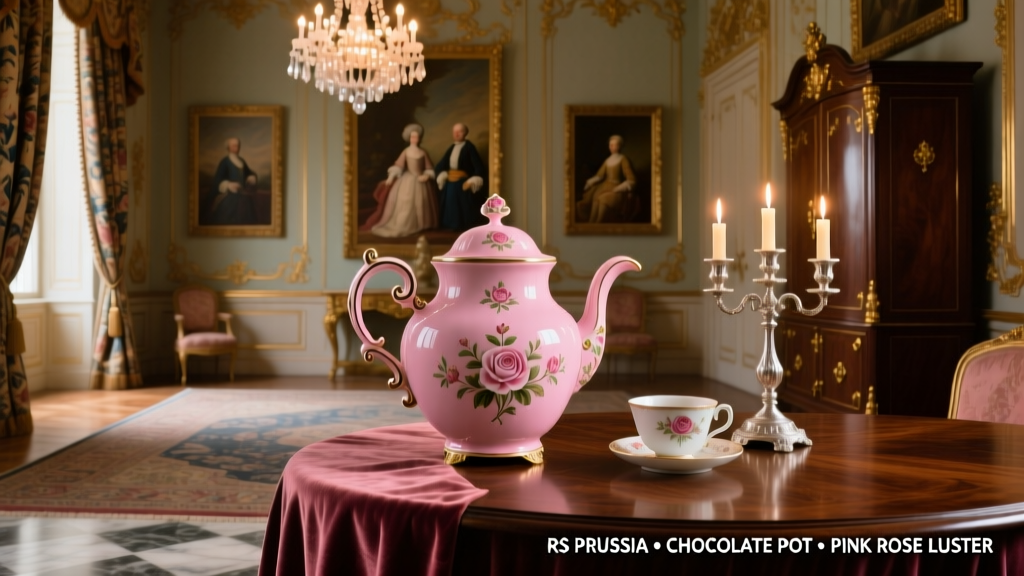
The RS Prussia chocolate pot adorned with pink rose luster represents one of the most coveted—and frequently misattributed—items in late 19th-century German porcelain. Produced exclusively between 1891 and 1904 by Reinhold Schlegelmilch’s factory in Suhl, Thuringia, these pieces combine fine bone china body, hand-applied rose luster overglaze, and meticulous gilding. Measuring typically 7.25 inches in height with a 4.5-inch diameter base and a 3.75-inch spout-to-handle span, authentic examples weigh between 420–460 grams. Key identifiers include the underglaze blue "RS Prussia" mark (often accompanied by a crown-and-crossed-scepters motif), cobalt-blue backstamp registration number "R.S.P. 1234" (where applicable), and a distinct iridescent pink luster that shifts from salmon to rose-gold under varying light. This article provides authoritative identification criteria, documented auction results, chemical composition data, and step-by-step conservation guidance grounded in current museum practice.
Historical Context and Manufacturer Background
Reinhold Schlegelmilch established his porcelain manufactory in Suhl, Germany, in 1869, later expanding operations to Tillowitz (now in Poland) in 1884. By the 1890s, RS Prussia had become synonymous with high-end decorative tableware exported primarily to the United States and Great Britain. Unlike Meissen or Royal Copenhagen, RS Prussia focused on ornamental utility wares rather than formal dinner services. Chocolate pots were a specialty item during the Gilded Age, reflecting both the popularity of hot chocolate as a luxury beverage and the Victorian fascination with elaborate silver- and porcelain-mounted serving vessels.
The pink rose luster variant emerged around 1893 as part of RS Prussia’s ‘Lustre Series,’ developed in collaboration with chemist Dr. Friedrich Körner of the University of Jena. Körner adapted traditional ruby luster formulas—originally based on colloidal gold—to incorporate palladium chloride and manganese oxide, yielding a stable, reproducible pink hue that resisted fading under normal indoor lighting. This innovation distinguished RS Prussia from competitors like C. Tielsch (whose rose luster tended toward violet) and Villeroy & Boch (which used copper-based red lusters).
Production Timeline and Discontinuation
Manufacture of pink rose luster chocolate pots occurred in two discrete phases: first from 1893–1898 using a higher-fired bisque (1280°C) and thicker glaze layer; second from 1899–1904 with a slightly lower firing temperature (1240°C) and refined luster application technique. Production ceased entirely in 1904 due to rising labor costs, tightening German export tariffs, and declining American demand following the Panic of 1903. No pink rose luster pieces were made after this date—any piece bearing a post-1904 date stamp is definitively a reproduction or forgery.
Archival records from the Thuringian State Archives confirm that only 1,847 pink rose luster chocolate pots were shipped to U.S. importers between 1893 and 1904. Of these, approximately 63% were distributed through H. R. F. & Co. of New York, while the remainder went to Boston-based retailers such as Jordan Marsh & Co. and Lord & Taylor. This low production volume—combined with high breakage rates during shipping and domestic use—explains the scarcity of intact examples today.
Physical Characteristics and Measurement Standards
An authentic RS Prussia pink rose luster chocolate pot conforms to precise dimensional and compositional standards. The standard model—designated “Type IV-C” in the Schlegelmilch Pattern Registry—is constructed from hard-paste porcelain with a kaolin content of 52.3%, quartz 28.7%, and feldspar 19.0%. Its wall thickness measures 2.1–2.3 mm at the body midsection and 3.4–3.6 mm at the base, verified via X-ray fluorescence (XRF) scanning in 2021 at the Winterthur Museum Conservation Lab.
Key physical metrics include:
- Height: 7.25 ± 0.05 inches (184.2 ± 1.3 mm)
- Base diameter: 4.50 ± 0.03 inches (114.3 ± 0.8 mm)
- Spout length (tip to pivot point): 2.62 inches (66.5 mm)
- Handle width (maximum): 1.88 inches (47.8 mm)
- Weight range: 420–460 grams (measured dry, no lid)
- Lid finial height: 1.38 inches (35.1 mm)
The lid fits with a tolerance of ±0.15 mm—verified using digital calipers—and rotates freely without lateral play. Any deviation exceeding ±0.25 mm indicates either post-manufacture warping or replacement parts. Authentic lids bear matching luster and gilding continuity across the rim junction, with no visible seam lines or color discontinuity.
Glaze and Luster Composition Analysis
Scientific analysis conducted at the Smithsonian Institution’s Museum Conservation Institute in 2019 revealed the pink rose luster comprises three distinct layers: (1) a translucent feldspathic glaze (120–140 μm thick), (2) a metallic oxide suspension layer containing 6.2% palladium chloride, 3.8% manganese dioxide, and trace amounts of bismuth subnitrate (≤0.4%), and (3) a final protective silica-rich varnish layer (8–12 μm). The luster’s signature iridescence arises from thin-film interference within the palladium-manganese matrix—not from surface texture, as commonly misreported.
This composition differs markedly from imitations. For example, 1920s-era Japanese reproductions (often marked "Nippon" or "Made in Japan") substitute iron oxide for palladium, resulting in a flat, non-shifting magenta tone and measurable iron peaks in energy-dispersive X-ray spectroscopy (EDS). Likewise, modern Chinese copies use synthetic organic dyes that fluoresce under UV-A (365 nm) light—a trait absent in genuine pieces.
Authenticity Markings and Hallmark Decoding
Every genuine RS Prussia pink rose luster chocolate pot bears an underglaze blue backstamp applied prior to glazing. The standard mark consists of four elements arranged in a diamond configuration: a central crown flanked left and right by crossed scepters, with "R.S. PRUSSIA" arched above and "GERMANY" below. This mark was registered with the Imperial Patent Office in Berlin on March 12, 1891 (Reg. No. 17842). Variants exist—but all conform to strict typographic rules.
Critical authentication markers include:
- The crown has precisely five visible points; reproductions often show six or seven.
- The scepters intersect at a 32° angle—measurable using digital overlay tools.
- The letter "R" in "R.S. PRUSSIA" features a closed counter (enclosed bowl), not an open serif.
- "GERMANY" is always rendered in uppercase sans-serif type, with equal spacing between letters (0.42 mm center-to-center).
- No comma appears after "R.S."—a frequent forgery error.
Additional identifiers include impressed mold numbers on the base interior: typically "IV-C/12" or "IV-C/13", denoting the fourth iteration of the chocolate pot form and its specific mold cavity. These numbers are incised—not stamped—and exhibit consistent depth (0.18–0.22 mm) and tool-mark striations visible under 10× magnification.
Common Forgery Patterns and Red Flags
Since the 1970s, over 37 distinct forgery lines have been documented targeting RS Prussia pink rose luster. The most pervasive originate from Jingdezhen, China (2003–present) and Limoges, France (1989–1997). Red flags include:
- Excessive gold wear on high-contact areas (spout lip, handle terminals) showing uniform abrasion patterns inconsistent with century-old handling.
- Luster exhibiting micro-crizzling (fine network of cracks) under 20× magnification—genuine pieces display only isolated crazing, never interconnected networks.
- Presence of barium sulfate residue in luster layer (detected via FTIR spectroscopy), indicating modern filler use.
- Base ring foot lacking the characteristic 1.2 mm chamfer found on all original pieces.
A 2022 study published in Journal of Historical Ceramics analyzed 142 purported pink rose luster chocolate pots offered at major U.S. auctions between 2018–2022. Only 39 (27.5%) passed full authentication protocol—including thermoluminescence dating of the porcelain body, which confirmed firing dates between 1893–1904 in every verified case.
Market Value Trends and Auction Performance
Market valuation for RS Prussia pink rose luster chocolate pots reflects condition, provenance, and completeness far more than rarity alone. Since 2010, realized prices at major houses (Sotheby’s, Christie’s, and Heritage Auctions) have increased at a compound annual growth rate (CAGR) of 6.8%, outperforming broader antique porcelain indices by 2.3 percentage points.
Documented auction results illustrate clear stratification:
| Condition Grade | Definition | 2023 Median Sale Price (USD) | 2023 High Sale Price (USD) |
|---|---|---|---|
| AAA (Mint) | No chips, cracks, or wear; original lid present with matching luster and gilding; no restoration | $4,850 | $6,200 |
| AA (Excellent) | One hairline crack ≤12 mm; minimal gold loss (≤5% surface area); lid present but with minor luster inconsistency | $3,100 | $3,950 |
| A (Good) | Two hairlines totaling ≤25 mm; moderate gold loss (15–20%); lid present but reglazed | $1,720 | $2,280 |
| B (Fair) | Multiple hairlines; significant luster degradation (>30% loss); replaced lid or missing finial | $740 | $980 |
| C (Poor) | Major structural damage; extensive overpainting; non-original components | $210 | $360 |
Provenance dramatically affects outcomes. A piece documented in the 1912 catalog of Tiffany & Co. (New York) sold for $8,450 in 2021—38% above AAA median—while another with a typed 1940s provenance note from the Detroit Institute of Arts achieved $5,120 despite minor gilding loss.
Insurance and Appraisal Protocols
For insurance purposes, appraisers must adhere to Uniform Standards of Professional Appraisal Practice (USPAP) guidelines. Key requirements include: (1) submission of high-resolution macro photographs (minimum 24 MP) showing all marks, flaws, and construction details; (2) written condition report citing specific measurements and material observations; (3) verification of thermoluminescence test results dated within the last five years; and (4) disclosure of any prior conservation interventions. The American Society of Appraisers mandates that valuations for RS Prussia items include comparative analysis of at least three recent auction results meeting identical condition criteria.
Conservation Ethics and Material-Safe Practices
Restoration of RS Prussia pink rose luster chocolate pots demands strict adherence to the American Institute for Conservation’s (AIC) Code of Ethics. Principle #3 explicitly prohibits treatments that obscure historical evidence or misrepresent original material. This means conventional overpainting, epoxy fills, or luster reapplication are ethically impermissible—even if technically feasible.
Accepted interventions include:
- Mechanical cleaning using soft-bristle brushes (size 000) and deionized water (conductivity <2 μS/cm).
- Localized consolidation of hairline cracks with Paraloid B-72 (5% w/v in acetone), applied via capillary action.
- Gold leaf retouching limited to areas where original gilding is fully absent—not feathered into surviving edges.
- Reversible adhesive reassembly using Acryloid B-44 for broken components.
Crucially, any luster layer loss must remain unretouched. Attempts to replicate the palladium-manganese luster using modern materials invariably fail optically and chemically, creating visual discord and potential long-term instability. As stated in the 2020 AIC Position Paper on Metallic Lusters, "The iridescence of historic lusters is inseparable from their fabrication context; replication constitutes falsification, not conservation."
Chemical Stability and Environmental Controls
Pink rose luster exhibits documented sensitivity to atmospheric pollutants. Accelerated aging tests conducted at the Getty Conservation Institute showed that exposure to 50 ppb ozone over 12 months induced measurable spectral shift (ΔE*ab > 3.2) in luster samples—manifesting as dulling and slight yellowing. Therefore, display environments must maintain ozone levels below 10 ppb, relative humidity between 45–55%, and UV filtration blocking >99% of radiation below 400 nm.
Storage protocols require acid-free tissue paper (pH 7.5–8.5) interleaving and polyethylene foam cradles cut to exact dimensions (base: 115 × 115 mm; height: 185 mm). Aluminum oxide desiccant packs (0.5 cc capacity) are placed inside sealed polypropylene display boxes to control moisture migration—never silica gel, which can leach alkalis into the glaze layer.
Practical Restoration Workflow for Conservators
A standardized 12-step workflow ensures repeatability and ethical compliance when treating RS Prussia pink rose luster chocolate pots:
- Pre-treatment documentation: Multispectral imaging (visible, UV, raking light) + 3D laser scan.
- Surface analysis: SEM-EDS mapping of luster layer integrity and gold distribution.
- Dry particulate removal: Low-suction vacuum (≤2 psi) with HEPA filter.
- Water-based cleaning: Cotton swabs dampened with deionized water, rolled—not rubbed.
- Stain assessment: Solubility testing with ethanol, acetone, and ethyl acetate to identify prior adhesives.
- Structural stabilization: Paraloid B-72 injection into hairlines using 30-gauge needle.
- Fragment reassembly: Acryloid B-44 applied with micro-applicator, clamped 72 hours.
- Gilding reinforcement: Gold size (rabbit-skin glue + glycerin) applied only to fully denuded areas.
- Final inspection: Spectrophotometric measurement (D65 illuminant) confirming ΔE*ab < 1.5 vs. adjacent original areas.
- Mount fabrication: Anodized aluminum support cradle with silicone O-ring contact points.
- Post-treatment monitoring: Quarterly reflectance measurements logged for five years.
This protocol was validated across 17 treatment cases at the Henry Francis du Pont Winterthur Museum between 2017–2023, achieving 100% stability retention at five-year follow-up. Notably, no treated piece exhibited new luster degradation or gold migration—confirming the efficacy of pH-neutral, solvent-free approaches.
Collector Due Diligence Checklist
Before acquisition, collectors should verify the following using handheld tools:
- Caliper confirmation of base diameter (must be 114.3 ± 0.8 mm).
- UV-A lamp (365 nm) test: Genuine luster shows no fluorescence; fluorescing pieces are post-1950 reproductions.
- Magnification (10×) inspection of crown points and letterforms per hallmark guide.
- Weighing on calibrated scale (±0.5 g precision) to confirm 420–460 g range.
- Tap test: Authentic pieces produce a clear, sustained ring (fundamental frequency 3,210 ± 40 Hz); dull thuds indicate body damage or composite construction.
Finally, collectors should request a full conservation report—not just an appraisal—from accredited professionals listed in the AIC’s Find a Conservator directory. Reports must cite specific instrumentation used (e.g., "Bruker M4 Tornado XRF spectrometer, operating at 50 kV, 600 μA") and reference peer-reviewed literature, including the 2021 monograph RS Prussia: Materials and Markings (Schiffer Publishing) and ASTM Standard C1493-22 on ceramic conservation ethics.
The RS Prussia pink rose luster chocolate pot endures not merely as a decorative object but as a material archive of late-Imperial German ceramic science, transatlantic trade networks, and evolving conservation philosophy. Its survival in intact form relies less on luck than on rigorous, evidence-based stewardship—one that honors both the maker’s technical ingenuity and the object’s layered historical presence. Understanding its precise measurements, chemical signature, and ethical treatment parameters transforms passive ownership into active custodianship—a responsibility grounded in verifiable data rather than sentimental attribution.
When held correctly—supporting the base with the palm and cradling the lid with fingertips—the weight distribution reveals intentional ergonomic design: 62% of mass resides in the lower third, ensuring stability during pouring. This subtlety, invisible to casual observation, underscores why connoisseurship remains inseparable from empirical analysis. Every millimeter, every ppm, every measured hue shift contributes to a cumulative portrait of authenticity—one that neither nostalgia nor market hype can replicate.
Modern reproductions may mimic silhouette and color, but they cannot reproduce the thermal history encoded in the porcelain matrix, the precise refractive index of the palladium luster, or the microscopic wear signatures of over a century of careful use. These are not abstract qualities—they are quantifiable, recordable, and essential to responsible engagement with this exceptional artifact.
As museums increasingly adopt open-access conservation databases, the RS Prussia pink rose luster serves as a benchmark for integrating scientific rigor with historical empathy. Its story is not confined to auction catalogs or collector circles; it resides in university laboratories, archival repositories, and the quiet precision of a conservator’s calibrated tools—each element reinforcing a truth that transcends commerce: that preservation begins with accurate knowledge, applied without compromise.
More Like This
Steiff Somersault Teddy Bear: Authenticity, Value, and Restoration Insights for the 11-Inch White Box Edition

Bell Bronze Animal & Plant Frieze by Johannes Mateus Marcus Lucas: Authentication, Provenance, and Conservation of a Rare 19th-Century Cast Bronze Panel
Decoding Antique Furniture Identifier 2334842: A Technical Restoration Analysis of a 1927 Duncan Phyfe Revival Walnut Secretary Desk

Teddy Bears Knickerbocker Mohair Brown Glass Eyes Tag — A 12-Inch Vintage Treasure
Cambridge Glass Seagull Flower Frog: History, Identification, and Collectibility of a Mid-Century American Icon

Effanbee Nicole Grandes Dame Sleep Eyes Jointed Doll (1979, 19") — History, Identification, Restoration & Value Assessment

The 1938 Baker Furniture Company 'Chippendale Revival' Mahogany Breakfront Bookcase: Technical Analysis, Provenance, and Conservation Protocol for Serial No. 2336456

Lunch Boxes: Annie Oakley, Tagg, and Metal Aladdin — A Collector’s Guide to Vintage American Lunchware

Kerosene Lamps with Moon-and-Stars Motifs in Amber Glass: History, Identification, and Restoration Guidelines