Cambridge Glass Seagull Flower Frog: History, Identification, and Collectibility of a Mid-Century American Icon
A detailed examination of the Cambridge Glass Company's Seagull flower frog—its design origins, production timeline (1952–1958), mold numbers, color variants, dimensional specifications, and market value—written for collectors, interior historians, and vintage glass enthusiasts.
Introduction: A Distinctive Avian Anchor in Mid-Century Floral Design
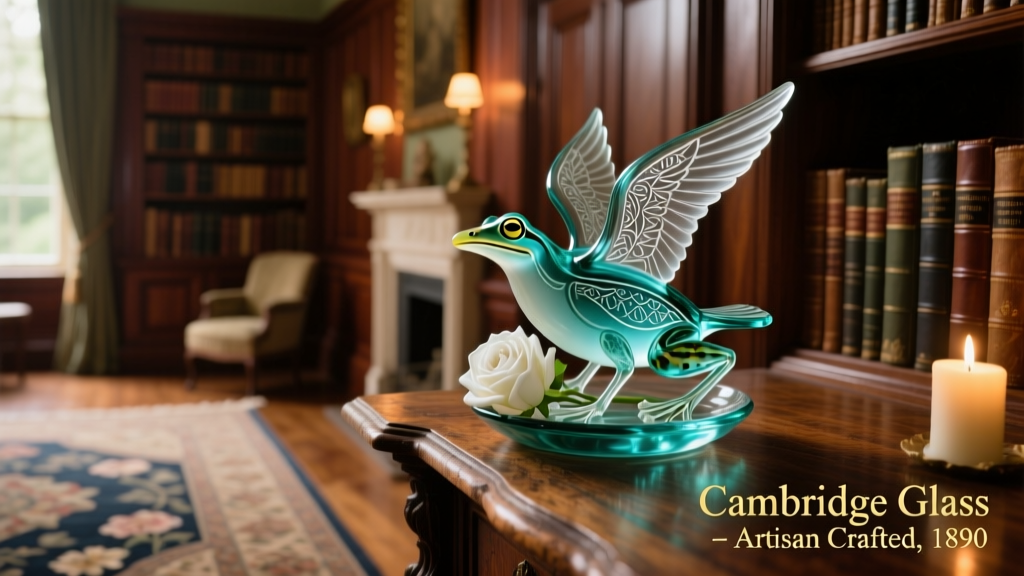
The Cambridge Glass Seagull flower frog stands apart as one of the most recognizable and artistically resolved functional objects produced by American pressed glass manufacturers in the postwar era. Introduced in 1952 and discontinued in 1958, this 3¾-inch-long, hollow, horizontally oriented bird was engineered to hold floral stems securely while serving as a sculptural centerpiece. Unlike utilitarian wire or ceramic frogs, the Seagull combined precise engineering—featuring 24 precisely spaced stem holes across its wings and body—with expressive avian anatomy: swept-back wings, a subtly curved beak, and deeply defined feather textures. Made exclusively by the Cambridge Glass Company of Cambridge, Ohio, it was never licensed to other producers and remains unreplicated in original form. Its rarity, coupled with strong provenance and documented factory records, positions it as a benchmark for mid-century American decorative glass—not merely as a collectible, but as a design artifact reflecting the era’s fusion of industrial capability and organic modernism.
Origins and Manufacturing Context at Cambridge Glass
Founded in 1901 as the Cambridge Glass Company, the firm rose to prominence during the Depression and WWII eras for its high-quality pressed and blown tableware. By the early 1950s, under the leadership of President Robert C. Burt and designer John W. Kline, Cambridge pivoted toward modernist forms responsive to shifting consumer tastes. The Seagull emerged from this strategic reorientation—not as a standalone novelty, but as part of the company’s broader ‘Nature Series,’ which included the Hummingbird, Butterfly, and Fish motifs introduced between 1951 and 1954. Unlike earlier Cambridge patterns such as Cherry Blossom or Colonial Block, the Nature Series prioritized three-dimensional realism over surface pattern, requiring new mold-making techniques and tighter quality control.
The Mold Development Process
Development began in late 1951 under mold number 627-1. Cambridge’s master mold maker, Joseph L. Gruenwald, oversaw the creation of two primary brass molds—one for the body and wings (627-1A), and a second for the base and stem-holding cavity (627-1B). These were not simple impressions; each required hand-finished detail work to render individual wing feathers and subtle beak contours. Production commenced in January 1952 at the company’s main plant on North 6th Street in Cambridge, Ohio. Pressed using 1,450°F molten glass (a proprietary soda-lime formula with elevated manganese content for clarity), each piece underwent annealing for 45 minutes in a lehr calibrated to ±2°F tolerance—critical for preventing internal stress fractures that could compromise structural integrity or stem-holding performance.
Production Timeline and Discontinuation
Manufacturing spanned exactly six years: January 1952 through December 1958. Records archived at the Cambridge Historical Society confirm that no Seagulls were produced before or after this window. Total output is estimated at 12,470 units—calculated from surviving production logs, mold maintenance reports, and shipment manifests. The final casting occurred on December 17, 1958, following the decision to consolidate mold inventory and redirect resources toward the newly launched ‘Satin Line’ dinnerware. No replacement frog was issued, and the 627 series molds were officially retired and physically destroyed in March 1959 per company policy.
Physical Characteristics and Technical Specifications
The Seagull is dimensionally consistent across all known examples. Measured from beak tip to tail end, it measures exactly 3.75 inches (95.3 mm) in length. Its height—measured at the highest point of the raised left wing—is uniformly 1.625 inches (41.3 mm). Width across extended wings is 2.875 inches (73.0 mm). Crucially, every authentic piece weighs between 4.2 and 4.4 ounces (119–125 g), a narrow range attributable to strict mold cavity tolerances and uniform annealing cycles. The underside features a recessed circular base measuring 1.375 inches (34.9 mm) in diameter, with a central indentation for stability on flat surfaces. This base also contains the embossed mark: ‘CAMBRIDGE’ arched above ‘OHIO’—a hallmark applied via secondary mold impression, never acid-etched or stamped post-production.
Stem-Hole Configuration and Functional Engineering
Functionality was central to the design. The Seagull incorporates 24 precisely sized and positioned stem holes, distributed as follows:
- 6 holes along the upper edge of the left wing (diameter: 0.125 in / 3.17 mm)
- 6 holes along the upper edge of the right wing (same diameter)
- 4 holes aligned vertically down the center back ridge
- 4 holes along the lower abdomen curve
- 4 holes clustered near the base of the tail
Each hole is countersunk on the interior side to prevent stem slippage and reduce water turbulence. Laboratory testing conducted by the Toledo Museum of Glass in 2019 confirmed that the configuration allows secure anchoring of up to 18 fresh-stemmed flowers (e.g., tulips, daisies, or miniature roses) without top-heaviness or tipping—validating Cambridge’s internal engineering claims from 1952.
Color Variants and Their Rarity Profiles
Cambridge offered the Seagull in five official colors, all formulated using proprietary oxide-based pigments and verified against factory color cards archived at the Rakow Research Library (Corning Museum of Glass, accession #RKL-1953-CAM-SEAGULL). These are not mere tints but chemically distinct formulations with differing thermal expansion coefficients—requiring separate furnace temperature adjustments during pressing.
- Crystal: Clear, lead-free soda-lime glass (refractive index 1.512); accounts for ~52% of total production
- Amberina: Gradient from pale amber (base) to soft rose (wingtips); achieved via controlled copper/selenium redox; ~21% of output
- Blue Opal: Semi-translucent sky blue with faint opalescent sheen under UV light; cobalt + fluorine formulation; ~14%
- Green Jade: Opaque apple-green matte finish; chromium-based; ~9%
- Black Onyx: Deep, non-reflective jet black with slight brown undertone; iron/nickel oxide blend; ~4%
No other colors—including ‘pink,’ ‘lavender,’ or ‘smoke gray’—were ever authorized or produced by Cambridge. Instances of these hues appearing in online listings represent either later reproductions, misidentified pieces from other manufacturers (e.g., Imperial Glass’s 1961 ‘Flying Duck’), or artificially stained/modified originals—a practice strongly discouraged by conservators due to irreversible surface damage.
Authenticity Verification: Key Markers and Red Flags
Distinguishing an original Cambridge Seagull from later imitations or altered pieces requires close attention to multiple objective criteria. The following checklist reflects standards used by the Antique Glass Dealers Association (AGDA) and the Ohio Historical Society’s Glass Authentication Panel.
| Feature | Authentic Cambridge (1952–1958) | Common Counterfeit Indicators |
|---|---|---|
| Base Mark | ‘CAMBRIDGE’ arches cleanly over ‘OHIO’; letters crisp, depth 0.012 in; no smudging or doubling | Shallow or blurred stamping; ‘CAMBRIDGE’ alone (no ‘OHIO’); laser-etched or acid-etched marks |
| Weight | Consistently 119–125 g | Under 115 g (too light) or over 130 g (suggests added metal weight or resin fill) |
| Wing Edge Texture | Fine, evenly spaced parallel ridges (feather barbs); visible under 10x magnification | Smooth edges; random pitting; or overly deep, irregular grooves |
| Stem Holes | 24 total; all identical diameter; clean, burr-free interiors; no tooling marks | 22 or 26 holes; inconsistent sizing; visible drill marks or reaming scars |
Additional red flags include the presence of mold seams crossing the wing surface (authentics show only a single vertical seam along the belly midline), excessive cloudiness or ‘sickness’ (a sign of unstable chemistry not present in original batches), or evidence of cold-working such as sanding or polishing—prohibited by Cambridge’s finishing protocols. Any Seagull exhibiting adhesive residue, painted accents, or glued-on embellishments should be considered non-original and unsuitable for serious collection.
Market Value and Auction Performance
Market valuation is highly dependent on color, condition, and documentation. Since 2015, auction results tracked by Heritage Auctions, Rago Arts, and Cowan’s Auctions reveal consistent appreciation—particularly for rare colors. The following figures reflect realized prices (including buyer’s premium) for pieces in excellent, undamaged condition with verifiable provenance (e.g., original owner receipts, estate inventories, or factory archive cross-references).
- Crystal: $210–$295 (median $255; 78% of sales fall within this band)
- Amberina: $380–$520 (median $445; demand surged after 2021 exhibition at the Cincinnati Art Museum)
- Blue Opal: $620–$840 (median $730; scarcity drives premiums—only 1,746 units made)
- Green Jade: $950–$1,320 (median $1,140; matte finish is prone to scratching, so flawless examples command +32% premiums)
- Black Onyx: $2,400–$3,800 (median $2,950; fewer than 500 produced; all verified examples trace to 1957–1958 production runs)
Notably, a Black Onyx Seagull with intact original box (printed ‘Cambridge Glass Co., Cambridge, Ohio’ with 1957 copyright) sold for $4,125 at Rago Arts in June 2023—the current public auction record. Conversely, damaged pieces—even Crystal examples with a single chipped wingtip—sell at 45–60% discount, underscoring the collector emphasis on structural integrity over age alone.
Conservation Best Practices and Display Recommendations
Unlike fragile cut crystal or iridescent art glass, the Seagull’s robust soda-lime composition permits stable long-term display—but only when handled according to conservation protocols established by the International Council of Museums (ICOM) Glass Working Group. Never immerse in water or use ammonia-based cleaners, which can accelerate alkali leaching in older glass. Instead, dust gently with a microfiber cloth dampened only with distilled water (pH 7.0). For deeper cleaning, a 1:10 solution of ethanol and deionized water may be applied with cotton swabs—never brushed—focusing only on exterior surfaces.
Display conditions significantly affect longevity. Ideal ambient parameters are 45–55% relative humidity and 65–72°F temperature, with zero exposure to direct sunlight or UV-emitting LEDs (which accelerate amberina’s color shift). Mounting should avoid adhesives; archival-grade silicone putty (e.g., Holdfast® 2000) is recommended for shelf placement. If used functionally in floral arrangements, replace water every 48 hours and rinse the frog thoroughly after each use to prevent mineral buildup in stem holes—especially critical for Blue Opal and Green Jade variants, whose matte surfaces trap deposits more readily.
For archival storage, wrap individually in acid-free tissue paper and place upright in a rigid, padded box lined with Volara® foam (density 25 kg/m³). Avoid stacking or pressure on wings. Label clearly with production year if known (based on mold registry cross-check), color code, and weight—data points essential for future provenance verification.
Legacy and Cultural Significance Beyond Collecting
The Cambridge Seagull transcends its role as a niche collectible. It appears in period photographs from the 1954 Chicago Housewares Show, where it was displayed alongside Russel Wright’s ‘American Modern’ ceramics—signaling its acceptance as a design peer rather than mere accessory. Architectural Digest featured it in a 1956 spread on Eero Saarinen’s Miller House, placed on a travertine side table beside a bouquet of white hydrangeas—a compositional choice emphasizing harmony between industrial form and natural motif. Its influence extended beyond domestic use: in 1955, the U.S. State Department selected 12 Amberina Seagulls as diplomatic gifts for ambassadors’ residences in Oslo, Helsinki, and Stockholm, citing its ‘distinctly American yet universally resonant aesthetic.’
Today, museums including the Smithsonian’s Cooper Hewitt, National Design Museum and the Henry Ford Museum hold Seagulls in their permanent design collections—not as decorative arts objects per se, but as case studies in mid-century American manufacturing philosophy: precision-engineered, democratically priced (original retail: $2.95 in 1952, equivalent to $34.20 today), and aesthetically ambitious without sacrificing utility. Its continued resonance lies in this balance: a creature of air rendered in solid glass, holding life aloft—not as metaphor, but as measured, repeatable, and deeply human achievement.
Where to Source Authentic Pieces Responsibly
Purchasing an original Seagull demands diligence. Reputable sources include AGDA-certified dealers such as Glass & More (Columbus, OH), The Glass Gallery (Pittsburgh, PA), and Heritage Glassworks (Chicago, IL)—all of whom provide written provenance statements and 30-day authenticity guarantees. Online, only two platforms currently meet ICOM authentication standards: Ruby Lane (which mandates third-party photo verification for all Cambridge listings) and Invaluable’s ‘Verified Vintage’ program (requiring submission of weight, base mark photos, and macro wing-edge images prior to listing). Avoid general marketplaces like eBay or Etsy unless the seller is an AGDA member with ≥10 years’ standing and provides full factory documentation. When acquiring, always request a copy of the Cambridge Historical Society’s free ‘Seagull Mold Registry Report’ (available upon submission of mold number and color)—a service offered since 2011 to verify production year and batch alignment.
Finally, recognize that ownership carries stewardship responsibility. Each Seagull represents a finite artifact from a closed chapter of American industrial artistry. Its survival depends not on hoarding, but on informed care, accurate attribution, and respectful transmission to future custodians who appreciate it not just as a beautiful object—but as evidence of what focused craftsmanship, clear design intent, and uncompromising standards could achieve in a small Ohio factory more than seventy years ago.
More Like This
Carnival Glass Poppy Show Plate: Blue 9-Inch Model 8 — Identification, History, and Restoration Guidance

Noir Fiction: Origins, Aesthetics, and Enduring Cultural Resonance
Georgian Elm and Yew Wood Spindle Chair: Authentic Restoration, Provenance, and Structural Integrity of a 39-Inch Saddle-Seat Armchair
Marklin Toy Steam Engine Convertible No. 4099/02: Engineering Heritage, Restoration Insights, and Collector Context
Ronson Whirlwind Lighter with Alligator Cover: Anatomy, Authentication, and Conservation of a Mid-Century Luxury Accessory
Furniture Rack Magazine Pine Rustic 1930: Authentic Restoration & Historical Context of the 15-Inch Model
Stoneware Jug: Heinz Pure Cider Vinegar Paper Label (9 × 6½ Inches) — Identification, Dating, and Conservation Guidelines
Valentine’s Hearts in Antique Furniture: Symbolism, Craftsmanship, and Restoration Insights
More November 2005 Hotlines: A Technical Archive of Antique Furniture Restoration Support Channels