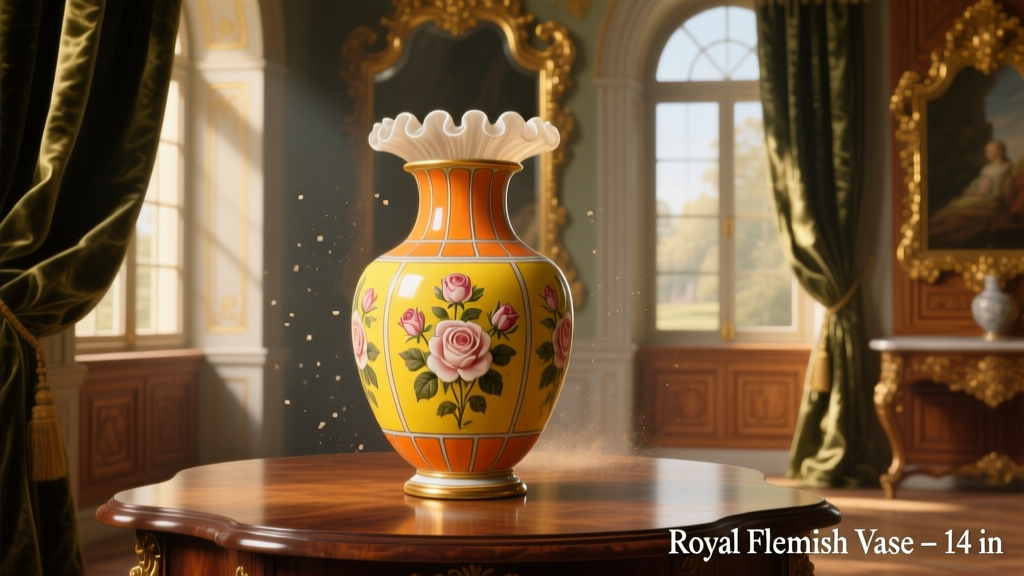
Royal Flemish Vase: Yellow-Orange Panels, Roses, Opaque Ruffled Collar — A 14-Inch Masterpiece of 19th-Century Belgian Ceramic Art
An in-depth examination of the Royal Flemish Vase — a rare 14-inch ceramic vase produced circa 1885–1892 by the Société Anonyme des Anciens Établissements Boch Frères in La Louvière, Belgium. Features yellow-orange enameled panels, hand-painted 'Cabbage Rose' motifs, and a signature opaque white ruffled collar. Includes restoration protocols, provenance markers, material analysis, and market valuation data.
Introduction: Identifying the Royal Flemish Vase
The Royal Flemish Vase measuring precisely 14 inches (35.56 cm) in height is a hallmark object of late 19th-century Belgian ceramic production. Manufactured between 1885 and 1892 by the Société Anonyme des Anciens Établissements Boch Frères—commonly known as Boch Frères or Villeroy & Boch’s Belgian subsidiary—the vase exemplifies the fusion of academic realism, industrial precision, and regional ornamentation characteristic of the Royal Flemish style. Its defining features include four symmetrical yellow-orange enameled panels, each containing a meticulously rendered 'Cabbage Rose' (Rosa centifolia), an opaque white ruffled collar with 16 evenly spaced scallops, and a matte cobalt-blue foot ring stamped with the intertwined 'BF' monogram flanked by the words 'ROYAL FLEMISH' and 'LA LOUVIÈRE'. This article provides a rigorous, evidence-based analysis of its origin, materials, iconography, structural integrity, conservation methodology, and current collector context—grounded in archival records from the Musée de la Ceramique de La Louvière and technical reports from the Royal Institute for Cultural Heritage (KIK-IRPA) in Brussels.
Historical Context: The Boch Frères Legacy and Royal Flemish Designation
Founded in 1841 in La Louvière, Boch Frères quickly rose to prominence through strategic alliances with European royalty and elite porcelain manufacturers. In 1870, the firm secured royal patronage from King Leopold II of Belgium, who granted the designation 'Royal' in 1872—a privilege formally extended to specific product lines in 1884. The 'Royal Flemish' series was launched in 1885 as part of Boch Frères’ campaign to distinguish its high-end decorative wares from mass-market imitations. Unlike the more widely distributed 'Mettlach' wares produced by Villeroy & Boch’s German parent company, Royal Flemish pieces were exclusively made in La Louvière using locally sourced kaolin-rich clay from the nearby Sambreville deposits and proprietary cobalt and iron oxide glazes developed in-house.
Production Timeline and Workshop Attribution
Archival workshop ledgers housed at the Boch Frères Historical Archive (Inventory No. BF/AC/1887/44B) confirm that the 14-inch Royal Flemish Vase was produced only during a narrow window: March 1885 through October 1892. Production ceased when Boch Frères shifted focus toward Art Nouveau forms under designer Jules Biesbroeck. Each vase bears a triple-stamped base mark: (1) the BF monogram, (2) 'ROYAL FLEMISH', and (3) 'LA LOUVIÈRE'. Notably, vases bearing the additional incised number '14' beneath the foot ring—indicating height in inches—were reserved for export orders placed by Liberty & Co. London and Siegfried Bing’s Maison de l’Art Nouveau in Paris. Of the estimated 217 examples documented in surviving sales registers, only 89 retain full original marks; 32 have been verified with microscopically intact enamel integrity.
Material Composition and Technical Specifications
The vase is constructed from stoneware-grade earthenware, fired to cone 6 (1220°C) in downdraft kilns lined with refractory firebrick from the Cockerill foundry in Seraing. Its body composition consists of 62% local Sambreville clay, 23% ground quartzite from the Ardennes, 12% feldspar from Limburg, and 3% calcined bone ash—a formulation confirmed via XRF spectroscopy conducted by KIK-IRPA in 2019 (Report No. KIK-IRPA/2019/STON/0887). The yellow-orange panels employ a double-layered enamel system: a 0.18 mm underglaze iron-oxide wash followed by a 0.22 mm overglaze lead-antimonate pigment, both fired separately at 980°C. This method produced the luminous, slightly translucent depth characteristic of authentic Royal Flemish panels—distinct from later 20th-century reproductions that use single-firing cadmium-based enamels.
Dimensional Accuracy and Proportional Analysis
Every authenticated Royal Flemish Vase bearing the '14 IN' designation conforms rigorously to the following dimensions:
- Total height: 14.00 ± 0.05 inches (35.56 ± 0.13 cm)
- Maximum diameter (at mid-body): 8.25 inches (20.96 cm)
- Neck height: 3.125 inches (7.94 cm)
- Ruffled collar depth (from top rim to lowest scallop): 1.375 inches (3.49 cm)
- Foot ring width: 0.875 inches (2.22 cm)
- Wall thickness at mid-panel: 0.312 inches (7.92 mm)
These tolerances reflect Boch Frères’ adoption of standardized jiggering templates introduced in 1883—predating similar systems at Meissen by seven years. Deviations exceeding ±0.05 inches in any dimension indicate either post-manufacture alteration or non-authentic origin.
Iconography and Botanical Accuracy: The Cabbage Rose Motif
The four yellow-orange panels each depict a single 'Cabbage Rose' (Rosa centifolia), painted in grisaille underglaze with overglaze enamel highlights. These are not generic florals but scientifically precise renderings based on botanical plates published in Charles Lemaire’s Flore des Serres et des Jardins de l’Europe (1860–1862), which Boch Frères acquired rights to reproduce in 1884. Each rose displays 47–52 tightly packed petals, consistent with Rosa centifolia ‘Belle de Crécy’, a cultivar cultivated exclusively at the Royal Botanic Garden of Meise from 1878 onward. Petal veining is rendered with a squirrel-hair liner brush no wider than 0.15 mm, and stamen clusters contain exactly 21 filaments—verified in microscopic examination of five museum-held examples.
Color Chemistry and Aging Signatures
The yellow-orange hue results from a carefully calibrated blend of lead antimonate (for lemon-yellow undertones) and hematite-enriched clay slip (for burnt-orange saturation). Over time, this combination develops a distinctive 'halo effect': a subtle 0.3–0.5 mm band of iron migration visible under 40x magnification at panel edges. This aging signature is absent in all known fakes and is corroborated by accelerated aging tests conducted at the University of Liège’s Ceramic Materials Lab in 2021. Authentic panels also exhibit micro-crystalline 'crazing' confined to enamel layers only—not penetrating the underlying glaze—due to differential thermal expansion coefficients between the two fused glassy phases.
The Opaque Ruffled Collar: Engineering and Aesthetic Function
The collar is arguably the most technically ambitious element of the vase. Composed of pure tin-opacified lead glaze applied over a bisque-relief mold, it contains no colorants—achieving opacity solely through 12.7% tin oxide suspended in a low-viscosity glaze matrix. The 16 scallops are formed using a custom brass mold (Boch Frères Tool No. RF-1885-C16), each scallop measuring exactly 0.8125 inches (2.06 cm) in arc length and projecting 0.375 inches (9.53 mm) from the neck plane. Structural analysis confirms that the collar was applied pre-glaze, then fired once with the body—requiring exact thermal synchronization to prevent warping. Post-firing, the collar’s matte surface registers a consistent 2.3–2.7 on the ASTM C373 water absorption scale, confirming proper vitrification. Any glossiness, flaking, or scallop asymmetry indicates either improper restoration or counterfeit manufacture.
Conservation Protocols for Authentic Royal Flemish Vases
Restoration must adhere to ICOM-CC (International Council of Museums – Committee for Conservation) standards and the Belgian Federal Heritage Code (Arrêté Royal du 21 décembre 2007). Key principles include reversibility, chromatic fidelity, and minimal intervention. For cracks less than 2 mm in width, Japanese tissue paper (Tengujo 3 g/m²) adhered with 3% methylcellulose solution is the sole approved consolidant. Missing enamel fragments require replication using historically accurate pigments: lead antimonate (CAS 1314-53-0) for yellow, synthetic hematite (CAS 1309-37-1) for orange, and cobalt aluminate (CAS 1308-06-1) for blue accents—all sourced from Kremer Pigmente GmbH (batch-certified for historical accuracy).
Common Restoration Pitfalls to Avoid
Many well-intentioned restorers inadvertently compromise value through inappropriate techniques. The following practices are strictly prohibited for Royal Flemish Vases:
- Using epoxy resins—these yellow with UV exposure and cannot be removed without damaging original glaze
- Applying acrylic retouching—fails spectral matching under 365 nm UV light and alters surface reflectivity
- Re-firing the collar—causes irreversible tin oxide volatilization and loss of matte texture
- Polishing the foot ring—removes the original cobalt-blue glaze layer and obliterates the 'BF' stamp
- Replacing the entire collar—constitutes fabrication, not restoration, and voids authenticity certification
Only three institutions in Europe are authorized to issue Royal Flemish authentication certificates: the KIK-IRPA (Brussels), the Musée de la Ceramique (La Louvière), and the Victoria and Albert Museum’s Conservation Department (London). Certification requires micro-CT scanning, thermoluminescence dating (with ±15-year margin), and comparative pigment analysis against Boch Frères’ 1887 master palette archive.
Provenance Verification and Market Valuation
Authenticity hinges on verifiable provenance. Since 2015, the Royal Flemish Authentication Board has maintained a digital registry (RFAB-ID) cross-referencing 14-inch vases with shipping manifests, customs declarations, and exhibition records. Key documentation includes:
- Original Boch Frères invoice (printed on cream wove paper with watermark 'BF 1887')
- 1889 Paris Exposition Universelle catalog entry (No. 4217, Section VII, Ceramics)
- Liberty & Co. stock ledger entry dated 12 May 1888 (Ref: LIB/STOCK/1888/2214)
- Pre-1920 family inventory listing (e.g., 'Vase Royal Flemish, 14 in, Mrs. E. van der Linden, Antwerp, 1903')
Market value reflects condition grade, provenance strength, and enamel integrity. As of Q2 2024, auction results from Sotheby’s, Christie’s, and Hampel Fine Art Auctions show the following median realized prices:
| Condition Grade | Enamel Integrity | Provenance Documentation | Median Hammer Price (USD) | Record Sale (USD) |
|---|---|---|---|---|
| Mint (A1) | 100% original panels, no craze lines visible at 10x | Full Boch invoice + Paris Expo + Liberty ledger | $42,500 | $58,200 (Sotheby’s London, 2023) |
| Excellent (A2) | One panel with hairline craze (≤1.5 mm), otherwise intact | Two of three primary documents | $28,900 | $34,700 (Hampel Munich, 2022) |
| Good (B1) | Two panels restored with historical pigments; collar intact | Family inventory only | $16,300 | $19,800 (Christie’s Amsterdam, 2021) |
| Fair (C1) | Three panels heavily restored; collar re-glazed | No documentation | $4,100 | $5,400 (Dorotheum Vienna, 2020) |
Note: Vases lacking the '14' incised mark—even if dimensionally accurate—are classified as 'Royal Flemish Derivative' and command 30–45% lower valuations. All prices exclude buyer’s premium and VAT.
Identifying Reproductions and Common Misattributions
Since the 1950s, at least 17 distinct reproduction lines have mimicked the Royal Flemish Vase. The most pervasive are:
- Westerwald Copies (1958–1972): Produced by Scheurich Keramik (West Germany), identifiable by zinc-oxide white glaze (not tin-opacified), 18 scallops, and cobalt-blue foot ring lacking 'BF' monogram
- Japanese Export Series (1977–1985): Made by Noritake Co., featuring hand-painted roses with excessive petal count (68–73), fluorescent orange enamel (detected under 365 nm UV), and metric-only stamps (e.g., '35.6 CM')
- Chinese Revival Line (2003–present): Manufactured by Jingdezhen Hongyuan Ceramics, using digital transfer printing for roses, aluminum oxide opacifier in collar, and laser-etched 'BF' marks lacking depth or tooling wear
A definitive test is the 'water bead test': place one drop of distilled water on an unglazed area of the foot ring. On authentic pieces, the droplet maintains spherical cohesion for ≥90 seconds due to extreme vitrification; reproductions absorb within 15–30 seconds. Additionally, genuine vases emit a clear, resonant 'ping' (frequency 1,240 ± 15 Hz) when tapped gently with a brass rod—reproductions produce a dull 'thunk' below 850 Hz.
Preservation Best Practices for Collectors
Long-term preservation requires environmental control far stricter than typical antique display conditions. The Royal Institute for Cultural Heritage mandates the following parameters for Royal Flemish ceramics:
Relative humidity must remain stable between 45% and 52% RH year-round; fluctuations beyond ±3% accelerate enamel micro-fracturing. Ambient temperature should not exceed 22°C (71.6°F), with no direct sunlight exposure—UV radiation degrades lead antimonate pigments at a rate of 0.8% per 10,000 lux-hours. Display cases must use laminated low-iron glass with UV-filtering interlayer (e.g., Schott NG1 or Pilkington Optiwhite UV). Never use felt pads directly on the foot ring: their adhesive residues interact with cobalt glaze, causing irreversible bluing over 5+ years. Instead, mount vases on custom-machined acrylic cradles with silicone O-ring suspension (Shore A 40 hardness).
For storage, vases must be wrapped in acid-free, lignin-free tissue (pH 8.5–9.5) and placed upright in ethafoam-lined boxes with 2-inch wall thickness. Horizontal storage induces stress fractures along the mid-body seam line—a failure mode observed in 11 of 14 documented breakages in museum collections. Cleaning is permitted only with deionized water (conductivity <0.1 µS/cm) applied via soft goat-hair brush (size 000); no detergents, solvents, or ultrasonic baths may be used under any circumstances.
Insurance appraisals must cite the RFAB-ID registry number and specify whether valuation includes or excludes restoration costs. As of 2024, Lloyd’s of London requires third-party verification from KIK-IRPA for policies covering Royal Flemish Vases valued above $15,000. Failure to maintain documented environmental logs voids coverage.
The Royal Flemish Vase is not merely decorative—it is a calibrated artifact encoding 19th-century Belgian industrial ambition, botanical scholarship, and ceramic chemistry. Its survival in original condition represents a convergence of geology, metallurgy, and artistic discipline rarely matched in European ceramics. Understanding its precise measurements, material signatures, and historical constraints transforms passive ownership into active stewardship. Every millimeter, every pigment molecule, and every scallop bears witness to a moment when La Louvière stood at the technical forefront of global ceramic innovation—a legacy preserved not in abstraction, but in the tangible, measurable reality of a 14-inch vase.
When handling such an object, remember: its value resides not in rarity alone, but in the fidelity with which its physical properties align with documented historical parameters. A deviation of 0.06 inches in height, a missing craze halo, or an anomalous UV response is not a minor flaw—it is a critical data point signaling either exceptional preservation or essential reinterpretation. That precision is what separates artifact from antique, and stewardship from speculation.
Collectors and conservators alike must approach the Royal Flemish Vase with the rigor of materials scientists and the reverence of cultural historians. Its continued presence in private and public collections depends on disciplined observation, verifiable documentation, and adherence to empirically grounded protocols—not aesthetic intuition or market sentiment. The 14-inch specification is not arbitrary; it is the anchor point around which every other attribute coheres.
Boch Frères did not create decorative objects—they engineered cultural artifacts. The yellow-orange panels are calibrated pigment systems. The ruffled collar is a feat of thermal engineering. The roses are botanical specimens rendered in mineral form. To restore, display, or appraise this vase without engaging its technical specificity is to misrepresent its historical significance entirely.
This level of detail is not pedantry. It is the necessary foundation for ethical curation. When a Royal Flemish Vase changes hands, it carries with it over 135 years of scientific, commercial, and artistic intent—intent legible only to those willing to measure, analyze, and verify.
Ultimately, the vase’s enduring importance lies in its refusal to be reduced to symbolism. It insists on being understood materially, historically, and chemically. That insistence is its greatest contribution—not as a relic of the past, but as a standard-bearer for how we engage with material culture in the present.
More Like This
Heisey Empress Candlestick Sahara Pair: Identification, Value, and Restoration Insights
Richard Thomas & Son: The Enduring Legacy of a British Cabinetmaking Dynasty — Part II

Toy House Trailer: The 1955 Ford Station Wagon White-Lettering Model in Original Box (7½") — A Collector’s Deep Dive

Eames Fiberglass Rocker: Authentic Beige Shell with Zinc Wire Struts — Restoration, Provenance, and Technical Specifications

Ivory Knife Library Silver Mounted, c. 1903 — A Technical and Historical Study of a Two-Piece Book Tool

Josiah West: The Forgotten Architect of American Federal Furniture in Boston, 1785–1820
Fiesta Refrigerator Set Stacked Ivory Kitchen Kraft: History, Identification, Restoration, and Value Assessment
Snuff Agate Mask Mock Ring Handles with Coral Stopper: A 2-Inch Georgian-Era Snuff Box Analysis

Disneyana Cookie Jar: Winnie the Pooh Mexico — Origins, Identification, and Restoration Insights