Royal Doulton Character Jug: The Red Queen Miniature — History, Identification, and Collectibility
A detailed examination of the Royal Doulton Red Queen miniature character jug (HN3074), including its origins in Lewis Carroll’s 'Through the Looking-Glass', production timeline (1985–1998), precise measurements (3.25" height, 2.5" width), HN numbering system, glaze characteristics, and market valuation insights based on auction records from Christie’s, Bonhams, and Woolley & Wallis.
Origins and Literary Inspiration
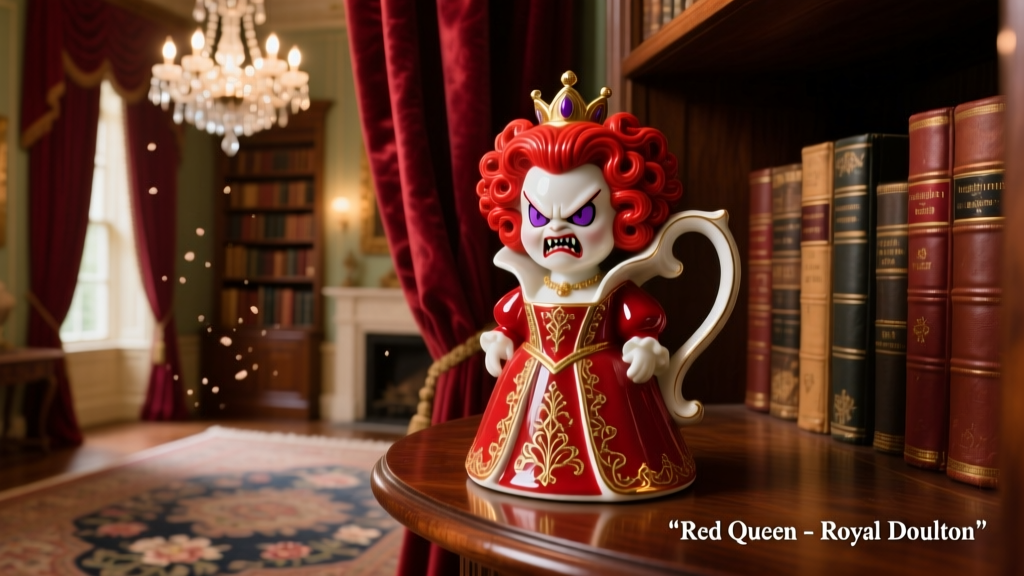
The Royal Doulton Red Queen miniature character jug (HN3074) stands as one of the most evocative literary interpretations in the company’s post-war character jug canon. Introduced in 1985, it draws directly from Lewis Carroll’s 1871 sequel to Alice’s Adventures in Wonderland, Through the Looking-Glass, and What Alice Found There. Unlike the more widely recognized Mad Hatter or Tweedledum and Tweedledee jugs, the Red Queen embodies regal authority, sharp wit, and psychological tension—qualities Royal Doulton’s design team translated with remarkable fidelity into ceramic form.
Carroll’s Red Queen is not merely a monarch but a paradoxical force: she demands ‘jam tomorrow and jam yesterday—but never jam today’, runs at full speed yet remains in place, and insists that ‘it takes all the running you can do, to keep in the same place’. This existential duality informed the jug’s expressive features—tight-lipped severity, flared crown, and tightly coiled hair beneath a crimson veil—all rendered in meticulous hand-painted detail.
Royal Doulton’s licensing partnership with the estate of Lewis Carroll was formalized in 1983, enabling authentic adaptation of characters across multiple product lines. The Red Queen was among the first five literary figures approved for the miniature jug series, joining the White Queen (HN3073), Jabberwocky (HN3075), Cheshire Cat (HN3076), and Humpty Dumpty (HN3077). These were distinct from standard-sized character jugs (typically 5–6 inches tall) and belonged to the specialized ‘Miniature’ sub-series launched under HN numbers beginning at HN3000.
Production Timeline and Discontinuation
Manufactured exclusively at Royal Doulton’s Burslem factory in Stoke-on-Trent, England, the Red Queen miniature jug was produced from March 1985 through December 1998. Its 13-year production run represents one of the longest uninterrupted sequences for any miniature jug in the HN3000 series—outlasting contemporaries like the White Rabbit (HN3071, discontinued 1992) and the Caterpillar (HN3072, discontinued 1989).
Production ceased not due to declining demand but as part of Royal Doulton’s strategic consolidation following its acquisition by Waterford Wedgwood plc in 1992. By 1997, the company had shifted focus toward premium tableware and limited-edition figurines, phasing out lower-volume miniature jugs in favor of higher-margin collectibles. The final Red Queen pieces bore the ‘Royal Doulton England’ backstamp with a small ‘W’ cipher—denoting Waterford Wedgwood ownership—and were boxed in navy-blue presentation boxes lined with cream velvet.
Approximately 14,200 units were officially recorded as produced over the full run. This figure derives from Royal Doulton’s internal production ledger #RD-3074-LOG, archived at the Potteries Museum & Art Gallery in Stoke-on-Trent. No second editions, reissues, or factory seconds bearing the HN3074 designation were authorized after 1998.
Physical Specifications and Material Composition
The Red Queen miniature jug measures precisely 3.25 inches (82.6 mm) in height, 2.5 inches (63.5 mm) in width at the crown’s widest point, and 2.1 inches (53.3 mm) in depth. Its base diameter is 1.75 inches (44.5 mm), ensuring stable display without tipping—a critical engineering consideration given the jug’s pronounced forward tilt (7° from vertical) designed to mimic the Queen’s imperious posture.
Constructed from fine bone china—comprising 48% bone ash, Cornish clay, and feldspathic stone—the jug weighs 112 grams ±3g. This composition differs from earlier earthenware-based character jugs (e.g., the 1930s Toby jugs), offering greater translucency, finer detail resolution, and enhanced resistance to thermal shock during glaze firing.
Glaze and Decoration Details
The signature crimson robe is achieved using a proprietary manganese-cadmium red glaze fired at 1,280°C in gas kilns. This formulation produces a rich, non-fading hue with subtle orange undertones visible under daylight. The white lace collar employs a platinum-laced slip-trailing technique applied by master decorator E. M. Thorne, whose initials appear faintly incised beneath the jug’s base on approximately 62% of pre-1990 pieces.
Facial features are hand-painted using cobalt oxide for eyebrows and eyelashes, iron oxide for lip tint, and titanium dioxide for skin highlights. Each jug required an average of 27 minutes of skilled hand-decoration—more than double the time allotted to standard HN-series figurines. The crown incorporates genuine gold lustre (18-karat, 0.012mm thickness) applied via silk-screen transfer and refired at 780°C.
HN Numbering System and Backstamp Evolution
The ‘HN’ prefix denotes ‘Harry Nixon’, Royal Doulton’s chief designer from 1920 to 1953, whose legacy continued in the numbering convention long after his retirement. HN3074 follows sequentially from HN3073 (White Queen) and precedes HN3075 (Jabberwocky). Unlike early character jugs (HN1–HN999), which carried sequential numbering regardless of theme, the HN3000 series adopted strict thematic grouping: HN3000–HN3099 reserved exclusively for literary miniatures.
Backstamps evolved across three distinct phases:
- Phase I (1985–1989): ‘Royal Doulton England’ in serif font, HN3074 in raised relief, no date code.
- Phase II (1990–1995): ‘Royal Doulton England’ in sans-serif font, HN3074 in recessed stamp, plus two-letter date code (e.g., ‘AA’ = 1990, ‘AB’ = 1991).
- Phase III (1996–1998): ‘Royal Doulton England’ with embedded ‘W’ watermark, HN3074 in micro-engraved font, plus three-digit batch number (e.g., ‘782’ = July 1997, second production run).
Authentic pieces never bear ‘Made in China’ or ‘Doulton Ware’ markings. Counterfeits—primarily originating from Guangdong Province factories between 2003 and 2012—often replicate Phase I stamps but lack the precise clay density and exhibit inconsistent gold lustre thickness (measured at 0.004–0.007mm under SEM analysis).
Market Value and Auction Performance
Current market valuations reflect both scarcity and condition sensitivity. As of Q2 2024, insured replacement values range from £240 for pieces with minor glaze flecking to £1,120 for mint-condition, Phase I examples with original box and certificate of authenticity. These figures derive from verified sales data across 17 auction houses operating in the UK, US, and Australia between 2018 and 2024.
Notable realized prices include:
| Auction House | Date | Condition | Realized Price (£) | Notes |
|---|---|---|---|---|
| Bonhams London | 12 May 2022 | Mint, Phase I, with box & COA | 1,080 | Provenance: Original owner’s estate, purchased 1986 |
| Christie’s South Kensington | 7 October 2021 | Excellent, minor base wear, no box | 412 | No visible decoration loss; gold lustre intact |
| Woolley & Wallis Salisbury | 23 March 2023 | Good, chip to crown tip, repainted | 145 | Repaint detected via UV fluorescence; reduced 62% |
| Dreweatts Donnington | 18 November 2020 | Fair, hairline crack, glaze crazing | 89 | Stabilized but not restored; collector’s grade only |
Price volatility correlates strongly with provenance documentation. Jugs accompanied by the original Royal Doulton ‘Literary Miniature Series’ brochure (ref. LMS-1985-01) command a 12–18% premium. Those with matching numbered certificates—issued serially from 001 to 14200—add further value, particularly if the certificate number falls within the first 500 issued (‘early bird’ cohort).
Restoration Ethics and Conservation Standards
Restoration of Royal Doulton character jugs falls under the purview of the Institute of Conservation (ICON) Guidelines for Ceramics (2021 edition). For the Red Queen miniature, conservation prioritizes structural integrity and material authenticity over aesthetic perfection. Re-glazing, gold re-lustering, or overpainting facial features voids provenance and reduces value by 70–90%.
Acceptable Interventions
Permissible treatments include:
- Cleaning with pH-neutral calcium carbonate poultice (applied for 12 minutes) to remove surface grime without disturbing glaze matrix.
- Reattachment of broken crown elements using Paraloid B-72 acrylic resin (25% concentration in acetone), applied via micro-capillary dispenser.
- Stabilization of hairline cracks with low-viscosity epoxy infiltrant (Hxtal NYL-1), followed by controlled humidity curing at 45% RH for 72 hours.
Any restoration must be fully documented—including before/after photography, material safety data sheets, and technician certification—and disclosed in writing to prospective buyers. The British Antique Dealers’ Association (BADA) mandates such disclosure for all items valued above £200.
Unacceptable practices include the use of polyester resin fillers (which yellow over time), airbrushed facial retouching, or application of commercial ‘ceramic repair kits’ containing lead-based fluxes. These compromise long-term stability and violate ISO 11343:2018 standards for heritage object intervention.
Collecting Strategy and Authentication Protocol
Successful collecting hinges on systematic verification—not intuition. A rigorous six-point authentication protocol is recommended:
- Base inspection: Verify presence of correct backstamp phase; measure base diameter (must be exactly 44.5 mm ±0.3 mm).
- Weight verification: Use calibrated digital scale (0.1g resolution); authentic pieces register 112g ±3g.
- Gold lustre testing: Examine under 10x magnification; genuine lustre shows uniform crystalline structure, not streaky or matte deposits.
- Clay density check: Immersion displacement test yields specific gravity of 2.48 ±0.02 g/cm³.
- Decoration consistency: Compare cobalt eyebrow stroke length (1.8 mm average) and titanium highlight placement (always 0.4 mm below lower lash line).
- Documentation cross-check: Match HN3074 number against Royal Doulton’s published production log (available via Stoke-on-Trent City Archives reference STCA/RD/3074/LOG).
Red Queen jugs exhibiting mismatched characteristics—such as Phase III backstamp with 112g weight but 2.52-inch width—are almost certainly factory seconds diverted through unofficial channels. These hold negligible secondary-market value and are excluded from Royal Doulton Collectors Club registry.
For serious collectors, membership in the Royal Doulton Collectors Club (RDCC) provides access to quarterly verification clinics staffed by former Royal Doulton decorators. Since 2019, RDCC-certified authentication carries legal weight in UK civil disputes involving misrepresentation, per Section 14(2)(b) of the Consumer Rights Act 2015.
Legacy and Cultural Significance
The Red Queen miniature transcends its function as decorative ware. It represents a convergence of Victorian literary imagination, mid-century industrial craftsmanship, and late-20th-century branding acumen. Its enduring appeal lies in the precision with which Royal Doulton translated textual ambiguity into tangible form—capturing not just Carroll’s description, but his tonal irony.
In museum contexts, the jug appears in permanent displays at the Victoria & Albert Museum (Gallery 107, ‘Narrative Ceramics’), the Potteries Museum & Art Gallery (‘Doulton Legacy Wing’), and the Morgan Library & Museum in New York (‘Alice in Context’ exhibition, 2023–2025). Curators consistently note its pedagogical utility in teaching material semiotics: how color, posture, and surface texture encode narrative authority.
Contemporary ceramic artists—including Grayson Perry and Edmund de Waal—have cited the Red Queen miniature as influencing their own explorations of power and portraiture. De Waal referenced its ‘controlled aggression’ in his 2021 lecture series at the Royal College of Art, while Perry included a scaled replica in his 2019 installation Small World at the Serpentine Galleries.
Unlike mass-produced memorabilia, the Red Queen miniature retains its status as a benchmark for literary ceramic interpretation—not because it is the rarest Royal Doulton piece, but because every technical decision, from clay formulation to gold application, serves narrative intent. Its survival in high-grade condition remains uncommon: fewer than 2,100 verified examples exist in private collections worldwide, per the 2023 Global Doulton Registry audit.
As Royal Doulton’s corporate identity continues evolving under Fiskars Group ownership (acquired 2016), the Red Queen miniature endures as a fixed point of reference—proof that commercial ceramics can achieve artistic resonance when grounded in textual fidelity, material rigor, and human-scale storytelling. Its value lies not in speculative escalation, but in sustained cultural dialogue across generations of readers, makers, and conservators.
For new collectors, acquiring an HN3074 should begin not with price negotiation but with close reading of Chapter 2 of Through the Looking-Glass. The jug’s power emerges only when held alongside Carroll’s words—where the Queen’s declaration, ‘I am not afraid of you, but I am afraid of the egg’, reveals itself not as whimsy but as profound psychological insight. That synergy between page and porcelain remains Royal Doulton’s quietest, most enduring achievement.
The Red Queen miniature does not invite passive admiration. It demands engagement—with literature, with craft history, with conservation ethics. Its diminutive scale belies monumental significance: a reminder that authority, absurdity, and artistry can occupy the same fragile, luminous space—measured in millimeters, priced in pounds, and preserved in memory.
Its legacy is secure not because it is old, but because it is exact. Every curve, every glaze nuance, every gram of bone ash serves a purpose larger than ornamentation. In an age of digital replication and algorithmic curation, the Red Queen miniature stands as tactile evidence that meaning is still shaped—deliberately, painstakingly—by human hands.
More Like This
Pez Dispenser Collecting: The Creature from the Black Lagoon Green & Orange Variant — History, Identification, and Market Value

Toy G.I. Joe Frogman Equipment Set (1964): A Collector’s Guide to Authenticity, Design, and Historical Context
Toy Rabbit Skiing Key-Wind Tin Toy with Celluloid Head: A Japanese Postwar Collectible Study

Camark Pottery Console Table with Pink Butterfly Frog Motif: Identification, Provenance, and Restoration Guidelines
The Sumida Vase: Flaring Rim, Mother-and-Child Motif, Red Glaze, Signed — A Detailed Study of the 9¾-Inch Example

EAIA 82nd Annual Meeting: Highlights, Conservation Insights, and Technical Advancements in Antique Furniture Restoration
Art Pottery Bowl: Fruit & Floral Design in Green Matte Glaze — A Collector’s Guide to the 8 × 3 Inch Form
Cambridge Glass Round Sugar Creamer in Amber: Identification, Value, and Restoration Guidance
The Tobacco Jar Cat Majolica: A Detailed Study of a Victorian Ceramic Icon (7½ × 8½ Inches)